
Global Diarrhea Market
 |
Author:
David J
|
Pages:
240
|
Author:
David J
|
Pages:
240
Global Diarrhea Market Size, Share, By Drug Class (Anti Diarrheal drugs, Antibiotics, and Oral Rehydration Solutions (ORS), and Probiotics), By Type (Acute diarrhoea, Chronic Diarrhea, and Traveler?s diarrhoea,) By Route of Administration (Oral, and Injectable) By End User (Hospitals, , Specialty clinics, and Homecare), and By Region (North America, Europe, Asia-Pacific, Latin America, Middle East, and Africa), Analysis and Forecast 2026-2035.
CAGR
5.2%
REVENUE 2025
USD Billion 10.97
FORECAST 2035
USD Billion 18.21
REPORT COVERAGE
Global
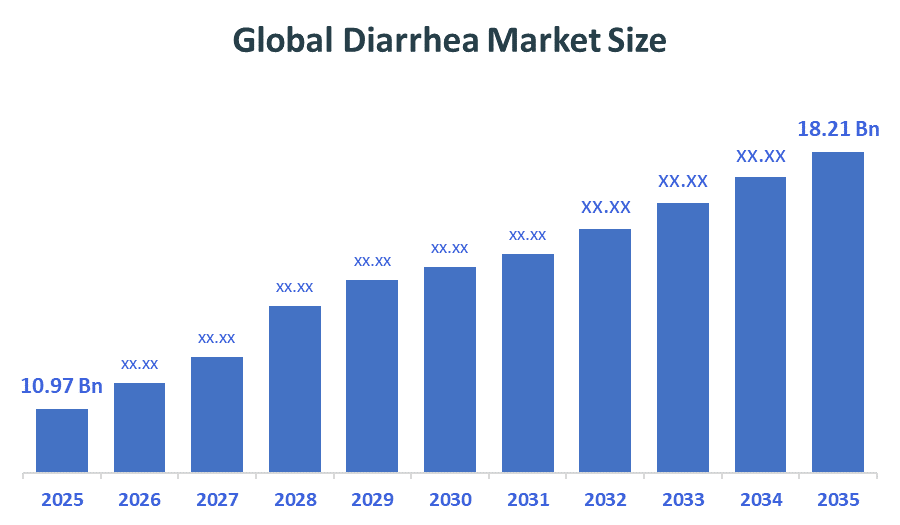
The Global Diarrhea Market Size is projected USD 10.97 Billion in 2025 and is forecasted to reach around USD 18.21 Billion by 2035. According to Decision Advisors, a detailed report on analysis of the Global Diarrhea Market indicates that the shift toward preventive healthcare through Oral Rehydration Solutions (ORS) and vaccination programs trend dominates the Market, accounting for approx. 40–45% of the total Global demand worldwide. GlaxoSmithKline dominates the Global Diarrhea Market, supported by revenue of approx. USD 10.8 billion, due to its strong worldwide presence, extensive distribution network, diversified product portfolio, and leadership in vaccines and consumer healthcare Markets Globally.
Market Snapshot
- Global Diarrhea Market Size (2025): USD 10.97 Billion
- Projected Global Diarrhea Market Size (2035): USD 18.21 Billion
- Global Diarrhea Market Compound Annual Growth Rate (CAGR): 5.2%
- Largest Regional Market: Asia pacific
- Fastest Growing Region: Africa
- 3rd Largest Region: North America
- Base Year: 2025
- Historical Period: 2021–2024
- Forecast Period: 2026–2035
Market Overview/ Introduction
The Global Diarrhoea Market refers to the Global healthcare Market that deals with the prevention, diagnosis, and management of a disease called diarrhoea. This is a condition whereby there is an excessive discharge of stool in a loose or watery manner. Diarrhoea results from infections (bacterial, viral, or parasitic infections), lack of adequate sanitation, consumption of infected food and water, and gastrointestinal diseases. It has been established that diarrhoea is one of the major causes of sickness and deaths, particularly amongst children aged below five years in developing nations. Management measures for this condition include ORS, antibiotics, anti-diarrheal, probiotics, and zinc supplements. The technology-driven improvements like rapid diagnostic tests, enhanced drugs, and probiotics are contributing to better health outcomes. The technological developments related to oral rehydration therapy like use of low osmolarity ORT and flavoured ORT are increasing compliance. The government’s role as seen from efforts made by organizations like WHO and UNICEF has been pivotal in terms of sanitization drives, immunization drives like rotavirus vaccine, and awareness drives.
- In April 2026 – India: Under National Health Mission, ASHAs and Anganwadi workers led door-to-door diarrhoea management, distributing ORS and zinc kits while educating mothers on hygiene and treatment practices.
Notable Insights: -
- Asia-Pacific holds the largest regional Market share approximately 40% in the Global Diarrhea Market.
- North America is the fastest growing region Market share approximately 17% in the Global Diarrhea Market.
- By Drug Class, the Oral Rehydration Solutions (ORS) segment held a dominant position with 43% in terms of Market share in 2025.
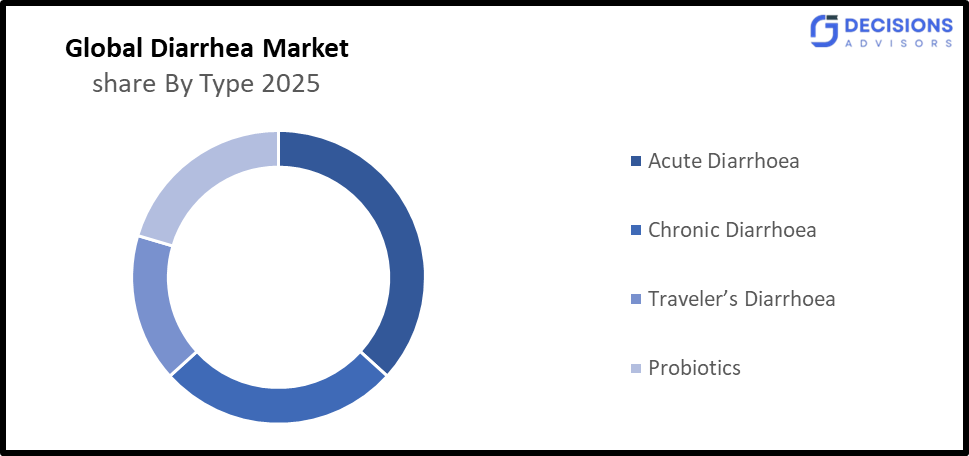
- By Type, Acute Diarrhoea segment is the dominating accounting for Market is approximately 58%.
- By end user, Hospitals segment held a dominant position Market is approximately 51%.
- By Route of Administration, Injectable segment held a dominant position Market is approximately 77%.
- The Market is likely to achieve a valuation of USD 18.21 Billion by 2035.
What is role of technology in grooming the Market?
Technology plays a vital role in shaping the Global diarrhoea Market by improving diagnosis, treatment, and prevention. Rapid diagnostic tests enable quick identification of pathogens, allowing targeted therapy. Advances in formulation technologies have led to improved oral rehydration solutions with better absorption and taste, increasing patient adherence. Digital health platforms and telemedicine help in early diagnosis and remote treatment, especially in rural areas. Additionally, probiotic innovations and microbiome research are opening new therapeutic avenues. Cold chain logistics and vaccine delivery systems have strengthened immunization programs, particularly for rotavirus. Overall, technology enhances treatment efficiency, reduces mortality, and supports large-scale public health interventions.
How is Recent Developments Helping the Market?
Recent developments have significantly strengthened the Global diarrhoea Market, particularly through preventive healthcare and improved treatment accessibility. The widespread adoption of rotavirus vaccines has reduced diarrhoea-related mortality by nearly 40% in children under five Globally. Governments and NGOs are expanding ORS and zinc supplementation programs in developing countries, improving survival rates. Technological advancements in rapid diagnostics and probiotic therapies are enhancing treatment precision. Additionally, Global sanitation initiatives and clean water programs are reducing disease incidence. The Global diarrhoea treatment Market continues to expand due to increasing awareness, rising healthcare spending, and strong support from international organizations, although challenges persist in low-income regions.
Market Drivers
Diarrhoea is one of the common health conditions that is driving demand for the Global diarrhoea Market. The Market growth can be attributed to the existence of some of the drivers such as the presence of widespread prevalence of diarrhoea cases in most parts of the world especially in developing countries that experience sanitation and water problems. Globally, it is believed that diarrhoea continues to cause many deaths in young children who are below five years old. Another driver for the diarrhoea Market includes increased awareness on oral rehydration therapy (ORT) which helps to treat and prevent dehydration due to diarrhoea. Moreover, the affordability of ORS products makes them popular across many nations. Growth in the healthcare sector infrastructure in emerging Markets will also aid the growth of the Market. Governments and Global health institutions are increasingly making efforts to invest in sanitation, vaccinations and nutrition strategies in order to fight diarrheal diseases. Increasing adoption of probiotics and improved drugs is also acting as another growth catalyst.
Restrain
The Global diarrhoea Market faces restraints such as limited healthcare access in rural regions, lack of awareness, and poor sanitation infrastructure. Overuse of antibiotics leading to resistance, inconsistent supply of ORS in low-income areas, and affordability issues further restrict growth. Additionally, inadequate diagnostic facilities and cultural barriers in some regions hinder effective treatment adoption.
Competitive Analysis:
The report offers the appropriate analysis of the key organizations/companies involved within the Diarrhea Market, along with a comparative evaluation primarily based on their Product of offering, business overviews, geographic presence, enterprise strategies, segment Market share, and SWOT analysis. The report also provides an elaborative analysis focusing on the current news and developments of the companies, which includes Product development, innovations, joint ventures, partnerships, mergers & acquisitions, strategic alliances, and Others. This allows for the evaluation of the overall competition within the Market.
Top Companies in Global Diarrhea Market
- GlaxoSmithKline
- Pfizer
- Sanofi
- Johnson & Johnson
- Procter & Gamble
- Bayer
- Abbott Laboratories
- Sun Pharmaceutical Industries
- Cipla
- Reckitt Benckiser
Government Initiatives
|
Country |
Key Government Initiatives |
|
Africa |
In July 2025 – Africa: UNICEF expanded WASH campaigns across African countries, improving clean water access and hygiene practices to prevent diarrhoeal diseases among children and vulnerable populations. |
|
India |
In June 2024 – India: Under National Health Mission, the government expanded STOP Diarrhoea Campaign, distributing ORS and zinc kits, promoting sanitation, and targeting zero child deaths nationwide. |
Study on the Supply, Demand, Distribution, and Market Environment of Diarrhoea Market
The Global diarrhoea Market operates within a high-demand healthcare environment driven by infectious disease prevalence and sanitation challenges. Supply is supported by pharmaceutical companies producing ORS, antibiotics, and probiotics at large scale, with generic manufacturers playing a key role in affordability. Demand remains high in developing regions due to poor sanitation and limited access to clean water. Distribution channels include hospitals, pharmacies, and community health programs, with NGOs playing a significant role in rural outreach. The Market environment is strongly influenced by public health policies, vaccination programs, and Global aid initiatives. While developed regions show stable demand, emerging economies continue to drive overall Market growth.
Price Analysis and Consumer Behaviour Analysis
The Global diarrhoea Market is characterized by high price sensitivity, especially in low-income regions. ORS products are highly affordable, typically costing less than USD 1 per treatment course, making them accessible to a wide population. Consumers prioritize cost-effective and readily available treatments, particularly in developing countries. There is increasing preference for probiotics and combination therapies in urban areas due to rising awareness. Post-pandemic, hygiene awareness has improved, influencing preventive healthcare behaviour. However, in rural regions, limited awareness and reliance on traditional remedies still affect treatment adoption. Overall, affordability, accessibility, and awareness remain key factors shaping consumer behaviour.
Market Segmentation
The Global Diarrhea Market share is classified into mounting drug class, type, route of administration, and end user
- The Oral Rehydration Solutions (ORS) segment dominated the Market in 2025, and is projected to grow at a substantial CAGR of approximately 5.5% during the forecast period.
Based on the Drug Class, the Global Diarrhea Market is divided into antidiarrheal drugs, antibiotics, and oral rehydration solutions (ORS), and probiotics. Among these, Oral Rehydration Solutions (ORS) dominate the Global Diarrhoea Market, accounting for approximately 40–45% of total Market revenue in 2025. This dominance is driven by their effectiveness in preventing dehydration, low cost, and strong recommendations from Global health authorities such as the World Health Organization. ORS is widely used across all age groups, especially in paediatric care in developing regions. The segment is projected to grow at a CAGR of around 5.2–5.8%, supported by ongoing public health programs and increased awareness.
- The Acute Diarrhea segment accounted for the largest share in 2025, and is anticipated to grow at a significant CAGR of approximately 5.3% during the forecast period.
Based on the Type, the Global Diarrhea Market is divided into Acute Diarrhoea, Chronic Diarrhoea, and Traveler’s Diarrhoea. Among these, Acute diarrhoea is the leading segment in the Global Diarrhoea Market, contributing approximately 55–60% of total Market revenue in 2025. This is due to its high prevalence caused by infections, contaminated food, and poor sanitation, particularly in low- and middle-income countries. The condition requires immediate treatment, driving strong demand for ORS and medications. The segment is expected to grow at a CAGR of approximately 4.8–5.4%, supported by rising infection rates, seasonal outbreaks, and expanding healthcare access globally.
- The Hospitals segment dominated the Market in 2025, and is projected to grow at a substantial CAGR of approximately 4.7% during the forecast period.
Based on the end user, the Global Diarrhea Market is divided into hospitals, specialty clinics, and homecare. Among these, Hospitals represent the dominant end-user segment in the Global Diarrhoea Market, accounting for approximately 48–52% of total Market revenue in 2025. This is due to the high number of severe diarrhoea cases requiring clinical supervision, especially among children and elderly patients. Hospitals provide advanced diagnostic facilities and intravenous treatments when necessary. The segment is expected to grow at a CAGR of approximately 4.5–5.0%, supported by increasing hospitalization rates and improved healthcare infrastructure worldwide.
- The oral route of administration dominated the Market in 2025, and is projected to grow at a substantial CAGR of approximately 5.2% during the forecast period.
Based on the Route of Administration, the Global Diarrhea Market is divided into Oral, and Injectable. Among these, the oral route of administration dominates the Global Diarrhoea Market, accounting for approximately 75–80% of total Market revenue in 2025. This dominance is attributed to ease of administration, patient convenience, and widespread use of oral therapies such as ORS, antibiotics, and probiotics. Oral treatments are particularly preferred in homecare and outpatient settings. The segment is projected to grow at a CAGR of around 5.0–5.6%, driven by increasing self-medication practices and accessibility of over-the-counter products.
Top of FormBottom of FormStrategies to Implement for Growth of the Market in Non-Leading Regions
Growth in non-leading regions of the Global Diarrhoea Market can be accelerated through targeted public health investments and improved treatment access. Globally, diarrhoea accounts for nearly 1.7 billion cases annually and causes around 443,000 deaths in children under five each year, highlighting strong unmet demand. Expanding access to low-cost therapies such as ORS and zinc is critical in underserved regions. Governments and organizations like the World Health Organization should strengthen sanitation and hygiene programs, as unsafe water remains a major cause. Additionally, improving vaccination coverage, local manufacturing, and rural healthcare delivery can significantly enhance treatment adoption and reduce mortality rates.
Regional Segment Analysis of the Global Diarrhea Market
- North America (U.S., Canada, Mexico)
- Europe (Germany, France, U.K., Italy, Spain, Rest of Europe)
- Asia-Pacific (China, Japan, India, Rest of APAC)
- South America (Brazil and the Rest of South America)
- The Middle East and Africa (UAE, South Africa, Rest of MEA)
Asia pacific is anticipated to hold the largest share of the Global Diarrhea Market over the predicted timeframe.
Asia-Pacific dominates the Global diarrhoea Market, accounting for approximately 40–45% of total Market revenue in 2025. This leadership is driven by a high burden of diarrheal diseases, large population base, and increasing government initiatives focused on sanitation, vaccination, and access to clean water. Countries such as India and China play a major role due to expanding healthcare infrastructure and strong generic drug production. The region is projected to grow at a CAGR of around 5.0–5.8%, supported by public health programs and rising awareness.
Africa is expected to grow at a rapid CAGR in the Global Diarrhea Market during the forecast period. Africa is the fastest-growing region in the Global diarrhoea Market, driven by significant unmet healthcare needs and a high prevalence of diarrheal diseases. Although its current Market share is lower, the region is witnessing rapid expansion due to increased support from Global organizations such as UNICEF and the World Health Organization. Investments in sanitation, clean water access, and vaccination programs are key growth drivers. The Market in Africa is expected to grow at a CAGR of approximately 6.5–7.5%, reflecting strong improvement potential.
North America is the 3rd largest region to grow in the Global Diarrhoea Market during the region. North America holds approximately 15–18% of the Global diarrhoea Market revenue in 2025, making it the third-largest region. The Market is characterized by advanced healthcare systems, high awareness levels, and widespread availability of treatment options, including probiotics and prescription medications. The United States leads the region due to strong healthcare infrastructure and preventive care practices. Growth is relatively stable, with a projected CAGR of around 3.5–4.2%, supported by innovation in treatment and increasing focus on gut health and microbiome research.
Future Market Trends in Global Diarrhoea Market: -
- Rising Adoption of Probiotics and Microbiome-Based Therapies
A key future trend in the Global diarrhoea Market is the increasing adoption of probiotics and microbiome-based therapies. These treatments focus on restoring the natural balance of gut bacteria rather than only controlling symptoms. Probiotics such as Lactobacillus and Bifidobacterium are widely used to reduce the duration and severity of diarrhoea, especially in children. Growing awareness of gut health, along with clinical evidence supporting probiotic efficacy, is driving demand. This trend reflects a shift toward preventive and holistic gastrointestinal care, improving long-term patient outcomes.
2. Expansion of Vaccination Programs and Preventive Healthcare
Preventive healthcare is becoming a major trend in the diarrhoea Market, with vaccination programs playing a crucial role. Rotavirus vaccines have significantly reduced severe diarrhoea cases and child mortality worldwide. Governments and Global organizations such as World Health Organization are expanding immunization coverage, particularly in developing countries. Additionally, initiatives promoting hygiene, sanitation, and safe drinking water are helping reduce disease incidence. This trend is gradually shifting the Market focus from treatment to prevention, supporting sustainable long-term growth.
- Development of Advanced and Combination Therapies
The development of advanced and combination therapies is transforming diarrhoea treatment approaches. Pharmaceutical companies are introducing integrated solutions that combine oral rehydration salts, zinc supplements, probiotics, and targeted medications to improve treatment effectiveness. These combination therapies enhance patient compliance and provide faster recovery. Innovations in drug formulation and rapid diagnostic tools are also enabling more precise and personalized treatment. This trend is particularly beneficial in both hospital and homecare settings, as it simplifies treatment protocols and improves clinical outcomes across diverse patient populations Globally.
Recent Development
In February 2025 – India: Kenvue and PSI India launched “Diarrhoea Se Darr Nahi” initiative targeting five million children with ORS and zinc to reduce diarrhoea-related mortality.
In May 2024 – United States: Vedanta Biosciences initiated Phase III RESTORATiVE303 trial of VE303, a defined bacterial consortium to prevent recurrent C. difficile infection and associated diarrhoea.
In August 2024 – Israel/United States: RedHill Biopharma reported RHB-102 showing positive Phase II (IBS-D) and Phase III (gastroenteritis) results, advancing once-daily ondansetron for gastrointestinal conditions including diarrhoea.
In June 2022 – India: Reckitt, with Uttar Pradesh government, launched Dettol Diarrhoea Net Zero programme targeting zero preventable child deaths, strengthening ORS and zinc supply, awareness, and healthcare capacity using WHO 7-point plan.
Market Segment
This study forecasts revenue at Global, regional, and country levels from 2021 to 2035. Decision Advisors has segmented the Diarrhea Market based on the below-mentioned segments:
Global Diarrhea Market, By Drug Class
- Antidiarrheal drugs
- Antibiotics
- Oral Rehydration Solutions (ORS)
Global Diarrhea Market, By Type
- Acute Diarrhoea
- Chronic Diarrhoea
- Traveler’s Diarrhoea
- Probiotics
Global Diarrhea Market, By Route of Administration
- Oral
- Injectable
Global Diarrhea Market, By End User
- Hospitals
- Specialty clinics
- Homecare
Global Diarrhea Market, By Regional Analysis
- North America
- US
- Canada
- Mexico
- Europe
- Germany
- UK
- France
- Italy
- Spain
- Russia
- Rest of Europe
- Asia Pacific
- China
- Japan
- India
- South Korea
- Australia
- Rest of Asia Pacific
- South America
- Brazil
- Argentina
- Rest of South America
- Middle East & Africa
- UAE
- Saudi Arabia
- Qatar
- South Africa
- Rest of the Middle East & Africa
Frequently Asked Questions (FAQ)
1. How does climate change impact the global diarrhoea market?
Climate change increases the frequency of floods, droughts, and water contamination, leading to higher incidence of waterborne diseases. This indirectly drives demand for diarrhoea treatments, especially in vulnerable regions.
2. What role do pharmacies and retail channels play in market expansion?
Retail pharmacies and over-the-counter availability significantly improve access to ORS, probiotics, and antidiarrheal drugs, especially in urban and semi-urban areas, supporting market penetration and self-care trends.
3. How are NGOs influencing diarrhoea treatment adoption globally?
Non-governmental organizations play a key role by distributing free treatment kits, conducting awareness campaigns, and supporting rural healthcare delivery, thereby increasing early treatment adoption and reducing mortality.
4. What challenges do manufacturers face in the diarrhoea market?
Manufacturers face challenges such as maintaining low-cost production, ensuring supply chain efficiency in remote regions, regulatory compliance, and competition from generic and local product manufacturers.
5. How is urbanization affecting the diarrhoea market?
Rapid urbanization leads to improved healthcare access but also increases risks of contaminated food and water in densely populated areas, sustaining demand for both preventive and treatment solutions.
Check Licence
Choose the plan that fits you best: Single User, Multi-User, or Enterprise solutions tailored for your needs.
We Have You Covered
- 24/7 Analyst Support
- Clients Across the Globe
- Tailored Insights
- Technology Tracking
- Competitive Intelligence
- Custom Research
- Syndicated Market Studies
- Market Overview
- Market Segmentation
- Growth Drivers
- Market Opportunities
- Regulatory Insights
- Innovation & Sustainability
Report Details
| Scope | Global |
| Pages | 240 |
| Delivery | PDF & Excel via Email |
| Language | English |
| Release | Apr 2026 |
| Access | Download from this page |