
Global Dihydrocitronellol Market
 |
Author:
Aditya G
|
Pages:
154
|
Author:
Aditya G
|
Pages:
154
Global Dihydrocitronellol Market Size, Share, and COVID-19 Impact Analysis, By Source (Natural and Synthetic), By Application (Fragrances, Personal Care, Household Products, and Others) and By Region (North America, Europe, Asia-Pacific, Latin America, Middle East, and Africa), Analysis and Forecast 2025 - 2035
CAGR
5.23%
REVENUE 2024
USD Million 311.6
FORECAST 2035
USD Million 545.8
REPORT COVERAGE
Global
Global Dihydrocitronellol Market Size Insights Forecasts to 2035
- The Global Dihydrocitronellol Market Size Was valued at USD 311.6 Million in 2024
- The Global Dihydrocitronellol Market Size is Expected to Grow at a CAGR of around 5.23% from 2025 to 2035
- The Worldwide Dihydrocitronellol Market Size is Expected to Reach USD 545.8 Million by 2035
- North America is expected to Grow the fastest during the forecast period.
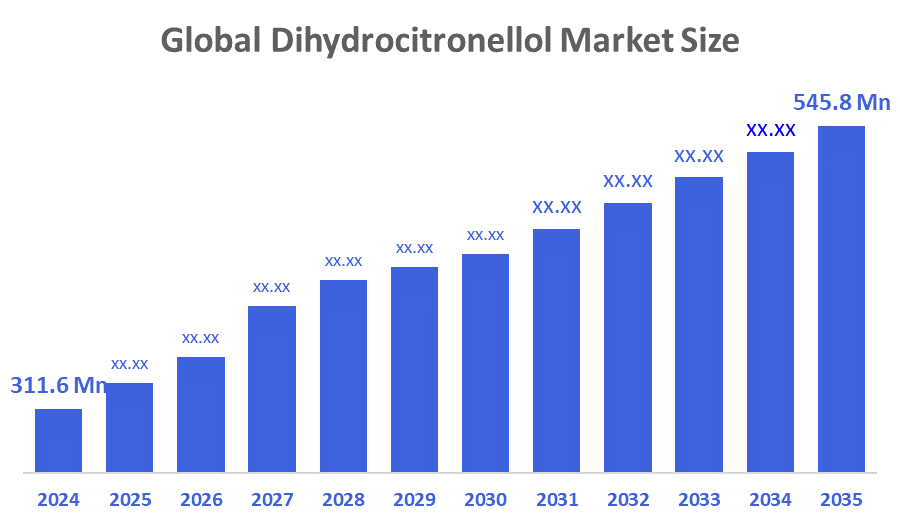
According to a Research Report Published by Decisions Advisors and Consulting, The Global Dihydrocitronellol Market Size was worth around USD 311.6 Million in 2024 and is predicted to Grow to around USD 545.8 Million by 2035 with a compound annual growth rate (CAGR) of 5.23% from 2025 to 2035. The fast-growing personal care sector, where consumers are spending more on perfumes, skin care, and grooming, is raising the demand for premium quality fragrance materials.
Market Overview
The worldwide dihydrocitronellol market symbolizes the whole industry which is committed to the manufacture and distribution of dihydrocitronellol, a major aroma chemical, utilized in the production of perfumes, personal care, and household items for giving floral and citrus scents. Additionally, the growth of e-commerce and the use of digital marketing strategies present a great opportunity for companies to a great extent. The online marketplaces are not simply a matter of great size, they also give access to an enormous data reservoir that can be mined for insights into consumer preferences and trends. The use of these insights would help companies to do an effective customization of their product range and at the same time, to establish a more intimate direct relationship with consumers, thereby, creating stronger brand loyalty. Moreover, the ability to quickly adapt to market needs and the introduction of new products through digital channels can be a turning point for the companies that are willing to see the growing demand for dihydrocitronellol-based products as a business opportunity.
Report Coverage
This research report categorizes the dihydrocitronellol market based on various segments and regions, forecasts revenue growth, and analyzes trends in each submarket. The report analyses the key growth drivers, opportunities, and challenges influencing the dihydrocitronellol market. Recent market developments and competitive strategies such as expansion, type launch, development, partnership, merger, and acquisition, have been included to draw the competitive landscape in the market. The report strategically identifies and profiles the key market players and analyses their core competencies in each sub-segment of the dihydrocitronellol market.
Driving Factors
The development of high-purity dihydrocitronellol is very much influenced by the technological innovations in fragrance formulation and green chemistry. Producers are using the cutting-edge hydrogenation method along with AI-assisted chemical modeling to not only increase the yield but also to cut the production costs significantly. The cosmetics industry, in particular, is turning to the use of dihydrocitronellol as it goes well with the natural ingredients and at the same time it extends the product life without causing any irritation. Furthermore, the detergent and fabric care markets are welcoming this compound for its ability to contribute to the cleanliness and freshness of the products as well as scent retention in household cleaning products. The personal care sector being globally expanded and complemented by the increase in disposable incomes, the dihydrocitronellol market is bound to enjoy a steady growth which is rich in product innovations, sustainability initiatives, and changing consumer expectations for clean, high-quality fragrances.
Restraining Factors
The global dihydrocitronellol market confronts limitations including but not limited to high production expenses, stringent regulatory compliance for perfume ingredients, allergen concerns regarding cosmetics, finite natural sources, and rivalry with other synthetic or bio-based aroma chemicals.
Market Segmentation
The dihydrocitronellol market share is classified into source and application.
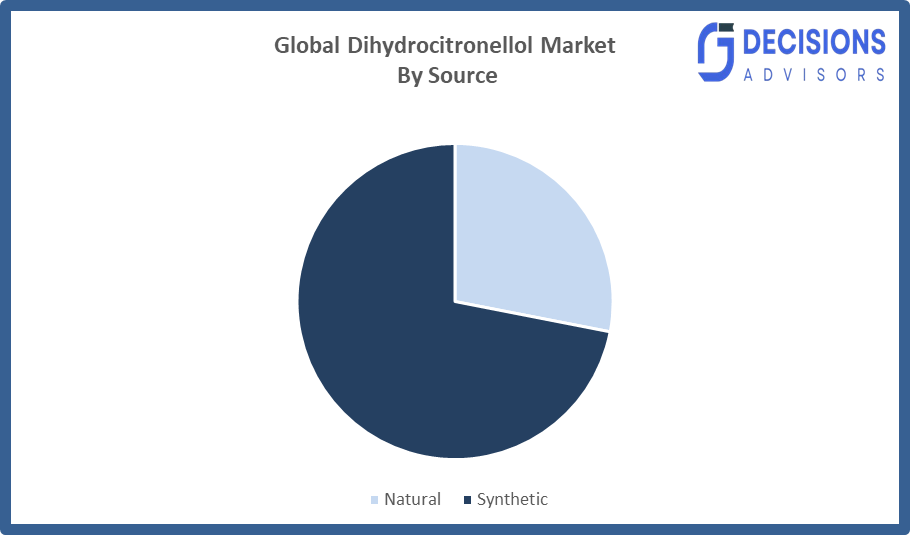
- The synthetic segment accounted for the largest share in 2024 and is anticipated to grow at a significant CAGR during the forecast period.
Based on the source, the dihydrocitronellol market is divided into natural and synthetic. Among these, the synthetic segment accounted for the largest share in 2024 and is anticipated to grow at a significant CAGR during the forecast period. The primary reasons for the continued usage of synthetic grades in home care, detergents, and mass-market personal-care categories were the cost efficiency, consistent quality, and scalability for high-volume applications. The availability of the material in large quantities and the reliability of its formulation have made it the preferred choice for large manufacturers who need a predictable supply and wish to control their margins.
- The fragrances segment accounted for the highest market revenue in 2024 and is anticipated to grow at a significant CAGR during the forecast period.
Based on the application, the dihydrocitronellol market is divided into fragrances, personal care, household products, and others. Among these, the fragrances segment accounted for the highest market revenue in 2024 and is anticipated to grow at a significant CAGR during the forecast period. The fragrance industry is witnessing a revival, where the consumers search for extraordinary scents that mirror their character and way of living. This need has resulted in the greater use of dihydrocitronellol, which combines nicely with other fragrance materials thereby making it a basic ingredient in the creation of both luxurious and low-cost goods. The unique scent profile of dihydrocitronellol has become the main reason for its gaining popularity in olfactory appealing of perfumes and body sprays.
Regional Segment Analysis of the Dihydrocitronellol Market
- North America (U.S., Canada, Mexico)
- Europe (Germany, France, U.K., Italy, Spain, Rest of Europe)
- Asia-Pacific (China, Japan, India, Rest of APAC)
- South America (Brazil and the Rest of South America)
- The Middle East and Africa (UAE, South Africa, Rest of MEA)
Asia Pacific is anticipated to hold the largest share of the dihydrocitronellol market over the predicted timeframe.
Asia Pacific is anticipated to hold the largest share of the dihydrocitronellol market over the predicted timeframe. The Asia Pacific region is advantageous due to the large-scale production of fragrance ingredients that are well correlated with the fast-growing consumer markets for personal and home care products. The growth of disposable incomes and the widespread use of scented products have a profound impact on consumption. The area’s solid production base contributes to the market’s competitiveness even more.
North America is expected to grow at a rapid CAGR in the dihydrocitronellol market during the forecast period. High consumer spending coupled with a strong inclination towards premium and innovative products are two significant factors that have a positive impact on the region. Alongside the major players in the market and the use of advanced distribution channels, the market is also getting more and more support. Besides, the increasing popularity of organic and natural products in the U.S. and Canada is a great plus for natural dihydrocitronellol in particular. This is because people are getting more and more concerned about their health and the environment, and thus they are looking for products that match their values.
Competitive Analysis:
The report offers the appropriate analysis of the key organizations/companies involved within the dihydrocitronellol market, along with a comparative evaluation primarily based on their type of offering, business overviews, geographic presence, enterprise strategies, segment market share, and SWOT analysis. The report also provides an elaborative analysis focusing on the current news and developments of the companies, which includes type development, innovations, joint ventures, partnerships, mergers & acquisitions, strategic alliances, and others. This allows for the evaluation of the overall competition within the market.
List of Key Companies
- BASF SE
- Symrise AG
- Givaudan SA
- International Flavors & Fragrances (IFF)
- Takasago International Corp.
- Firmenich (now merged with DSM)
- Zhejiang NHU Co., Ltd.
- Kao Corporation
- Mane SA
- Sensient Technologies
- Others
Key Target Audience
- Market Players
- Investors
- End-users
- Government Authorities
- Consulting and Research Firm
- Venture capitalists
- Value-Added Resellers (VARs)
Recent Development
- In June 2024, DSM?Firmenich had released its Sharing Innovation 2024 booklet, which unveiled a new collection of perfumery ingredients, including naturals, synthetics, and biotech solutions, aimed at driving fragrance innovation, sustainability, and regulatory adaptability.
Market Segment
This study forecasts revenue at global, regional, and country levels from 2020 to 2035. Decisions Advisors has segmented the dihydrocitronellol market based on the below-mentioned segments:
Global Dihydrocitronellol Market, By Source
- Natural
- Synthetic
Global Dihydrocitronellol Market, By Application
- Fragrances
- Personal Care
- Household Products
- Others
Global Dihydrocitronellol Market, By Regional Analysis
- North America
- US
- Canada
- Mexico
- Europe
- Germany
- UK
- France
- Italy
- Spain
- Russia
- Rest of Europe
- Asia Pacific
- China
- Japan
- India
- South Korea
- Australia
- Rest of Asia Pacific
- South America
- Brazil
- Argentina
- Rest of South America
- Middle East & Africa
- UAE
- Saudi Arabia
- Qatar
- South Africa
- Rest of the Middle East & Africa
Frequently Asked Questions (FAQ)
- What is the CAGR of the dihydrocitronellol market over the forecast period?
A: The global dihydrocitronellol market is projected to expand at a CAGR of 5.23% during the forecast period.
- What is the market size of the dihydrocitronellol market?
A: The global dihydrocitronellol market size is estimated to grow from USD 311.6 Million in 2024 to USD 545.8 Million by 2035, at a CAGR of 5.23% during the forecast period 2025-2035.
- Which region holds the largest share of the dihydrocitronellol market?
A: Asia Pacific is anticipated to hold the largest share of the dihydrocitronellol market over the predicted timeframe.
- Who are the top 10 companies operating in the global dihydrocitronellol market?
A: BASF SE, Symrise AG, Givaudan SA, International Flavors & Fragrances (IFF), Takasago International Corp., Firmenich (now merged with DSM), Zhejiang NHU Co., Ltd., Kao Corporation, Mane SA, Sensient Technologies, and Others.
- What are the market trends in the dihydrocitronellol market?
A: The dihydrocitronellol market is characterized by several major trends among which are the increasing demand from cosmetics and perfumery, the higher adoption rate of natural aroma chemicals, the escalating popularity of organic formulary, and the widening of its use in both the household and luxury fragrance sectors.
Check Licence
Choose the plan that fits you best: Single User, Multi-User, or Enterprise solutions tailored for your needs.
We Have You Covered
- 24/7 Analyst Support
- Clients Across the Globe
- Tailored Insights
- Technology Tracking
- Competitive Intelligence
- Custom Research
- Syndicated Market Studies
- Market Overview
- Market Segmentation
- Growth Drivers
- Market Opportunities
- Regulatory Insights
- Innovation & Sustainability
Report Details
| Scope | Global |
| Pages | 154 |
| Delivery | PDF & Excel via Email |
| Language | English |
| Release | Jan 2026 |
| Access | Download from this page |