
UK Dimmers Market
 |
Author:
Shruti G
|
Pages:
210
|
Author:
Shruti G
|
Pages:
210
UK Dimmers Market Size, Share, By Type (Rotary Dimmers, Slide Dimmers, Touch Dimmers, Smart Dimmers, and Remote-Controlled Dimmers), By Technology (Leading Edge Dimmers, Trailing Edge Dimmers) and By End Use (Residential, Commercial, Industrial, and Hospitality), Analysis and Forecast 2026 to 2035.
CAGR
10.27%
REVENUE 2025
USD Million 29.5
FORECAST 2035
USD Million 78.43
REPORT COVERAGE
Country
Market Snapshot
- UK Dimmers Market Size (2025): USD 29.50 Million
- UK Dimmers Projected Market Size (2035): USD 78.43 Million
- UK Dimmers Compound Annual Growth Rate (CAGR): 10.27%
- Base Year: 2025
- Historical Period: 2021–2024
- Forecast Period: 2026–2035
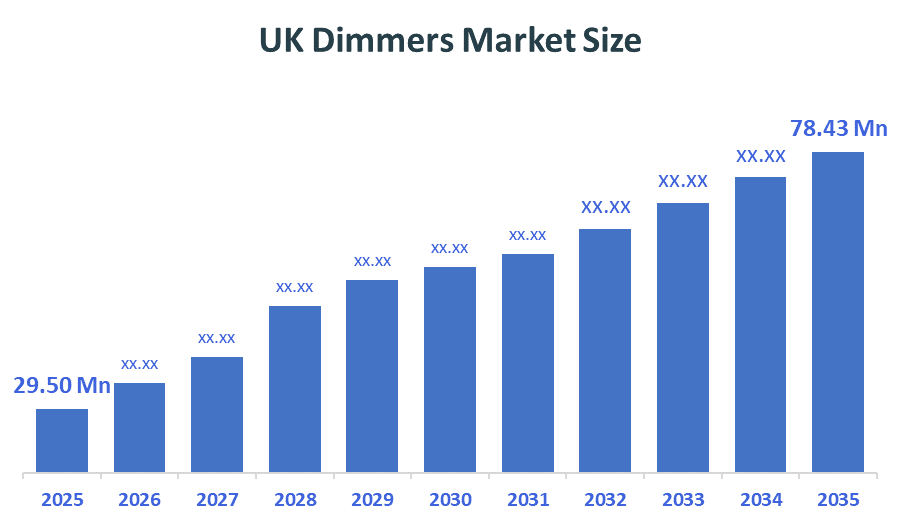
According to Decision Advisors, the UK dimmers market size was expected to grow from USD 29.50 million in 2025 to USD 78.43 million by 2035, at a CAGR of 10.27% during the forecast period 2026–2035. The UK market for lighting control is anticipated to grow substantially over the next ten years, owing to the rising need for energy-saving products as well as the incorporation of smart home technology in homes in the United Kingdom. Even though simpler switching options exist, the preference for mood-setting lights and the requirement for controlling LED light performance using no-flicker systems are key considerations for this sector. Additionally, the strict building codes, as well as the trend towards zero-net building infrastructure, have been forcing people in both domestic and commercial spaces to adopt dimmer switches.
Market Overview/Introduction
The UK dimmers market entails the development and application of sophisticated lighting components for the regulation of electrical lights’ intensity in various locations. Such equipment is crucial for effective use of lighting systems since they employ advanced techniques like phase cut, pulse width, or digital addressing methods to attain the desired level of illumination according to the specifications stipulated by building codes and interior design guidelines. Their high popularity results from the fact that these systems have been instrumental in ensuring extended lives of LEDs, lowering peak electricity loads, and functioning as an interface system of environmental light control in expensive properties. The market features classic rotary and push button modules, trailing edge and leading edge electronic dimmers, alongside advanced systems with built-in sensors and wireless features. The products' high popularity is attributed to initiatives geared towards creating sustainable buildings and cutting down national carbon footprint.
Market trend for dimming systems in the UK involves the quick acceptance of IoT-based equipment where universal dimming systems capable of managing the capacitance load of the new LED drivers are developed. Precision lighting solutions have become popular, especially in commercial spaces and hotels, whereby lighting systems are installed in order to project the identity of the brand as well as create human-cantered lighting designs.
- In January 2026, LIFX introduced a new smart in-wall dimmer switch with Matter compatibility, improving integration with platforms like Alexa and Google Home
- In November 2025, the release of Matter 1.5 standard improved smart lighting ecosystems in the UK, enhancing compatibility of dimmers with connected home devices
Notable Insights: -
- The UK dimmers market is expected to grow at a CAGR of approximately 10.27% from 2025 to 2035, driven by strong demand for smart lighting systems and government initiatives focused on energy efficiency and carbon reduction.
- By technology, trailing-edge dimmers are gaining higher adoption due to their compatibility with LED lighting systems and ability to deliver smooth dimming performance with reduced noise and energy loss.
- By end use, the residential segment holds a dominant position, supported by growing renovation activities and rising consumer focus on energy-efficient and aesthetic lighting solutions in modern homes.
What is the Role of Technology in Grooming the Market?
The key reasons for the increasing complexity of the UK dimmers market are the application of advanced precision engineering in tandem with IoT-based connectivity technologies. The key trend of development in this market refers to the creation of the smart lighting ecosystem featuring a high degree of reliability because of the use of digital dimming technology in compliance with the UK requirements for no flickering. Advanced technological innovations include, among other solutions, the application of universal dimming modules and microprocessor control units to deliver advanced voltage management and phase-cut synchronisation in domestic and commercial areas. The output quality is usually guaranteed by means of automatic load sensing and overload thermal protection.
Market Drivers
The driving forces behind the growth of the dimmers market in the United Kingdom are the upgrading of the existing residential buildings and the development of efficient building management technologies. Among the major factors contributing to the market equilibrium is the increasing desire to have personalised lighting solutions because of the rapid increase in the market share of smart home devices and luxurious interior design. The unique demands of the commercial hospitality sector, which requires programmable lighting scenes and human-centric lighting technology, guarantees that the premium segment will have steady consumer interest. Additionally, the United Kingdom features advanced research and development facilities enabling local manufacturers to convert ordinary switches into premium wireless control devices.
Restraints
While the technology holds great importance, there are certain possible challenges that may arise because of the development of other types of lighting technology such as smart light bulbs equipped with dimming functionality. One of the possible challenges could be the increased complexity and cost of meeting the UKCA marking requirements and other electrical safety requirements regarding wireless interference.
Study on the Supply, Demand, Distribution, and Market Environment
As far as dimmers for the UK market is concerned, this product is perceived to be mature, since it is regarded as an essential product for constructing and renovation purposes and has high dependence on electronic engineering. As regards the sources of production for this product’s components, the components are provided by semiconductor producers and plastic moulders, where this product is assembled in the Midlands and South East. Speaking about the product’s demands, it is worth saying that its demands are stable because of the requirements coming from the construction basics, as well as retail and corporate offices.
Price Analysis and Consumer Behaviour Analysis
The findings from the price-based analysis show that the market involves the existence of hierarchy, in which ordinary manual rotary dimmers are priced at constant rates, but highly developed smart dimming hubs, touchless glass panels, and particular architectural dimmers are expensive because of their complex nature. Despite being expensive compared to the other devices, such as light switches, consumers view them as assets in their hands and not just products for consumption. In the case of UK purchases, it is evident that buyers focus greatly on their energy saving abilities and aesthetic features. For the consumers, it is better to purchase systems that are highly effective in terms of power used during standby. Furthermore, there is another segment of consumers that are interested in utilizing the dimming hub that communicates wirelessly in the building management system.
Market Segmentation
The UK dimmers market is categorised by type, technology, connectivity, and end-use industry.
The smart dimmers segment dominated the market in 2025 and is projected to grow at a steady CAGR of approximately 11.4% during the forecast period.
Based on the type, the dimmers market is divided into Rotary Dimmers, Slide Dimmers, Touch Dimmers, Smart Dimmers, and Remote-Controlled Dimmers. Among these, the smart dimmers segment dominated the market in 2025 and is projected to grow at a steady CAGR of approximately 11.4% during the forecast period. This kind of domination is associated with the need for interconnected home environments and energy-efficient lighting controls, providing maximum convenience. These kinds of devices have high demand in the UK premium-level residential and hospitality sector because they can meet the requirements of modern households looking for voice-controlled and automated solutions. Modern technologies of Wi-Fi integration and microprocessor-based controls have quickly been introduced into British manufacturing facilities to follow the necessary UKCA and CE quality standards.
The wireless and trailing edge technology segment dominated the market in 2025 and is projected to grow at a substantial CAGR of approximately 9.7% during the forecast period.
Based on technology and connectivity, the dimmers market is divided into Leading Edge Dimmers, Trailing Edge Dimmers, Wired Dimmers, and Wireless Dimmers. Among these, the wireless and trailing edge technology segment dominated the market in 2025 and is projected to grow at a substantial CAGR of approximately 9.7% during the forecast period. In actual fact, it is because of the efficiency and effectiveness of these designs in terms of compatibility with LED bulbs, coupled with stringent compliance to the UK Wiring Regulations (BS 7671), that makes the trailing edge and wireless segments the most efficient designs to bear with the complex electrical loads associated with today’s modern lighting. While traditional wired rotary designs have been maintaining presence in the basic renovation market segment due to their cost-effective nature, the shift toward wireless retrofitting within the commercial and residential industry (which is the biggest user) still makes the modern wireless segments the giants of the market structure.
The residential and hospitality application segment accounted for the largest share in 2025 and is anticipated to grow at a significant CAGR of approximately 10.8% during the forecast period.
Based on the end-use industry, the dimmers market is divided into Residential, Commercial, Industrial, and Hospitality. Among these, the residential and hospitality application segment accounted for the largest share in 2025 and is anticipated to grow at a significant CAGR of approximately 10.8% during the forecast period. The integration of advanced dimmers in the process of interior design and energy management becomes inevitable due to the need for ambient control and cost reduction in domestic and leisure settings; following the stringent building regulations of the country with regards to energy efficiency, coupled with the rising demand for luxury home automation technology. Among one of the factors responsible for the increase in potential is the emergence of the smart city initiatives in the United Kingdom, as well as the adoption of effective lighting management systems.
Recent Developments
- In March 2026, major lighting manufacturers such as Signify and Zumtobel Group expanded their smart lighting portfolios in the UK, focusing on IoT-enabled dimming solutions integrated with automation systems to improve energy savings by up to 30 to 40%.
- In August 2025, the UK lighting market continued transitioning after earlier halogen and fluorescent bans, with LED adoption exceeding 65% of total lighting sales, supported by a regulatory push toward energy-efficient technologies.
- In January 2025, the UK government introduced stricter lighting efficiency standards under updated building regulations, promoting smart lighting controls and dimmer integration across commercial and residential infrastructure to support net zero targets.
Competitive Analysis
The report offers the appropriate analysis of the key organisations/companies involved within the UK dimmers market, along with a comparative evaluation primarily based on their product offering, business overviews, geographic presence, enterprise strategies, segment market share, and SWOT analysis. The report also provides an elaborate analysis focusing on the current news and developments of the companies, which includes product development, innovations, joint ventures, partnerships, mergers & acquisitions, strategic alliances, and others. This allows for the evaluation of the overall competition within the market.
Top Key Companies in the UK Dimmers Market
- Doyle & Tratt Products Ltd (Varilight)
- Hamilton IT Solutions Ltd (Hamilton Litestat)
- LightwaveRF PLC
- Mode Lighting Ltd
- Wandsworth Electrical Ltd
- Lutron Electronics Co., Inc
- Zano Controls
- Scolmore Group (Click)
- Signify N.V. (Philips Dynalite)
- Schneider Electric SE
- Luceco PLC (BG Electrical)
- Hager Group
- MK Electric (Honeywell)
- Legrand SA
- Others
Key Target Audience
- Market Players
- Investors
- End-users
- Government Authorities
- Consulting and Research Firm
- Venture capitalists
- Value-Added Resellers (VARs)
Market Segmentation
This study forecasts revenue at the national level from 2021 to 2035. Decisions Advisors segmented the UK Dimmers Market based on the following segments:
UK Dimmers Market, By Type
- Rotary Dimmers
- Slide Dimmers
- Touch Dimmers
- Smart Dimmers
- Remote-Controlled Dimmers
UK Dimmers Market, By Technology
- Leading Edge Dimmers
- Trailing Edge Dimmers
UK Dimmers Market, By End Use
- Residential
- Commercial
- Industrial
- Hospitality
Frequently Asked Questions (FAQ)
How is the demand for energy-efficient infrastructure driving the UK dimmers market?
The emphasis on reducing carbon emissions and managing electricity consumption serves as an adequate source of motivation to drive the industry forward. The need for advanced dimmers due to their ability to extend LED lifespans and lower peak power demand plays a crucial role in enhancing the importance of these control devices in modern building projects.
Why is the United Kingdom a leading market for smart dimming technology?
The dominance of the UK lies in its excellence in digital infrastructure and strict regulatory environments, which has been made possible due to the presence of large technology hubs and a high rate of smart home adoption. This has been coupled with a focus on producing high-quality electrical components that adhere to rigorous safety standards, together with the fact that the UK is well known for its early transition to nationwide LED-only lighting policies.
What is the role of trailing edge technology, and how does it help growth?
It allows dimming units to accurately manage the electronic loads of modern LED bulbs through a soft-start approach that eliminates flickering and audible noise. It assists in increasing the compatibility of lighting systems to ensure that residential and commercial installations can easily comply with the stringent lighting quality requirements while at the same time maintaining the aesthetic integrity of the interior environment.
What is the role of IoT and wireless connectivity in the market?
The recent trend is toward automated wireless dimming systems, which result in control networks that lack the need for complex internal wiring and have become highly appreciated within the global hospitality and luxury residential industries. It not only enhances the flexibility of the lighting setup but also makes the equipment easier to install and upgrade during renovation cycles without damaging building structures.
How do BS 7671 standards impact the 2035 forecast?
The national policies for electrical installations emphasize the transition to smart lighting systems that contain built-in safety protections and are fully compatible with modern circuitry. This, combined with government support for smart city infrastructure and energy-saving mandates, ensures that by 2035, the shift toward intelligent and fully compliant lighting supply chains will have already taken place. Continued growth will be ensured through the adoption of new international standards in wireless lighting control and human-centric design.
Check Licence
Choose the plan that fits you best: Single User, Multi-User, or Enterprise solutions tailored for your needs.
We Have You Covered
- 24/7 Analyst Support
- Clients Across the Globe
- Tailored Insights
- Technology Tracking
- Competitive Intelligence
- Custom Research
- Syndicated Market Studies
- Market Overview
- Market Segmentation
- Growth Drivers
- Market Opportunities
- Regulatory Insights
- Innovation & Sustainability
Report Details
| Scope | Country |
| Pages | 210 |
| Delivery | PDF & Excel via Email |
| Language | English |
| Release | Apr 2026 |
| Access | Download from this page |