
Global Ducted Air Conditioning Market
 |
Author:
Pranali P
|
Pages:
210
|
Author:
Pranali P
|
Pages:
210
Global Ducted Air Conditioning Market Size, Share, By Product Type (Single-Split Packaged AC, Multi-Split Packaged AC, and VRF Systems) By Technology (Inverter and Non-Inverter Systems) By Application (Residential, Commercial, and Industrial) By End User (Office Buildings, Hotels, Retail Stores, Healthcare Facilities, and Educational Institutions) and By Region (North America, Europe, Asia-Pacific, Latin America, Middle East and Africa), Analysis and Forecast 2026-2035
CAGR
4.19%
REVENUE 2025
USD Billion 10.95
FORECAST 2035
USD Billion 16.5
REPORT COVERAGE
Global
Market Snapshot
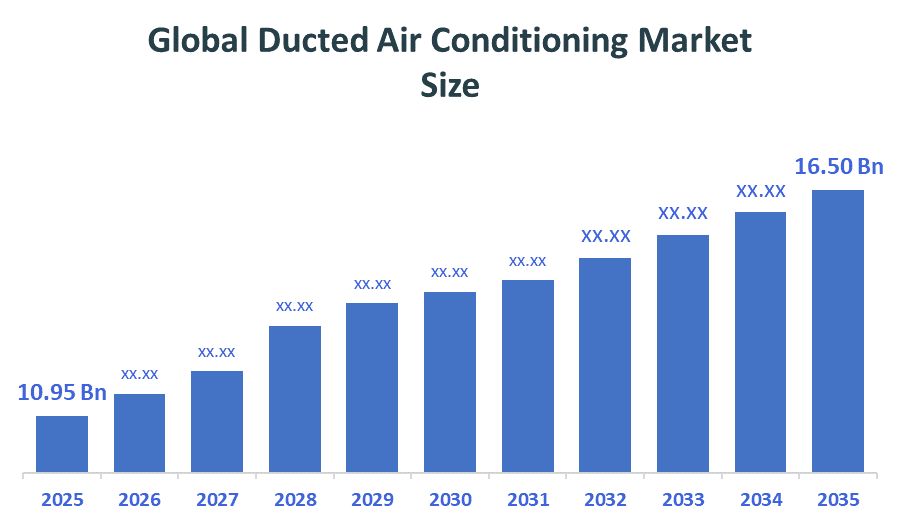
- Global Ducted Air Conditioning Market Size (2025): USD 10.95 Billion
- Global Ducted Air Conditioning Projected Market Size (2035): USD 16.50 Billion
- Global Ducted Air Conditioning Compound Annual Growth Rate (CAGR): 4.19%
- Largest Regional Market: Asia-Pacific
- Fastest Growing Region: North America
- 3rd Largest Region: Europe
- Base Year: 2025
- Historical Period: 2021 to 2024
- Forecast Period: 2026 to 2035
Market Overview / Introduction
The ducted air conditioning systems are an array of centralized climate management systems that work towards consistent temperature regulation for residential, commercial, and index industrial spaces. The ducted air conditioning systems serve as a vital intermediate phase between basic ventilation and advanced climate control systems, using modern heat exchange technology and fluid dynamics for rapid cooling with minimal energy consumption. Modern ducted air conditioning systems possess features such as variable refrigerant flow and micro-channel coils to ensure consistent performance levels while lowering the possibility of system damage. The ducted air conditioning systems were formerly basic rigid duct designs but have been upgraded into fully autonomous climate management systems with high seasonal energy efficiency ratings, energy savings technology, and integration within smart building environments. The increased adoption of ducted air conditioning systems is attributed to the rise in demand for aesthetics-focused cooling and efficient heat management in luxury residential sectors and corporate offices. Ducted air conditioning systems help protect architectural integrity and provide comfort due to their ability to maintain a stable environment without the visual clutter of older wall-mounted units.
- The commercial and hospitality segments contribute to approximately 55% of the application-based use in the market, driven by the increasing demand for centralized cooling in shopping malls, luxury hotels, and large-scale office complexes.
- Smart climate protection technology in the residential sector is experiencing substantial growth, with a CAGR forecasted to rise on account of the increasing adoption of multi-zone control systems as part of the advanced generation of smart homes for providing optimized safety and comfort to different living areas.
Notable Insights: -
- Multi-split ducted modules make up about 42.5% of the total market share of this sector. They have gained a reputation in high-end real estate developments, particularly in premium apartments, boutique hotels, and modern healthcare facilities.
- About 68.4% of all installations occur in urban commercial zones and new residential townships. These investments are stimulated mainly by high levels of investment into green building projects and energy conservation initiatives because many property developers seek low-carbon footprint cooling that avoids localised heat islands.
- Applications of ducted cooling in the sphere of public infrastructure account for almost 35.8% of all demand. The rapid development of airport terminals and transit hubs, alongside increased worries about indoor air quality in high-occupancy zones, has become one of the main drivers of using these advanced systems.
- About 52.3% of the market value belongs to the Asia-Pacific region in 2026. Many countries within this region, like China and India, invest considerable amounts of money in urban infrastructure and commercial real estate in order to address the growing needs of their expanding urban populations.
- Inverter-driven ducted systems show an annual increase above 7.2%. The rise in smart home automation and frequent occurrences of retrofitting old buildings create the conditions that encourage property owners to invest more money in energy-efficient ducted air conditioning solutions.
What is the Role of Technology in Shaping the Market?
Technological progress is making some groundbreaking modifications within the HVAC industry with respect to heat transfer efficiency, noise reduction, and automation of operations. The present generation of climate management platforms has ceased to be simple air blowers, but now they are complex fluid and air flow management platforms capable of self-operation for prolonged periods of time owing to their capacity to utilize eco-friendly refrigerants, advanced thermal management components, and diagnostic network integration capability.
How are Recent Developments Helping the Market?
These innovations include the implementation of AI-integrated zone control systems, the incorporation of advanced filtration performance, and voice-activated control systems. These innovations have significantly aided in promoting development and growth within the market. Innovations have included the creation of slim-line ducted units that are capable of fitting into low-ceiling voids, which may range from compact apartments to modern office floors, all without fail. Using smart sensor-based mechanics, such innovations will enable autonomous management of airflow through utilization of occupancy detection and real-time temperature feedback without any form of human error or system inefficiency occurring.
Market Drivers
Market demand for global ducted air conditioning systems is rising owing to the increased funding of construction firms and government bodies towards sustainable urban development and energy-efficient structures that can satisfy global climate targets in the present times. The modern ducted systems have gained considerable popularity in the market on account of their benefits associated with incorporating several features, including precise temperature zoning, quiet operation, and hidden installation in one robust and maintenance-free solution. Conversely, the emergence of smart city projects has led to an increased need for centralized thermal solutions that can help cater to the trend of large-scale climate management in densely populated urban centers where the application of multiple individual split units is becoming difficult.
Restraints
The growth of the international market for the ducted air conditioning industry is constrained by the difficulties in installation within existing old structures because of the necessity for extensive ductwork and ceiling modifications.
Competitive Analysis:
The report offers the appropriate analysis of the key organisations/companies involved within the ducted air conditioning market, along with a comparative evaluation primarily based on their product offerings, business overviews, geographic presence, enterprise strategies, segment market share, and SWOT analysis. The report also provides an elaborate analysis focusing on the current news and developments of the companies, which includes product development, innovations, joint ventures, partnerships, mergers & acquisitions, strategic alliances, and others. This allows for the evaluation of the overall competition within the market.
Top 10 Companies in the Global Ducted Air Conditioning Market
- Daikin Industries, Ltd.
- Carrier Global Corporation
- Mitsubishi Electric Corporation
- Trane Technologies plc
- Johnson Controls International plc
- Gree Electric Appliances, Inc.
- Midea Group Co., Ltd.
- Panasonic Holdings Corporation
- LG Electronics Inc.
- Lennox International Inc.
Government Initiatives
|
Country |
Key Government Initiatives |
|
US |
Following the intensification of support in late 2025, the federal government has extended tax credits into 2026 through the Energy Efficient Home Improvement Credit. Residents can claim up to $2,000 annually for high-efficiency heat pumps and up to $1,200 for other HVAC upgrades, effectively subsidizing 30% of project costs. |
|
EU |
By May 2026, all member states are required to submit their National Building Renovation Plans. These plans mandate the phase-out of fossil fuel boilers by 2040 and require all new buildings from 2030 to be Zero-Emission. A new EU Heating and Cooling Strategy is being launched in Q2 2026 to triple the deployment rate of heat pumps. |
|
India |
The 2026 Union Budget officially classified data centers and green commercial corridors as Critical Infrastructure. Under the Gati Shakti Master Plan, the government now provides a 35% grant for Green Capex, specifically targeting centralised District Cooling Systems (DCS) in Special Economic Zones to reduce the urban heat island effect. |
Study on the Supply, Demand, Distribution, and Market Environment
The success of the ducted air conditioning industry depends on finding the sweet spot between the ability to operate with maximum cooling reliability and the growing need for constant, smart-enabled energy management. The supply of ducted air conditioning systems comes from a focus on producing high-efficiency compressors and low-static duct components capable of delivering instantaneous temperature stabilization without the excessive operational noise associated with legacy air-cooling hardware.
Price Analysis and Consumer Behaviour Analysis
The pricing for ducted air conditioning systems varies depending on the cooling capacity, zoning complexity, and smart integration capabilities. Higher-end products using variable refrigerant flow technology and equipped with state-of-the-art AI-driven remote monitoring sensors are more expensive. However, standard single-split packaged units for residential use are less costly and provide an ideal opportunity for localized cooling services in mid-sized residential spaces. Consumers have clearly demonstrated a preference toward long-term cost-effectiveness and energy efficiency; hence, companies are expected to favor products that ensure operational autonomy, easy architectural integration, and precise temperature positioning for long periods of time.
Market Segmentation
The Global Ducted Air Conditioning Market share is classified into product type, technology, application, and end user.
The Multi-Split Packaged AC segment holds the largest share, contributing approximately 45% of the market in 2025.
Based on the Product Type, the global ducted air conditioning market is divided into single-split packaged ac, multi-split packaged ac, and vrf systems. Among these, the multi-split packaged AC segment holds the largest share, contributing approximately 45% of the market in 2025. The reason for this dominance lies in their ability to perform better in terms of zone-specific climate control and their ability to cool multiple rooms from a single outdoor unit without consuming excessive amounts of energy compared to multiple individual units.
The Inverter segment accounts for the largest share, representing over 65% of the global market in 2025.
Based on the Technology, the global ducted air conditioning market is divided into inverter and non-inverter systems. Among these, the Inverter segment accounts for the largest share, representing over 65% of the global market in 2025. These systems are critical for reducing energy bills, improving system longevity, and providing precise temperature control through the adoption of variable speed motors.
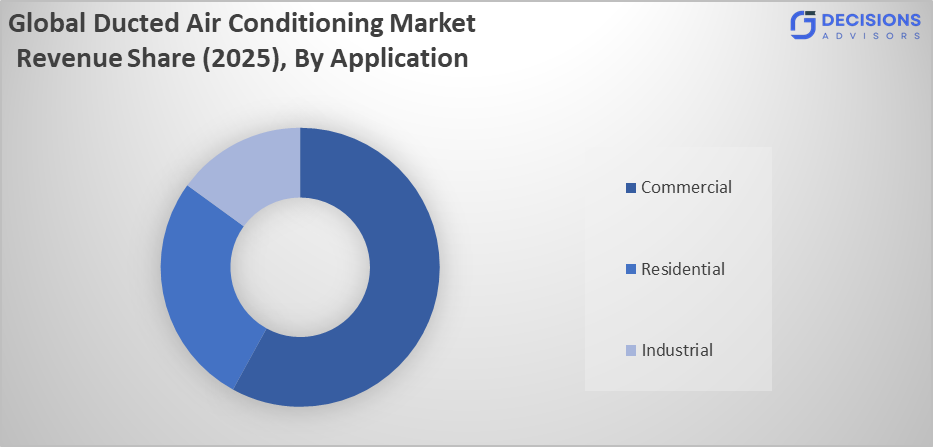
Commercial applications dominate the global market, accounting for approximately 58% of the total revenue in 2025.
Based on the Application, the global ducted air conditioning market is divided into residential, commercial, and industrial. Among these, commercial applications dominate the global market, accounting for approximately 58% of the total revenue in 2025. This segment is preferred by operators who require large-scale integrated solutions for retail environments and office buildings. The Residential category is seeing a sharp increase in use, especially in modern housing developments where central cooling is a standard requirement.
The Office Buildings segment dominates the global market, accounting for approximately 42% of the total revenue in 2025.
Based on the End User, the global ducted air conditioning market is divided into office buildings, hotels, retail stores, healthcare facilities, and educational institutions. Among these, the office buildings segment dominates the global market, accounting for approximately 42% of the total revenue in 2025. This segment is preferred by planners who require large-scale professional thermal engineering for corporate infrastructure. The Hotels and Retail segments are seeing a sharp increase in use, especially by operators who value the aesthetics of hidden climate control.
Strategies to Implement for Growth of the Market in Non-Leading Regions
The potential for growth within the ducted air conditioning industry in emerging regions could be increased through the deployment of efficient modular units for local industrial developers, as well as local agencies tasked with urban infrastructure management. Programs aimed at achieving sustainable housing by governments, coupled with the expansion of commercial retail hubs, contribute substantially toward demand within regions where traditional wall units previously posed challenges. Further support through increasing investments in training local HVAC technicians, as well as setting up regional maintenance facilities, will facilitate the adoption of sustainable climate control and smart thermal response solutions.
Regional Segment Analysis of the Global Ducted Air Conditioning Market
- North America (U.S., Canada, Mexico)
- Europe (Germany, France, U.K., Italy, Spain, Rest of Europe)
- Asia-Pacific (China, Japan, India, South Korea, Rest of APAC)
- Latin America (Brazil and the Rest of Latin America)
- The Middle East and Africa (UAE, South Africa, Rest of MEA)
Asia-Pacific is projected to be the fastest-growing region over the forecast period. This region is anticipated to witness a growth rate of around 6.5% CAGR, maintaining a dominant market share within the global industry. In 2025, the Asia-Pacific region already account for approximately 52.3% of global revenue. This is owing to the fast-developing urban infrastructure, coupled with the growing demand for modern climate control in countries such as China, India, and Japan. Other reasons for the same include greater investments made toward sustainable smart city planning in the region and widespread adoption of sensor-based control strategies.
North America is expected to hold a significant share of the ducted air conditioning market during the forecast period. This region holds approximately 25.4% share of global revenue in 2025, thanks to its high adoption of energy-efficient technology in both residential and high-value commercial applications. The largest part of this region’s revenues comes from the United States, as there is a lot of spending at the corporate level in green building programs.
Europe is anticipated to hold a substantial share, contributing approximately 18.2% of the global market share. There is a competitive advantage in the region owing to clusters of environmental technology innovation and financing for sustainable construction. There is also a comparative advantage with countries like Germany and the United Kingdom, which are highly skilled at precision engineering for high-performance self-adjusting units.
Recent Developments
- In June 2025, global HVAC leaders announced plans to shift 100% of ducted production to R32 and other low-GWP refrigerants to comply with upcoming global environmental regulations.
- In March 2024, industry trends indicated that centralised ducted installations in multi-family residential projects grew by 15%, reflecting a shift toward high-efficiency building designs.
- In November 2023, the European Union updated its F-Gas Regulation, accelerating the phase-down of HFCs and pushing the ducted market toward natural and sustainable refrigerants.
- In July 2022, infrastructure investments in green buildings accelerated, with ducted cooling technologies playing a key role in reducing building energy intensity by nearly 12% in certified projects.
Market Segmentation
This study forecasts revenue at global, regional, and country levels from 2021 to 2035. Decision Advisors has segmented the ducted air conditioning market based on the following segments:
Global Ducted Air Conditioning Market, By Product Type
- Single-Split Packaged AC
- Multi-Split Packaged AC
- VRF Systems
Global Ducted Air Conditioning Market, By Technology
- Inverter
- Non-Inverter Systems
Global Ducted Air Conditioning Market, By Application
- Residential
- Commercial
- Industrial
Global Ducted Air Conditioning Market, By End User
- Office Buildings
- Hotels
- Retail Stores
- Healthcare Facilities
- Educational Institutions
Global Ducted Air Conditioning Market, By Regional Analysis
- North America
- United States
- Canada
- Mexico
- Europe
- Germany
- United Kingdom
- France
- Italy
- Spain
- Russia
- Rest of Europe
- Asia Pacific
- China
- Japan
- India
- South Korea
- Australia
- Rest of Asia Pacific
- Latin America
- Brazil
- Argentina
- Rest of Latin America
- Middle East & Africa
- United Arab Emirates
- Saudi Arabia
- Qatar
- South Africa
- Rest of Middle East & Africa
Frequently Asked Questions (FAQ)
What is a ducted air conditioning system, and why is it important?
A ducted air conditioning system is a specialized climate regulation framework designed to maintain optimal temperatures through a network of ducts that distribute conditioned air throughout a building. These systems are essential for uniform air distribution, architectural aesthetics, and high-capacity cooling in multi-zone environments.
What factors are driving the growth of the ducted air conditioning market?
The market growth can be attributed to the massive investments made in commercial real estate by global developers, the rising requirements for energy-efficient green building certifications, and the widespread adoption of inverter-based centralized systems.
Which product type dominates the ducted air conditioning market?
Multi-split packaged ducted systems represent the largest and most influential segment of the market due to their superior cooling capacity, the capability to handle multiple zones independently, and their versatility in adapting to various building layouts.
Which applications are widely used in this market?
Commercial office buildings and hospitality sectors are the most prominent applications due to the acute necessity to maintain stable indoor temperatures and provide high-quality air circulation for large numbers of occupants.
Check Licence
Choose the plan that fits you best: Single User, Multi-User, or Enterprise solutions tailored for your needs.
We Have You Covered
- 24/7 Analyst Support
- Clients Across the Globe
- Tailored Insights
- Technology Tracking
- Competitive Intelligence
- Custom Research
- Syndicated Market Studies
- Market Overview
- Market Segmentation
- Growth Drivers
- Market Opportunities
- Regulatory Insights
- Innovation & Sustainability
Report Details
| Scope | Global |
| Pages | 210 |
| Delivery | PDF & Excel via Email |
| Language | English |
| Release | Apr 2026 |
| Access | Download from this page |