
Global Electric Actuator Market
 |
Author:
Achal E
|
Pages:
210
|
Author:
Achal E
|
Pages:
210
Global Electric Actuator Market Size, Share, By Type (Linear Actuators, Rotary Actuators), By Voltage (Less than 12V, 12V-24V, Above 24V), By Application (Robotics, Industrial Automation, Vehicle Equipment, Process Control), and By Region (North America, Europe, Asia-Pacific, Latin America, Middle East, and Africa), Analysis and Forecast 2026-2035
CAGR
4.99%
REVENUE 2025
USD Billion 4.85
FORECAST 2035
USD Billion 7.89
REPORT COVERAGE
Global
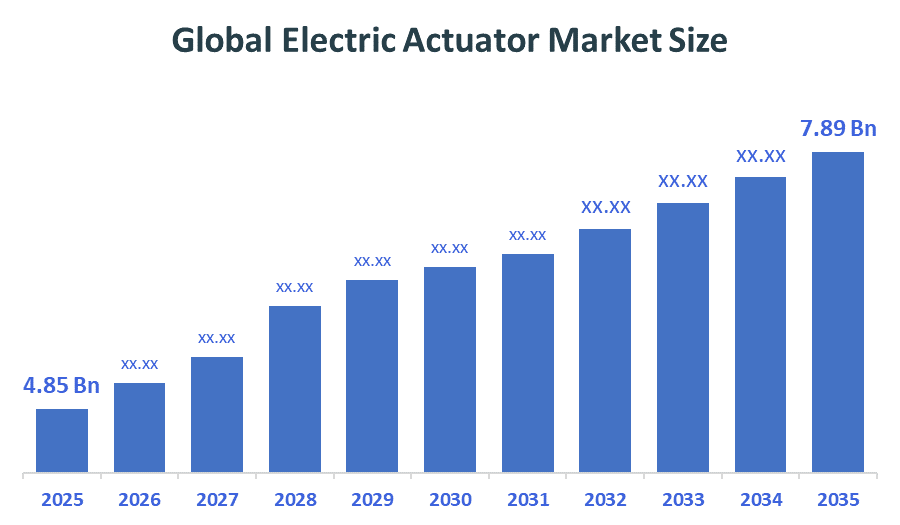
The Global Electric Actuator Market Size is Expected to grow from USD 4.85 billion in 2025 and is expected to reach around USD 7.89 billion by 2035. According to Decision Advisors, a detailed analysis reveals that the automation trend dominates the global electric actuator market, accounting for approximately 35-40% of the global market. Emerson Electric Co demonstrates a strong global presence, generating USD 17-18 Billion in revenue while holding approximately 12-15% market share worldwide, affecting international industry direction and competitive frameworks.
Market Snapshot
- Global Electric Actuator Market Size (2025): USD 4.85 billion
- Projected Global Electric Actuator Market Size (2035): USD 7.89 billion
- Global Electric Actuator Market Compound Annual Growth Rate (CAGR): 4.99%
- Largest Regional Market: Asia-Pacific
- Fastest Growing Region: Europe
- 3rd Largest Region: North America
- Base Year: 2025
- Historical Period: 2021-2024
- Forecast Period: 2026-2035
Market Overview/ Introduction
The global electric actuator market includes motor-operated systems which transform electrical power into exact linear or rotational movement. These actuators find their use in industrial robotics, automotive systems, aerospace control systems, process industries, renewable energy infrastructure, and medical equipment to deliver high-performance motion control operational efficiency and expandable automation capabilities throughout advanced industrial systems. The innovations such as smart IoT-enabled systems, miniaturized designs, and durable, hygienic materials, which improve operational efficiency and control precision of electric actuators. The market for future opportunities emerges through five key drivers, which include EV battery systems, renewable energy infrastructure, AI-based automation systems, smart building technologies, and aerospace electrification, because of these systems require actuators for their operation in energy-efficient industrial systems that deliver high performance throughout the world.
- In China, accelerated Made in China 2025, channelling over USD 1.4 trillion into smart manufacturing, significantly boosting automation intensity and reinforcing demand momentum across the global electric actuator market through robotics-led industrial modernization.
- In India, launched the PM E-DRIVE scheme with a ?10,900 crore (USD 1.3 billion) outlay, accelerating EV adoption and infrastructure, thereby strengthening demand dynamics across the global electric actuator market through vehicle electrification.
- In United States, advanced defense procurement, allocating over USD 22 billion for Virginia-class submarines, reinforcing demand momentum in the global electric actuator market through mission-critical naval automation and control systems integration.
Notable Insights: -
- Asia-Pacific holds the largest regional market share, approximately 39.8% in the global electric actuator market.
- Europe is the fastest growing region in the electric actuator market supported by the Germany and France currently lead industrial automation technology investments because they need to meet their sustainability requirements and their electrification needs and their Industry 4.0 development goals.
- By type, the linear actuators segment held a dominant position with 63.4% in terms of market share in 2025.
- By voltage, 12V-24V segment is the dominating accounting for over 47.2% of the global market share in 2025.
- The compound annual growth rate of the global electric actuator market is 4.99%.
- The market is likely to achieve a valuation of USD 7.89 billion by 2035.
What is role of technology in grooming the market?
The global electric actuator market experiences fundamental transformation because technological advancements serve as the main driver behind upcoming industrial developments. The combination of smart sensors with IoT technology and AI-based control systems creates a system that can execute predictive maintenance and achieve exact motion control and continuous performance monitoring. The development of energy-efficient products which use smaller designs has enabled multiple industries including automotive and healthcare and robotics to adopt new uses. The adoption of Industry 4.0 technologies drives increased demand for smart networkable actuators which can connect with different systems. The world experiences digitalization growth which enables companies to achieve better operational results through technological improvements that create new business opportunities while sustaining long-term market expansion.
How is Recent Developments Helping the Market?
Recent developments are driving the global electric actuator market forward because of the growing electrification market together with smart manufacturing and electric vehicle ecosystems is driving demand for precise actuation systems which now have expanded use throughout multiple sectors. The latest product developments which feature both compact designs and digitally connected actuators create improvements in operational efficiency, dependable performance, and extended product lifespan. The government-backed industrial policies together with sustainability programs create incentives for industries to transition from traditional pneumatic and hydraulic systems toward more energy-efficient electric systems.
Market Drivers
The global electric actuator market is being propelled by the industrial modernization and electrification trends create powerful structural elements which drive its development. The industrial sector needs precision motion systems which provide maximum repeatability and operational efficiency while requiring less maintenance because of businesses are adopting automation and robotics technologies at an increasing rate. The rising electric vehicle market drives increased actuator usage in braking systems and HVAC systems and advanced driver assistance systems and in-cabin comfort systems which results in higher volume production. The market demonstrates growth in energy-efficient technology adoption due to the organizations now prefer electric systems over hydraulic and pneumatic systems to meet sustainability regulations and reduce expenses. The implementation of IoT-based smart actuators enables organizations to perform predictive maintenance and real-time asset performance monitoring which results in better equipment efficiency. The aerospace and defense, healthcare and food processing industries all increase their automation investments which results in stronger market foundations that establish electric actuators as essential components for future industrial systems.
Restrain
The global electric actuator market faces notable restraints which arise from both its cost requirements and its operational difficulties. Elevated upfront capital requirements which include advanced controllers and installation infrastructure create limits to adoption for cost-sensitive enterprises. The process of integrating existing hydraulic or pneumatic systems presents challenges which increase both engineering work and the duration of implementation projects. The performance of electric actuators becomes limited because extreme industrial conditions with heat and moisture and dust create challenges for maintaining their operational durability and reliability. The process of switching systems becomes expensive for businesses while production downtime creates further obstacles to transition, especially in capital-intensive sectors which results in market penetration restrictions despite the existence of long-term efficiency benefits.
Competitive Analysis:
The report offers the appropriate analysis of the key organizations/companies involved within the global electric actuator market, along with a comparative evaluation primarily based on their product of offering, business overviews, geographic presence, enterprise strategies, segment market share, and SWOT analysis. The report also provides an elaborative analysis focusing on the current news and developments of the companies, which includes product development, innovations, joint ventures, partnerships, mergers & acquisitions, strategic alliances, and others. This allows for the evaluation of the overall competition within the market.
Top Companies in Global Electric Actuator Market
- Emerson Electric Co.
- Rotork plc
- ABB Ltd.
- Siemens AG
- AUMA Riester GmbH & Co. KG
- SMC Corporation
- Honeywell International Inc.
- Parker Hannifin Corporation
- Flowserve Corporation
- Moog Inc.
- Rockwell Automation, Inc.
- Curtiss-Wright Corporation
Government Initiatives
|
Country |
Key Government Initiatives |
|
South Korea |
In South Korea advanced its 2050 Carbon Neutral Strategy, mobilizing over KRW 12 trillion (USD 9 billion) for green industrial transition, thereby accelerating electrification trends in the global electric actuator market through energy-efficient automation deployment. |
|
Italy |
Italy advanced the Transizione 4.0 initiative, allocating over €13.4 billion in tax credits to accelerate Industry 4.0 adoption, thereby strengthening demand in the global electric actuator market through automation-driven industrial modernization. |
|
|
Market Segmentation
The Electric Actuator Market share is classified into type, voltage, and application
- The linear actuators segment dominated the market in 2024 and is projected to grow at a substantial CAGR of approximately 7.1% during the forecast period.
Based on the type, the electric actuator market is divided into linear actuators, rotary actuators. Among these,the linear actuators segment dominated the market in 2024 and is projected to grow at a substantial CAGR of approximately 7.1% during the forecast period. It is because of the industrial automation sector, robotics industry, and healthcare field show strong demand due to the advanced manufacturing systems and motion control systems provide higher precision better load capacity and seamless system integration features.
- The 12V-24V segment accounted for the largest share in 2024 and is anticipated to grow at a significant CAGR of approximately 6.4% during the forecast period.
Based on the voltage, the electric actuator market is divided into less than 12V, 12V-24V, above 24V. Among these, the 12V-24V segment accounted for the largest share in 2024 and is anticipated to grow at a significant CAGR of approximately 6.4% during the forecast period. It is dominating because of the higher energy density, faster charging and longer lifecycle. The lightweight design together with its exceptional performance enables the product to be used in construction, industrial, and DIY projects, which helps the product maintain its market dominance while its global market expansion continues.
- The industrial automation segment dominated the market in 2024, and is projected to grow at a substantial CAGR during the forecast period.
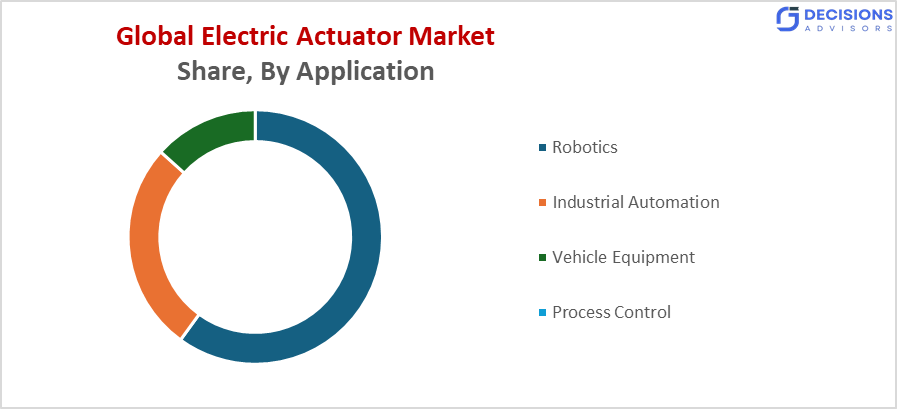
Based on the application, the electric actuator market is divided into robotics, industrial automation, vehicle equipment, process control, others. Among these, the industrial automation segment dominated the market in 2024, and is projected to grow at a substantial CAGR during the forecast period. It is because of the industrial sector worldwide experiences operational efficiency improvements through Industry 4.0 technology, which increases robotics usage together with the growing need for precise motion control systems.
Strategies to Implement for Growth of the Market in Non-Leading Regions
The global electric actuator market needs three essential elements to expand into non-leading regions which require specific policy support, cost-efficient solutions, and localized technological development. The government should establish specific tax incentives and infrastructure funding programs which will help small and medium-sized enterprises to implement automation technology. Manufacturers can boost their market presence through the creation of local manufacturing facilities which will help them decrease their need for international shipments and their costs. The local OEMs and system integrators will help businesses develop better distribution systems and create customized solutions through their strategic partnerships.
Regional Segment Analysis of the Global Electric Actuator Market
- North America (U.S., Canada, Mexico)
- Europe (Germany, France, U.K., Italy, Spain, Rest of Europe)
- Asia-Pacific (China, Japan, India, Rest of APAC)
- South America (Brazil and the Rest of South America)
- The Middle East and Africa (UAE, South Africa, Rest of MEA)
Asia-Pacific is anticipated to hold the largest share of the Electric Actuator Market over the predicted timeframe. The Asia-Pacific is anticipated to hold the largest share of the electric actuator market, accounting for approximately 42.2% of total revenue over the forecast period. It is because of the industrial growth of China, Japan, and India together with their increasing demand for automated systems has resulted in permanent industrial output growth across these countries.
Europe is expected to grow at a rapid CAGR in the Electric Actuator Market during the forecast period. The Europe market will experience fast growth because it accounts for approximately 7.3% of it is due to the industry 4.0 investments, electrification trends, and sustainability mandates across Germany, France, and Italy, accelerating automation adoption and technological advancement.
North America is the 3rd largest region to grow in the Electric Actuator Market during the region. The North America region stands as the third biggest area global for the electric actuator market since it holds approximately 23.2% the United States and Canada have advanced industrial automation capabilities together with their strong aerospace and energy industries because of their ongoing financing for smart manufacturing technologies.
Future Market Trends in Electric Actuator Market: -
- Smart Actuation & AI Integration
The global electric actuator market is transitioning toward intelligent actuation systems powered by AI and IoT integration. Advanced sensors together with predictive analytics technology enable systems to perform real-time monitoring while making automatic adjustments and preventing system failures. The digital transformation process creates operational efficiency improvements which reduce downtime and generate valuable business opportunities for smart manufacturing systems that operate worldwide.
- Shift Toward Energy-Efficient Alternatives
The market is undergoing a fundamental change because it now shifts from hydraulic and pneumatic systems toward energy-efficient electric actuators. The transition process experiences acceleration because environmental regulations and carbon reduction targets are becoming more stringent. Electric actuators provide sustainable industrial transformation solutions because they consume less energy and produce fewer emissions and require almost no upkeep.
3. Miniaturization and Advanced Material Innovation
The technological advancements are driving the development of compact lightweight electric actuators which achieve high performance. Innovations in materials and design enable better durability and efficiency improvements together with increased application flexibility. The current trend expands actuator applications into healthcare and aerospace and robotics industries which creates new growth opportunities for specialized high-precision applications.
Recent Development
- In April 2026, China, Nexteer Automotive introduced market-ready electro-mechanical braking systems at Auto China, advancing actuator-driven motion control and reinforcing innovation-led growth in the global electric actuator market through autonomous mobility integration.
- In February 2025, United States-based industrial players accelerated investments exceeding USD 500 million in electro-hydraulic actuator technologies, enhancing high-force automation capabilities and strengthening growth dynamics in the global electric actuator market across energy and heavy industries.
- In April 2025, United States accelerated robotics investments surpassing USD 1.8 billion, boosting deployment of high-precision electric actuators in automation, thereby reinforcing growth prospects in the global electric actuator market through advanced robotic and industrial integration.
- In December 2025, Germany-based Festo introduced the CMMT-AS-S3 servo drive, strengthening high-precision motion control ecosystems and accelerating innovation-led demand across the global electric actuator market through advanced automation technologies.
Market Segment
This study forecasts revenue at global, regional, and country levels from 2020 to 2035. Decision Advisors has segmented the electric actuator market based on the above-mentioned segments:
Global Electric Actuator Market, By Type
- Linear Actuators
- Rotary Actuators
Global Electric Actuator Market, By Voltage
- Less than 12V
- 12V-24V
- Above 24V
Global Electric Actuator Market, By Application
- Robotics
- Industrial Automation
- Vehicle Equipment
- Process Control
Global Electric Actuator Market, By Regional Analysis
- North America
- US
- Canada
- Mexico
- Europe
- Germany
- UK
- France
- Italy
- Spain
- Russia
- Rest of Europe
- Asia Pacific
- China
- Japan
- India
- South Korea
- Australia
- Rest of Asia Pacific
- South America
- Brazil
- Argentina
- Rest of South America
- Middle East & Africa
- UAE
- Saudi Arabia
- Qatar
- South Africa
- Rest of the Middle East & Africa
Frequently Asked Questions (FAQ)
Q. Why are electric actuators replacing hydraulic and pneumatic systems?
A. The growing demand for electric actuators results from their ability to deliver better energy efficiency and lower maintenance expenses and greater control precision. The system provides advantages for digital integration and complete Industry 4.0 compatibility because it prevents fluid leakage which occurs in hydraulic and pneumatic systems.
Q. Which industries are the largest consumers of electric actuators?
A. The industrial automation and automotive and aerospace and healthcare and energy sectors represent the main industrial sectors which utilize these technologies. The industrial automation sector leads the market because companies increase their adoption of robotics, while the automotive sector experiences fast growth because electric vehicles and advanced driver assistance systems create new revenue opportunities.
Q. What role do electric vehicles play in market expansion?
A. The increasing use of electric vehicles drives higher actuator requirements for all braking and thermal management and comfort systems in vehicles. The global adoption of electric vehicles which is driven by regulatory incentives and sustainability objectives will lead to increased actuator integration. This development will drive market expansion while generating fresh business prospects for the entire automotive electrification value chain.
Q. What are the future opportunities in the Global Electric Actuator Market?
A. The future opportunities for development exist in smart actuators and robotics expansion and renewable energy integration and miniaturization technologies. The automation industry together with AI systems and sustainable infrastructure development will create new business opportunities which will improve both market competition and profits that last for an extended period
Check Licence
Choose the plan that fits you best: Single User, Multi-User, or Enterprise solutions tailored for your needs.
We Have You Covered
- 24/7 Analyst Support
- Clients Across the Globe
- Tailored Insights
- Technology Tracking
- Competitive Intelligence
- Custom Research
- Syndicated Market Studies
- Market Overview
- Market Segmentation
- Growth Drivers
- Market Opportunities
- Regulatory Insights
- Innovation & Sustainability
Report Details
| Scope | Global |
| Pages | 210 |
| Delivery | PDF & Excel via Email |
| Language | English |
| Release | Apr 2026 |
| Access | Download from this page |