
Global Electric Container Cook Pots Market
 |
Pages:
210
|
Pages:
210
Global Electric Container Cook Pots Market Size, Share, By Product Type (Multi-Functional Cook Pots, Single Function Cook Pots, Smart Electric Cook Pots), By Capacity (Below 2L, 2?5L, above 5L), By End Use (Residential, Commercial), and By Region (North America, Europe, Asia-Pacific, Latin America, Middle East, and Africa), Analysis and Forecast 2026 - 2035
REPORT COVERAGE
Global
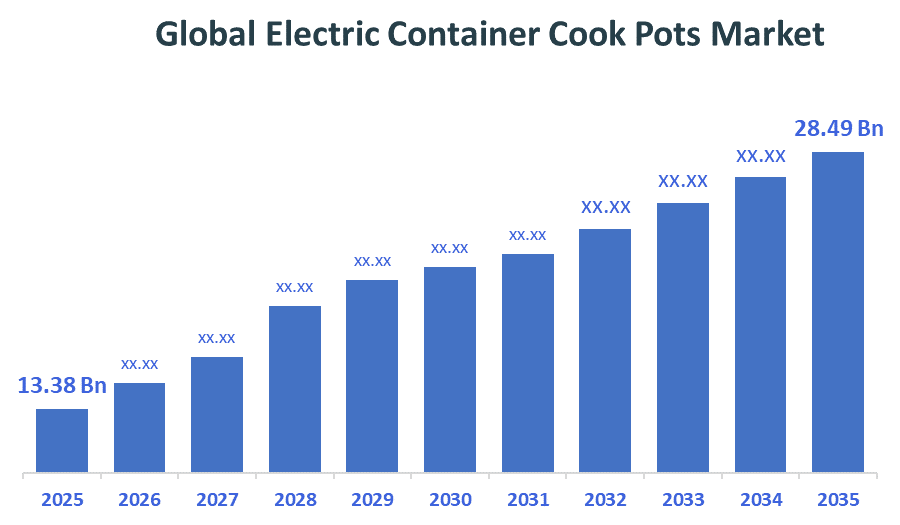
The Global Electric Container Cook Pots Market Size is forecasted to grow from USD 13.38 Billion in 2025 and going to reach approx. USD 28.49 Billion by 2035. According to Decision Advisors, there is a detailed research report on Global Electric Container Cook Pots Market attributes that the multi-functional electric cook pots dominate the global market, accounting for approximately 50–55% of the total share worldwide. Midea Group generates strong revenue, which accounts for approximately 12–18% of the market share, thus acting as a main driver that iinnovation in smart cooking technologies.
Market Snapshot
- Market Size (2025): USD 13.38 Billion
- Projected Market Size (2035): USD 28.49 Billion
- Compound Annual Growth Rate (CAGR): 7.85%
- Largest Regional Market: North America
- Fastest Growing Region: Asia-Pacific
- 3rd Largest Region: Europe
- Base Year: 2025
- Historical Period: 2021–2024
- Forecast Period: 2025–2035
Market Overview/ Introduction
The Global Electric Container Cook Pots Market refers to electrically powered cooking appliances which provide users with portable and efficient food preparation capabilities for their home, dormitory, office, and small commercial kitchen needs. The market experiences continuous growth because of urbanization which causes more than 55% of people to reside in cities and people increasingly demand smaller kitchen appliances. Approximately 60 to 70% of consumers choose cooking solutions which provide convenience because their daily routines make it difficult to cook. The market shows growing interest in technological advancements which include smart temperature control and IoT-enabled cooking as 35 to 40% of new products now include smart features. Energy-efficient heating elements enable power savings of 20 to 30% while multi-functional cook pots enhance cooking performance by 30 to 40% which results in higher global product demand.
- In November 2023 in India, The National Efficient Cooking Programme (NECP) launched by Energy Efficiency Services Limited promotes induction cookers as affordable, energy-efficient, and clean alternatives to LPG for large-scale adoption.
Notable Insights: -
- North America holds the largest regional market share approximately 30% in Global Electric Container Cook Pots Market.
- Asia Pacific is the fastest growing region in the Global Electric Container Cook Pots Market with a CAGR of approximately 9%.
- By product type, the multi-functional cook pots segment held a dominant position with approximately 7% in terms of market share in 2025.
- By Capacity, 2–5L segment is the dominating accounting for over 6% of the global market share in 2025.
- The compound annual growth rate of the Global Electric Container Cook Pots Market is 7.85%.
- The market is likely to achieve a valuation of USD 28.49 billion by 2035.
What is role of technology in grooming the market?
Technology is significantly transforming the Electric Container Cook Pots market by enhancing convenience, efficiency, and safety. Smart cook pots now feature digital temperature control, auto shut-off, and programmable cooking modes, improving usability and reducing cooking errors by nearly 25–30%. IoT-enabled appliances allow remote operation via mobile apps, with adoption rising to approximately 38% of new product launches. Energy-efficient heating elements help reduce power consumption by 20–30%, supporting sustainability goals and lowering electricity costs. Additionally, advanced non-stick coatings and durable materials increase product lifespan by 15–20% and simplify cleaning. Around 45% of modern cook pots now include smart or semi-smart features, while multi-functional designs improve cooking efficiency by nearly 35%, making them highly attractive for modern consumers.
Market Drivers
The Electric Container Cook Pots market grows because people want small cooking equipment which they can use anywhere after more than half of the world now lives in cities with restricted cooking facilities. People who work in offices now make up about 60% of city residents who need fast cooking options which need little time to prepare. E-commerce platforms contribute to approximately 38% of total sales, which makes it easier for customers to access products. The increasing student population together with single-person households who make up 30–35% of city residents drive demand for small kitchen appliances. The residential segment dominates the market because it produces approximately 70% of total market consumption. The market expands worldwide because people want to buy energy-efficient appliances which become available with their growing disposable income.
Restrain
The market encounters multiple obstacles which restrict its ability to expand. The cooking capacity of smaller units limits their ability to serve larger households because these units depend on electrical power which creates problems for regions that experience frequent power interruptions thus affecting about 25 to 30% of users in developing regions. Price sensitivity remains a concern, as around 40% of consumers in emerging markets prefer low-cost alternatives, limiting adoption of advanced smart appliances. Customers who use the product need safety certifications, because they use safety testing documents to protect their security from dangers like overheating and electrical problems and product reliability defects. The combination of these elements prevents the market from achieving full distribution.
Competitive Analysis:
The report offers the appropriate analysis of the key organizations/companies involved within the Global Electric Container Cook Pots Market, along with a comparative evaluation primarily based on their product of offering, business overviews, geographic presence, enterprise strategies, segment market share, and SWOT analysis. The report also provides an elaborative analysis focusing on the current news and developments of the companies, which includes product development, innovations, joint ventures, partnerships, mergers & acquisitions, strategic alliances, and others. This allows for the evaluation of the overall competition within the market.
Top Companies in the Global Electric Container Cook Pots Market
- Midea Group
- Philips
- Panasonic Corporation
- Xiaomi Corporation
- Tefal
- Joyoung
- Bear Electric Appliance
- Instant Pot Brands
- Morphy Richards
- Hamilton Beach
- Wonderchef
- Prestige Group
- Bajaj Electricals
- Agaro
- Pigeon
- Cuckoo Electronics
- Pensonic
Government Initiatives
|
Country |
Key Government Initiatives |
|
UK |
In November 2021 in UK, The COP26 Product Efficiency Call to Action, led by the UK Government and International Energy Agency, aims to double efficiency of appliances including cookers by 2030 |
|
US |
In US, New York City is promoting building electrification and gas-to-electric transition initiatives, encouraging adoption of induction cooking through retrofit programs and clean energy policies. |
|
India
|
In India, Carbon trading initiatives are linking electric cooking adoption with carbon credits, enabling households to earn incentives while reducing emissions and supporting clean energy transition. |
Study on the Supply, Demand, Distribution, and Market Environment Global Electric Container Cook Pots Market
The market for Global Electric Container Cook Pots maintains a stable supply-demand equilibrium which results from increasing urban consumption together with the growth of manufacturing operations. The Asia-Pacific region supplies more than 55 to 60% of global production because it provides cost-efficient manufacturing services and possesses strong electronics supply chain networks. The major brands maintain control over approximately 60% of the entire market share which allows them to deliver their products to various markets. About 65 to 70% of total demand comes from residential customers while small commercial establishments like hostels and offices account for the remaining demand. The distribution system increasingly moves toward e-commerce because online channels experience annual growth rates of 7 to 10% while offline retail maintains a dominant market share of 60 to 65%. The entire market landscape operates under intense competition which drives innovation because customers demand advanced compact energy-saving cooking devices that can perform multiple functions
Price Analysis and Healthcare Facilities Behaviour Analysis
The Global Electric Container Cook Pots Market demonstrates a diverse pricing structure based on capacity, features, and brand positioning. The price of entry-level cook pots starts from USD 15 to USD 40 which budget-conscious consumers and students can afford. The price of mid-range models which offer multi-functional capabilities starts from USD 40 and extends up to USD 100. Premium smart cook pots with IoT connectivity and advanced temperature control and durable materials can exceed USD 120. From a consumer behavior perspective, approximately 65% of buyers choose products based on their convenience and portability while 52% of buyers choose products based on their energy efficiency and safety features. About 48% of consumers prefer appliances which combine boiling and steaming and frying capabilities into one device. Online reviews and e-commerce platforms influence about 45% of purchases which shows how digital retail channels affect consumer buying behavior.
Market Segmentation
The Global Electric Container Cook Pots Market share is classified into solution product type, Capacity, and end use
- The multi-functional cook pots segment dominated the market in 2025, and is projected to grow at a substantial CAGR of approximately 7% during the forecast period.
Based on the product type, the Global Electric Container Cook Pots market is divided into Multi-Functional Cook Pots, Single Function Cook Pots, Smart Electric Cook Pots. Among these, the multi-functional cook potssegment dominated the market in 2025, and is projected to grow at a substantial CAGR of approximately 7% during the forecast period. The multi-functional cook pots segment dominated the market, driven by increasing consumer preference for versatile appliances that combine boiling, steaming, frying, and slow cooking in a single device. The products enable kitchen users to prepare food using one appliance, which makes them extremely attractive to people living in cities. The segment is expected to grow at a compound annual growth rate of approximately 7% during the forecast period because convenience cooking products and ongoing product development create increasing consumer demand.
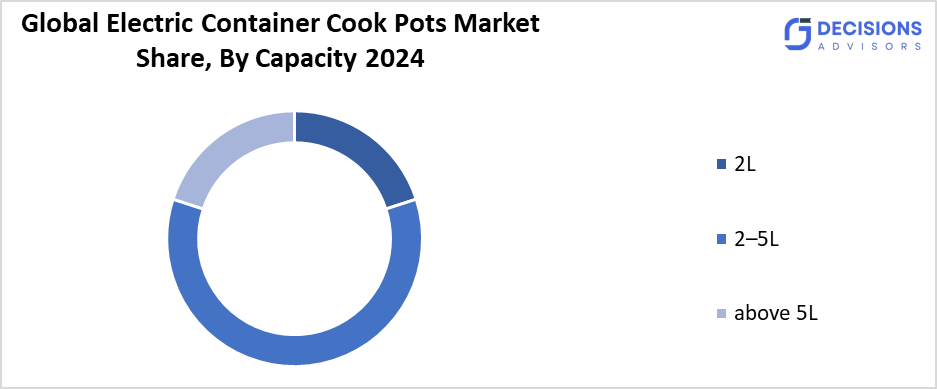
- The 2–5L segment accounted for the largest share in 2025, and is anticipated to grow at a significant CAGR of approximately 6% during the forecast period.
Based on the Capacity, the Global Electric Container Cook Pots Market is divided into Below 2L, 2–5L, above 5L. Among these, the 2–5L segment accounted for the largest share in 2025, and is anticipated to grow at a significant CAGR of approximately 6% during the forecast period. The solution provides the best combination of storage space and user-friendly features for households that fall within the small to medium size range. This segment typically caters to families and working professionals, which represent a major consumer base globally. Mid-capacity cookers maintain their market strength through their ability to handle diverse cooking tasks and their practical application for various needs. The segment is further expected to grow at a CAGR of approximately 6% during the forecast period, supported by increasing urbanization, rising nuclear families, and growing preference for compact yet efficient kitchen appliances.
- The residential segment dominated the market at a CAGR of approximately 7% in 2025, and is projected to grow at a substantial CAGR during the forecast period.
Based on the End Use, the global electric container cook pots market is divided into residential, commercial. Among these, the residential segment dominated the market at a CAGR of approximately 7% in 2025, and is projected to grow at a substantial CAGR during the forecast period. The widespread use of electric cook pots in homes for their cooking convenience creates a major portion of the market share. Studies show that residential users constitute 60 to 70% of total demand which results from urbanization and compact living spaces and people who have active daily routines. The market segment will experience growth at a compound annual growth rate between 5 and 7% during the forecast period because of increasing demand for portable and energy-efficient cooking devices which multifunctional capabilities.
Strategies to Implement for Growth of the Market in Non-Leading Regions
The Global Electric Container Cook Pots Market needs companies to implement affordable pricing and localized products and market awareness strategies to succeed in business operations throughout Latin America and Middle Eastern and African countries and Southeast Asian territories. Manufacturers need to produce affordable products and mid-priced products because 50 to 60% of consumers in developing countries show price sensitivity. Local assembly or manufacturing facilities enable companies to achieve 20 to 30% cost savings on logistics and import expenses which results in improved product distribution. The company needs to expand distribution through e-commerce platforms and regional retail networks because online appliance sales in emerging economies are growing at over 10 to 12% annual rate. Companies need to fund campaigns that educate consumers about energy-efficient safety features and convenient product usage because these efforts will increase customer adoption between 25 and 35%. The company will enhance its market reach through partnerships with local distributors and supermarkets and electronics retailers. The company can attract middle-income customers by providing multi-functional energy-efficient cook pots which come with various pricing options and EMI payment plans. Government support for energy-efficient appliances together with rising electrification rates creates market conditions that benefit businesses in their quest for long-term development.
Regional Segment Analysis of the Global Electric Container Cook Pots Market
- North America (U.S., Canada, Mexico)
- Europe (Germany, France, U.K., Italy, Spain, Rest of Europe)
- Asia-Pacific (China, Japan, India, Rest of APAC)
- South America (Brazil and the Rest of South America)
- The Middle East and Africa (UAE, South Africa, Rest of MEA)
North America is anticipated to hold the largest share approximately 30% of the Global Electric Container Cook Pots Market over the predicted timeframe. North America is expected to maintain its position as the largest market for the Global Electric Container Cook Pots Market throughout the forecast period with a share 30%. People in this area spend money on expensive kitchen tools which drives up their demand for advanced cooking equipment that supports smart functions and multiple cooking methods. The region has modern cooking facilities which people establish in their homes because they want to use cooking methods that require minimal effort. The market expands because consumers demand energy-saving devices that connect to the Internet of Things while top manufacturers establish their operations in the area. The adoption of new electric cooking appliances in homes accelerates because people with high incomes and digital expertise in their families.
Asia Pacific is expected to grow at a rapid CAGR approximately 9% in the Global Electric Container Cook Pots Market during the forecast period. The fast growth of urban areas together with rising disposable incomes and the developing middle class in China and India drive this strong economic expansion. The demand for kitchen appliances has increased because students and working professionals now prefer compact and affordable products. The market is experiencing faster growth because e-commerce platforms have better product accessibility. Electric cook pots become more accessible in the region because manufacturers produce low-cost products and the area has a strong manufacturing presence. The Asian Pacific market continues to grow because people adopt new lifestyles and prefer cooking methods that save time and effort.
Europe is the 3rd largest region to grow in the Global Electric Container Cook Pots Market during the region.
Europe stands as the third most extensive area which controls the Global Electric Container Cook Pots Market throughout the forecast period. The region experiences growth because urban households prefer to use compact kitchen appliances which consume less energy. The market shows growth because consumers increasingly use smart cooking devices which serve multiple functions and demonstrate energy efficiency through their sustainable features. The countries of Germany, France, and the UK support the market because they have established retail networks and their citizens possess high spending power. The European market receives strength from the rising preference of consumers who live in small homes and lead active lives to choose efficient cooking products.
Future Market Trends Global Electric Container Cook Pots Market: -
- Rising Adoption of Smart & Connected Appliances
The market is witnessing strong growth in smart cook pots with IoT-enabled controls, app connectivity, and programmable features. Nearly 30–40% of new models now include smart functionalities, enhancing convenience and energy optimization.
- Growing Demand for Multifunctional Cooking Solutions
Consumers increasingly prefer appliances that combine boiling, frying, steaming, and slow cooking in one unit. Multifunctional cookers are expected to dominate, with over 50% of buyers prioritizing versatility and time-saving features.
- Shift Toward Energy-Efficient and Sustainable Appliances
Energy-efficient heating technologies are becoming a key trend, driven by rising electricity costs and sustainability concerns. Modern cook pots reduce energy consumption by 20–30%, making them attractive in both developed and emerging markets.
Recent Development
- In September 2025, Xiaomi launched a 4L Mijia smart variable-pressure IH rice cooker featuring app connectivity, XiaoAI voice control, and touchscreen interface for advanced, customizable cooking.
- In August 2025 Panasonic Corporation launched a high-end AI rice cooker using advanced sensors and AI to optimize cooking time, temperature, and moisture, enhancing rice texture, flavor, and overall cooking precision.
- In 2025, Philips partnered with Amazon to expand its smart kitchen ecosystem and e-commerce distribution, including electric lunch boxes and connected cooking solutions
- In September 2022 Energy Efficiency Services Limited partnered with Modern Energy Cooking Services to deploy over 20,000 electric pressure cookers and induction units, promoting clean, sustainable cooking adoption.
How is Recent Developments Helping the Market?
The Global Electric Container Cook Pots Market is experiencing growth because recent developments have enabled product innovation and increased user convenience while supporting the market growth in both residential and commercial sectors. AI-powered multifunctional cook pots now have auto-cooking modes and app connectivity and adaptive temperature control, which together create an advanced user experience that boosts cooking efficiency. The newest models provide users with more than 10 cooking functions and 40 preset modes, which enable users to accomplish various cooking activities with one device. The development of modern heating technologies and materials through innovations like rapid heating elements and stainless-steel liners and non-stick coatings has led to better product durability and safety and cooking performance improvements. The study found that 50% of recent product innovations concentrate on developing enhanced heat distribution and safety systems to improve product reliability and product lifespan. The rising popularity of smart and interconnected features acts as a primary growth force because approximately 30 to 40% of new models now include digital control systems and programmable functions and IoT technology for remote management and power efficiency. Product launches and brand innovations create new options for customers, while more than 45% of manufacturers dedicate their resources to research activities and development of intelligent home appliances, which will support sustained market development. The current advancements lead to better operational performance and increase cooking safety, while the new cooking system provides multiple cooking methods, which results in greater market acceptance of electric cook pots.
Market Segment
This study forecasts revenue at global, regional, and country levels from 2020 to 2035. Decision Advisor has segmented the Global Electric Container Cook Pots based on the below-mentioned segments:
Global Electric Container Cook Pots Market, By Product Type
- Multi-Functional Cook Pots
- Single Function Cook Pots
- Smart Electric Cook Pots
Global Electric Container Cook Pots Market, By Capacity
- Below 2L
- 2–5L
- above 5L
Global Electric Container Cook Pots Market, By End Use
- Residential
- Commercial
Global Electric Container Cook Pots Market, By Regional Analysis
- North America
- US
- Canada
- Mexico
- Europe
- Germany
- UK
- France
- Italy
- Spain
- Russia
- Rest of Europe
- Asia Pacific
- China
- Japan
- India
- South Korea
- Australia
- Rest of Asia Pacific
- South America
- Brazil
- Argentina
- Rest of South America
- Middle East & Africa
- UAE
- Saudi Arabia
- Qatar
- South Africa
- Rest of the Middle East & Africa
Frequently Asked Questions (FAQ)
1. How are electric container cook pots influencing micro-living and co-living housing trends globally?
Electric cook pots are becoming essential in micro-apartments and co-living spaces because they eliminate the need for full kitchens, enabling compact, flexible urban housing designs.
2. Why are electric container cook pots gaining popularity in non-traditional cooking spaces like offices and hostels?
Their portability, safety shut-off features, and low energy consumption make them suitable for controlled environments where full kitchen infrastructure is unavailable.
3. How does cooking behavior change when consumers shift from gas-based systems to electric cook pots?
Users tend to adopt batch cooking, simplified recipes, and multi-function cooking modes due to automation and preset cooking programs.
4. What role does electricity pricing play in shaping product innovation in this market?
Rising electricity costs are pushing manufacturers to design low-wattage, rapid-heating, and energy-optimized cook pots to maintain affordability and demand.
5. How are smart electric cook pots integrating with broader smart home ecosystems?
Modern cook pots connect with mobile apps and smart assistants, allowing synchronization with home energy systems and voice-controlled kitchen environments.
Check Licence
Choose the plan that fits you best: Single User, Multi-User, or Enterprise solutions tailored for your needs.
We Have You Covered
- 24/7 Analyst Support
- Clients Across the Globe
- Tailored Insights
- Technology Tracking
- Competitive Intelligence
- Custom Research
- Syndicated Market Studies
- Market Overview
- Market Segmentation
- Growth Drivers
- Market Opportunities
- Regulatory Insights
- Innovation & Sustainability
Report Details
| Scope | Global |
| Pages | 210 |
| Delivery | PDF & Excel via Email |
| Language | English |
| Release | Apr 2026 |
| Access | Download from this page |