
Global Electric Power Steering Market
 |
Author:
Atul K
|
Pages:
190
|
Author:
Atul K
|
Pages:
190
Global Electric Power Steering Market Size, Share By Type (Column Assist EPS, Rack Assist EPS, Pinion Assist EPS, and Others), By Component (Steering Column, Steering Rack, Sensors, Electric Motor, Electronic Control Unit, and Others), By Vehicle Type (Passenger Cars, Light Commercial Vehicles, and Heavy Commercial Vehicles), and By Region (North America, Europe, Asia-Pacific, Latin America, Middle East & Africa), Analysis and Forecast 2026-2035
CAGR
5.72%
REVENUE 2025
USD Billion 31.5
FORECAST 2035
USD Billion 54.92
REPORT COVERAGE
Global
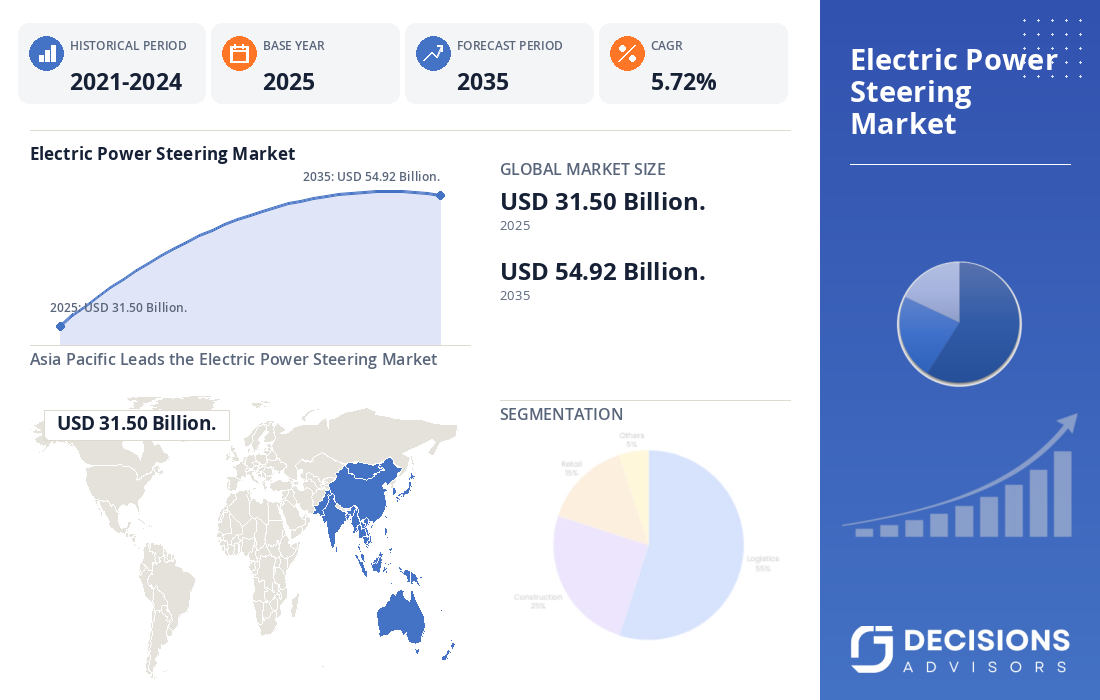
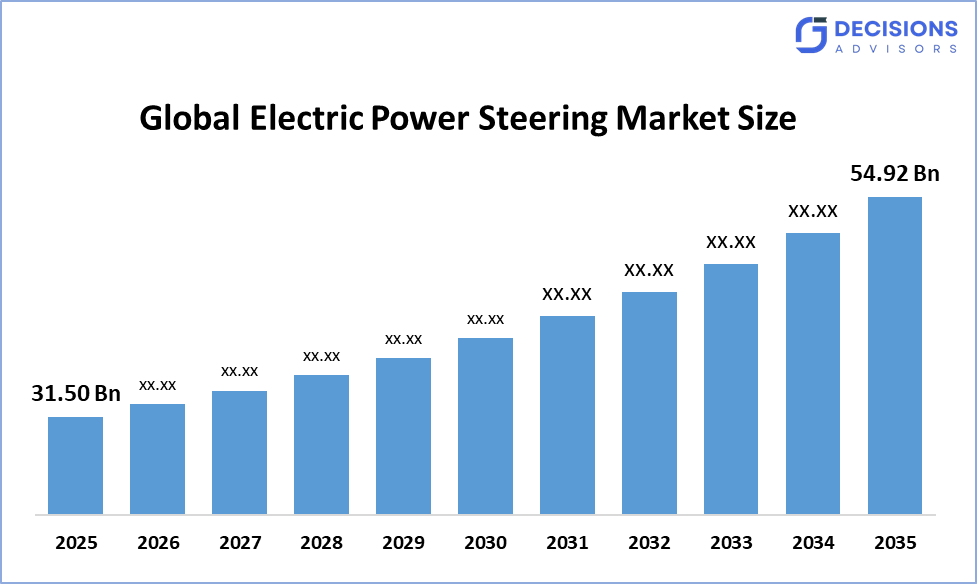
The global electric power steering market size is predicted to grow from USD 31.50 Billion in 2025 and is likely to reach around USD 54.92 Billion by 2035 with a CAGR of 5.72%. According to Decision Advisors, increasing vehicle electrification, ADAS integration, automated parking, and the transition toward software-defined vehicle architectures are major factors supporting market growth. The market is led by established automotive technology suppliers including JTEKT Corporation, Nexteer Automotive, ZF Friedrichshafen AG, Bosch, NSK, and Denso. Independent industry research places the 2025 EPS market close to USD 29.4 billion, making the higher Decision Advisors estimate a deliberately more bullish market-sizing scenario reflecting stronger EV, ADAS, and advanced-steering adoption.
Market Snapshot
- Global Electric Power Steering Market Size (2025): USD 31.50 Billion.
- Projected Global Electric Power Steering Market Size (2035): USD 54.92 Billion.
- Global Electric Power Steering Market Compound Annual Growth Rate (CAGR): 5.72%.
- Largest Regional Market: Asia Pacific
- 2nd Largest Region: North America
- Fastest Growing Region: Europe
- Base Year: 2025
- Historical Period: 2021-2024
- Market Forecast Period: 2026-2035
Market Overview/ Introduction
The global electric power steering (EPS) market comprises electronically assisted steering systems that use an electric motor, sensors, electronic control units, and steering mechanisms to provide steering assistance. Unlike hydraulic power steering, EPS does not require a continuously driven hydraulic pump, allowing manufacturers to improve energy efficiency, reduce mechanical complexity, and integrate steering with electronic vehicle-control systems. EPS has consequently become a core chassis technology for modern passenger cars, SUVs, electric vehicles, and increasingly advanced commercial vehicles. The market is expanding as automakers increase EV production and integrate ADAS functions such as lane keeping, automated parking, highway assistance, and other steering-control functions. NHTSA identifies lane-keeping assistance as a Level 1 steering-assistance technology and describes Level 2 systems as providing continuous steering together with acceleration/braking assistance, demonstrating the increasing role of electronically controlled steering in modern vehicle architectures.
- United States, Increasing adoption of ADAS, EVs, and electronically controlled chassis technologies is supporting EPS demand. Federal vehicle-safety policy also encourages deployment of steering-related driver-assistance technologies.
- Japan, Japanese automotive suppliers remain important developers of EPS and next-generation steer-by-wire technologies. JTEKT has developed linkless steer-by-wire systems with redundant architectures for future mobility applications.
- China, China is strengthening intelligent-connected vehicle standards, software management, and advanced-driving technology. Its 2025 policy framework specifically strengthens product approval, testing, recall, and OTA management for intelligent-connected vehicles.
Notable Insights: -
- Asia Pacific is anticipated to hold approximately 58% share of the Global Electric Power Steering Market over the predicted timeframe.
- Europe is expected to grow at a rapid CAGR in the Global Electric Power Steering Market, holding approximately 17% share during the forecast period.
- By Type, the Column Assist EPS segment dominated the market and holds approximately 46% share in 2025 and is projected to grow at a substantial CAGR during the forecast period.
- By Vehicle Type, the Passenger Cars segment dominated the market and holds approximately 76% share in 2025 and is projected to grow at a substantial CAGR during the forecast period.
- The compound annual growth rate of the Global Electric Power Steering Market is 5.72%.
- The market is likely to achieve a valuation of approximately USD 54.92 Billion by 2035.
Market Drivers
The major growth driver for the global electric power steering market is the increasing electrification of the automotive industry. EPS consumes electrical energy according to steering demand and avoids the continuous mechanical load associated with traditional hydraulic steering pumps, making it well suited to hybrid and battery-electric vehicles. EV manufacturers are also adopting advanced steering systems to support ADAS, automated parking, lane keeping, and future automated-driving functions. At the same time, vehicle manufacturers are increasingly integrating steering with centralized vehicle computers, software platforms, sensors, and other chassis-control systems. Demand for improved fuel economy, lower vehicle weight, enhanced steering response, and reduced maintenance requirements further supports EPS adoption. High-output EPS is also extending the technology into heavier EVs and commercial vehicles; Nexteer's high-output portfolio is designed for higher front-axle loads and offers column, pinion, and rack-assist configurations.
Restrain
The global electric power steering market faces several restraints, including high development costs, functional-safety requirements, electronic-system complexity, and supply-chain exposure to motors, sensors, semiconductors, and control electronics. Advanced EPS systems must maintain reliable steering assistance under temperature changes, vibration, electrical disturbances, and demanding road conditions. Steer-by-wire and high-availability EPS architectures require additional redundancy, validation, and cybersecurity measures. The growing software content of modern steering systems also increases testing and regulatory requirements, particularly as governments introduce stricter rules for connected and automated vehicles.
Competitive Analysis:
The report offers the appropriate analysis of the key organizations/companies involved within the Global Electric Power Steering Market, along with a comparative evaluation primarily based on their product offerings, business overviews, geographic presence, enterprise strategies, segment market share, and SWOT analysis. The report also provides an elaborative analysis focusing on the current news and developments of the companies, which includes product development, innovations, joint ventures, partnerships, mergers & acquisitions, strategic alliances, and others. This allows for the evaluation of the overall competition within the market.
Top Companies in the Global Electric Power Steering Market
- JTEKT Corporation
- Nexteer Automotive
- NSK Ltd.
- ZF Friedrichshafen AG
- Robert Bosch GmbH
- Denso Corporation
- Hyundai Mobis Co., Ltd.
- Hitachi Astemo, Ltd.
- Mitsubishi Electric Corporation
- thyssenkrupp AG.
Government Initiatives
|
Country |
Key Government Initiatives |
|
United States |
NHTSA's vehicle-safety framework supports deployment of driver-assistance technologies, including lane-keeping assistance and other steering-related functions |
|
Japan |
Japan continues to support advanced automotive technologies, electrification, and automated-driving development, creating a favorable environment for electronically controlled steering systems |
|
China |
China's 2025 intelligent-connected vehicle framework strengthens product approval, testing, recall, OTA management, and safety requirements while supporting intelligent-vehicle technology development |
Market Segmentation
The global electric power steering market share is classified into type, component, and vehicle type.
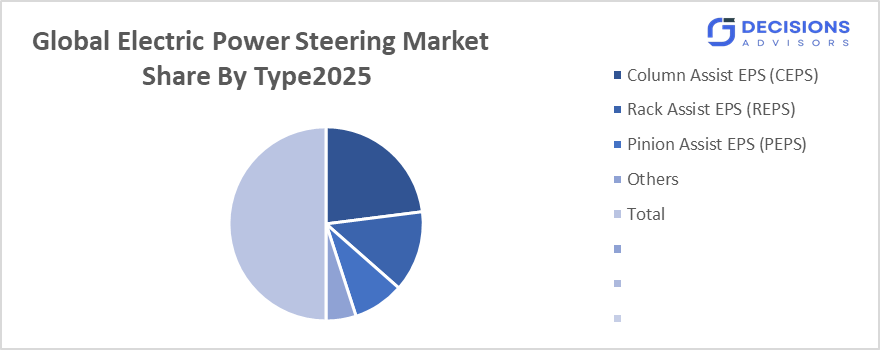
- The Column Assist EPS segment dominated the market and holds approximately 46% share in 2025 and is projected to grow at a substantial CAGR during the forecast period.
Based on type, the global electric power steering market is divided into Column Assist EPS (CEPS), Rack Assist EPS (REPS), Pinion Assist EPS (PEPS), and Others. Among these, Column Assist EPS dominates because it offers compact packaging, relatively lower system costs, and suitability for high-volume passenger vehicles. CEPS integrates the motor, controller, sensor, and assist mechanism around the steering column. Nexteer currently offers brush and brushless CEPS, including high-output versions reaching up to 110 Nm.
- The Electric Motor segment accounted for the largest share of approximately 29% in 2025 and is anticipated to grow at a significant CAGR during the forecast period.
Based on component, the market is divided into steering column, steering rack, sensors, electric motor, electronic control unit, and others. The electric motor represents a critical component because it produces the assist torque required by the steering mechanism. Increasing demand for compact, lightweight, high-efficiency motors is supporting segment growth. The development of high-output EPS for larger EVs and commercial vehicles is also increasing the importance of high-torque electric motors.
- The Passenger Cars segment accounted for the largest share of approximately 76% in 2025 and is anticipated to grow at a significant CAGR during the forecast period.
Based on vehicle type, the market is divided into passenger cars, light commercial vehicles, and heavy commercial vehicles. Passenger cars dominate because EPS has become widely established in compact vehicles, sedans, SUVs, and EVs. Increasing ADAS penetration further supports adoption because electronically controlled steering can provide the steering input required for lane keeping and automated parking. Growing EV sales and demand for digitally controlled cockpits will continue to support this segment.
Regional Segment Analysis of the Global Electric Power Steering Market
- North America (U.S., Canada, Mexico)?
- Europe (Germany, U.K., France, Italy, Spain, Netherlands, Rest of Europe).
- Asia-Pacific (China, Japan, India, Australia, South Korea, Rest of Asia-Pacific).
- South America (Brazil, Argentina, Rest of South America).
- Middle East & Africa (UAE, Saudi Arabia, South Africa, Rest of MEA).
Asia Pacific is anticipated to hold approximately 58% share of the Global Electric Power Steering Market over the predicted timeframe.
Asia Pacific represents the largest EPS market because of its extensive automotive manufacturing base, large passenger-vehicle population, expanding EV production, and strong presence of Japanese, Korean, Chinese, and international automotive suppliers. China remains a major growth engine because of its large EV market and rapid development of intelligent-connected vehicles. Japan contributes through established steering-system suppliers and advanced automotive R&D, while India is developing as an important manufacturing and consumption center. China's continued development of intelligent-connected NEVs and advanced autonomous-driving technologies provides an additional long-term demand opportunity.
North America is expected to grow at a rapid CAGR in the Global Electric Power Steering Market, holding approximately 18% of the share during the forecast period.
Growth is supported by the strong presence of global vehicle manufacturers and Tier-1 suppliers, high demand for SUVs and pickup trucks, increasing EV adoption, and expanding ADAS deployment. North American suppliers are also developing higher-output EPS for heavier vehicles. Nexteer's 2025 HO CEPS launch expanded steering assistance up to 110 Nm and specifically targeted heavier vehicle applications and EV platforms.
Europe is the fastest-growing region in the Global Electric Power Steering Market during the period, holding approximately 17% share.
Europe's growth is supported by stringent vehicle-safety requirements, electrification, premium vehicle production, and increasing adoption of automated-driving functions. The EU General Safety Regulation requires new vehicles to incorporate multiple driver-assistance technologies, including lane keeping for cars and vans. These requirements strengthen the long-term need for electronically controlled steering architectures capable of communicating with ADAS and vehicle-control systems.
Future Market Trends in Global Electric Power Steering Market: -
-
- Expansion of EPS in Electric Vehicles
EV adoption is expected to remain a major EPS growth catalyst. Electric vehicles require energy-efficient auxiliary systems, and EPS avoids the continuous parasitic load associated with hydraulic pumps. The growing weight and performance requirements of EVs are also creating demand for high-output steering systems.
-
- Integration with ADAS
EPS is increasingly becoming an active vehicle-control technology. Lane keeping, automated parking, highway assistance, and other ADAS functions require electronic control of steering. As these functions become more common, EPS suppliers will increasingly focus on low-latency control, redundancy, cybersecurity, and functional safety.
-
- High-Output EPS for Larger Vehicles
The traditional association of CEPS with smaller vehicles is changing. High-output systems are enabling EPS to address heavier SUVs, EVs, pickup trucks, and commercial vehicles. Nexteer's HO CEPS increases assistance capacity to 110 Nm, demonstrating how suppliers are expanding EPS into higher-load vehicle categories.
-
- Transition Toward Steer-by-Wire
Steer-by-wire is expected to become one of the most important long-term technologies in the steering market. By eliminating the conventional mechanical connection between steering input and steering gear, it provides greater flexibility for vehicle packaging and automated-driving functions.
Recent Development
- In April 2025, Nexteer Automotive launched High-Output Column-Assist Electric Power Steering (HO CEPS), expanding its steering-assist capability to as much as 110 Nm and targeting heavier vehicles and EV applications.
- In December 2024, ZF expanded its EPS production capacity in China through an investment agreement with the Shanghai Anting Economic Development Centre, with volume production planned for the end of 2025.
- In October 2025, JTEKT announced the adoption of its linkless steer-by-wire system and Libuddy backup power supply in the Lexus RZ, representing the first linkless steer-by-wire application in a Lexus vehicle.
Market Segment
This study forecasts revenue at global, regional, and country levels from 2021 to 2035. Decision Advisors has segmented the global electric power steering market based on the below-mentioned segment:
Global Electric Power Steering Market, By Type.
- Column Assist EPS
- Rack Assist EPS
- Pinion Assist EPS
- Others.
Global Electric Power Steering Market, By Component.
- Steering Column
- Steering Rack
- Sensors
- Electric Motor
- Electronic Control Unit
- Others.
Global Electric Power Steering Market, By Vehicle Type.
- Passenger Cars
- Light Commercial Vehicles
- Heavy Commercial Vehicles.
Global Electric Power Steering Market, By Regional Analysis.
- North America
- US
- Canada
- Mexico
- Europe
- Germany
- UK
- France
- Italy
- Spain
- Russia
- Rest of Europe
- Asia Pacific
- China
- Japan
- India
- South Korea
- Australia
- Rest of Asia Pacific
- South America
- Brazil
- Argentina
- Rest of South America
- Middle East & Africa
- UAE
- Saudi Arabia
- Qatar
- South Africa
- Rest of the Middle East & Africa
Frequently Asked Questions (FAQ)
Q. What is driving the growth of the global electric power steering market?
A. The main drivers are vehicle electrification, increasing ADAS penetration, demand for improved energy efficiency, automated parking, and the development of software-defined vehicles. EPS provides the electronic steering control required by many advanced vehicle functions.
Q. Why is EPS preferred over hydraulic power steering?
A. EPS eliminates the continuously driven hydraulic pump and can therefore reduce energy losses and mechanical complexity. It also provides an electronic interface that can support ADAS and automated steering functions.
Q. Which EPS type is expected to dominate the market?
A. Column Assist EPS is expected to remain the leading type because of its compact architecture, cost advantages, and extensive use in passenger vehicles. Rack-assist and pinion-assist systems are expected to gain share as vehicle size, steering loads, and automation requirements increase.
Q. How are electric vehicles influencing EPS demand?
A. EVs are accelerating EPS adoption because electronically assisted steering is well suited to electric vehicle architectures. Higher vehicle weights and ADAS requirements are simultaneously increasing demand for high-output and redundant EPS systems.
Check Licence
Choose the plan that fits you best: Single User, Multi-User, or Enterprise solutions tailored for your needs.
We Have You Covered
- 24/7 Analyst Support
- Clients Across the Globe
- Tailored Insights
- Technology Tracking
- Competitive Intelligence
- Custom Research
- Syndicated Market Studies
- Market Overview
- Market Segmentation
- Growth Drivers
- Market Opportunities
- Regulatory Insights
- Innovation & Sustainability
Report Details
| Scope | Global |
| Pages | 190 |
| Delivery | PDF & Excel via Email |
| Language | English |
| Release | Aug 2026 |
| Access | Download from this page |