
Global Electric Vehicle (EV) Battery Pack Market
 |
Author:
Atul K
|
Pages:
240
|
Author:
Atul K
|
Pages:
240
Global Electric Vehicle (EV) Battery Pack Market Size, Share By Battery Chemistry (Lithium-ion, Nickel-Metal Hydride, Solid State), By Pack Configuration (Prismatic, Cylindrical, pouch), By Cooling Technology (Air Cooling, Liquid Cooling, Phase Change Material Cooling), and By Region (North America, Europe, Asia-Pacific, Latin America, Middle East & Africa), Analysis and Forecast 2026-2035.
CAGR
16.91%
REVENUE 2025
USD Billion 59.71
FORECAST 2035
USD Billion 284.86
REPORT COVERAGE
Global
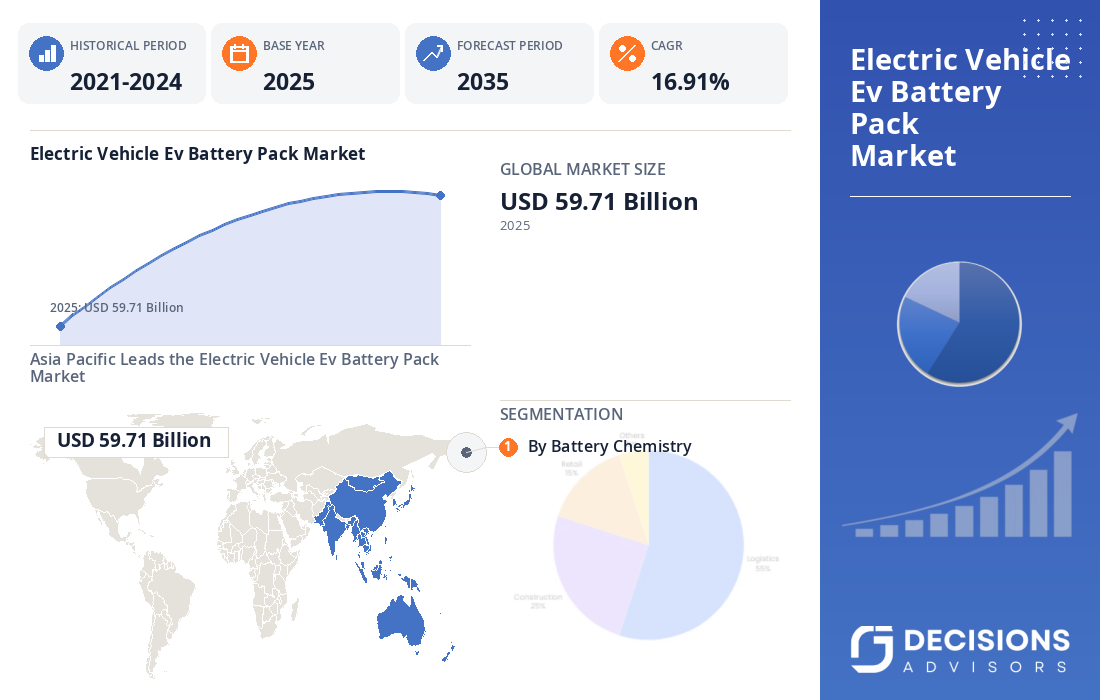
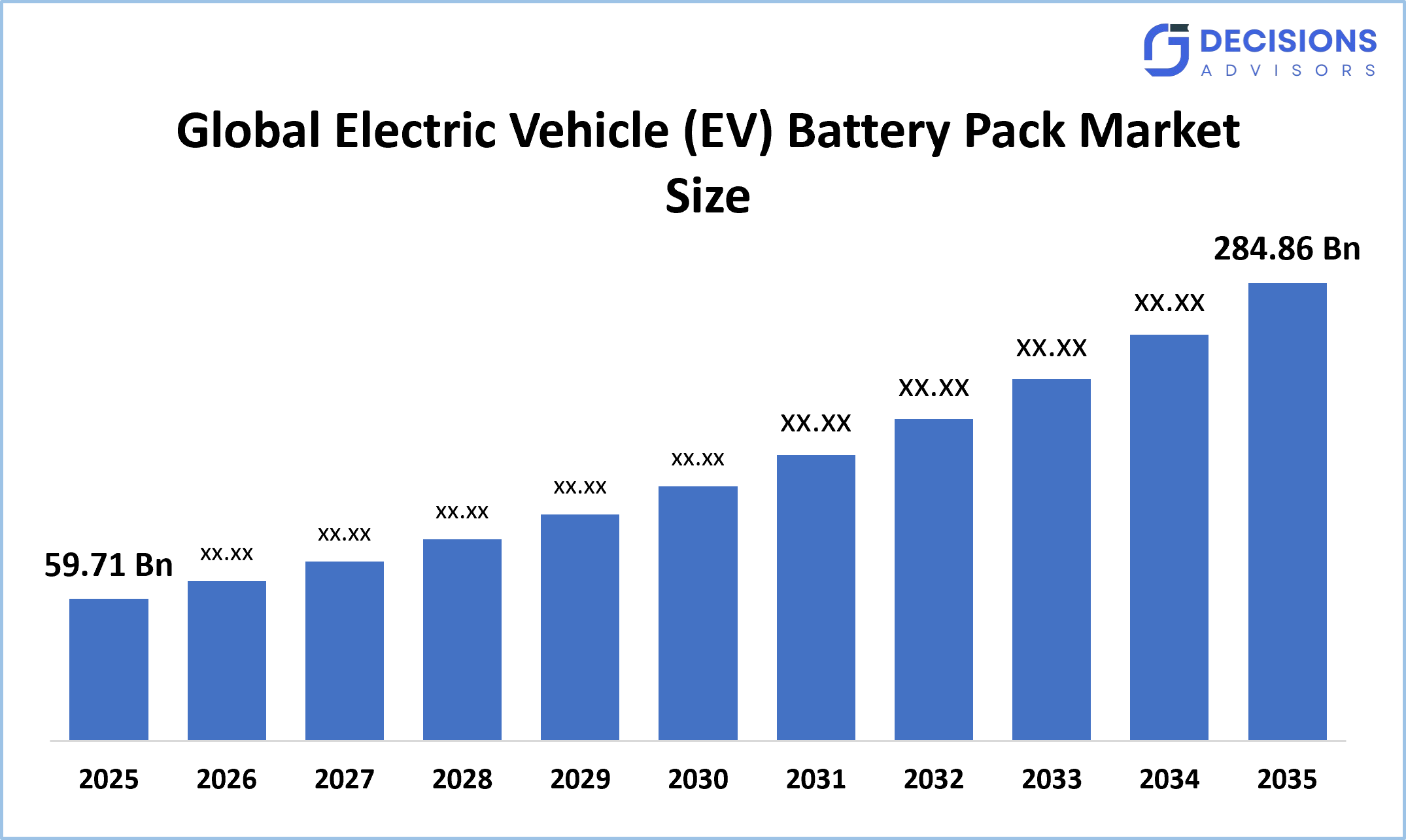
The Global Electric Vehicle (EV) Battery Pack Market Size is predicted to grow from USD 59.71 Billion in 2025 and is likely to reach around USD 284.86 Billion by 2035 with a CAGR of 16.91%. According to Decision Advisors, a comprehensive study of the market has indicated that lithium-ion battery packs have a very prominent presence in the Global Electric Vehicle (EV) Battery Pack Market, capturing roughly 82% of the overall market share. CATL (Contemporary Amperex Technology Co., Limited) dominates the market, with around USD 50 billion in annual revenue and a market share of about 36% - 38%, thereby making it a pivotal player in the global market environment.
Market Snapshot
- Global Electric Vehicle (EV) Battery Pack Market Size (2025): USD 59.71 Billion
- Projected Global Electric Vehicle (EV) Battery Pack Market Size (2035): USD 284.86 Billion
- Global Electric Vehicle (EV) Battery Pack Market Compound Annual Growth Rate (CAGR): 16.91%
- Largest Regional Market: Asia-Pacific
- 2nd Largest Region: Europe
- Fastest Growing Region: North America
- Base Year: 2025
- Historical Period: 2021-2024
- Market Forecast Period: 2026-2035
Market Overview/ Introduction
The Global Electric Vehicle (EV) Battery Pack Market is made up of the manufacturing, installation, and delivery of rechargeable batteries that are used to power electric vehicles, including cars, buses, trucks, and commercial vehicles. The battery packs, which mostly use lithium-ion technology, are what determines vehicle performance, efficiency, range, and charging time. The growth of the market has been supported by various incentives from governments around the world through policies such as the Inflation Reduction Act in the United States, the EU Battery Regulation, NEV subsidies in China, and PM E-DRIVE and PLI scheme in India for the manufacturing of advanced chemistry cell batteries. Recent developments in the market include the construction of battery gigafactories, commercial use of LFP and high nickel batteries, and innovations in solid state batteries. The rising electric vehicle sales, expanding charging network, falling prices of batteries, and constant innovation are expected to boost market growth during the forecast period.
- India’s financial incentive program accelerates EV adoption across vehicle categories, driving local demand for advanced battery packs and expanding public charging infrastructure nationwide.
- A joint €15.2 million fund under the Trade and Technology Council boosts cutting-edge recycling tech, material recovery, and sustainable circular supply chains.
Notable Insights: -
- Asia Pacific is anticipated to hold approximately 58% share of the Global Electric Vehicle (EV) Battery Pack Market over the predicted timeframe.
- North America is expected to grow at a rapid CAGR in the Global Electric Vehicle (EV) Battery Pack Market by holding approximately 16% of the share during the forecast period.
- By battery chemistry, the Lithium-ion segment dominated the market and holds approximately 82% share in 2025 and is projected to grow at a substantial CAGR during the forecast period.
- By pack configuration, the Prismatic segment dominated the market and holds approximately 48% share in 2025 and is projected to grow at a substantial CAGR during the forecast period.
- The compound annual growth rate of the Global Electric Vehicle (EV) Battery Pack Market is 16.91%.
- The market is likely to achieve a valuation of USD 284.86 Billion by 2035.
Market Drivers
The global market of the Electric Vehicle (EV) Battery Pack Market is fueled by the growing popularity of electric vehicles globally due to the strict emission regulations imposed by the government and the encouragement towards environmentally friendly transport systems. Increased investment in battery gigafactory production, establishment of infrastructure for charging facilities, and incentive programs ensure that the batteries are produced on a large scale and increase the number of electric vehicles in use. Continuous improvement in the development of lithium-ion batteries in terms of energy density, fast-charging, safety, and long-lasting batteries ensures continued growth in the market. Decreasing costs of battery manufacturing reduces the cost of electric vehicles, thus encouraging the demand for the product. In addition, increased investment in battery recycling and secondary uses of energy storages also support the sustainable growth of the market.
Restrain
High raw material costs, supply chain interruptions, limited lithium availability, complicated recycling, and battery safety issues are some of the issues facing the global electric vehicle (EV) battery pack market. High prices for nickel and lithium raise the cost of producing batteries and lower manufacturer profit margins.
Competitive Analysis:
The report offers the appropriate analysis of the key organizations/companies involved within the Global Electric Vehicle (EV) Battery Pack Market along with a comparative evaluation primarily based on their product offerings, business overviews, geographic presence, enterprise strategies, segment market share, and SWOT analysis. The report also provides an elaborative analysis focusing on the current news and developments of the companies, which includes product development, innovations, joint ventures, partnerships, mergers & acquisitions, strategic alliances, and others. This allows for the evaluation of the overall competition within the market.
Top Companies in the Global Electric Vehicle (EV) Battery Pack Market
- CATL
- BYD
- LG Energy Solution
- CALB
- Gotion High-Tech
- SK On
- Panasonic
- EVE Energy
- Samsung SDI
- Sunwoda
Government Initiatives
|
Country |
Key Government Initiatives |
|
China |
Implements state-led industrial planning, generous supply-chain subsidies, and vehicle trade-in schemes that discount new purchases, solidifying its dominance in global manufacturing and battery technology deployment. |
|
India |
Drives self-reliance via the Production Linked Incentive (PLI) scheme for Advanced Chemistry Cell battery storage, offering financial rewards to boost local cell manufacturing capacity. |
|
United States |
Uses the U.S. Department of Energy funding alongside the Inflation Reduction Act's tax credits to spur domestic gigafactory investments and cut reliance on foreign battery supply chains. |
Market Segmentation
The Global Electric Vehicle (EV) Battery Pack Market share is classified into Battery Chemistry, Pack Configuration and Cooling Technology
- The Lithium-ion segment dominated the market and holds approximately 82% share in 2025 and is projected to grow at a substantial CAGR during the forecast period.
Based on the battery chemistry, the Global Electric Vehicle (EV) Battery Pack Market is categorized into Lithium-ion Batteries, Nickel-Metal Hydride (NiMH) Batteries, and Solid-State Batteries. In all these categories, the Lithium-ion batteries category holds the major market share accounting for about 82% in 2025. The domination is based on features such as higher energy density, lightweight, longevity, faster charging, and efficiency. Lithium-ion batteries are used in a wide range of vehicles from passenger cars to commercial EVs and buses, thus, the battery type of choice by global EV manufacturers.
- The Prismatic segment accounted for the largest share of approximately 48% in 2025 and is anticipated to grow at a significant CAGR during the forecast period.
Based on the pack configuration, the Global Electric Vehicle (EV) Battery Pack Market is classified into Prismatic, Cylindrical, and Pouch batteries. Of these three types, the Prismatic segment constituted the largest share with around 48% market share in 2025. The reasons for this dominance are the small size, high energy density, space-efficient design, and better thermal management. Prismatic batteries find wide use in both passenger and commercial electric vehicles due to easier battery pack assembly, better safety, and better performance of the vehicles, and thus they become the most common type of battery among major EV manufacturers worldwide.
- The Liquid Cooling segment accounted for the largest share of approximately 54% in 2025 and is anticipated to grow at a significant CAGR during the forecast period.
Based on cooling technology, the Global Electric Vehicle (EV) Battery Pack Market Segmentation includes the following categories: Air Cooling, Liquid Cooling, and Phase Change Material Cooling. Out of all these categories, the Liquid Cooling category leads the market share with around 54% of market share in 2025. The reason for the market dominance of this category is its ability to provide better heat dissipation, increased battery safety, improved charging efficiency, and longer life expectancy of batteries. Due to its effective cooling features, liquid cooling is highly used in performance-based passenger and commercial electric vehicles.
Regional Segment Analysis of the Global Electric Vehicle (EV) Battery Pack Market
- Asia-Pacific (China, Japan, South Korea, and Rest of Asia-Pacific)?
- Europe (Germany, Norway, France, United Kingdom, Sweden, Denmark, and Rest of Europe)
- North America (United States and Canada)
- Latin America (Brazil, Argentina, Mexico, Colombia, Chile, and Rest of Latin America)?
- The Middle East and Africa (Saudi Arabia, United Arab Emirates (UAE), South Africa, Egypt, Israel, Turkey, Iran, and Rest of Middle East and Africa)
Asia Pacific is anticipated to hold approximately 45% share of the Global Electric Vehicle (EV) Battery Pack Market over the predicted timeframe.
The Asia-Pacific region accounts for roughly 45% of the Global Electric Vehicle (EV) Battery Pack Market due to the wide range of electric vehicles produced in the region, which includes countries like China, Japan, South Korea, and India. This is because the region has some of the leading battery companies along with well-established supply chains and sufficient capacity for the processing of batteries. Growth in the market is further accelerated using government incentives, growth in the number of batteries gigafactories, and increased usage of electric vehicles. Investment in lithium-ion and next-generation batteries improves regional competitiveness even further.
North America is expected to grow at a rapid CAGR in the Global Electric Vehicle (EV) Battery Pack Market, holding approximately 16% of the share during the forecast period
The North American region comprises around 16% of the Global Electric Vehicle (EV) Battery Pack Market due to the increasing use of electric vehicles, increasing domestic production of batteries, and heavy government backing to promote eco-friendly transportation. Large-scale investments in battery gigafactories, local supply chain operations, and charging facilities have further boosted the growth of the regional market. The presence of established players from the automobile industry and battery technology sectors helps speed up innovations in advanced battery packs. Rising demands for passenger and commercial electric vehicles, along with the favorable policies, including the U.S. Inflation Reduction Act, also drive market growth.
North America is the fastest-growing region in the Global Electric Vehicle (EV) Battery Pack Market during the period, holding approximately 16% share.
North America is one of the largest regions, accounting for approximately 16% of the Global Electric Vehicle (EV) Battery Pack Market due to increased penetration of electric vehicles, high investments in the construction of battery gigafactories, and supportive policies of the government encouraging the domestic manufacturing of batteries. The region enjoys increased investment in charging infrastructure, localization of battery supply chains, and key players of the battery manufacturing industry and automakers in the region. Increased demand for passenger and commercial electric vehicles, along with incentives from clean energy policies such as the Inflation Reduction Act of the U.S., has been driving the market growth.
Future Market Trends in Global Electric Vehicle (EV) Battery Pack Market: -
-
- Expansion of Solid-State Battery Technology
The solid-state battery is increasingly becoming popular owing to its high energy density, increased safety, faster charging capacity, and increased longevity when compared to conventional lithium-ion batteries. The auto industry and battery producers have invested a lot of money in ensuring that the product becomes commercial, which makes it a major emerging trend.
-
- AI-Driven Battery Management Systems (BMS)
There has been an increasing incorporation of AI in battery management systems for purposes of enhancing the charging process, battery life, maintenance requirements prediction, among other benefits. Using AI, battery life can be extended, operational risks minimized and performance monitored in real time.
-
- Rapid Growth of Battery Recycling and Second-Life Applications
The field of battery recycling is growing at an astonishing pace to reuse valuable materials and reduce any negative environmental impact. In addition, second life solutions for energy storage are being implemented to make sure that the whole production process becomes sustainable from the supply chain point of view.
-
- Increasing Investment in High-Capacity Battery Gigafactories
Investments in battery gigafactories around the world are growing to cope with the demand for electric vehicles and manufacture batteries locally. Battery gigafactories increase the efficiency of production, decrease the dependency on the supply chain, minimize production costs, and foster innovations in batteries.
Recent Development
- In July 2026, Samsung SDI stated that its solid-state battery prototypes had been successfully evaluated by customers. This is a major step toward the commercial manufacture of next-generation EV batteries with improved safety and higher energy density.
- In April 2026, to enhance charging speed, energy density, and EV performance, CATL unveiled its third-generation Shenxing Superfast Charging Battery, third-generation Qilin Battery, and Naxtra Sodium-ion Battery together with a battery-swapping solution.
- In March 2026, BYD introduced the second-generation Blade Battery with FLASH Charging Technology, which improves vehicle economy and charging convenience by charging an EV battery from 10% to 70% in about five minutes.
Market Segment
This study forecasts revenue at global, regional, and country levels from 2020 to 2035. Decision Advisors has segmented the Global Electric Vehicle (EV) Battery Pack Market based on the below-mentioned segments:
Global Electric Vehicle (EV) Battery Pack Market, By Battery Chemistry
- Lithium-ion
- Nickel-Metal Hydride
- Solid State
Global Electric Vehicle (EV) Battery Pack Market, By Pack Configuration
- Prismatic
- Cylindrical
- pouch
Global Electric Vehicle (EV) Battery Pack Market, By Cooling Technology
- Air Cooling
- Liquid Cooling
- Phase Change Material Cooling
Global Electric Vehicle (EV) Battery Pack Market, By Regional Analysis
- Asia-Pacific
- China
- Japan
- South Korea
- Rest of Asia-Pacific
- Europe
- Germany
- Norway
- France
- United Kingdom
- Sweden
- Denmark
- Rest of Europe
- North America
- United States
- Canada
- Latin America
- Brazil
- Argentina
- Mexico
- Colombia
- Chile
- Rest of Latin America
- Middle East & Africa
- Saudi Arabia
- United Arab Emirates (UAE)
- South Africa
- Egypt
- Israel
- Turkey
- Iran
- Rest of Middle East and Africa
Frequently Asked Questions (FAQ)
Q. How are EV battery packs improving electric vehicle performance?
A. Higher energy density, quicker charging, increased driving range, and better thermal management are all benefits of advanced EV battery packs, which improve total vehicle performance, dependability, and efficiency.
Q. Why are lithium-ion batteries preferred in electric vehicle battery packs?
A. Lithium-ion batteries are the favored option for most electric vehicles globally due to their high energy density, lightweight design, long cycle life, fast charging capability, and improved efficiency.
Q. What role do battery management systems (BMS) play in EV battery packs?
A. By keeping an eye on cell voltage, temperature, and charging cycles, battery management systems guarantee peak performance, improved safety, extended battery life, and economical energy use.
Q. How is battery technology innovation influencing the Global Electric Vehicle (EV) Battery Pack Market?
A. Innovations in solid-state batteries, fast-charging technologies, AI-based battery management, and battery recycling are increasing safety, prolonging battery life, cutting prices, and hastening the adoption of electric vehicles worldwide.
Check Licence
Choose the plan that fits you best: Single User, Multi-User, or Enterprise solutions tailored for your needs.
We Have You Covered
- 24/7 Analyst Support
- Clients Across the Globe
- Tailored Insights
- Technology Tracking
- Competitive Intelligence
- Custom Research
- Syndicated Market Studies
- Market Overview
- Market Segmentation
- Growth Drivers
- Market Opportunities
- Regulatory Insights
- Innovation & Sustainability
Report Details
| Scope | Global |
| Pages | 240 |
| Delivery | PDF & Excel via Email |
| Language | English |
| Release | Aug 2026 |
| Access | Download from this page |