
Global Encephalitis Market
 |
Author:
David J
|
Pages:
240
|
Author:
David J
|
Pages:
240
Global Encephalitis Market Size, Share, and COVID-19 Impact Analysis, By Disease Type (Primary encephalitis, and Secondary encephalitis), By Treatment (Antiviral agents, Steroid injections, Antibiotics, Immunoglobulin therapy, Plasmapheresis, and Other treatments), By Route of Administration (Oral, Parenteral, and Other), and By Region (North America, Europe, Asia-Pacific, Latin America, Middle East, and Africa), Analysis and Forecast 2025-2035
CAGR
5.39%
REVENUE 2024
USD Billion 21.45
FORECAST 2035
USD Billion 38.23
REPORT COVERAGE
Global
Global Encephalitis Market Insights Forecasts to 2035
- The Global Encephalitis Market Size Was Estimated at USD 21.45 Billion in 2024
- The Market Size is Expected to Grow at a CAGR of around 5.39% from 2025 to 2035
- The Worldwide Encephalitis Market Size is Expected to Reach USD 38.23 Billion by 2035
- North America is expected to grow the fastest during the forecast period.
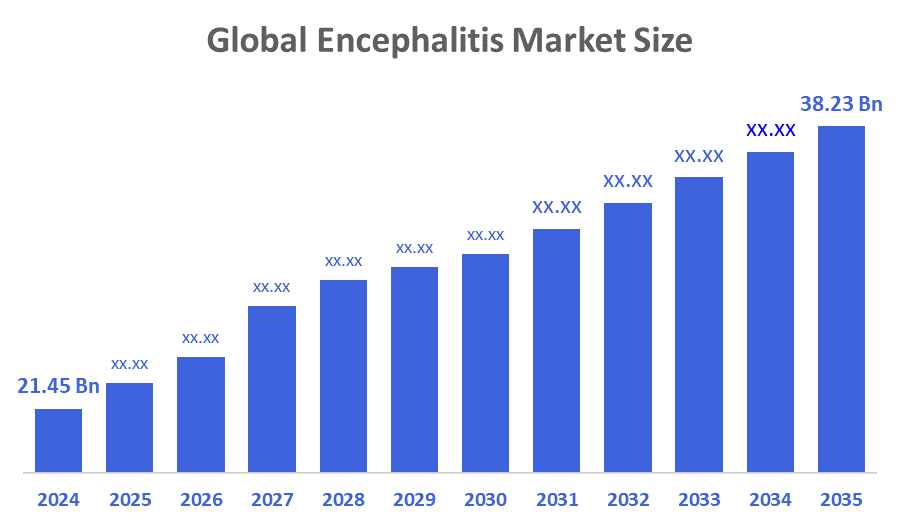
According to a research report published by Decisions Advisors and Consulting, The Global Encephalitis Market Size Was Worth Around USD 21.45 Billion In 2024 And Is Predicted To Grow To Around USD 38.23 Billion By 2035 With A Compound Annual Growth Rate (CAGR) Of 5.39% From 2025 To 2035. Pharmaceutical companies are continuously investing in research to create new antiviral medications, next-generation immunotherapies, and biologics in response to this increasing demand, which is fueling market expansion. Further, the number of trends that are influencing the market, it is growing significantly. The increasing creation and accessibility of novel treatments is one of the noteworthy trends.
Market Overview
Encephalitis is a rare but severe condition characterised by inflammation of the brain. The symptoms can differ significantly, frequently beginning with flu-like signs, such as fever, headache, fatigue, muscle or joint pain, and an overall sense of being unwell, etc. As the illness advances, more severe symptoms might arise, including confusion or disorientation, seizures, alterations in personality or behaviour, headaches, abrupt high fever, hallucinations, issues with speech or hearing, loss of consciousness, and challenges with movement or sensation, etc. In severe instances, encephalitis may result in life-threatening complications like respiratory failure, coma, or brain injury. Diagnosing encephalitis involves a comprehensive medical history and physical examination, where the physician searches for indicators of brain inflammation. Specific diagnostic tests, such as a lumbar puncture (spinal tap), may follow to analyse cerebrospinal fluid for signs of inflammation or infection. Different neuroimaging methods, such as magnetic resonance imaging (MRI), are frequently employed to map brain structures and identify any swelling or irregularities. Furthermore, blood tests are employed to detect possible infectious agents or immune reactions.
SK Bioscience announced that it has initiated global Phase 1/2 clinical trials of its first mRNA-based Japanese encephalitis vaccine candidate, GBP560, in Australia and New Zealand, with interim results expected by 2026. CEPI will provide up to USD 40 million in initial funding for the joint R&D initiative between SK and CEPI.
Report Coverage
This research report categorises the encephalitis market based on various segments and regions, forecasts revenue growth, and analyzes trends in each submarket. The report analyses the key growth drivers, opportunities, and challenges influencing the encephalitis market. Recent market developments and competitive strategies, such as expansion, product launch, development, partnership, merger, and acquisition, have been included to draw the competitive landscape in the market. The report strategically identifies and profiles the key market players and analyzes their core competencies in each sub-segment of the encephalitis market.
Driving Factors
Encephalitis is becoming more frequent, while there is also an increasing recognition and development of new epilepsy therapies that are less invasive/interventional. Advances made in diagnostics, as well as increased investment in research & development, are also pushing forward the growth of this market. The global population continues to expand along with increased global travel, resulting in rising numbers of encephalitis within the population and thus also contributing to the growth of this market. The increased mortality and morbidity associated with encephalitis have also increased the demand for the development of new epilepsy therapies. Government-supported vaccination efforts continue to emerge, which materially support the continued expansion of the encephalitis therapy market. Vaccination has become a critical consideration for consumers and has driven the growth of the encephalitis therapy market. Increasing incidence rates of cancer are also driving the expansion of the encephalitis therapy market. The immune response associated with fighting cancer may result in an incidence of encephalitis, and thus leads to the increased demand for this new treatment. Overall, the increase in investment in healthcare infrastructure and the increased public and private sector support for conditions and treatments have led to increased demand for effective treatments.
Restraining Factors
A lack of qualified specialists with more professionals with the necessary training to treat encephalitis is needed. It also costs a lot to treat. The market is being constrained by each of these issues. Additionally, the market for encephalitis treatment is being hampered by the low-income nations' inadequate healthcare infrastructure.
Market Segmentation
The encephalitis market share is classified into disease type, treatment and route of administration.
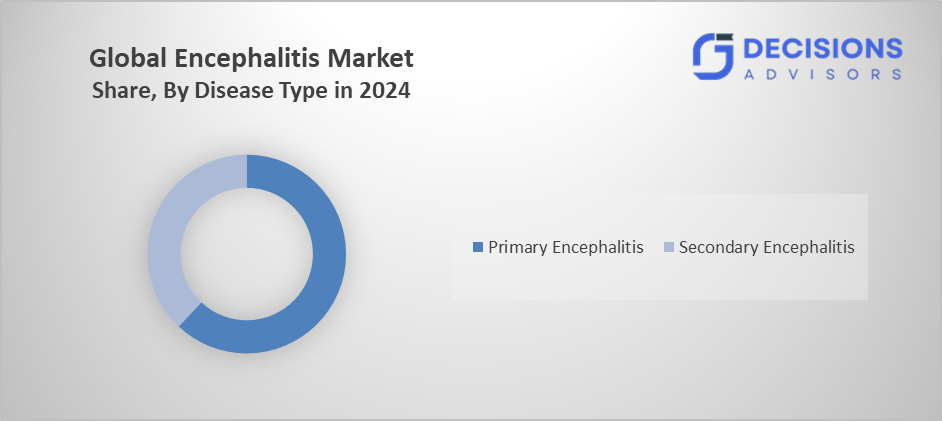
- The primary encephalitis segment accounted for the largest market share in 2024 and is projected to grow at a notable CAGR over the forecast period.
Based on the disease type, the encephalitis market is divided into primary encephalitis, and secondary encephalitis. Among these, the primary encephalitis segment accounted for the largest market share in 2024 and is projected to grow at a notable CAGR over the forecast period. The segment growth is expanding as a result of the increased number of primary encephalitis patients brought on by these viral infections. The market's primary encephalitis sector has grown even more as a result of the widespread availability of antiviral medications. Furthermore, the impact of climate change on vector-borne illnesses raises the prevalence of primary encephalitis, increasing the need for encephalitis treatment alternatives.
- The antiviral agents segment accounted for the largest market share in 2024 and is anticipated to grow at a substantial CAGR over the forecast period.
Based on the treatment, the encephalitis market is divided into antiviral agents, steroid injections, antibiotics, immunoglobulin therapy, plasmapheresis, and other treatments. Among these, the antiviral agents segment accounted for the largest market share in 2024 and is anticipated to grow at a substantial CAGR over the forecast period. The rise in viral encephalitis cases, which raises the demand for antiviral medications, is the reason for this market's expansion. These antiviral medications are quite successful in lowering neurological issues and inflammation. The expansion of this market has been aided by their recognised role in encephalitis treatment protocols and their demonstrated efficacy.
- The oral segment accounted for the highest market revenue in 2024 and is anticipated to grow at a significant CAGR during the forecast period.
Based on the route of administration, the encephalitis market is divided into oral, parenteral, and others. Among these, the oral segment accounted for the highest market revenue in 2024 and is anticipated to grow at a significant CAGR during the forecast period. Patient adherence to therapy has increased because oral drugs are more convenient than intravenous or injectable therapies. Oral medication use has increased as a result of the growing tendency of home care settings, which has decreased hospitalisation. The expansion of this market has also been aided by the affordability of oral medications as well as their general accessibility and availability.
Regional Segment Analysis of the Encephalitis Market
- North America (U.S., Canada, Mexico)
- Europe (Germany, France, U.K., Italy, Spain, Rest of Europe)
- Asia-Pacific (China, Japan, India, Rest of APAC)
- South America (Brazil and the Rest of South America)
- The Middle East and Africa (UAE, South Africa, Rest of MEA)
Asia Pacific is anticipated to hold the largest share of the encephalitis market over the predicted timeframe.
Asia Pacific is anticipated to hold the largest share of the encephalitis market over the predicted timeframe. A significant public health issue is represented by encephalitis throughout the Asia-Pacific region because of many factors, including a large population of children, high levels of infectious disease burden, and a broad variation in access to health care facilities. The Asia-Pacific region has reported a high number of encephalitis cases each year due to the predominance of viral infections, including JE, HSV, enteroviruses, dengue, and many emerging zoonotic pathogens.
The countries that have the highest incidence of encephalitis include India, China, Japan, Vietnam, and Indonesia, where many districts of rural and semi-urban areas, despite vaccination campaigns that are being conducted.
For instance, Kerala’s Health Services Director has reassured the public that the Japanese Encephalitis (JE) vaccine is safe, following concerns raised in the state. The vaccine is part of Kerala’s immunisation program to protect children against this mosquito-borne viral disease, which can cause severe brain inflammation.
North America is expected to grow at a rapid CAGR in the encephalitis market during the forecast period. The growth of the North America encephalitis market has been influenced by a variety of factors, including a rise in the incidence of both viral and autoimmune forms of encephalitis, increased awareness among healthcare providers regarding these diseases as circumstances continue to develop, and new technologies that allow for improved diagnostic measures. Additionally, a stable healthcare infrastructure supported by favourable reimbursement policies and the active involvement of pharmaceutical and biotechnology companies in the development of new products will help to stimulate continued expansion within this marketplace. In addition, Federal government funding for novel virus-treated and immunotherapy methods will further accelerate the growth of the North American encephalitis market.
Competitive Analysis:
The report offers the appropriate analysis of the key organizations/companies involved within the encephalitis market, along with a comparative evaluation primarily based on their product offering, business overviews, geographic presence, enterprise strategies, segment market share, and SWOT analysis. The report also provides an elaborative analysis focusing on the current news and developments of the companies, which includes product development, innovations, joint ventures, partnerships, mergers & acquisitions, strategic alliances, and others. This allows for the evaluation of the overall competition within the market.
List of Key Companies
- Abbott Laboratories
- Allergan
- Basilea Pharmaceutica
- F. Hoffmann-La Roche
- GlaxoSmithKline
- Melinta Therapeutics
- Merck
- Pfizer
- Sanofi
- Teva Pharmaceutical Industries
- Others
Key Target Audience
- Market Players
- Investors
- End-users
- Government Authorities
- Consulting and Research Firm
- Venture capitalists
- Value-Added Resellers (VARs)
Recent Development
- In February 2025, the World Health Organisation (WHO) launched its new technical brief on encephalitis titled “Encephalitis: Global Threats, Trends and Public Health Implications.” It highlights encephalitis as a growing global health priority and guides policymakers, clinicians, and researchers.
- In December 2024, the Epilepsy Research Institute announced that Dr Sukhvir Wright, a trustee and research theme lead at the Institute, has been awarded a £3.4m Career Development Award by the Wellcome Trust. This funding will support Dr Wright’s groundbreaking research into autoimmune encephalitis, a severe inflammatory brain condition in children that can give rise to epilepsy.
Market Segment
This study forecasts revenue at global, regional, and country levels from 2020 to 2035. Decisions Advisors has segmented the encephalitis market based on the below-mentioned segments:
Global Encephalitis Market, By Disease Type
- Primary encephalitis
- Secondary encephalitis
Global Encephalitis Market, By Treatment
- Antiviral agents
- Steroid injections
- Antibiotics
- Immunoglobulin therapy
- Plasmapheresis
- Other treatments
Global Encephalitis Market, By Route of Administration
- Oral
- Parenteral
- Others
Global Encephalitis Market, By Regional Analysis
- North America
- US
- Canada
- Mexico
- Europe
- Germany
- UK
- France
- Italy
- Spain
- Russia
- Rest of Europe
- Asia Pacific
- China
- Japan
- India
- South Korea
- Australia
- Rest of Asia Pacific
- South America
- Brazil
- Argentina
- Rest of South America
- Middle East & Africa
- UAE
- Saudi Arabia
- Qatar
- South Africa
- Rest of the Middle East & Africa
Frequently Asked Questions (FAQ)
- What is the current size of the global encephalitis market?
The market was valued at USD 21.45 billion in 2024.
- What is the projected market size by 2035?
It is expected to reach USD 38.23 billion by 2035.
- What is the CAGR of the global encephalitis market?
The market is projected to grow at a CAGR of 5.39% from 2025 to 2035.
- What are the main disease types in the encephalitis market?
The market is segmented into primary encephalitis and secondary encephalitis, with primary holding the largest share in 2024.
- Which treatment segment leads the market?
Antiviral agents accounted for the largest market share in 2024 and are expected to grow at a substantial CAGR.
- What is the dominant route of administration?
The oral segment generated the highest revenue in 2024 and is anticipated to grow significantly.
- Which region holds the largest market share?
Asia-Pacific is expected to hold the largest share over the forecast period due to high incidence rates.
- Which region will grow the fastest?
North America is projected to grow at the fastest CAGR, driven by advanced diagnostics and funding.
Check Licence
Choose the plan that fits you best: Single User, Multi-User, or Enterprise solutions tailored for your needs.
We Have You Covered
- 24/7 Analyst Support
- Clients Across the Globe
- Tailored Insights
- Technology Tracking
- Competitive Intelligence
- Custom Research
- Syndicated Market Studies
- Market Overview
- Market Segmentation
- Growth Drivers
- Market Opportunities
- Regulatory Insights
- Innovation & Sustainability
Report Details
| Scope | Global |
| Pages | 240 |
| Delivery | PDF & Excel via Email |
| Language | English |
| Release | Jan 2026 |
| Access | Download from this page |