
Global Endoscopic Hemostasis Devices Market
 |
Author:
Disha B
|
Pages:
240
|
Author:
Disha B
|
Pages:
240
Global Endoscopic Hemostasis Devices Market Size, Share, and COVID-19 Impact Analysis, By Product (Ligation Clips, Ligation Bands, Injection Needles, and Hemostatic Spray), By End use (Hospitals and Outpatient Facilities) and By Region (North America, Europe, Asia-Pacific, Latin America, Middle East, and Africa), Analysis and Forecast 2025-2035
CAGR
4.71%
REVENUE 2024
USD Billion 2.11
FORECAST 2035
USD Billion 3.5
REPORT COVERAGE
Global
Global Endoscopic Hemostasis Devices Market Size Insights Forecasts to 2035
- The Global Endoscopic Hemostasis Devices Market Size Was valued at USD 2.11 Billion in 2024
- The Global Endoscopic Hemostasis Devices Market Size is Expected to Grow at a CAGR of around 4.71% from 2025 to 2035
- The Worldwide Endoscopic Hemostasis Devices Market Size is Expected to Reach USD 3.50 Billion by 2035
- Asia-Pacific is expected to grow the fastest during the forecast period.
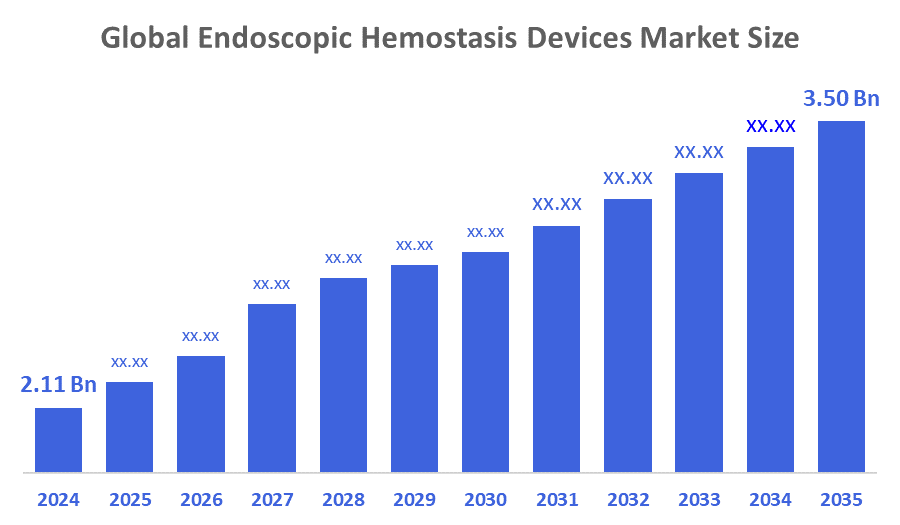
According to a research report published by Decisions Advisors and Consulting, The Global Endoscopic Hemostasis Devices Market Size Was Worth Around USD 2.11 Billion In 2024 And Is Predicted To Grow To Around USD 3.50 Billion By 2035 With A Compound Annual Growth Rate (CAGR) Of 4.71% From 2025 To 2035. There is rising support for endoscopic procedures because they have lower complication rates and speed up patient recovery times. The combination of these factors results in an increased implementation of hemostatic solutions during endoscopic procedures, which leads to substantial growth for the industry.
Market Overview
The Global Endoscopic Hemostasis Devices Market refers to medical devices used to control bleeding within the gastrointestinal tract during endoscopic procedures. The devices which include clips and thermal probes and hemostatic powders provide doctors with tools to treat gastrointestinal bleeding through minimally invasive methods which result in lower medical complications and shorter hospital stays and faster patient recovery times. The market grows because more people develop gastrointestinal disorders and people prefer less invasive medical procedures and device manufacturers create new technological innovations for their products. The worldwide market receives government support through healthcare programs which include funding for cutting-edge endoscopic technology and reimbursement systems and initiatives which accelerate the identification and management of gastrointestinal disorders. The market gains international acceptance through the development of new hospital facilities and the increased public understanding of gastrointestinal health issues.
Report Coverage
This research report categorizes the endoscopic hemostasis devices market based on various segments and regions, forecasts revenue growth, and analyzes trends in each submarket. The report analyses the key growth drivers, opportunities, and challenges influencing the endoscopic hemostasis devices market. Recent market developments and competitive strategies such as expansion, type launch, development, partnership, merger, and acquisition, have been included to draw the competitive landscape in the market. The report strategically identifies and profiles the key market players and analyses their core competencies in each sub-segment of the endoscopic hemostasis devices market.
Driving Factors
The Endoscopic Hemostasis Devices Market will experience growth because of contemporary portable medical technology which combines disposable and user-friendly design elements. The conventional hemostasis tools require specialized operator training and sterilization processes and routine maintenance procedures which limit their use in small hospitals and facilities with limited resources. The use of single-use medical devices which nurses can easily throw away provides an effective solution for large medical facilities and remote healthcare centers because it reduces nurse workload and minimizes contamination risks.
Restraining Factors
Market development faces multiple challenges which include expensive equipment costs, potential hazards from medical procedures, shortage of qualified endoscoped operators, strict requirements for regulatory certification, minimal use of technology in emerging markets, and preference for alternative non-invasive hemostasis treatments.
Market Segmentation
The endoscopic hemostasis devices market share is classified into product and end use.
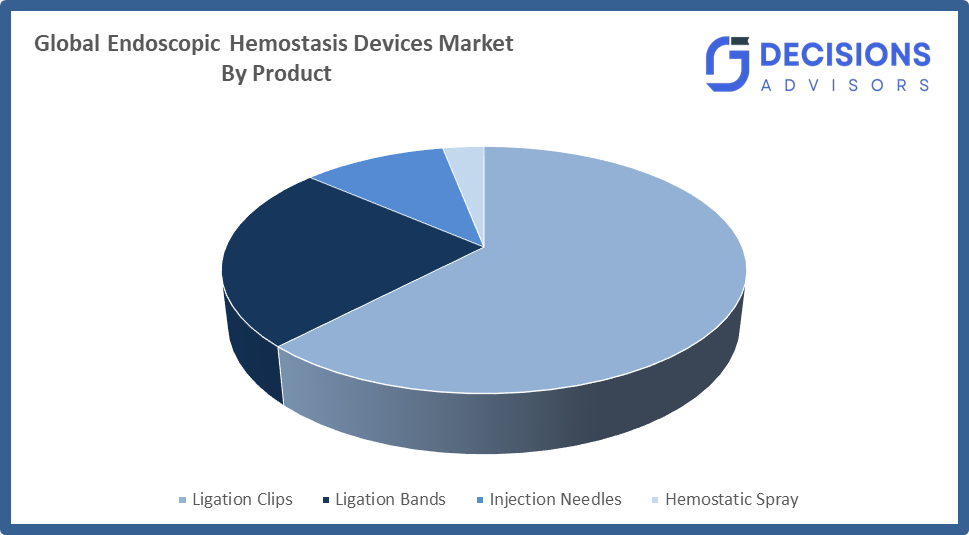
- The ligation clips segment accounted for the largest share in 2024 and is anticipated to grow at a significant CAGR during the forecast period.
Based on the product, the endoscopic hemostasis devices market is divided into ligation clips, ligation bands, injection needles, hemostatic spray. Among these, the ligation clips segment accounted for the largest share in 2024 and is anticipated to grow at a significant CAGR during the forecast period. Endoscopic ligation clips are small permanent clips which surgeons use during laparoscopic procedures to shut down blood flow and block the passage of all tubular systems. They are common in many surgical procedures, from gastrointestinal to gynecological surgeries. The clips are created to surround the targeted tissue which the special applicator will use to shut down the blood flow through the vessel or tubular system. For instance, the LIGACLIP Endoscopic Rotating Multiple Clip Applier is offered by Ethicon US, LLC (Johnson & Johnson Inc.). The device serves its purpose through metal ligation clip attachment to both tubular structures and vascular systems. The tissue needs ligation because it must match the size requirements of the clip.
- The hospitals segment accounted for the highest market revenue in 2024 and is anticipated to grow at a significant CAGR during the forecast period.
Based on the end use, the endoscopic hemostasis devices market is divided into hospitals and outpatient facilities. Among these, the hospitals segment accounted for the highest market revenue in 2024 and is anticipated to grow at a significant CAGR during the forecast period. Hospitals, especially large academic and teaching hospitals, make hospitals the primary institutions which adopt new medical technologies such as endoscopic hemostasis devices. The advanced devices provide hospitals with three main advantages which include better patient outcomes and improved diagnostic accuracy and more efficient clinical operations. The hospital sector experiences market expansion because of increasing hospital establishments. For instance, the American Hospital Association reports that the United States had a total of 6120 hospitals in 2024. The UK had 1148 hospitals which existed as of August 2023.
Regional Segment Analysis of the Endoscopic Hemostasis Devices Market
- North America (U.S., Canada, Mexico)
- Europe (Germany, France, U.K., Italy, Spain, Rest of Europe)
- Asia-Pacific (China, Japan, India, Rest of APAC)
- South America (Brazil and the Rest of South America)
- The Middle East and Africa (UAE, South Africa, Rest of MEA)
North America is anticipated to hold the largest share of the endoscopic hemostasis devices market over the predicted timeframe.
North America is anticipated to hold the largest share of the endoscopic hemostasis devices market over the predicted timeframe. The high prevalence of several diseases, such as Gastrointestinal (GI) disorders, respiratory conditions, urological problems, gynecological issues, and cancer, is increasing the need for endoscopic procedures for diagnosis & treatment in North America. The market operates through rapid technological progress which creates opportunities for developing new endoscopic hemostasis products.
Asia-Pacific is expected to grow at a rapid CAGR in the endoscopic hemostasis devices market during the forecast period. The increasing occurrences of GI disorders together with the growth of medical tourism and the fast development of healthcare systems in countries like China and India and Japan drive the current market conditions. The market expansion receives support from government funding which enhances public healthcare systems and from growing public understanding about the importance of early gastrointestinal disease detection. The local manufacturing of endoscopic devices, which maintains low costs, enables wider population access to advanced medical treatments.
Competitive Analysis:
The report offers the appropriate analysis of the key organizations/companies involved within the endoscopic hemostasis devices market, along with a comparative evaluation primarily based on their type of offering, business overviews, geographic presence, enterprise strategies, segment market share, and SWOT analysis. The report also provides an elaborative analysis focusing on the current news and developments of the companies, which includes type development, innovations, joint ventures, partnerships, mergers & acquisitions, strategic alliances, and others. This allows for the evaluation of the overall competition within the market.
List of Key Companies
- Boston Scientific Corporation
- CONMED Corporation
- Olympus Corporation
- STERIS
- Medtronic
- MICRO-TECH (Nanjing) Co., Ltd.
- B. Braun SE
- Diversatek, Inc.
- Cook
- Duomed
- Others
Key Target Audience
- Market Players
- Investors
- End-users
- Government Authorities
- Consulting and Research Firm
- Venture capitalists
- Value-Added Resellers (VARs)
Recent Development
- In May 2024, Galvanize Therapeutics, Inc., a biomedical platform company, received U.S. FDA 510(k) regulatory clearance for its INUMI Flex endoscopic needle, which was used with the Aliya PEF System for soft tissue ablation. This advancement allowed for minimally invasive endoscopic delivery and enhanced the functionality of the previously approved percutaneous needle.
Market Segment
This study forecasts revenue at global, regional, and country levels from 2020 to 2035. Decisions Advisors has segmented the endoscopic hemostasis devices market based on the below-mentioned segments:
Global Endoscopic Hemostasis Devices Market, By Product
- Ligation Clips
- Ligation Bands
- Injection Needles
- Hemostatic Spray
Global Endoscopic Hemostasis Devices Market, By End use
- Hospitals
- Outpatient Facilities
Global Endoscopic Hemostasis Devices Market, By Regional Analysis
- North America
- US
- Canada
- Mexico
- Europe
- Germany
- UK
- France
- Italy
- Spain
- Russia
- Rest of Europe
- Asia Pacific
- China
- Japan
- India
- South Korea
- Australia
- Rest of Asia Pacific
- South America
- Brazil
- Argentina
- Rest of South America
- Middle East & Africa
- UAE
- Saudi Arabia
- Qatar
- South Africa
- Rest of the Middle East & Africa
Frequently Asked Questions (FAQ)
- What is the CAGR of the endoscopic hemostasis devices market over the forecast period?
A: The global endoscopic hemostasis devices market is projected to expand at a CAGR of 4.71% during the forecast period.
- What is the market size of the endoscopic hemostasis devices market?
A: The global endoscopic hemostasis devices market size is estimated to grow from USD 2.11 billion in 2024 to USD 3.50 billion by 2035, at a CAGR of 4.71% during the forecast period 2025-2035.
- Which region holds the largest share of the endoscopic hemostasis devices market?
A: North America is anticipated to hold the largest share of the endoscopic hemostasis devices market over the predicted timeframe.
- Who are the top 10 companies operating in the global endoscopic hemostasis devices market?
A: Boston Scientific Corporation, CONMED Corporation, Olympus Corporation, STERIS, Medtronic, MICRO-TECH (Nanjing) Co., Ltd., B. Braun SE, Diversatek, Inc., Cook, Duomed, and Others.
- What are the market trends in the endoscopic hemostasis devices market?
A: The key market trends show that three major factors drive the increasing usage of minimally invasive endoscopic procedures while hemostasis device technology progresses and gastrointestinal disorders become more common and healthcare providers gain better understanding and hospitals and surgical facilities expand across the world.
Check Licence
Choose the plan that fits you best: Single User, Multi-User, or Enterprise solutions tailored for your needs.
We Have You Covered
- 24/7 Analyst Support
- Clients Across the Globe
- Tailored Insights
- Technology Tracking
- Competitive Intelligence
- Custom Research
- Syndicated Market Studies
- Market Overview
- Market Segmentation
- Growth Drivers
- Market Opportunities
- Regulatory Insights
- Innovation & Sustainability
Report Details
| Scope | Global |
| Pages | 240 |
| Delivery | PDF & Excel via Email |
| Language | English |
| Release | Jan 2026 |
| Access | Download from this page |