
Global ENT Devices Market
 |
Pages:
210
|
Pages:
210
Global ENT Devices Market Size, Share, By Product Type (Diagnostic ENT Devices, Surgical ENT Devices, Hearing Aids, Hearing Implants, Nasal Splints, and Others) By End-User (Hospitals, Specialty Clinics, and Others) and By Region (North America, Europe, Asia-Pacific, Latin America, Middle East, and Africa), Analysis and Forecast 2025 ? 2035.
REPORT COVERAGE
Global
Market Snapshot
- Market Size (2025): USD 29.10 Billion
- Projected Market Size (2035): USD 55.60 Billion
- Compound Annual Growth Rate (CAGR): 6.69%
- Largest Regional Market: North America
- Fastest Growing Region: Asia-Pacific
- 3rd Largest Region: Europe
- Base Year: 2025
- Historical Period: 2021–2024
- Forecast Period: 2025–2035
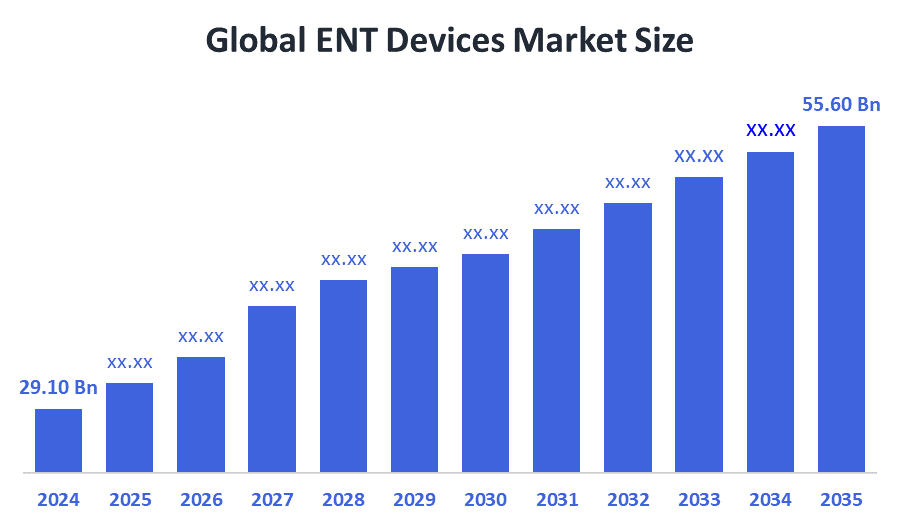
According to Decision Advisors, the Global ENT devices market Size is expected to grow from USD 29.10 billion in 2025 to USD 55.60 billion by 2035, at a CAGR of 6.69% during the forecast period 2025-2035. The global ENT devices market is projected to grow significantly over the next decade due to the increasing occurrence of ear, nose, and throat disorders, which involve hearing loss, sinusitis, and throat infections. There has been a need for additional diagnostic and surgical methods. The rising senior citizen population demands advanced medical equipment which includes both diagnostic devices and surgical instruments. The market expansion is supported by technological advancements, which include better hearing aids and medical procedures that require low-invasive methods.
Market Overview/ Introduction
The global ENT devices market includes all medical devices that physicians use to diagnose and treat ear, nose, and throat disorders. The market includes various products that range from hearing aids to endoscopes, surgical instruments, and diagnostic systems. The market experiences consistent growth because more people develop hearing loss, sinus infections, and throat-related diseases, while the elderly population increases. The market presents its main opportunities through technological advancements of minimally invasive surgeries and AI-based diagnostic tools, and enhanced hearing solutions, which emerge in developing countries through expanded healthcare access. The market grows because people become more aware of the benefits of early diagnosis and treatment. Healthcare systems require ENT devices as essential equipment because those devices support hospital operations and specialty clinic work and ambulatory surgical center procedures, which include ear surgeries, sinus treatments, throat examinations, and cochlear implantation.
- Medtronic plc. is a leading global medical device company, generating over $32.364 billion in revenue in 2024. Its portfolio includes ENT-related products such as surgical navigation systems and powered instruments, strengthening its position in the global ENT devices market.
- Olympus Corporation is a key player in endoscopic imaging systems used in ENT procedures. The company continues to expand its advanced endoscopy portfolio, supporting minimally invasive diagnostics and contributing to market growth driven by technological innovation.
Notable Insights: -
- North America holds the largest regional market share approximately 40.1%, in the global ENT devices market.
- Asia Pacific is the fastest growing region in the global ENT devices market.
- By product type, the hearing aids segment held a dominant position with approximately 62.1% in terms of market share in 2025.
- By end-user, hospitals were the most lucrative segment, is the dominating with approximately 49.5% of the global market share in 2025.
- The compound annual growth rate of the global ENT devices market is 6.69%.
- The market is likely to achieve a valuation of USD 55.60 billion by 2035.
What is role of technology in grooming the market?
The global ENT devices market operates under the influence of technology, which generates new developments and enhances operational efficiency and market acceptance. The combination of high-definition endoscopes and otoscopes and AI-assisted imaging systems serves as advanced diagnostic tools that enhance detection accuracy for ear, nose, and throat conditions while minimizing misdiagnoses and improving patient results. The combination of powered instruments and robotic-assisted systems and navigation platforms enables surgeons to perform precise procedures, which result in quicker patient recovery times, thus driving both patient preference and device market demand. AI-enabled devices, together with cochlear implants and bone-anchored hearing aids, provide hearing solutions that expand patient access through their ability to process sounds based on different situations. The combination of digital health integration, together with telemedicine and remote monitoring systems, provides emerging markets with improved access to healthcare services, which results in higher service utilization rates. Advanced ENT devices become more appealing to healthcare providers because automation and 3D-printed surgical tools and AI-driven planning technologies decrease costs while increasing operational efficiency, which leads to market growth.
How is Recent Developments Helping the Market?
Recent developments are significantly strengthening the ENT devices market by enhancing clinical outcomes, expanding treatment options, and improving patient access. Innovations in robotic?assisted surgery and image?guided navigation are making ENT procedures more precise, less invasive, and quicker to recover from, which increases adoption by surgeons and healthcare facilities. Advances in AI and machine learning are improving diagnostic accuracy in hearing and sinus disorders, enabling early detection and personalized treatment plans. The emergence of smart and connected hearing aids with Bluetooth and adaptive sound technology is driving demand among a broader patient population. Furthermore, the expansion of telehealth and mobile audiology tools is helping reach previously underserved regions, particularly in developing markets. Ongoing R&D collaborations between major manufacturers and academic centers are also accelerating product innovation, driving competitive differentiation and overall market growth.
Market Drivers
The ENT devices market is driven by various robust factors that include increasing demand and industry expansion. A key factor is the increasing occurrence of ENT disorders globally, such as chronic sinusitis, otitis media, sleep apnea, and various respiratory and hearing conditions, which heightens the demand for diagnostic, therapeutic, and surgical intervention tools. This trend is further strengthened by swift urban development and alterations in lifestyle, including heightened pollution and allergy prevalence, leading to more frequent cases of sinus and throat issues and increasing patient visits to healthcare centers. The increasing elderly population worldwide, especially in both developed and developing areas, drives demand as age-related hearing impairments and ENT disorders become more prevalent, requiring sophisticated solutions such as hearing aids, implants, and endoscopic systems.
Restrain
The global ENT devices market faces several restraining factors, including high device costs, limited reimbursement in certain regions, and the complexity of advanced surgical equipment, which can slow adoption. Additionally, lack of skilled ENT specialists, stringent regulatory approvals, and concerns over device safety and maintenance in emerging markets may hinder market growth.
Competitive Analysis:
The report offers the appropriate analysis of the key organizations/companies involved within the ENT devices market, along with a comparative evaluation primarily based on their product of offering, business overviews, geographic presence, enterprise strategies, segment market share, and SWOT analysis. The report also provides an elaborative analysis focusing on the current news and developments of the companies, which includes product development, innovations, joint ventures, partnerships, mergers & acquisitions, strategic alliances, and others. This allows for the evaluation of the overall competition within the market.
Top Companies in Global ENT Devices Market
- Medtronic plc.
- Cochlear Limited
- Stryker Corporation
- Smith and Nephew
- Sonova Holding AG
- Olympus Corporation
- KARL STORZ SE & Co. KG
- MED?EL Elektromedizinische Geräte GmbH
- GN Store Nord A/S
- PENTAX Medical
- Rion Co., Ltd.
- Atos Medical AB / Coloplast (Atos)
Government Initiatives
|
Country |
Key Government Initiatives |
|
UK |
The UK government issued guidance enabling the sale and wider access to innovative hearing aid technologies, including devices that integrate hearing test functions as part of broader health policy to support digital health innovation and patient autonomy. |
|
US |
The U.S. Food and Drug Administration (FDA) established a new regulatory category for over?the?counter (OTC) hearing aids, allowing adults with mild to moderate hearing loss to purchase hearing aids directly from retail or online outlets without a prescription or medical exam, expanding access and affordability of hearing devices. |
|
China |
China’s government implemented bulk procurement of cochlear implants and other medical consumables, significantly reducing the prices of cochlear implants to improve affordability and access for people with severe hearing loss. |
Market Segmentation
The ENT devices market share is classified into product type and end-user
- The hearing aids segment dominated the market in 2025, and is projected to grow at a substantial CAGR during the forecast period.
Based on the product type, the hearing aids segment led the global ENT devices market, securing the largest share owing to the widespread incidence of hearing loss and the growing use of advanced hearing technologies. By product type, the hearing aids segment held a dominant position with approximately 62.1% in terms of market share in 2025. In 2025, hearing aids, encompassing both analog and digital options, continued to be the top revenue-generating category as individuals look for tailored solutions for mild to severe hearing loss. Their supremacy is propelled by swift technological advancements like digital signal processing, AI-driven adaptive audio, rechargeable options, and Bluetooth connectivity, which improve user experience and increase demand. Additionally, the availability of over-the-counter (OTC) hearing aids in key markets has enhanced accessibility and affordability, thereby expanding the customer demographic across different age ranges and areas. Growth is further propelled by increasing global awareness of hearing health and expanded insurance and reimbursement options in both developed and emerging markets, solidifying hearing aids as a key component of the ENT devices market in 2025.
- The end-user segment accounted for the largest share in 2025 and is anticipated to grow at a significant CAGR during the forecast period.
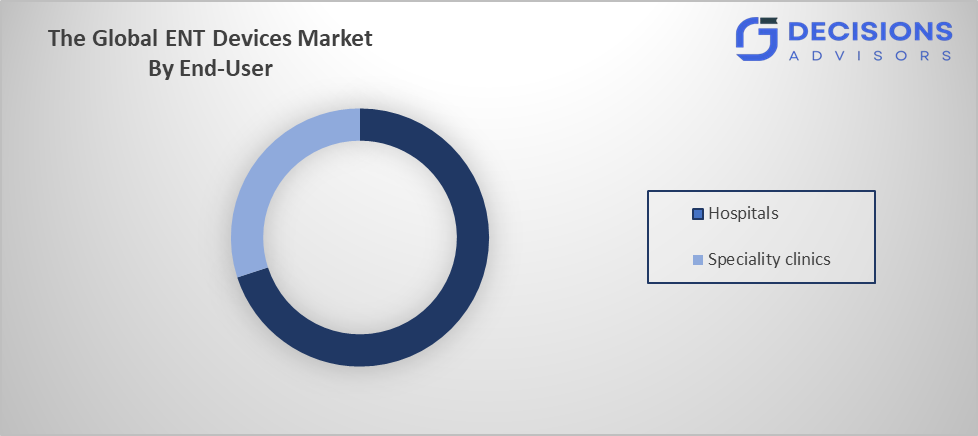
Based on the end-user, hospitals, comprising major multispecialty centers and dedicated ENT clinics, led the global ENT devices market regarding distribution channel revenue, as they serve as the main venues for diagnostic evaluations, surgical interventions, and hearing rehabilitation services. By end-user, hospitals were the most lucrative segment, is the dominating with approximately 49.5% of the global market share in 2025. This robust stance is fueled by the extensive use of sophisticated ENT equipment like endoscopes, surgical navigation systems, and digital hearing aids in healthcare facilities, along with increased reimbursement options for diagnostic and therapeutic ENT treatments in numerous developed regions. Specialty clinics are growing quickly, providing targeted ENT services with advanced technologies that enhance clinical results and patient satisfaction. Additionally, the increasing prevalence of ENT disorders and the need for comprehensive clinical care services are consistently shifting patient preferences towards these organized healthcare facilities, which promotes ongoing CAGR growth during the forecast period.
What is the Reason of the Region Dominance?
The dominance of regions in the global ENT devices market is driven by a mix of infrastructure, technology, and demographics. North America leads due to advanced healthcare systems, high adoption of digital hearing aids, endoscopic tools, and favorable reimbursement policies, supported by major manufacturers like Medtronic and Cochlear. Asia-Pacific, the fastest-growing region, benefits from expanding hospitals, rising disposable incomes, government initiatives like India’s NPPCD, and a large patient population with increasing ENT disorders. Together, these factors shape regional market leadership and growth.
Strategies to Implement for Growth of the Market in Non-Leading Regions
To drive growth of the ENT devices market in non-leading regions, companies should focus on expanding healthcare infrastructure by investing in hospitals, specialty ENT clinics, and diagnostic centers to improve accessibility. Increasing awareness through public health campaigns and community-based hearing and ENT screening programs can identify patients early and boost device adoption. Introducing affordable and innovative solutions, such as low-cost hearing aids, mobile audiology tools, and telemedicine platforms, helps reach rural and underserved populations. Collaborating with governments to enhance reimbursement policies and subsidies, alongside training programs for clinicians and technicians, ensures quality care. Strategic partnerships with local distributors and NGOs strengthen supply chains and market penetration, fostering sustainable growth.
Regional Segment Analysis of the ENT devices market
- North America (U.S., Canada, Mexico)
- Europe (Germany, France, U.K., Italy, Spain, Rest of Europe)
- Asia-Pacific (China, Japan, India, Rest of APAC)
- South America (Brazil and the Rest of South America)
- The Middle East and Africa (UAE, South Africa, Rest of MEA)
North America is anticipated to hold the largest share of the ENT devices market over the predicted timeframe.
North America holds the largest regional market share, approximately 40.1%, in the global ENT devices market. The North American ENT devices market maintains a leading global position, driven by a high prevalence of ENT disorders, advanced healthcare infrastructure, and strong adoption of innovative technologies. The region faces a significant burden of chronic conditions such as sinusitis, obstructive sleep apnea, and age-related hearing loss, creating a large and consistent patient base. This supports steady demand for both diagnostic and therapeutic ENT devices, while well-established hospitals, specialty clinics, and reimbursement policies further reinforce the market’s dominance and sustained growth potential.
Asia Pacific is expected to grow at a rapid CAGR in the ENT devices market during the forecast period. Asia Pacific is expected to be the fastest-growing region in the ENT devices market. Growth is supported by technological innovations like real-time monitoring and wireless solutions, rising healthcare spending, and regulatory support. Additionally, an increasing geriatric population and the growing prevalence of ear, nose, and throat disorders are driving demand for diagnostic and therapeutic ENT devices, reinforcing the region’s strong market expansion potential.
Europe is the 3rd largest region to grow in the ENT devices market during the region.
The European ENT devices market is expected to experience significant growth during the forecast period, with key markets including the UK, Germany, Italy, France, and Spain. The rising geriatric population in these developed countries is a major factor driving demand, as age-related ear, nose, and throat disorders become more prevalent. Coupled with growing awareness of early diagnosis and the adoption of advanced diagnostic and surgical ENT devices, these trends are anticipated to support steady market expansion across the region
Future Market Trends in Global ENT Devices Market: -
- Integration of Artificial Intelligence (AI) and Machine Learning
AI and machine learning technologies are increasingly being embedded in diagnostic and treatment devices. This includes AI?assisted hearing aids, automated image analysis in endoscopy, and predictive analytics for surgical planning. These innovations improve diagnostic accuracy, personalize patient care, and reduce clinician workload, accelerating the adoption of advanced ENT solutions.
- Growth of Tele?ENT and Remote Patient Care
Telemedicine and remote monitoring tools are transforming ENT care delivery. Tele?audiology services, mobile hearing tests, and connected devices allow clinicians to assess and manage patients remotely, expanding access in rural and underserved regions. This trend is expected to continue, especially with rising demand for convenient and cost?effective care.
- Miniaturization and Wearable Technologies
Miniaturized, wearable ENT devices (e.g., compact hearing aids, bone conduction wearables) are becoming more popular due to comfort, aesthetics, and enhanced functionality. Continued advancements in battery life, wireless connectivity, and sensors will drive greater adoption of smart, user?friendly ENT solutions.
Recent Development
In October 2025, Olympus highlighted its versatile ENT portfolio of hybrid endoscopy and advanced imaging at the AAO and ARS annual meetings. The company showcased its latest technologies for diagnostic and minimally invasive ENT procedures, demonstrating innovation, clinical effectiveness, and expanded market presence, reinforcing its position as a leading provider of ENT devices globally
In June 2025, Neurent Medical made its mark in the ENT space by developing the NEUROMARK System, a minimally invasive device for treating chronic rhinitis. It secured FDA 510(k) clearance, demonstrated positive clinical trial results, and raised significant funding to expand commercialization, enabling broader adoption of its innovative ENT treatment solutions.
Market Segment
This study forecasts revenue at global, regional, and country levels from 2020 to 2035. Decision Advisor has segmented the ENT devices market based on the below-mentioned segments:
Global ENT devices market, By Product Type
- Diagnostic ENT Devices
- Surgical ENT Devices
- Hearing Aids
- Hearing Implants
- Nasal Splints
- Others
Global ENT devices market, By End-User
- Hospitals
- Specialty Clinics
- Others
Global ENT devices market, By Regional Analysis
- North America
- US
- Canada
- Mexico
- Europe
- Germany
- UK
- France
- Italy
- Spain
- Russia
- Rest of Europe
- Asia Pacific
- China
- Japan
- India
- South Korea
- Australia
- Rest of Asia Pacific
- South America
- Brazil
- Argentina
- Rest of South America
- Middle East & Africa
- UAE
- Saudi Arabia
- Qatar
- South Africa
- Rest of the Middle East & Africa
Frequently Asked Questions (FAQ)
Q. What role are emerging economies playing in the growth of the ENT devices market?
A. Emerging economies, particularly in Asia-Pacific and Latin America, are contributing to market growth due to expanding healthcare infrastructure, rising awareness of ENT disorders, and increasing disposable income. Government initiatives to improve access to hearing aids, cochlear implants, and ENT diagnostic tools are also facilitating adoption, making these regions key growth opportunities despite currently lower market penetration.
Q. How is the trend of home-based ENT care influencing the market?
A. Home-based ENT care, including remote hearing tests, tele-audiology, and wearable devices, is growing rapidly. These solutions allow patients to monitor conditions like hearing loss and sinus issues from home, reducing hospital visits and improving accessibility. This trend is driving demand for user-friendly, connected ENT devices, especially in regions with limited clinical infrastructure.
Q. What is the impact of insurance coverage on the adoption of ENT devices?
A. Expanding insurance coverage and reimbursement policies for hearing aids, cochlear implants, and ENT surgeries are positively impacting market adoption. In countries where devices are partially or fully reimbursed, patient access increases, stimulating demand for advanced ENT technologies and supporting higher sales among hospitals and specialty clinics.
Q. How is the aging population influencing market demand?
A. The growing geriatric population is a key driver, as age-related hearing loss, sinus issues, and other ENT disorders become more prevalent. This increases the demand for hearing aids, implants, and diagnostic devices, particularly in developed countries with higher elderly populations.
Check Licence
Choose the plan that fits you best: Single User, Multi-User, or Enterprise solutions tailored for your needs.
We Have You Covered
- 24/7 Analyst Support
- Clients Across the Globe
- Tailored Insights
- Technology Tracking
- Competitive Intelligence
- Custom Research
- Syndicated Market Studies
- Market Overview
- Market Segmentation
- Growth Drivers
- Market Opportunities
- Regulatory Insights
- Innovation & Sustainability
Report Details
| Scope | Global |
| Pages | 210 |
| Delivery | PDF & Excel via Email |
| Language | English |
| Release | Mar 2026 |
| Access | Download from this page |