
Global Enteral Stents Market
 |
Author:
David J
|
Pages:
230
|
Author:
David J
|
Pages:
230
Global Enteral Stents Market Size, Share, and COVID-19 Impact Analysis, By Product type (Gastroduodenal Stents, Oesophageal Stents, and Colon Stents), By Material Type (Self-Expandable Plastic Stents and Self-Expandable Metal Stents), By End User (Specialty Clinics, Hospitals, Ambulatory Surgical Centers, and Others), and By Region (North America, Europe, Asia-Pacific, Latin America, Middle East, and Africa), Analysis and Forecast 2025-2035
CAGR
6.83%
REVENUE 2024
USD Million 838.67
FORECAST 2035
USD Million 1735.22
REPORT COVERAGE
Global
Global Enteral Stents Market Size Insights Forecasts to 2035
- The Global Enteral Stents Market Size Was Estimated at USD 838.67 million in 2024
- The Market Size is Expected to Grow at a CAGR of around 6.83% from 2025 to 2035
- The Worldwide Enteral Stents Market Size is Expected to Reach USD 1735.22 million by 2035
- North America is expected to grow the fastest during the forecast period.
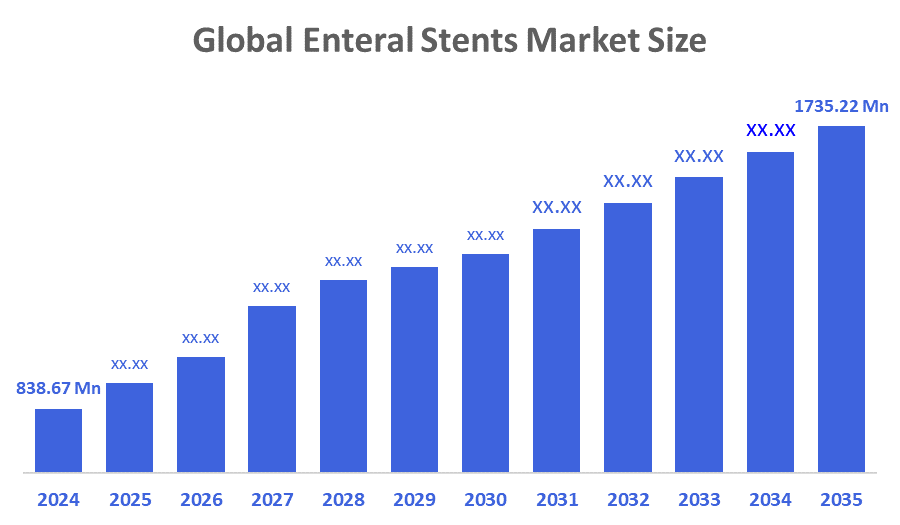
According to a research report published by Decisions Advisors and Consulting, The Global Enteral Stents Market Size Was Worth Around USD 838.67 Million In 2024 And Is Predicted To Grow To Around USD 1735.22 Million By 2035 With A Compound Annual Growth Rate (CAGR) Of 6.83% From 2025 To 2035. Besides, continuous investigations and work on life technologies have led to the invention of drug-eluting and fully covered stents, thus expanding the clinical applicability. The market is also witnessing an upsurge driven by better public knowledge and diagnosis at an early stage of gastrointestinal diseases, which results in the increased use of such products.
Market Overview
The Enteral Stents Market Size includes a highly specialised segment of the medical devices industry. It is focused on devices that keep the enteral tract open, the enteral tract being the oesophagus, stomach, duodenum, small intestine, and colon. Enteral stents are mainly used to remove blockages resulting from malignant tumour growth or benign narrowing, usually related to cancer or other gastrointestinal disorders. The sector covers a variety of stent types: self-expanding metal stents (SEMS), plastic stents, and biodegradable stents, with each type being only suitable for a specific clinical condition. Worldwide, the demand for enteral stents is on the rise because of the increasing number of gastrointestinal cancer cases, the ageing of the population, and progress in minimally invasive treatment methods. Medical practitioners resort more and more to endoscopic procedures with the use of stents as a palliative and therapeutic option aimed at enhancing the patients' quality of life and at limiting the duration of hospital stays. Furthermore, market demand can be diversified by extending indications beyond malignant obstructions to benign strictures and other gastrointestinal disorders.
Report Coverage
This research report categorises the Enteral Stents Market Size based on various segments and regions, forecasts revenue growth, and analyzes trends in each submarket. The report analyses the key growth drivers, opportunities, and challenges influencing the Enteral Stents market. Recent market developments and competitive strategies, such as expansion, product launch, development, partnership, merger, and acquisition, have been included to draw the competitive landscape in the market. The report strategically identifies and profiles the key market players and analyzes their core competencies in each sub-segment of the Enteral Stents market.
Driving Factors
The market for enteral stents is being driven by a number of factors, including the growing use of stents in non-malignant applications and the need for effective therapies that will lower the risk of complications. Further, the growing use of removable and fully-covered metal stents in gastrointestinal applications, technological advancements in stent technology that delivery innnews market opportunities. The growing inclination towards the use of minimally invasive techniques, and patient awareness. Real-time monitoring and guided stent placement using cutting-edge imaging modalities are examples of digital health integration that can enhance patient safety and procedural outcomes while creating opportunities for product differentiation. Commercial partnerships between hospitals and medical device companies can support training initiatives and clinical trials, increasing adoption.
Restraining Factors
The market for enteral stents faces a number of significant obstacles despite its growth potential. The possibility of stent-related problems, such as stent migration, blockage from tumour ingrowth or overgrowth, perforation, and infection, is one important concern. These issues may make further interventions necessary, raising clinical risk and expense and occasionally deterring doctors from choosing stents as a course of treatment.
Market Segmentation
The enteral stents market share is classified into product type, material type, and end user.
- The oesophageal stents segment accounted for the largest share in 2024 and is anticipated to grow at a significant CAGR during the forecast period.
Based on the product type, the enteral stents market is differentiated into gastroduodenal stents, oesophageal stents, and colon stents. Among these, the oesophageal stents segment accounted for the largest share in 2024 and is anticipated to grow at a significant CAGR during the forecast period. This is because benign strictures and oesophageal cancer are so common. Oesophageal stents are categorised by indication (malignant strictures, benign strictures, fistula closure), material (metal vs. plastic), and covering (totally, partially, or uncovered).
- The self-expandable metal stents segment accounted for the largest market share in 2024 and is projected to grow at a substantial CAGR over the forecast period.
Based on the material type, the enteral stents market is classified into self-expandable plastic stents and self-expandable metal stents. Among these, the self-expandable metal stents segment accounted for the largest market share in 2024 and is projected to grow at a substantial CAGR over the forecast period. They are preferred because they are more flexible, easier to implant, and have a longer patency than plastic stents. They are categorised as enteral stents (GI lumen) and biliary stents (bile ducts). In recent years, self-expandable metal stents (SEMS) have been applied in the fields of gastroenterology and oncology to help patients suffering from malignant obstructions in the oesophagus, duodenum, colon, and biliary tract.
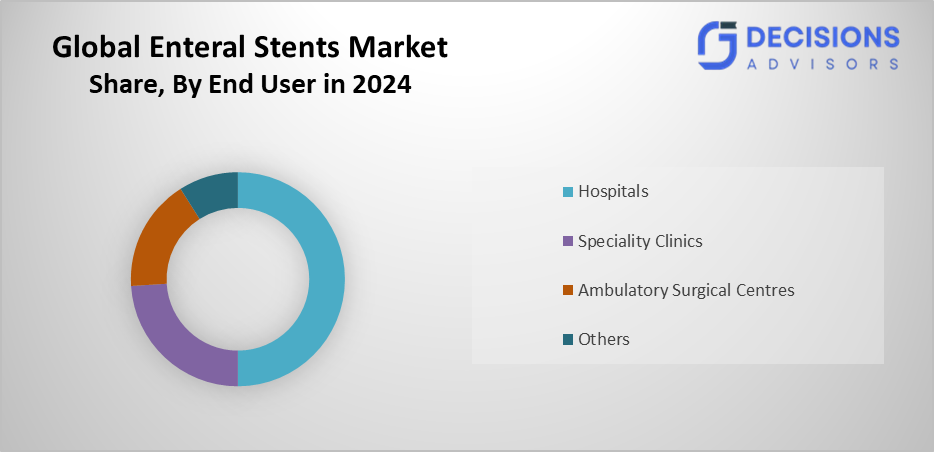
- The hospitals segment accounted for the highest revenue share in 2024 and is anticipated to grow at a significant CAGR during the forecast period.
Based on the end user, the enteral stents market is segmented into speciality clinics, hospitals, ambulatory surgical centres, and others. Among these, the hospitals segment accounted for the highest revenue share in 2024 and is anticipated to grow at a significant CAGR during the forecast period. The hospital segment dominates the market due to they have access to cutting-edge endoscopic facilities. Clinical preference, economic effectiveness, patient profile, and technical availability are some of the elements that affect segment growth. Manufacturers can successfully customise products and marketing tactics to seize new opportunities by having a thorough understanding of these categories.
Regional Segment Analysis of the Enteral Stents Market
- North America (U.S., Canada, Mexico)
- Europe (Germany, France, U.K., Italy, Spain, Rest of Europe)
- Asia-Pacific (China, Japan, India, Rest of APAC)
- South America (Brazil and the Rest of South America)
- The Middle East and Africa (UAE, South Africa, Rest of MEA)
Asia Pacific is anticipated to hold the largest share of the enteral stents market over the predicted timeframe.
Asia Pacific is anticipated to hold the largest share of the enteral stents market over the predicted timeframe. The Asia Pacific market is expanding due to the rising growth of the population, advancements in the healthcare infrastructure, increasing per capita expenditure, and increasing research and development. The market will witness rising opportunities in the region due to the increasing consumption of alcoholic beverages, the increasing investment by key manufacturers, health care insurance coverage by private and government firms, and the growing awareness among customers. The growing need is being driven in the region, particularly in nations like China, Japan, and India, by rapid economic growth, rising awareness, and increased access to healthcare.
North America is expected to grow at a rapid CAGR in the enteral stents market during the forecast period. This is driven by a sizable patient population with gastrointestinal disorders, high healthcare costs, and sophisticated medical infrastructure. Strong clinical research, advantageous reimbursement policies, and widespread physician adoption of minimally invasive procedures support the U.S.'s substantial market share. Other factors driving market growth in the North American region include rising cancer cases, technological advancements, shifting lifestyles, and rapid adoption of early treatment.
Competitive Analysis:
The report offers the appropriate analysis of the key organizations/companies involved within the enteral stents market, along with a comparative evaluation primarily based on their product offering, business overviews, geographic presence, enterprise strategies, segment market share, and SWOT analysis. The report also provides an elaborative analysis focusing on the current news and developments of the companies, which includes product development, innovations, joint ventures, partnerships, mergers & acquisitions, strategic alliances, and others. This allows for the evaluation of the overall competition within the market.
List of Key Companies
- Abbott Vascular
- B. Braun Melsungen AG
- Biosensors International
- Boston Scientific Corp
- C. R. Bard, Medtronic. Inc.
- Cook Medical
- Cordis Corporation
- Merit Medical Systems Inc
- Micro-Tech Nanjing Co Ltd
- MITech Co Ltd
- Stryker Corporation
- Taewoong Medical Co Ltd
- Terumo Corporation
- Wilson-Cook Medical Inc
- Others
Key Target Audience
- Market Players
- Investors
- End-users
- Government Authorities
- Consulting and Research Firm
- Venture capitalists
- Value-Added Resellers (VARs)
Market Segment
This study forecasts revenue at global, regional, and country levels from 2020 to 2035. Decisions Advisors has segmented the enteral stents market based on the below-mentioned segments:
Global Enteral Stents Market, By Product Type
- Gastroduodenal Stents
- Oesophageal Stents
- Colon Stents
Global Enteral Stents Market, By Material Type
- Self-Expandable Plastic Stents
- Self-Expandable Metal Stents
Global Enteral Stents Market, By End User
- Speciality Clinics
- Hospitals
- Ambulatory Surgical Centres
- Others
Global Enteral Stents Market, By Regional Analysis
- North America
- US
- Canada
- Mexico
- Europe
- Germany
- UK
- France
- Italy
- Spain
- Russia
- Rest of Europe
- Asia Pacific
- China
- Japan
- India
- South Korea
- Australia
- Rest of Asia Pacific
- South America
- Brazil
- Argentina
- Rest of South America
- Middle East & Africa
- UAE
- Saudi Arabia
- Qatar
- South Africa
- Rest of the Middle East & Africa
Frequently Asked Questions (FAQ)
- What is the current size of the global enteral stents market?
The market was valued at USD 838.67 million in 2024.
- What is the projected market size by 2035?
It is expected to reach USD 1,735.22 million by 2035.
- What is the CAGR for the forecast period?
The market is projected to grow at a CAGR of 6.83% from 2025 to 2035.
- Which product type holds the largest share?
Oesophageal stents accounted for the largest share in 2024 and are expected to grow significantly.
- What material type dominates the market?
Self-expandable metal stents held the largest share in 2024 due to their flexibility and longer patency.
- Which end-user segment leads the market?
Hospitals generated the highest revenue share in 2024, driven by advanced endoscopic facilities.
- Which region is expected to grow the fastest?
North America is anticipated to grow at the fastest CAGR, supported by advanced healthcare infrastructure and rising cancer cases.
- What drives growth in the Asia-Pacific region?
Rapid population growth, healthcare infrastructure improvements, and increasing awareness in countries like China, Japan, and India fuel expansion.
Check Licence
Choose the plan that fits you best: Single User, Multi-User, or Enterprise solutions tailored for your needs.
We Have You Covered
- 24/7 Analyst Support
- Clients Across the Globe
- Tailored Insights
- Technology Tracking
- Competitive Intelligence
- Custom Research
- Syndicated Market Studies
- Market Overview
- Market Segmentation
- Growth Drivers
- Market Opportunities
- Regulatory Insights
- Innovation & Sustainability
Report Details
| Scope | Global |
| Pages | 230 |
| Delivery | PDF & Excel via Email |
| Language | English |
| Release | Jan 2026 |
| Access | Download from this page |