
Europe Industrial Dryers Market
 |
Author:
Pranali P
|
Pages:
195
|
Author:
Pranali P
|
Pages:
195
Europe Industrial Dryers Market Size, Share, By Type (Spray Dryers, Rotary Dryers, Fluidized Bed Dryers, Freeze Dryers, Others), By Technology (Convective Drying, Conductive Drying, Radiative Drying, Dielectric Drying), By Application (Food & Beverage, Pharmaceuticals, Chemicals, Pulp & Paper, Wastewater Treatment), Analysis and Forecast 2026-2035.
CAGR
5.62%
REVENUE 2025
USD Billion 3.26
FORECAST 2035
USD Billion 5.63
REPORT COVERAGE
Country
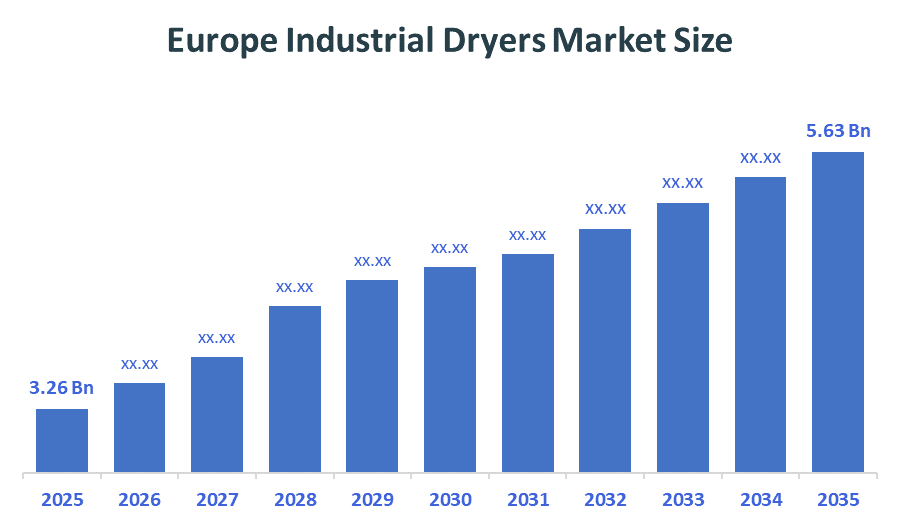
The Europe Industrial Dryers Market size is forecasted to grow from USD 3.26 Billion in 2025 and going to reach approx. USD 5.63 Billion by 2035. According to Decision Advisors, there is a detailed research report on the Europe Industrial Dryers Market highlights that spray dryers and fluidized bed dryers dominate the global market, accounting for approximately 45–50% of the total share worldwide. GEA Group and ANDRITZ AG collectively generate strong revenue through higher efficiency, energy savings, and consistent product quality, which accounts for approximately 20–25% market share, thus acting as a main driver strengthening Europe’s industrial processing capabilities.
Market Snapshot
- Market Size (2025): USD 3.26 Billion
- Projected Market Size (2035): USD 5.63 Billion
- Compound Annual Growth Rate (CAGR): 5.62%
- Base Year: 2025
- Historical Period: 2021–2025
- Forecast Period: 2026–2035
Market Overview/Introduction
The Europe Industrial Dryers Market comprises equipment used to remove moisture from materials in industries such as food, pharmaceuticals, chemicals, pulp & paper, and wastewater treatment. Industrial dryers play a crucial role in ensuring product stability, shelf life, and quality consistency. Growth is driven by increasing demand for processed food, stricter environmental regulations, and energy-efficient manufacturing practices. In addition, rapid industrial automation and the adoption of Industry 4.0 technologies are transforming drying processes across Europe. Manufacturers are increasingly integrating smart sensors, IoT-enabled monitoring systems, and advanced control technologies to optimize drying efficiency and reduce operational costs. The rising focus on sustainability has encouraged the adoption of low-emission and energy-efficient drying solutions, particularly in compliance with stringent European environmental standards. Furthermore, expanding pharmaceutical production and increasing demand for specialty chemicals are boosting the need for precision drying technologies such as freeze drying and vacuum drying. Growing investments in wastewater treatment infrastructure and circular economy initiatives are also contributing to sustained market expansion across the region.
- In February 2025, the European Commission strengthened industrial energy efficiency regulations, encouraging adoption of advanced drying systems.
- In January 2024, European food and pharmaceutical industries expanded production capacity, boosting demand for high-performance drying equipment.
Notable Insights: -
- By type, the Spray Dryers held a dominant position with 6% in terms of market share in 2025.
- By technology, Convective Drying is the dominating accounting for over 6.4% of the Europe market share in 2025.
- The compound annual growth rate of the Europe Industrial Dryers Market is 5.62%.
- The market is likely to achieve a valuation of USD 5.63 Billion by 2035.
What is role of technology in grooming the market?
Technological advancements are significantly improving industrial dryer efficiency and sustainability. Modern drying systems reduce energy consumption by 20–30% through heat recovery systems and optimized airflow design. Smart sensors and IoT-enabled monitoring allow real-time process control, reducing downtime by 25–35% and improving product consistency. Advanced drying technologies such as vacuum drying and freeze drying enable processing of temperature-sensitive materials, particularly in pharmaceuticals and specialty chemicals. Hybrid drying systems combining multiple technologies are also gaining traction, enhancing drying speed by 15–20% while maintaining product quality. These innovations are expected to account for over 60% of new installations by 2030.
Market Drivers
Industrial growth across food processing, pharmaceuticals, and chemicals is a major driver for the Europe Industrial Dryers Market. The food industry contributes nearly 35–40% of total demand, driven by rising consumption of packaged and processed foods. Pharmaceutical manufacturing accounts for approximately 20–25%, requiring precision drying for drug stability. Environmental regulations promoting wastewater treatment contribute around 15–20% demand, where sludge drying is essential. Increasing focus on energy efficiency and sustainability further accelerates adoption of advanced drying technologies. Additionally, automation and digitalization are enhancing operational efficiency across industrial processes.
Restrain
High initial investment costs and energy consumption remain key challenges for the Europe Industrial Dryers Market. Advanced drying systems can cost 20–30% more than conventional equipment, limiting adoption among small and medium enterprises. Energy-intensive operations contribute significantly to operational expenses, particularly in regions with high energy costs. Maintenance complexity and the need for skilled labor also pose barriers. Furthermore, stringent environmental regulations regarding emissions and energy usage increase compliance costs for manufacturers, slowing down market growth to some extent.
Study on the Supply, Demand, Distribution, and Market Environment Europe Industrial Dryers Market
The Europe Industrial Dryers Market operates through a structured supply chain involving OEMs, EPC contractors, and industrial end-users. OEMs account for approximately 60% of supply, supported by advanced manufacturing capabilities and strong industry partnerships. Food and beverage industries contribute nearly 40% of demand, followed by pharmaceuticals (25%) and chemicals (20%). Wastewater treatment applications are growing rapidly, contributing around 15% of demand. EPC contractors and industrial distributors manage nearly 65% of equipment procurement, ensuring efficient project execution. Digital procurement platforms are expanding at a rate of over 18% annually, improving supply chain efficiency. Replacement demand accounts for approximately 30–35% of the total market due to aging industrial infrastructure across Europe.
Price Analysis and Healthcare Facilities Behaviour Analysis
Industrial dryer prices in Europe vary significantly based on equipment type, capacity, level of automation, and underlying technology. Rotary dryers are generally priced between USD 10,000 and 150,000, making them suitable for bulk material processing in industries such as mining and chemicals. Spray dryers, widely used in food and dairy applications, range from USD 100,000 to 1 million due to their complexity and precision. Fluidized bed dryers cost between USD 50,000 and 500,000, offering efficient heat transfer and uniform drying, while freeze dryers, used in pharmaceuticals and high-value products, can range from USD 200,000 to 2 million. Buyer behavior shows a strong shift toward efficiency and sustainability. Around 70% of buyers prioritize energy-efficient systems, while 60% focus on reducing long-term operational costs. Nearly 50% evaluate automation and smart monitoring features, and about 35–40% consider carbon footprint and compliance with stringent EU environmental regulations.
Strategies to Implement for Growth of the Market
Manufacturers in the Europe Industrial Dryers Market should prioritize the development of energy-efficient and low-emission drying technologies to comply with increasingly stringent environmental regulations and carbon reduction targets across the region. Investing in research and development for hybrid and advanced drying systems can significantly enhance process efficiency by 20–25%, while also improving product consistency and reducing energy consumption. Building strategic partnerships with EPC contractors and industrial operators can streamline project execution, optimize supply chains, and reduce project timelines by 15–18%. Additionally, establishing regional manufacturing and service facilities can help companies’ lower logistics and transportation costs by 10–15%, while ensuring faster delivery and improved after-sales support. The integration of IoT-enabled monitoring systems and predictive maintenance tools can further reduce equipment downtime by 30–35%, enhance operational reliability, and deliver greater long-term value to customers, supporting the broader transition toward smart and sustainable industrial operations in Europe.
Market Segmentation
The Europe Industrial Dryers Market share is classified into Type, Technology, and application
- The Spray Dryers dominated the market in 2024, and is projected to grow at a substantial CAGR of approximately 6% during the forecast period.
Based on the Type, the Europe Industrial Dryers Market is divided into Spray Dryers, Rotary Dryers, Fluidized Bed Dryers, Freeze Dryers, Others. Among these, the Spray Dryers dominated the market in 2024, and is projected to grow at a substantial CAGR of approximately 6% during the forecast period. This dominance is driven by their extensive use in the food & beverage and pharmaceutical industries, where uniform particle size, consistent moisture removal, and high product quality are critical. Spray dryers enable rapid drying of liquids into powders, making them ideal for dairy products, infant formula, and active pharmaceutical ingredients. Their ability to support large-scale continuous processing further strengthens their adoption across Europe.
- The Convective Drying accounted for the largest share in 2024, and is anticipated to grow at a significant CAGR of approximately 4% during the forecast period.
Based on the Technology, the Europe Industrial Dryers Market is divided into Convective Drying, Conductive Drying, Radiative Drying, Dielectric Drying. Among these, the Convective Drying dominated the market in 2024, and is projected to grow at a substantial CAGR of approximately 4% during the forecast period. This is because convective systems hot air drying are highly versatile, cost-effective, and suitable for a wide range of industrial applications. Industries prefer this technology due to its simplicity, scalability, and compatibility with bulk materials. Additionally, advancements in heat recovery and airflow optimization have improved energy efficiency, making it compliant with European sustainability regulations.
- The Food and Beverage segment dominated the market in 2024, and is projected to grow at a substantial CAGR approximately 6.8% during the forecast period.
Based on the Application, the Europe Industrial Dryers Market is divided into Food & Beverage, Pharmaceuticals, Chemicals, Pulp & Paper, Wastewater Treatment. Among these, the Food and Beverage segment dominated the market in 2024, and is projected to grow at a substantial CAGR approximately 6.8% during the forecast period. This is primarily due to rising demand for processed, packaged, and convenience foods across Europe. Industrial dryers are essential for extending shelf life, ensuring food safety, and maintaining product quality. Increasing consumption of dairy powders, instant foods, and nutritional products, along with strict hygiene standards, continues to drive demand for advanced drying systems in this sector. Growing demand for smart grids and replacement of aging infrastructure further strengthens this segment’s leading position.
Recent Development
- In March 2025, GEA Group launched energy-efficient spray drying solutions to reduce industrial carbon emissions.
- In February 2025, ANDRITZ AG expanded its drying technology portfolio for waste water treatment applications.
- In January 2025, Buhler Group introduced advanced drying systems for food processing with improved automation features.
- In July 2025, FLSmidth enhanced industrial drying systems for cement and mining industries
Competitive Analysis
The report offers the appropriate analysis of the key organisations/companies involved within the Europe Industrial Dryers Market, along with a comparative evaluation primarily based on their integration type offering, business overviews, geographic presence, enterprise strategies, segment market share, and SWOT analysis. The report also provides an elaborative analysis focusing on the current news and developments of the companies, which includes integration type development, innovations, joint ventures, partnerships, mergers & acquisitions, strategic alliances, and others. This allows for the evaluation of the overall competition within the market.
Top Key Companies in Europe Industrial Dryers Market
- GEA Group
- ANDRITZ AG
- Bughler Group
- FLSmidth
- SPX Flow
- Atlas Copco
- Thyssenkrupp AG
- Others
Key Target Audience
- Market Players
- Investors
- End-users
- Government Authorities
- Consulting and Research Firm
- Venture capitalists
- Value-Added Resellers (VARs)
Market Segment
This study forecasts revenue at the Europe, regional, and country levels from 2020 to 2035. Decision Advisors has segmented the Europe Industrial Dryers Market based on the below-mentioned segments
Europe Industrial Dryers Market, By Type
- Spray Dryers
- Rotary Dryers
- Fluidized Bed Dryers
- Freeze Dryers
- Others
Europe Industrial Dryers Market, By Technology
- Convective Drying
- Conductive Drying
- Radiative Drying
- Dielectric Drying
Europe Industrial Dryers Market, By Application
- Food & Beverage
- Pharmaceuticals
- Chemicals
- Pulp & Paper
- Wastewater Treatment
Frequently Asked Questions (FAQ)
1. What is driving the Europe Industrial Dryers Market growth?
Growth is driven by increasing demand from food processing, pharmaceuticals, and wastewater treatment industries, along with energy efficiency regulations.
2. Which type of dryer dominates the market?
Spray dryers dominate due to their efficiency and widespread use in food and dairy applications.
3. How important is energy efficiency in this market?
Over 70% of buyers prioritize energy-efficient systems due to high operational costs and regulatory compliance.
4. What role does automation play in industrial drying?
Automation improves process control, reduces downtime by 25–35%, and enhances product quality.
5. Which industries generate the highest demand?
Food & beverage leads with around 40% demand, followed by pharmaceuticals and chemicals
Check Licence
Choose the plan that fits you best: Single User, Multi-User, or Enterprise solutions tailored for your needs.
We Have You Covered
- 24/7 Analyst Support
- Clients Across the Globe
- Tailored Insights
- Technology Tracking
- Competitive Intelligence
- Custom Research
- Syndicated Market Studies
- Market Overview
- Market Segmentation
- Growth Drivers
- Market Opportunities
- Regulatory Insights
- Innovation & Sustainability
Report Details
| Scope | Country |
| Pages | 195 |
| Delivery | PDF & Excel via Email |
| Language | English |
| Release | May 2026 |
| Access | Download from this page |