
Global Evaporative Air Cooler Market
 |
Author:
Omkar J
|
Pages:
210
|
Author:
Omkar J
|
Pages:
210
Global Evaporative Air Cooler Market Size, Share, By Product Type (Portable Coolers, Tower Coolers, Desert Coolers, and Window-Mounted Coolers) By Deployment Type (Residential, Commercial, and Industrial) By Application (Residential Housing, Office Buildings, Data Centers, Manufacturing Plants, and Public Infrastructure) By End User (Household Consumers, Retail & Hospitality, IT & Telecom, Manufacturing, and Healthcare) and By Region (North America, Europe, Asia-Pacific, Latin America, Middle East and Africa), Analysis and Forecast 2026-2035
CAGR
7.79%
REVENUE 2025
USD Billion 2.03
FORECAST 2035
USD Billion 4.3
REPORT COVERAGE
Global
Market Snapshot
- Global Evaporative Air Cooler Market Size (2025): USD 2.03 Billion
- Global Evaporative Air Cooler Projected Market Size (2035): USD 4.3 Billion
- Global Evaporative Air Cooler Compound Annual Growth Rate (CAGR): 7.79%
- Largest Regional Market: Asia-Pacific
- Fastest Growing Region: North America
- 3rd Largest Region: Europe
- Base Year: 2025
- Historical Period: 2021 to 2024
- Forecast Period: 2026 to 2035
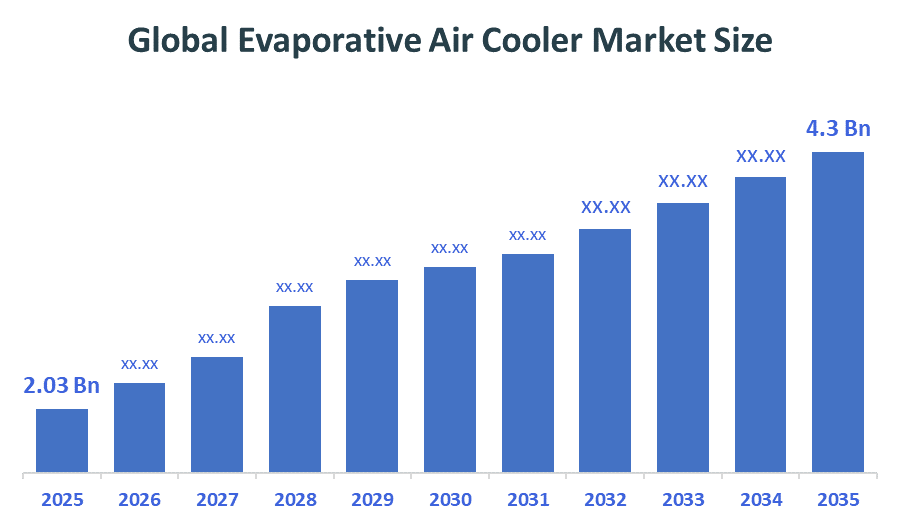
According to Decision Advisors, the global evaporative air cooler market size was expected to grow from USD 2.03 Billion in 2025 to USD 4.3 Billion by 2035, with a CAGR of 7.79% during the forecast period from 2026 to 2035. Evaporative cooling solutions have been growing at a steady rate, as there is an increasing need for these kinds of solutions among cost-conscious households and energy-intensive industries. The cooling process consumes about 70% less power than traditional air conditioning, and that is why better, eco-friendly solutions have been sought after. Smart IoT-enabled coolers and BLDC motor-based solutions for monitoring are being developed to reduce costs and improve reliability.
Market Overview / Introduction
The Evaporative Air Coolers are an ensemble of sustainable cooling mechanisms that aim at attaining natural cooling temperatures for residential, commercial, and industrial uses. The evaporative air coolers function as the crucial intermediary mechanism between ceiling fans and costly air conditioning systems through applying the state-of-the-art honeycomb pads and fluid dynamics to achieve fast cooling results without utilizing much energy. Contemporary evaporative air coolers have characteristics like high-performance PM 2.5 air filters and multistage pump safety measures to guarantee constant performance capabilities without causing any hardware destruction. Evaporative air coolers were initially simple metal box fans but have now been advanced to self-contained climate control units with air filtering abilities, energy-saving technologies, and Internet of Things compatibility within smart homes. Evaporative air coolers have gained popularity due to the growing desire for sustainable climate control systems and worldwide calls for carbon-neutral emissions from residential areas and manufacturing plants. Evaporative air coolers help protect consumer budgets and environments due to their ability to maintain a stable environment without the use of high-GWP refrigerants or carbon-intensive compressor systems.
- The residential housing segment contributes to approximately 61% of the application-based use in the market, driven by the increasing demand for affordable localised cooling, rising middle-class disposable income, and the rapid urbanisation of tropical regions.
- Automated smart cooling technology in the commercial sector is experiencing substantial growth, with a CAGR forecasted to surpass 6.3% on account of the increasing adoption of large-scale desert coolers as part of the advanced generation of energy-efficient workspaces for providing optimised airflow to warehouses and open-air retail zones.
Notable Insights: -
- Portable air coolers make up about 55% of the total market share of this sector. They have gained a reputation in compact urban housing, particularly in rental apartments, student accommodations, and small retail outlets.
- About 72.5% of all installations in dry arid regions occur in residential and small-scale commercial facilities. These investments are stimulated mainly by high levels of investment into energy-efficient appliances and green living initiatives because many households experience high electricity bills that result in the seasonal usage of traditional ACs.
- Applications of evaporative cooling in the sphere of industrial facilities account for almost 29% of all demand. The rapid development of high-ceiling warehouses, alongside increased worries about worker heat stress in non-air-conditioned spaces, has become one of the main drivers of using these advanced systems.
- About 64% of the market share belongs to the Asia-Pacific region in 2025. Many countries within this region, like India and China, invest considerable amounts of money in consumer appliance manufacturing and rural electrification in order to address the growing needs of their expanding populations.
- Tower-type cooling systems show an annual increase above 6.9%. The rise in space-saving designs and frequent occurrences of vertical urban living create the conditions that encourage enterprises to invest more money in modular evaporative cooling solutions.
What is the Role of Technology in Shaping the Market?
Some innovative changes have been brought about by the advances in technology in the field of air-cooling in terms of water efficiency, noise efficiency, and automation of systems. The current systems of evaporative devices are no longer just wet fans; rather, they are sophisticated air-management systems, which can operate on their own for long durations due to their ability to use anti-bacterial cooling pads, high-end BLDC motor units, and the capacity to use mobile apps.
How are Recent Developments Helping the Market?
These innovations include the implementation of AI-integrated humidity control systems, the incorporation of advanced inverter technology, and voice-controlled activation systems. These innovations have significantly aided in promoting development and growth within the market. Innovations have included the creation of hybrid cooling systems that are capable of safeguarding indoor air quality, which may range from personal desk units to full-fledged industrial coolers, all without fail. Using smart sensor-based mechanics, such innovations will enable autonomous management of water flow through the utilisation of the ambient temperature levels without any form of human intervention or system failure occurring.
Market Drivers
The need for evaporative air coolers worldwide is increasing due to the increasing investment by consumer electronics companies and government agencies towards sustainable energy programs and cost-effective cooling systems that can meet the climate goals in the current environment. Modern evaporative air coolers have become very popular in the market due to their advantages with respect to various advantages they incorporate, such as multi-level air filtration, silent running, and stylish design in one system. In contrast, there is a growing need for inexpensive heat management systems in response to the increasing occurrence of hot weather, which is making the use of evaporative cooling technology attractive as a cheaper alternative to the use of traditional air conditioning in arid regions.
Restraints
The growth of the international market for the evaporative air cooler industry is constrained by the difficulties in maintaining cooling efficiency under high humidity conditions because of the physical limits of evaporation and the possibility of dampness in closed environments.
Competitive Analysis:
The report offers the appropriate analysis of the key organisations/companies involved within the global evaporative air cooler market, along with a comparative evaluation primarily based on their product offerings, business overviews, geographic presence, enterprise strategies, segment market share, and SWOT analysis. The report also provides an elaborate analysis focusing on the current news and developments of the companies, which includes product development, innovations, joint ventures, partnerships, mergers & acquisitions, strategic alliances, and others. This allows for the evaluation of the overall competition within the market.
Top 10 Companies in the Global Evaporative Air Cooler Market
- Symphony Limited
- Bajaj Electricals Ltd.
- Havells India Ltd.
- Honeywell International Inc.
- Seeley International Pty Ltd.
- Portacool, LLC
- Munters Group AB
- Usha International Ltd.
- Orient Electric Limited
- De'Longhi Appliances S.r.l.
Government Initiatives
|
Country |
Key Government Initiatives |
|
US |
In alignment with state-level energy conservation goals for 2026, many Western states have intensified rebate programs for evaporative cooling. Under the Inflation Reduction Act (HEEHRA), low-to-moderate income households can receive up to $8,000 in point-of-sale rebates for high-efficiency cooling systems, aiming to reduce peak grid load by an estimated 15-20% in arid regions. |
|
EU |
The EU Ecodesign Directive has set stricter energy efficiency requirements for cooling appliances as of 2026. This framework mandates a transition to low-GWP (Global Warming Potential) refrigerants specifically targeting a GWP of less than 150, and promotes the adoption of evaporative technologies to meet a 20% reduction in primary energy consumption by 2030. |
|
India |
Under the India Cooling Action Plan (ICAP) and Union Budget 2026, the government has proposed a lower GST bracket of 12% (down from 28%) for energy-efficient air coolers. Additionally, the Production Linked Incentive (PLI) scheme offers a 4-6% incentive on incremental sales for indigenous manufacturing of high-efficiency components to address urban heat islands. |
Study on the Supply, Demand, Distribution, and Market Environment
The success of the evaporative air cooler industry depends on finding the sweet spot between the ability to operate with maximum water efficiency and the growing need for constant, smart-enabled humidity management. The supply of evaporative air coolers comes from a focus on producing high-density honeycomb pads and highly efficient, quiet motors capable of delivering instantaneous temperature stabilisation without the excessive operational noise associated with legacy fan hardware.
Price Analysis and Consumer Behaviour Analysis
The pricing for evaporative air coolers varies depending on the tank capacity, airflow delivery, and smart features. Higher-end products using multi-stage purification technology and equipped with state-of-the-art AI-driven remote-control sensors are more expensive. However, personal coolers and smaller tower-based systems for residential rooms are less costly and provide an ideal opportunity for localised supplemental cooling. Consumers have clearly demonstrated a preference toward long-term cost-effectiveness and energy efficiency; hence, companies are expected to favour products that ensure operational autonomy, low maintenance, and precise humidity control for long periods of time.
Market Segmentation
The Global Evaporative Air Cooler Market share is classified into product type, deployment type, application, and end user.
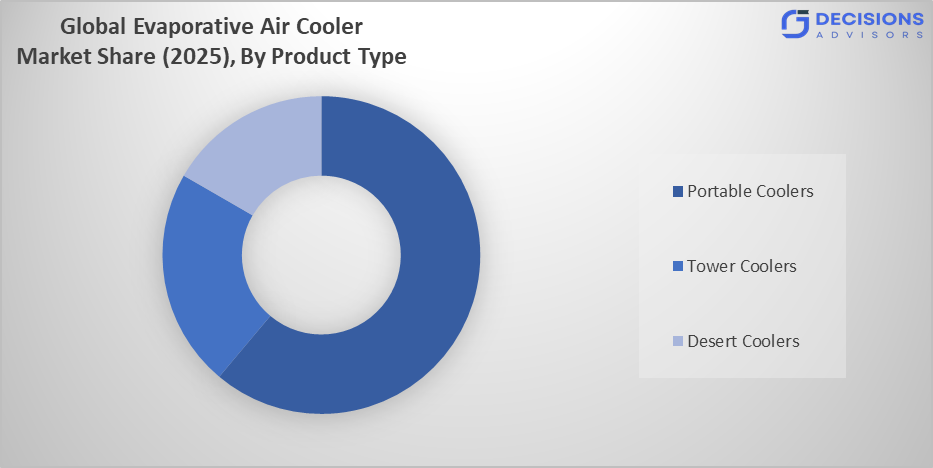
The Portable Coolers segment holds the largest share, contributing approximately 55% of the market in 2025.
Based on the Product Type, the global evaporative air cooler market is divided into Portable Coolers, Tower Coolers, Desert Coolers, and Window-Mounted Coolers. Among these, the Portable Coolers segment holds the largest share, contributing approximately 55% of the market in 2025. The reason for this dominance lies in their ease of installation, mobility, and the ability to provide localised cooling in urban apartments without requiring structural modifications.
The Residential segment accounts for the largest share, representing over 61% of the global market in 2025.
Based on the deployment type, the global market is divided into residential, commercial, and industrial. Among these, the Residential segment accounts for the largest share, representing over 61% of the global market in 2025. These deployments are critical for middle-class households looking for cost-effective alternatives to air conditioning. On the other hand, the Commercial segment has emerged as a rapidly growing sector, thanks to the increasing adoption of large desert coolers in open-air venues and warehouses.
Residential Housing dominates the global market, accounting for approximately 61% of the total revenue in 2025.
Based on the Application, the global market is divided into residential housing, office buildings, data centers, manufacturing plants, and public infrastructure. Among these, Residential Housing dominates the global market, accounting for approximately 61% of the total revenue in 2025. This segment is preferred by consumers who require affordable localised cooling. The Industrial/Manufacturing category is seeing a sharp increase in use, especially in large factories where cooling large volumes of air with traditional AC is cost-prohibitive.
The Household Consumers segment dominates the global market, accounting for approximately 58% of the total revenue in 2025.
Based on the End User, the global market is divided into household consumers, retail & hospitality, it & telecom, manufacturing, and healthcare. Among these, the Household Consumers segment dominates the global market, accounting for approximately 58% of the total revenue in 2025. This segment is preferred by urban and semi-urban planners who prioritise energy savings. The Manufacturing segment is seeing a sharp increase in use, especially by operators who value the low maintenance and fresh air ventilation provided by advanced evaporative units.
Strategies to Implement for Growth of the Market in Non-Leading Regions
The potential for growth within the evaporative air cooler industry in emerging regions could be increased through the deployment of efficient modular units for rural infrastructure, as well as local agencies tasked with disaster management. Programs aimed at energy conservation by governments contribute substantially toward demand within regions with traditional hardware. Further support through increasing investments in training local maintenance technicians and setting up regional service networks will facilitate the adoption of sustainable climate control solutions.
Regional Segment Analysis of the Global Evaporative Air Cooler Market
- North America (U.S., Canada, Mexico)
- Europe (Germany, France, U.K., Italy, Spain, Rest of Europe)
- Asia-Pacific (China, Japan, India, South Korea, Rest of APAC)
- Latin America (Brazil and the Rest of Latin America)
- The Middle East and Africa (UAE, South Africa, Rest of MEA)
Asia-Pacific is projected to be the fastest-growing region over the forecast period. This region is anticipated to witness a growth rate of around 7.5% CAGR, maintaining a dominant market share within the global industry. In 2025, the Asia-Pacific region already account for approximately 64% of global revenue. This is owing to the fast-developing urban infrastructure, coupled with the growing demand for modern housing in countries such as India and China. Other reasons for the same include greater investments made toward low-cost indigenous manufacturing and widespread adoption of energy-efficient living strategies.
North America is expected to hold a significant share of the evaporative air cooler market during the forecast period. This region holds approximately 18% share of global revenue in 2025, thanks to its extensive adoption of portable units in the US Sunbelt states and high-value industrial warehouse applications. The largest part of this region’s revenues comes from the United States, as there is a lot of spending on eco-friendly green building products.
Europe is anticipated to hold a substantial share, contributing approximately 12.5% of the global market share. There is a competitive advantage in the region owing to clusters of environmental technology innovation and financing for sustainable climate protection research.
Recent Developments
- In June 2025, several leading manufacturers such as Honeywell International Inc. and Voltas Limited introduced a new range of AI-powered Wind-Free evaporative coolers equipped with smart sensors that detect occupancy and automatically adjust airflow, significantly improving water conservation and energy efficiency.
- In March 2024, the India Meteorological Department reported record-breaking summer temperatures, leading to a 25% surge in the domestic air cooler market as consumers sought affordable cooling.
- In November 2023, major logistics firms such as Amazon and DHL deployed large-scale evaporative cooling towers in fulfilment centres, reducing energy consumption by up to 70-75% compared to conventional cooling while supporting ESG sustainability goals.
- In July 2022, manufacturers such as UltraCool Solutions LLP and D. P. Engineers introduced advanced honeycomb pad materials that improved water retention and airflow, delivering nearly 20–30% higher cooling efficiency compared to traditional wood wool pads, supported by enhanced cellulose structures with higher absorption capacity.
Market Segmentation
This study forecasts revenue at global, regional, and country levels from 2021 to 2035. Decision Advisors has segmented the global evaporative air cooler market based on the following segments:
Global Evaporative Air Cooler Market, By Product Type
- Portable Coolers
- Tower Coolers
- Desert Coolers
- Window-Mounted Coolers
Global Evaporative Air Cooler Market, By Deployment Type
- Residential
- Commercial
- Industrial
Global Evaporative Air Cooler Market, By Application
- Residential Housing
- Office Buildings
- Data Centers
- Manufacturing Plants
- Public Infrastructure
Global Evaporative Air Cooler Market, By End User
- Household Consumers
- Retail & Hospitality
- IT & Telecom
- Manufacturing
- Healthcare
Global Evaporative Air Cooler Market, By Regional Analysis
- North America
- United States
- Canada
- Mexico
- Europe
- Germany
- United Kingdom
- France
- Italy
- Spain
- Russia
- Rest of Europe
- Asia Pacific
- China
- Japan
- India
- South Korea
- Australia
- Rest of Asia Pacific
- Latin America
- Brazil
- Argentina
- Rest of Latin America
- Middle East & Africa
- United Arab Emirates
- Saudi Arabia
- Qatar
- South Africa
- Rest of Middle East & Africa
Frequently Asked Questions (FAQ)
What is an evaporative air cooler, and why is it important?
An evaporative air cooler is a sustainable thermal regulation system designed to cool air through the natural process of water evaporation. These systems are essential for providing energy-efficient cooling, maintaining indoor humidity, and offering a low-cost alternative to traditional AC in dry climates.
What factors are driving the growth of the evaporative air cooler market?
The market growth can be attributed to the rising global temperatures, the massive shift toward eco-friendly appliances, increasing electricity costs, and the high demand for affordable cooling in emerging economies.
Which product type dominates the evaporative air cooler market?
Portable air coolers represent the largest segment due to their versatility, low installation costs, and the growing trend of compact urban living where permanent fixtures are not always possible.
Which applications are widely used in this market?
Residential housing and industrial warehouses are the most prominent applications due to the acute necessity to provide reliable, low-cost climate control for large groups of people and sensitive goods.
Check Licence
Choose the plan that fits you best: Single User, Multi-User, or Enterprise solutions tailored for your needs.
We Have You Covered
- 24/7 Analyst Support
- Clients Across the Globe
- Tailored Insights
- Technology Tracking
- Competitive Intelligence
- Custom Research
- Syndicated Market Studies
- Market Overview
- Market Segmentation
- Growth Drivers
- Market Opportunities
- Regulatory Insights
- Innovation & Sustainability
Report Details
| Scope | Global |
| Pages | 210 |
| Delivery | PDF & Excel via Email |
| Language | English |
| Release | Apr 2026 |
| Access | Download from this page |