
Global Exhaust Heat Recovery System Market
 |
Pages:
195
|
Pages:
195
Global Exhaust Heat Recovery System Market Size, Share, By Component (Turbine, TEG Module, Compressor, Evaporator, EGR Valve and Cooler, Condenser, Others), By Vehicle Type (Passenger Car, LCV, HCV), By Technology (Exhaust Gas Recirculation, Thermoelectric Generator, Organic Rankine Cycle, Turbocharger, Others), and By Region (North America, Europe, Asia-Pacific, Latin America, Middle East, and Africa), Analysis and Forecast 2026-2035.
REPORT COVERAGE
Global
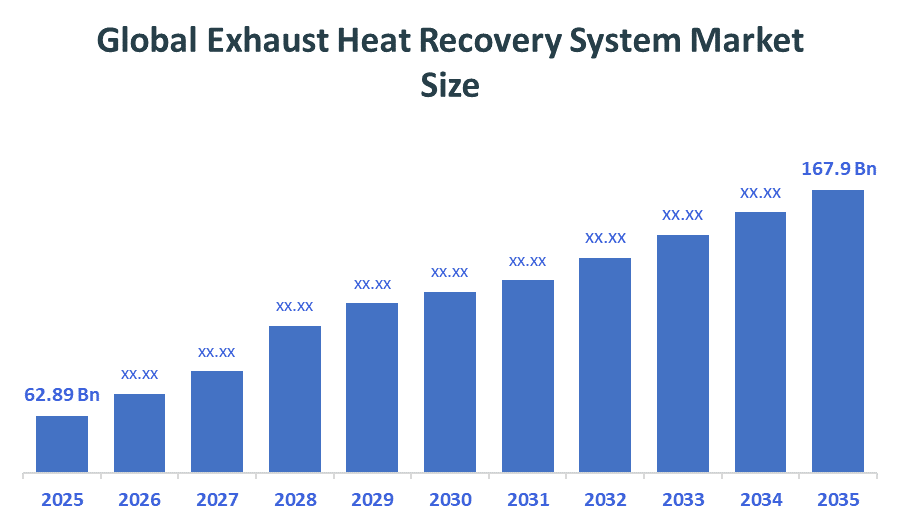
The Global Exhaust Heat Recovery System Market Size is Predicted to grow from USD 62.89 billion in 2025 and is expected to reach around USD 167.9 billion by 2035. According to Decision Advisors, a detailed research report on exhaust heat recovery system market Indicates that the Regulations trend dominates the global exhaust heat recovery system market, In the range of 52-58% of across global markets. BorgWarner secures a significant foothold in the market, reporting around USD 14.3 Billion in 2025, revenue and capturing approximately 9-16% global share, defining the growth path and strategic direction of the global exhaust heat recovery system market
Market Snapshot
- Global Exhaust Heat Recovery System Market Size (2025): USD 62.89 billion
- Projected Global Exhaust Heat Recovery System Market Size (2035): USD 167.9 billion
- Global Exhaust Heat Recovery System Market Compound Annual Growth Rate (CAGR): 10.32%
- Largest Regional Market: Asia-Pacific
- Fastest Growing Region: Europe
- 3rd Largest Region: North America
- Base Year: 2025
- Historical Period: 2021-2024
- Forecast Period: 2026-2035
Market Overview/ Introduction
The exhaust heat recovery system functions as a sophisticated energy optimization technology which transforms waste heat from engine exhaust and industrial operations into usable energy that improves efficiency while decreasing fuel usage. Its applications span from passenger vehicles through which emission standards drive their use to commercial fleets which need to manage thermal loads and industrial operations which use recovered heat for preheating and power generation and operational efficiency. The system serves as an essential component for achieving sustainable energy utilization. The rapid innovation because of thermoelectric generators, Organic Rankine Cycle systems, and compact heat exchangers improve energy conversion efficiency. The potential for future growth exists in three areas which include hybrid vehicle development, industrial waste heat recovery, and creation of improved materials. The combination of AI and IoT digitalisation enables real-time system optimization, which establishes EHRS as an essential technology that enables energy-saving industrial and automotive systems which produce low carbon emissions throughout the global market.
- India is driving the global exhaust heat recovery system market through BS-VI emission norms, prompting automakers to invest over USD 10 billion in advanced exhaust and efficiency technologies, accelerating adoption of heat recovery solutions to reduce emissions and enhance fuel efficiency.
- China is strengthening the global exhaust heat recovery system market through large-scale deployment of Organic Rankine Cycle technologies, supported by over USD 15 billion in industrial efficiency investments, enabling waste heat utilization, reducing fuel consumption, and enhancing energy productivity across key manufacturing sectors.
- In Japan advanced the global exhaust heat recovery system market by launching renewable heat subsidies, backed by investments exceeding USD 1 billion, supporting industrial waste heat recovery projects, reducing emissions, and accelerating adoption of energy-efficient technologies across manufacturing sectors.
Notable Insights: -
- Asia-Pacific holds the largest regional market share, approximately 47.5% in the global exhaust heat recovery System Market.
- Europe is the fastest growing region in the exhaust heat recovery system market is supported by automotive and manufacturing industries are adopting energy-efficient industrial technologies at an increasing pace because of three factors strict emission rules, high decarbonization requirements, and growing investments in energy-efficient industrial technologies.
- By component, the turbine segment held a dominant position with 38.2% in terms of market share in 2025.
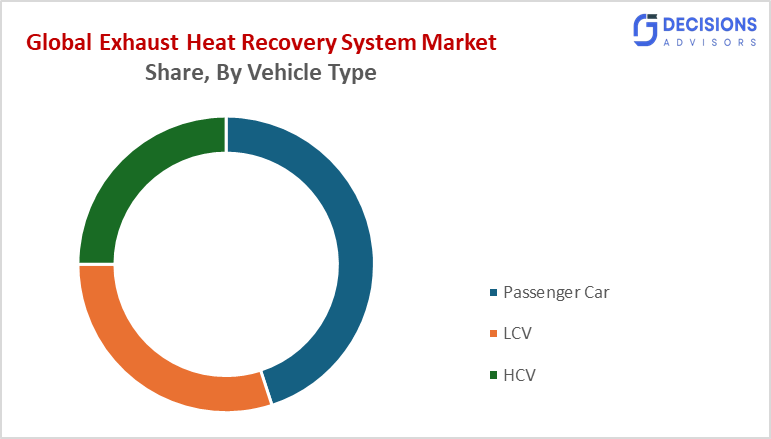
- By vehicle type, passenger cars segment is the dominating accounting for over 63.1% of the global market share in 2025.
- The compound annual growth rate of the global exhaust heat recovery system market is 10.32%.
- The market is likely to achieve a valuation of USD 167.9 billion by 2035.
What is role of technology in grooming the market?
The global exhaust heat recovery system market undergoes fundamental changes because of the technological advancements which enable greater efficiency and wider industrial utilization. The organic Rankine cycle systems and thermoelectric generators together with advanced heat exchangers drive progress in energy conversion performance. The system performance and reliability improvements come from digital monitoring systems together with IoT-enabled control systems and predictive maintenance tools. The automotive integration is accelerating the global exhaust heat recovery system market, with increasing deployment in hybrid and plug-in hybrid vehicles to enhance fuel efficiency, reduce emissions, and optimize thermal management, supporting the transition toward cleaner and more energy-efficient mobility solutions. The ongoing research and development funding supports the creation of compact and affordable technologies which will speed up their use in automotive and power generation and heavy industrial applications around the global market.
How is Recent Developments Helping the Market?
Recent technological development together with the governmental policies have created a powerful market force which drives the global exhaust heat recovery system industry. The government provides financial support through specific subsidies and establishes emission standards while creating decarbonization policies to motivate industrial sectors and automotive manufacturers to develop energy recovery technologies. The efficiency of Organic Rankine Cycle systems and thermoelectric modules together with hybrid vehicle systems is being improved through ongoing technological improvements. The partnership between automotive original equipment manufacturers and technology companies creates new opportunities for product development. The new technologies decrease operational expenses while they enhance energy efficiency, establishing exhaust heat recovery systems as essential elements which support the worldwide shift towards industrial processes that use sustainable energy sources.
The Europe is advancing the global exhaust heat recovery system market through widespread adoption of Organic Rankine Cycle technologies, supported by €20 billion sustainability investments, enabling conversion of low-grade waste heat into electricity while enhancing industrial energy efficiency and reducing emissions.
Market Drivers
The global exhaust heat recovery system market is growing because regulatory requirements together with economic conditions and technological advancements are working together. The strict emission regulations that Asia- Pacific, Europe, and North America have implemented force industries and automakers to use advanced exhaust control systems which help them comply with stricter carbon and pollutant emission standards. The combination of high fuel prices with current market conditions drives businesses to pursue energy efficiency through the implementation of systems which transform waste heat into valuable energy. The expanding hybrid mobility market drives increased demand for advanced thermal management solutions. The industrial sectors need to decrease their greenhouse gas emissions which has resulted in faster adoption of energy-efficient technologies across energy-intensive industries. The development of silicon carbide ceramics and improved system design has lowered costs while increasing performance capabilities which enables EHRS solutions to become commercially viable and usable in various fields.
Restrain
The global exhaust heat recovery system market faces some restraints driven by high capital intensity and technical complexity, particularly in advanced systems such as Organic Rankine Cycle solutions, which restrict smaller companies from entering the market. The accelerating transition toward battery electric vehicles further constrains demand because of there are no exhaust heat sources available. The main factors that prevent large-scale deployment are retrofitting challenges and operational disruptions, whereas corrosion problems in low-temperature settings continue to decrease system performance and industrial application durability.
Competitive Analysis:
The report offers the appropriate analysis of the key organizations/companies involved within the global exhaust heat recovery system market, along with a comparative evaluation primarily based on their product of offering, business overviews, geographic presence, enterprise strategies, segment market share, and SWOT analysis. The report also provides an elaborative analysis focusing on the current news and developments of the companies, which includes product development, innovations, joint ventures, partnerships, mergers & acquisitions, strategic alliances, and others. This allows for the evaluation of the overall competition within the market.
Top Companies in Global Exhaust Heat Recovery System Market
- BorgWarner Inc.
- Continental AG
- DENSO Corporation
- MAHLE GmbH
- Faurecia
- Cummins Inc.
- Mitsubishi Heavy Industries Ltd.
- Honeywell International Inc.
- Dana Incorporated
- Robert Bosch GmbH
Government Initiatives
|
Country |
Key Government Initiatives |
|
US |
The United States is propelling the global exhaust heat recovery system market, as EPA regulations under the Clean Air Act drive automakers to invest over USD 50 billion in emission reduction and fuel efficiency technologies, accelerating adoption of advanced heat recovery solutions. |
|
Japan |
The Germany is accelerating the global exhaust heat recovery system market through government-backed subsidies, supporting over USD 10 billion in clean energy investments, reducing upfront costs and encouraging industries to adopt energy-efficient waste heat recovery technologies across industrial sectors. |
|
|
Market Segmentation
The exhaust heat recovery system market share is classified into component, vehicle type, and technology
- The turbine segment dominated the market in 2024 and is projected to grow at a substantial CAGR of approximately 8.2% during the forecast period.
Based on the component, the exhaust heat recovery system market is divided into turbine, TEG module, compressor, evaporator, EGR valve and cooler, condenser, others. Among these, the turbine segment dominated the market in 2024 and is projected to grow at a substantial CAGR of approximately 8.2% during the forecast period. It is because of the system achieves exceptional waste heat conversion efficiency which enables the production of usable energy. The system has achieved widespread use in both automotive and industrial markets which drives its continuous development and research progress.
- The passenger cars screening segment accounted for the largest share in 2024 and is anticipated to grow at a significant CAGR of approximately 9.1% during the forecast period.
Based on the vehicle type, the exhaust heat recovery system market is divided into passenger car, LCV, HCV. Among these, the passenger cars screening segment accounted for the largest share in 2024 and is anticipated to grow at a significant CAGR of approximately 9.1% during the forecast period. It is dominating because the combination of high vehicle production volumes and strict emission regulations drives automakers to implement energy-efficient technologies which improve fuel economy and decrease emissions.
- The turbocharger segment dominated the market in 2024, and is projected to grow at a substantial CAGR during the forecast period.
Based on the technology, the exhaust heat recovery system market is divided into exhaust gas rrecirculation, thermoelectric generator, organic Rankine cycle, turbocharger, others. Among these, the turbocharger segment dominated the market in 2024, and is projected to grow at a substantial CAGR during the forecast period. The technology improves fuel efficiency and power output through its common use in automotive engines which enables car manufacturers to meet their emission reduction targets while maintaining their leading market position in both passenger and commercial vehicle markets.
Strategies to Implement for Growth of the Market in Non-Leading Regions
The non-leading regions of the global exhaust heat recovery system market will experience faster growth through three specific elements which are policy support combined with localized manufacturing and strategic cost optimization. The governments should implement fiscal incentives together with carbon pricing systems and energy efficiency standards to promote their sustainable practices adoption. The industry needs to create affordable modular EHRS systems which meet the needs of customers who have limited budgets. The strengthening of public-private partnerships together with technology transfer programs will improve both technical abilities and infrastructure development. The growth of demand will occur because of the people will learn about the long-term advantages of fuel savings and environmental protection. The market will achieve sustainable growth and operational stability through investments in workforce training and development of aftersales service networks.
Regional Segment Analysis of the Global Exhaust Heat Recovery System Market
- North America (U.S., Canada, Mexico)
- Europe (Germany, France, U.K., Italy, Spain, Rest of Europe)
- Asia-Pacific (China, Japan, India, Rest of APAC)
- South America (Brazil and the Rest of South America)
- The Middle East and Africa (UAE, South Africa, Rest of MEA)
Asia-Pacific is anticipated to hold the largest share of the Exhaust Heat Recovery System Market over the predicted timeframe. The Asia-Pacific is anticipated to hold the largest share of the exhaust heat recovery system market, accounting for approximately 48.7% of total revenue over the forecast period. It is because the country maintains its position as an automotive leader through both expanding automotive production and its energy efficiency policies which support industrial development. The production of electric vehicles now represents the largest segment of the automotive market which drives further growth in manufacturing capacity.
Europe is expected to grow at a rapid CAGR in the Exhaust Heat Recovery System Market during the forecast period. The Europe market will experience fast growth because it accounts for approximately 9.3% of it is due to the region experiences rapid adoption of energy-efficient automotive and industrial technologies because of factors such as strict emission standards, strong decarbonisation goals, and higher investments in these technologies.
North America is the 3rd largest region to grow in the Exhaust Heat Recovery System Market during the region. The North America region stands as the third biggest area global for the exhaust heat recovery system market since it holds approximately 23.1% the market demonstrates continuous growth through three factors which include strict emission regulations together with technological progress, rising use of energy-saving solutions in both automotive and industrial sectors.
Future Market Trends in Exhaust Heat Recovery System Market: -
- Electrification-Compatible Heat Recovery Systems Emerge
The automotive industry is undergoing changes which require EHRS technologies to develop solutions for hybrid and electric powertrain systems. Manufacturers need to create new systems which can work together with electric components to achieve better thermal performance. The current trend will create new design requirements which will enable EHRS systems to function with both traditional internal combustion engines and other types of power systems.
- Integration of Advanced Materials and Heat Exchangers
The technological innovation in materials science research is achieving better performance results for electronic health record systems. The use of modern alloys together with high-performance heat exchangers improves system durability while enhancing their capacity to transfer heat, which enables systems to maintain optimal performance during severe temperature conditions while achieving longer operational lifetimes and decreased need for maintenance.
- Growth of Waste Heat-to-Power Applications
The process of converting waste heat into electrical energy has become more popular among industrial operations which are searching for new sources of power generation. The Organic Rankine Cycle system provides a technology that enables efficient electricity production from low-temperature thermal energy resources which establishes EHRS as a system that delivers both energy efficiency and electrical output.
Recent Development
- In March 2025, Germany is advancing the global exhaust heat recovery system market through adoption of silicon carbide ceramics, supported by over €5 billion in industrial efficiency investments, enhancing high-temperature performance, durability, and energy recovery capabilities across manufacturing sectors.
- In April 2025, Japan is strengthening the global exhaust heat recovery system market through rising adoption of variable geometry turbochargers, supported by over ¥2 trillion in automotive innovation investments, enhancing engine efficiency, optimizing exhaust energy utilisation, and reducing emissions.
- In January 2025, Australia is supporting the global exhaust heat recovery system market with rising demand for industrial heat exchangers, backed by over AUD 1.2 billion in energy efficiency investments, driving adoption across mining, power, and process industries.
Market Segment
This study forecasts revenue at global, regional, and country levels from 2020 to 2035. Decision Advisors has segmented the exhaust heat recovery system market based on the above-mentioned segments:
Global Exhaust Heat Recovery System Market, By Component
- Turbine
- TEG Module
- Compressor
- Evaporator
- EGR Valve and Cooler
- Condenser
- Others
Global Exhaust Heat Recovery System Market, By Vehicle Type
- Passenger Car
- LCV
- HCV
Global Exhaust Heat Recovery System Market, By Technology
- Exhaust Gas Recirculation
- Thermoelectric Generator
- Organic Rankine Cycle
- Turbocharger
- Others
Global Exhaust Heat Recovery System Market, By Regional Analysis
- North America
- US
- Canada
- Mexico
- Europe
- Germany
- UK
- France
- Italy
- Spain
- Russia
- Rest of Europe
- Asia Pacific
- China
- Japan
- India
- South Korea
- Australia
- Rest of Asia Pacific
- South America
- Brazil
- Argentina
- Rest of South America
- Middle East & Africa
- UAE
- Saudi Arabia
- Qatar
- South Africa
- Rest of the Middle East & Africa
Frequently Asked Questions (FAQ)
Q. Why is exhaust heat recovery gaining strategic importance globally?
A. The exhaust heat recovery has become a vital tool for global energy efficiency because industries now recognize waste heat as a valuable resource. As energy security risks increase and decarbonization requirements become mandatory, companies implement EHRS to generate new profits from current operations while achieving their environmental sustainability goals.
Q. What structural shifts are influencing long-term market evolution?
A. The market is experiencing fundamental changes because integrated energy systems have become the new standard. Companies nowadays use complete systems that integrate heat recovery and digital monitoring and renewable energy sources instead of using independent systems.
Q. What role does innovation play in differentiating market players?
A. Innovation has emerged as a vital factor that distinguishes different businesses which now concentrate on developing smaller products that deliver better thermal performance and complete digital system integration. Companies that achieve an effective balance between product performance and cost-effectiveness maintain a competitive edge in markets where customers prioritize price. Our ongoing research and development enable us to create tailored solutions that meet the specific needs of different industrial and automotive applications.
Q. How will future investment trends shape the EHRS market?
A. The future investments will focus on EHRS technologies that can scale up and adapt to changing needs. The funding of projects now follows sustainability guidelines through sustainability-linked financing which creates an incentive to implement energy-saving technologies. The current transformation will speed up the development process while making EHRS commercially usable in various business sectors.
Check Licence
Choose the plan that fits you best: Single User, Multi-User, or Enterprise solutions tailored for your needs.
We Have You Covered
- 24/7 Analyst Support
- Clients Across the Globe
- Tailored Insights
- Technology Tracking
- Competitive Intelligence
- Custom Research
- Syndicated Market Studies
- Market Overview
- Market Segmentation
- Growth Drivers
- Market Opportunities
- Regulatory Insights
- Innovation & Sustainability
Report Details
| Scope | Global |
| Pages | 195 |
| Delivery | PDF & Excel via Email |
| Language | English |
| Release | Apr 2026 |
| Access | Download from this page |