
Global Fertility Testing Devices Market Size, Trends
 |
Author:
David J
|
Pages:
210
|
Author:
David J
|
Pages:
210
Global Fertility Testing Devices Market Size, Share, By Product Type (Ovulation Prediction Kits (OPKs), Fertility Monitors, and Male Fertility Testing Devices), By Test Type (Urine-based hormone tests, Blood-based fertility hormone tests, Digital/app-connected fertility tracking devices, and Semen analysis technologies) By Application (Female fertility testing, Male fertility testing, Couples fertility assessment, and Pre-conception or family planning testing) By End User (Home care settings, Fertility clinics, Hospitals, and Diagnostic laboratories), and By Region (North America, Europe, Asia-Pacific, Latin America, Middle East, and Africa), Analysis and Forecast 2026-2035
CAGR
7.68%
REVENUE 2025
USD Billion 2.68
FORECAST 2035
USD Billion 5.62
REPORT COVERAGE
Global
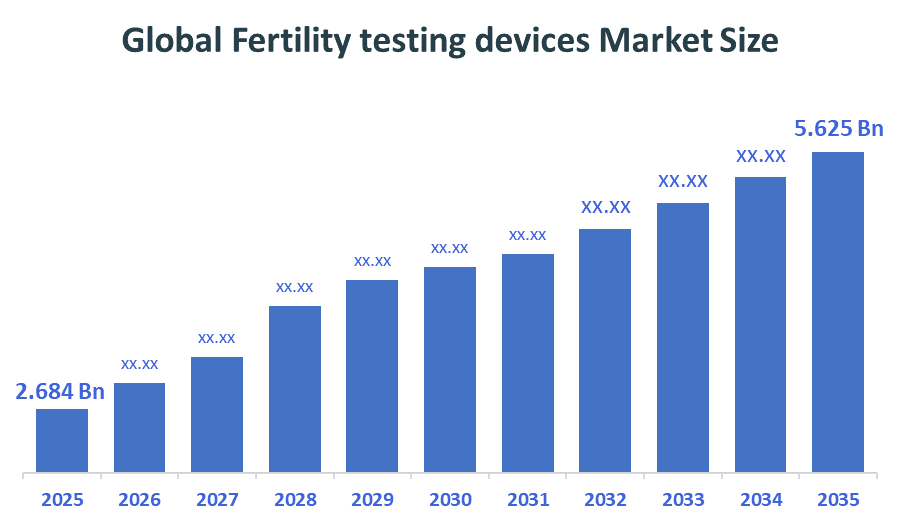
The Global Fertility Testing Devices Market Size is projected USD 2.684 Billion in 2025 and is forecasted to reach around USD 5.625 Billion by 2035. According to Decision Advisors, a detailed report on analysis of the Global Fertility testing devices Market indicates that the Home-based Ovulation Prediction Kits (OPKs) trend dominates the market, accounting for approx. 42.01% of the total global demand worldwide. SPD Swiss Precision Diagnostics (Clearblue) dominates the Global Fertility testing devices Market, supported by revenue of approx. USD 600–900 million, due to strong global brand trust, high ovulation kit sales, wide retail distribution, and advanced digital fertility technology adoption.
Market Snapshot
- Global Fertility testing devices Market Size (2025): USD 2.684 Billion
- Projected Global Fertility testing devices Market Size (2035): USD 5.625 Billion
- Global Fertility testing devices Compound Annual Growth Rate (CAGR): 7.68%
- Largest Regional Market: Asia pacific
- Fastest Growing Region: North America
- 3rd Largest Region: Europe
- Base Year: 2025
- Historical Period: 2021–2024
- Forecast Period: 2026–2035
Market Overview/ Introduction
Market for fertility testing devices implies the industry associated with the creation, manufacturing, and distribution of diagnostic equipment that allows estimating a person's reproductive abilities. Fertility testing devices are devices developed and intended for testing the presence of certain hormones, checking the ovulation period, evaluating sperm quality, among others, making it easier for people to conceive. The products are applied in such cases as family planning, conception planning, diagnosis of infertility, and overall monitoring of reproductive health. Ovulation prediction kits, fertility monitors, and at-home sperm tests represent examples of popular products within the category. The market is expected to expand rapidly due to rising infertility rates, postponing pregnancy periods, high awareness about reproductive health, and growing popularity of privacy and convenience-oriented products. Changes in lifestyles, increased stress, obesity, and environmental factors have contributed to the growth of fertility problems. Technological trends in this sphere involve artificial intelligence-powered fertility monitoring, smartphone connectivity, hormone sensors, digital health apps, and other similar innovations. Wearable fertility monitors and home pregnancy tests that are comparable to those used in laboratories are revolutionizing the consumer diagnostics industry. In addition, awareness campaigns about reproductive health and maternity care in some nations have boosted the growth of the market.
- In January 2026: Several state health schemes such as CMCHIS and Karnataka ArK support subsidized infertility diagnostics and selected ART procedures for eligible low-income couples, improving access to reproductive healthcare.
- In January 2026: NHS provides basic fertility investigations including hormone tests and semen analysis, while national health strategies emphasize infertility awareness and early diagnosis, supporting broader fertility care access.
- In October 2025: Policymakers and employers are expanding fertility benefits and affordability initiatives, including IVF cost support and insurance coverage discussions, improving access to broader fertility care and diagnostics.
Notable Insights: -
- Asia-Pacific holds the largest regional market share approximately 38% in the global Fertility testing devices market.
- North America is the fastest growing region market share approximately 29% in the global Fertility testing devices market.
- By product type, the Ovulation Prediction Kits (OPKs) segment held a dominant position with 45% in terms of market share in 2025.
- By Test Type, urine-based hormone tests segment is the dominating accounting for market is approximately 49%.
- By end user, home care settings segment held a dominant position market is approximately 68%.
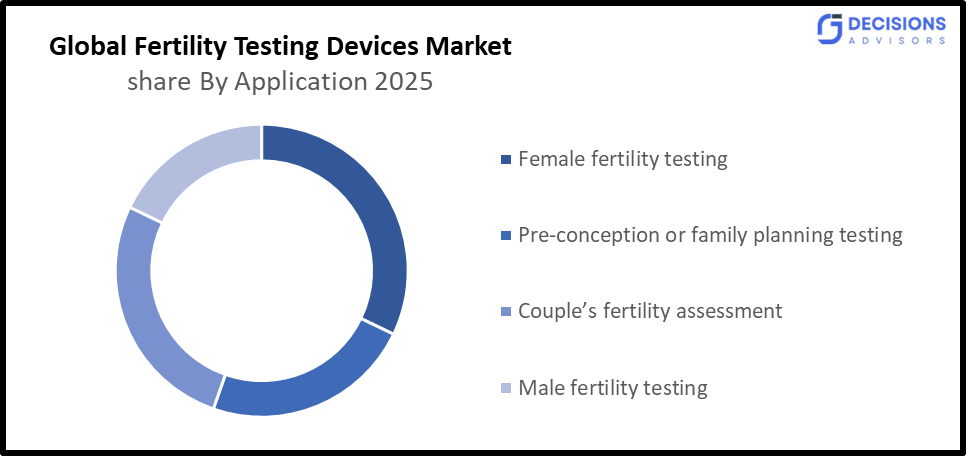
- By Application, female fertility testing segment held a dominant position market is approximately 63%.
- The market is likely to achieve a valuation of USD 5.625 Billion by 2035.
What is role of technology in grooming the market?
Technology has proven important in facilitating growth in the market for fertility test device because of increased accuracy and ease of use. Artificial Intelligence algorithms have been used to analyse cycles of menstruation and hormonal trends to provide accurate predictions about ovulation periods. Smart fertility monitors and wearable technology can collect real-time physiological information, providing fertility-related information. The integration of technology through mobile applications facilitates the collection, storage, and analysis of fertility-related data. Advances in the development of biosensors and digital urine test strips ensure improved accuracy of test results. Cloud-based data analysis provides assistance in reproductive health management over time.
How is Recent Developments Helping the Market?
The latest trends have greatly sped up the development of the fertility testing devices market by making it more accessible, precise, and user-friendly. The advent of artificial intelligence-based fertility monitoring applications and advanced ovulation prediction systems has paved the way for very accurate personal cycle tracking. At-home sperm testing kits and digital hormonal testing systems are being offered by businesses, raising awareness about male fertility testing. The availability of such products via online shopping websites and telemedicine has made it easier and more discreet to use these products. Besides, research and development in the field of biosensors and microfluidics has improved test accuracy.
Market Drivers
Several important factors are fuelling the growth of the fertility testing devices market in the global market environment. An essential factor that plays a crucial role in fostering market growth is the increasing cases of infertility, due to the changing lifestyle, stress, obesity, and late marriages, which require an accurate fertility evaluation. Furthermore, the growing awareness about reproductive health and family planning is driving people to purchase fertility kits. The increasing requirement for easy-to-use products, which do not involve clinical visits, is another important factor fuelling the growth of the market. The development of new technologies, such as artificial intelligence-based fertility trackers, wearable devices, and smart device-based monitors, can significantly improve accuracy levels. Moreover, the growing popularity of online sales and remote services, such as telehealth, is enhancing the availability of products across the globe. The increasing male infertility awareness is another factor driving the demand for sperm testing kits. In addition, various government initiatives to promote maternal health and reproductive health education programs in different countries have also contributed to market growth.
Restrain
The fertility testing devices market faces several restraints, including the high cost of advanced digital fertility monitors, which limits adoption in price-sensitive regions. Inaccurate results from low-quality OTC kits can reduce consumer trust. Lack of awareness in developing countries also restricts market penetration. Additionally, emotional sensitivity and social stigma around infertility testing discourage usage. Regulatory challenges and limited clinical validation of some home-based devices further hinder market growth globally.
Competitive Analysis:
The report offers the appropriate analysis of the key organizations/companies involved within the Fertility testing devices market, along with a comparative evaluation primarily based on their Product of offering, business overviews, geographic presence, enterprise strategies, segment market share, and SWOT analysis. The report also provides an elaborative analysis focusing on the current news and developments of the companies, which includes Product development, innovations, joint ventures, partnerships, mergers & acquisitions, strategic alliances, and Others. This allows for the evaluation of the overall competition within the market.
Top Companies in Global Fertility testing devices Market
- SPD Swiss Precision Diagnostics (Clearblue)
- Church & Dwight Co., Inc. (First Response)
- Abbott Laboratories
- QuidelOrtho Corporation
- bioMérieux
- Siemens Healthineers
- Proov
- Mira (Quanovate Tech)
- Fertility Focus Ltd
- Fairhaven Health
Government Initiatives
|
Country |
Key Government Initiatives |
|
U.S.
|
In February 2026: FDA regulates fertility testing devices such as OPKs and digital hormone trackers as medical devices, while telehealth expansion supports remote reproductive monitoring and clinical integration of results. |
|
Germany |
In January 2026: Europe’s publicly funded healthcare systems and insurance coverage for fertility diagnostics are supporting early testing and awareness. Germany leads in coverage, driving adoption of clinic and home-based fertility testing devices. |
|
Switzerland |
In November 2025: WHO issued its first global infertility guideline, promoting safer and equitable fertility care with 40 recommendations covering diagnosis, treatment, hormone testing, and semen analysis worldwide. |
Study on the Supply, Demand, Distribution, and Market Environment of Fertility testing devices Market
In this regard, the market for fertility testing products can be said to have a delicate balance of supply, demand, distribution, and market environment. On the supply side, the global brands such as Clearblue, Abbott, and the femtech companies are ramping up their production of ovulation test kits, fertility monitoring devices, and semen analysis products. On the demand side, there are more patients who need such products because of infertility and delayed pregnancy issues. There has also been a greater awareness of reproductive health. On the distribution side, the availability of these products in pharmacies and through online retail platforms is increasing.
Price Analysis and Consumer Behaviour Analysis
In the market for fertility testing devices, there exists a considerable difference in the pricing pattern, based on types and technologies employed in each device. Simple ovulation prediction kits have lower prices, whereas more sophisticated digital and artificial intelligence-assisted devices have comparatively higher prices, restricting their acceptance in price-sensitive geographies. The premium category of self-testing sperm analysers too falls into the category of higher-priced devices, because of the presence of advanced biosensors. Privacy, convenience, and ease of use play a significant role in influencing consumer behaviour towards choosing home testing kits. Preference is exhibited towards over-the-counter products purchased from drug stores and online sources. Enhanced awareness about health issues, delayed pregnancies, and infertility issues are making consumers buy ovulation kits multiple times.
Market Segmentation
The Fertility testing devices market share is classified into mounting product type, test type, application, and end user
- The product type segment dominated the market in 2025, and is projected to grow at a substantial CAGR of approximately 5.5% during the forecast period.
Based on the product type, the fertility testing devices market is divided into ovulation prediction kits (OPKS), fertility monitors, and male fertility testing devices. Among these, Ovulation Prediction Kits (OPKs) dominate globally. They hold the largest market share due to their affordability, ease of use, wide OTC availability, and strong adoption for natural conception planning. OPKs account for approximately 42%–48% of the total market share worldwide. The segment is also expected to grow steadily at a CAGR of around 5.3%–5.8% during the forecast period. Continuous demand from women tracking ovulation cycles and increasing awareness of fertility health further support OPKs’ leadership position globally.
Top of Form
- The Test Type segment accounted for the largest share in 2025, and is anticipated to grow at a significant CAGR of approximately 5.6% during the forecast period.
Based on the test type, the fertility testing devices market is divided into urine-based hormone tests, blood-based fertility hormone tests, digital/app-connected fertility tracking devices, and semen analysis technologies. Among these, urine-based hormone tests dominate the fertility testing devices market globally. These include ovulation prediction strips and kits that detect luteinizing hormone (LH) surges, helping identify peak fertility days. Their dominance is driven by low cost, easy usage, and wide availability in pharmacies and online platforms. Urine-based tests account for approximately 45%–50% of the total market share worldwide. The segment is projected to grow at a CAGR of around 5.2%–5.7% during the forecast period, supported by rising demand for convenient home-based fertility monitoring solutions.
- The Application segment dominated the market in 2025, and is projected to grow at a substantial CAGR of approximately 8.8% during the forecast period.
Based on the application, the fertility testing devices market is divided into female fertility testing, male fertility testing, couples’ fertility assessment, and pre-conception or family planning testing. Among these, female fertility testing dominates the fertility testing devices market globally. This segment leads due to widespread use of ovulation prediction kits, fertility monitors, and hormonal testing devices for cycle tracking and conception planning. Rising awareness of reproductive health, delayed pregnancies, and increasing infertility rates among women further support its dominance. Female fertility testing accounts for approximately 60%–65% of the total market share. It is projected to grow at a CAGR of around 5.3%–5.8% during the forecast period, driven by strong demand for home-based and digital fertility solutions.
Bottom of Form
- The end user segment dominated the market in 2025, and is projected to grow at a substantial CAGR of approximately 6% during the forecast period.
Based on the end user, the fertility testing devices market is divided into home care settings, fertility clinics, hospitals, and diagnostic laboratories. Among these, home care settings dominate the fertility testing devices market globally. This segment leads due to the rising preference for privacy, convenience, and cost-effective self-testing solutions. Increasing availability of ovulation kits, digital fertility monitors, and smartphone-connected devices has significantly boosted adoption in home environments. Home care settings account for approximately 65%–70% of the total market share worldwide. The segment is projected to grow at a CAGR of around 5.5%–6.0% during the forecast period, driven by growing awareness of reproductive health and expanding e-commerce distribution channels.
Top of Form
Bottom of Form
Strategies to Implement for Growth of the Market in Non-Leading Regions
In order to penetrate the fertility testing device market in non-domesticated countries, such as certain regions of Asia-Pacific, Latin America, and Africa, a number of measures could be implemented. These include improving affordability, increasing consumer awareness, and making the products more accessible to the customers. First of all, introducing inexpensive ovulation strips and fertility devices would help achieve this goal. Secondly, strengthening the sales channel through the use of pharmacies, clinics, and even e-commerce platforms can contribute to reaching customers in rural and semi-urban regions. Campaigns are needed to remove any taboos concerning infertile patients and to provide consumers with information on reproductive health issues. Partnership with public health institutions in the region can also help introduce fertility testing devices in the context of broader maternal health care programs. Finally, creating applications in multiple languages for fertility testing will increase customer engagement.
Regional Segment Analysis of the Fertility testing devices Market
- North America (U.S., Canada, Mexico)
- Europe (Germany, France, U.K., Italy, Spain, Rest of Europe)
- Asia-Pacific (China, Japan, India, Rest of APAC)
- South America (Brazil and the Rest of South America)
- The Middle East and Africa (UAE, South Africa, Rest of MEA)
Asia pacific is anticipated to hold the largest share of the fertility testing devices market over the predicted timeframe.
Asia Pacific is expected to dominate the fertility testing devices market due to its large population base, rising infertility rates, increasing awareness of reproductive health, and rapid adoption of home-based diagnostic solutions. Growing urbanization, delayed pregnancies, and expanding e-commerce access further support demand. Government initiatives promoting maternal health also strengthen market growth. The region is projected to hold over 38% market share, reaching approximately USD 1.4 billion by 2033, growing at a CAGR of around 6.2% during the forecast period.
North America is expected to grow at a rapid CAGR in the fertility testing devices market during the forecast period. North America is expected to grow at a rapid CAGR due to high infertility awareness, strong healthcare infrastructure, and early adoption of advanced fertility testing technologies like AI-based monitors and digital ovulation kits. Increasing delayed pregnancies and lifestyle-related fertility issues further drive demand. The region benefits from widespread availability through pharmacies, e-commerce, and fertility clinics. North America holds approximately 28%–30% of the global fertility testing devices market revenue, growing at a CAGR of around 5.8% during the forecast period. High disposable income and strong presence of key players like Clearblue and Abbott also support market expansion.
Top of Form
Bottom of Form
Europe is the 3rd largest region to grow in the fertility testing devices market during the region. Europe is the third-largest region in the fertility testing devices market due to high awareness of reproductive health, supportive healthcare systems, and increasing adoption of at-home diagnostic solutions. Delayed pregnancies, rising infertility rates, and strong demand for digital fertility tracking tools are key growth drivers. However, growth is moderate compared to Asia Pacific and North America due to market maturity. Europe is projected to reach approximately USD 0.9 billion by 2033, growing at a CAGR of around 5.2% during the forecast period.
Future Market Trends in Global Fertility testing devices Market: -
- AI-Powered Fertility Tracking
AI-based fertility tracking will become a major trend, using algorithms to analyze menstrual cycles, hormone levels, and lifestyle data. These tools provide highly accurate ovulation predictions and personalized fertility insights. Integration with smartphones and wearable devices enhances real-time monitoring and convenience. This trend is driven by demand for precision, convenience, and digital healthcare solutions, making fertility planning more efficient and user-friendly worldwide.
2. Expansion of Male Fertility Testing
Male fertility testing will grow rapidly with at-home semen analysis kits and digital diagnostic tools. Rising awareness of male infertility, which contributes significantly to conception issues, is driving demand. These devices offer privacy, quick results, and affordability compared to clinical testing. Innovations in biosensors and microfluidics are improving accuracy, encouraging more men to participate in fertility assessment and early diagnosis.
- Growth of Home-Based Diagnostic Devices
Home-based fertility testing devices will dominate future demand due to convenience, privacy, and cost-effectiveness. Consumers increasingly prefer ovulation kits, digital monitors, and app-connected devices for self-testing without clinical visits. E-commerce expansion and telehealth integration further support adoption. This trend is fuelled by lifestyle changes, delayed pregnancies, and growing awareness of reproductive health, making at-home fertility management a global standard.
Recent Development
- In January 2026: Mira Ultra4, an at-home hormone monitor, measures FSH, LH, E3G, and PdG using fluorescent immunoassay technology, providing lab-quality fertility insights for ovulation, PCOS, and cycle health tracking.
- In January 2025: Eli Health launched its Hormometer at CES 2025, a smartphone-based saliva hormone analyser for at-home cortisol testing, later expanding to progesterone and testosterone to support fertility and wellness monitoring.
Market Segment
This study forecasts revenue at global, regional, and country levels from 2021 to 2035. Decision Advisors has segmented the fertility testing devices market based on the below-mentioned segments:
Global Fertility testing devices Market, By Product Type
- Ovulation Prediction Kits (OPKs)
- Fertility Monitors
- Male Fertility Testing Devices
Global Fertility testing devices Market, By Test Type
- Urine-based hormone tests
- Blood-based fertility hormone tests
- Digital/app-connected fertility tracking devices
- Semen analysis technologies
Global Fertility testing devices Market, By Application
- Female fertility testing
- Male fertility testing
- Couple’s fertility assessment
- Pre-conception or family planning testing
Global Fertility testing devices Market, By End User
- Home care settings
- Fertility clinics
- Hospitals
- Diagnostic laboratories
Global Fertility testing devices Market, By Regional Analysis
- North America
- US
- Canada
- Mexico
- Europe
- Germany
- UK
- France
- Italy
- Spain
- Russia
- Rest of Europe
- Asia Pacific
- China
- Japan
- India
- South Korea
- Australia
- Rest of Asia Pacific
- South America
- Brazil
- Argentina
- Rest of South America
- Middle East & Africa
- UAE
- Saudi Arabia
- Qatar
- South Africa
- Rest of the Middle East & Africa
Frequently Asked Questions (FAQ)
1. What factors are shaping the future demand for fertility testing devices?
Future demand is being shaped by rising digital health adoption, increasing preference for self-monitoring solutions, and growing integration of fertility data with telehealth platforms. Additionally, improvements in sensor accuracy and AI-driven cycle interpretation are making devices more reliable, encouraging broader consumer acceptance across both developed and emerging economies.
2. How is the competitive landscape evolving in this market?
The competitive landscape is evolving with strong entry of femtech startups alongside established diagnostics companies. Innovation-led competition is focusing on multi-hormone testing, app-based ecosystems, and subscription-based fertility tracking services. Strategic collaborations between healthcare providers and digital health companies are also increasing, enhancing product credibility and market penetration.
3. What role do digital health ecosystems play in market expansion?
Digital health ecosystems are enabling seamless integration of fertility data into broader wellness platforms. Mobile applications, cloud analytics, and connected devices allow users to track reproductive health continuously. This integration improves user engagement, encourages long-term monitoring, and supports personalized fertility insights, thereby expanding the overall adoption of diagnostic solutions.
4. How is consumer behaviour influencing product innovation?
Consumer preference for convenience, privacy, and quick results is driving innovation toward compact, user-friendly devices. Demand for real-time results and minimal clinical dependency is pushing companies to develop portable, app-synced testing solutions. This shift is also encouraging subscription models and bundled fertility wellness services tailored to individual reproductive needs.
5. What opportunities exist for new entrants in this market?
New entrants can focus on underserved markets by offering affordable, simplified testing solutions and localized digital platforms. Opportunities also exist in developing AI-powered predictive tools, multi-hormone analysis devices, and fertility wellness integrations. Partnerships with telehealth providers and expansion into preventive reproductive health solutions can further enhance market entry success.
Check Licence
Choose the plan that fits you best: Single User, Multi-User, or Enterprise solutions tailored for your needs.
We Have You Covered
- 24/7 Analyst Support
- Clients Across the Globe
- Tailored Insights
- Technology Tracking
- Competitive Intelligence
- Custom Research
- Syndicated Market Studies
- Market Overview
- Market Segmentation
- Growth Drivers
- Market Opportunities
- Regulatory Insights
- Innovation & Sustainability
Report Details
| Scope | Global |
| Pages | 210 |
| Delivery | PDF & Excel via Email |
| Language | English |
| Release | Apr 2026 |
| Access | Download from this page |