
Global Fish Vaccines Market
 |
Author:
Disha B
|
Pages:
240
|
Author:
Disha B
|
Pages:
240
Global Fish Vaccines Market Size, Share by Product Type (Inactivated Vaccines, Live Attenuated Vaccines, DNA Vaccines, Recombinant Vaccines), By Route of Administration (Injection Vaccination, Immersion Vaccination, Oral Vaccination), By Species (Salmon, Tilapia, Carp, Trout, Others), By Application (Bacterial Diseases, Viral Diseases, Parasitic Diseases, Others), By End User (Aquaculture Farms, Hatcheries, Research Institutes) and By Region (North America, Europe, Asia-Pacific, Latin America, Middle East & Africa), Analysis and Forecast 2025-2035
CAGR
9.63%
REVENUE 2025
USD Million 415.2
FORECAST 2035
USD Million 1041.1
REPORT COVERAGE
Global
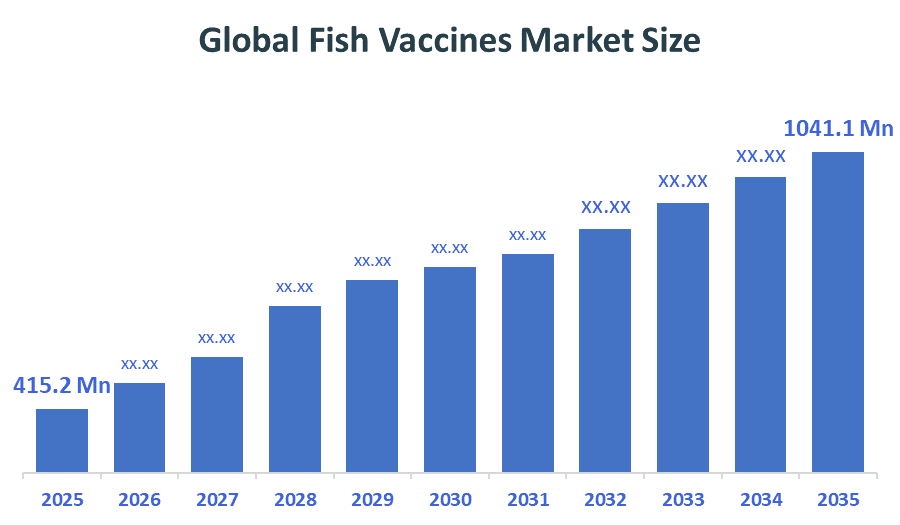
The Global Fish Vaccines Market Size is foreseen to grow from USD 415.2 Million in 2025 and is govern to reach around USD 1041.1 Million by 2035. According to Decision Advisors, a detailed research report on the global fish vaccines market is boosted by a shift toward sustainable aquaculture practices, accounting for nearly upto the 50% to 60% share of the total share worldwide. Zoetis Inc. is the prime player in the market with approximately $285 million in annual turnover and a 35-50% market share, positioning it as the primary driver of the global fish vaccines market.
Market Snapshot
- Global Fish Vaccines Market Size (2025): USD 415.2 Million
- Projected Global Fish Vaccines Market Size (2035): USD 1041.1 Million
- Global Fish Vaccines Market Compound Annual Growth Rate (CAGR): 9.63%
- Largest Regional Market: North America
- Fastest Growing Region: Asia Pacific
- 2nd Largest Region: Europe
- Base Year: 2025
- Historical Period: 2021–2024
- Forecast Period: 2026–2035
Market Overview/ Introduction
The Global Fish Vaccines Market, also known as the aquaculture vaccines market, refers to the industry focused on developing and distributing biological preparations that stimulate the immune systems of farmed aquatic species like fish and shrimp to provide resistance against viral, bacterial, and parasitic pathogens. Basically, the industry's heavy hitters like Zoetis and Merck are moving far beyond basic injections. They are now diving into high-tech DNA vaccines and using specialised robots that can vaccinate thousands of fish in record time with total precision. But the real dream that everyone is chasing and the biggest opportunity for future growth is perfected oral vaccines. Imagine just mixing the medicine directly into the fish's food. It’s a win-win: the fish stay calm because they aren't being handled, and farmers save a massive amount of time and manual labour. Making this work reliably at scale is the next big frontier for the market, as massive producers in Asia (like China and Vietnam) start adopting these higher standards, the market is expected to more than double in size over the next decade.
- ICAR-CIBA and Indian Immunologicals Limited enter into an agreement for the commercial development of a fish vaccine.
- IIL has signed partnerships with at least three major ICAR institutes (CIFE, CIFA, and CIBA) to develop vaccines for bacterial and viral diseases in fish, showing a strong multi-institutional collaboration model.
- Companies like MSD Animal Health are collaborating with aquaculture producers by offering integrated vaccine programs alongside digital monitoring and disease management solutions, strengthening long-term partnerships.
Notable Insights: -
- North America is anticipated to hold the largest share, approximately 35% of the global fish vaccines market over the predicted timeframe.
- Asia Pacific is expected to grow at the fastest CAGR in the Global Fish Vaccines Market during the forecast period.
- By product type, the thoracoscopes segment dominated the market in 2025 with approximately 45% share, and is projected to grow at a substantial CAGR during the forecast period.
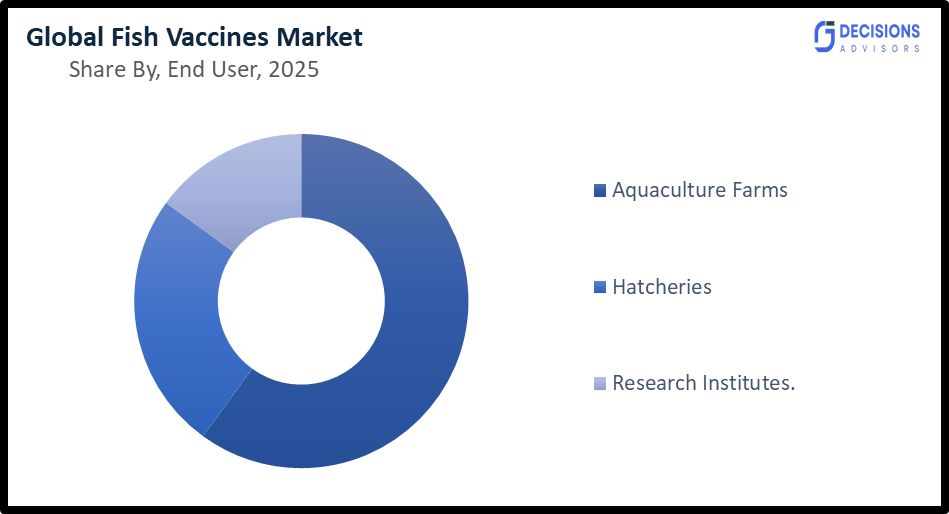
- By end user, the aquaculture farms segment dominated the market in 2025 with approximately 65% share, and is projected to grow at a substantial CAGR during the forecast period.
- The compound annual growth rate of the Global Fish Vaccines Market is 9.63%.
- The market is likely to achieve a valuation of USD 1041.1 Million by 2035.
What is the role of technology in grooming the market?
Technology plays a crucial role in shaping the fish vaccines market by enabling the development of advanced vaccines such as DNA and recombinant vaccines, which offer higher efficacy and longer protection. Innovations in delivery methods, including oral and immersion vaccination, have improved ease of administration in large-scale aquaculture operations. Additionally, advancements in biotechnology, diagnostics, and precision aquaculture help in early disease detection and targeted immunization, reducing mortality rates and improving overall productivity. These technological improvements are driving adoption and supporting the sustainable growth of the market.
Market Drivers
First, we have a massive demand for seafood, but as fish farms get more crowded to keep up, diseases spread like wildfire. To avoid losing half their stock overnight, farmers are treating vaccines like a high-tech insurance policy. Second, there’s a huge push to get antibiotics out of our food. Governments are tightening the rules, and shoppers today want to know their salmon wasn't pumped full of drugs. This shift makes vaccines the only real way to keep fish healthy while keeping the organic or sustainable labels people want. Lastly, it’s about making life easier. New tech, like robots that can vaccinate thousands of fish in an hour or the dream of just "feeding" the vaccine to them in their pellets, is removing the old-school headache of manual labor. It’s basically moving fish farming from a react-to-crisis business to a prevention first high-tech industry.
Restrain
The fish vaccines market faces several restraints, including the high cost of vaccine development and administration, which can limit adoption among small-scale aquaculture farmers. Additionally, challenges in mass vaccination methods, such as handling stress during injection and inconsistent efficacy in oral delivery, hinder widespread use.
Competitive Analysis:
The report offers the appropriate analysis of the key organizations/companies involved within the global fish vaccines market, along with a comparative evaluation primarily based on their product of offering, business overviews, geographic presence, enterprise strategies, segment market share, and SWOT analysis. The report also provides an elaborative analysis focusing on the current news and developments of the companies, which includes product development, innovations, joint ventures, partnerships, mergers & acquisitions, strategic alliances, and others. This allows for the evaluation of the overall competition within the market.
Top Companies in the Global Fish Vaccines Market
- Zoetis Inc.
- Merck Animal Health
- Elanco Animal Health
- HIPRA
- Vaxxinova International
- Phibro Animal Health Corporation
- Ceva Santé Animale
- KBNP
- Nisseiken Co., Ltd.
- Kyoto Biken Laboratories, Inc.
Government Initiatives
|
Country |
Key Government Initiatives |
|
UK |
A project focused on vaccinating ballan wrasse (cleaner fish) against bacterial disease (Aeromonas salmonicida) received nearly £40,000 from the Sustainable Aquaculture Innovation Centre (SAIC) to improve sea lice control. |
|
US |
The U.S. government supports fish vaccine development through funding programs and national aquaculture strategies. For instance, the Foundation for Food & Agriculture Research (FFAR) funded around USD 790,000 in 2021 to develop vaccine delivery systems for tilapia diseases. |
|
Vietnam |
Vietnam has received international and government-backed funding for vaccine development in aquaculture. For example, a project led by the University of Stirling secured over USD 1 million in 2024 to support fish vaccine development and adoption in Vietnamese aquaculture, particularly to combat antimicrobial resistance. |
Study on the Supply, Demand, Distribution, and Market Environment of the Global Fish Vaccines Market
The global fish vaccines market demonstrates a balanced interaction between supply, demand, distribution, and market environment. On the supply side, major pharmaceutical and animal health companies leverage strong R&D capabilities and global production networks to develop advanced vaccines, including DNA and recombinant types. Demand is primarily driven by the rising incidence of diseases in aquaculture and increasing global seafood consumption, which pushes farmers toward preventive vaccination to reduce losses and improve yield. Distribution is supported by veterinary clinics, aquaculture service providers, and increasingly by e-commerce platforms, ensuring wider accessibility even in remote farming regions. The overall market environment is shaped by regulatory frameworks, government support for sustainable aquaculture, and growing emphasis on reducing antibiotic use, collectively fostering steady market growth.
Price Analysis and Consumer Behaviour Analysis
Price analysis in the fish vaccines market indicates that costs are relatively high due to advanced R&D, stringent regulatory requirements, and specialized storage and transportation needs. Prices vary based on vaccine type, administration method, and species targeted, with injectable vaccines generally being more expensive than oral or immersion alternatives. From a consumer behavior perspective, aquaculture farmers prioritize cost-effectiveness, ease of administration, and proven efficacy when selecting vaccines. Larger commercial farms are more inclined to adopt advanced and premium vaccines, while small-scale farmers remain price-sensitive, often limiting adoption despite awareness of long-term benefits.
Market Segmentation
The Global Fish Vaccines Market share is classified into product type, route of administration, species, application and end user.
- The inactivated vaccines segment dominated the market in 2025 with approximately 40% share, and is projected to grow at a substantial CAGR during the forecast period.
Based on the product type, the global fish vaccines market is divided into inactivated vaccines, live attenuated vaccines, DNA vaccines, and recombinant vaccines. Among these, the inactivated vaccines segment dominated the market in 2025 with approximately 40% share, and is projected to grow at a substantial CAGR during the forecast period, owing to their high safety and regulatory acceptance. For instance, in Norway’s salmon farming industry, inactivated vaccines are widely used to control bacterial diseases such as furunculosis, significantly reducing antibiotic usage. Live attenuated vaccines accounted for nearly 25%, followed by recombinant vaccines at around 20%, while DNA vaccines held the remaining share due to their emerging but promising adoption.
- The injection vaccination segment accounted for the largest share in 2025 with approximately 55%, and is anticipated to grow at a significant CAGR during the forecast period.
Based on the route of administration, the global fish vaccines market is divided into injection vaccination, immersion vaccination, and oral vaccination. Among these, the injection vaccination segment accounted for the largest share in 2025 with approximately 55%, and is anticipated to grow at a significant CAGR during the forecast period, driven by its higher efficacy and longer immunity duration. For example, Atlantic salmon farms in Chile and Norway commonly use injectable vaccines before sea transfer to ensure strong disease protection. Immersion vaccination contributed nearly 30%, especially for juvenile fish, while oral vaccination held around 15% due to ongoing advancements in feed-based delivery systems.
- The salmon segment dominated the market in 2025 with approximately 35% share, and is projected to grow at a substantial CAGR during the forecast period.
Based on the species, the global fish vaccines market is divided into salmon, tilapia, carp, trout, and others. Among these, the salmon segment dominated the market in 2025 with approximately 35% share, and is projected to grow at a substantial CAGR during the forecast period, owing to its high commercial value and intensive farming practices. For instance, countries like Norway and Chile heavily invest in vaccination programs for salmon to prevent large-scale economic losses from diseases such as sea lice and bacterial infections.
- The bacterial diseases segment accounted for the largest share in 2025 with approximately 50%, and is anticipated to grow at a significant CAGR during the forecast period.
Based on the application, the global fish vaccines market is divided into bacterial diseases, viral diseases, parasitic diseases, and others. Among these, the bacterial diseases segment accounted for the largest share in 2025 with approximately 50%, and is anticipated to grow at a significant CAGR during the forecast period, driven by the widespread occurrence of bacterial infections in aquaculture. For example, vaccines targeting Aeromonas salmonicida and Vibrio species are extensively used across Europe and Asia to reduce mortality rates. Viral diseases contributed nearly 30%, parasitic diseases around 15%, and other applications held the remaining share.
- The aquaculture farms segment dominated the market in 2025 with approximately 65% share, and is projected to grow at a substantial CAGR during the forecast period.
Based on the end user, the global fish vaccines market is divided into aquaculture farms, hatcheries, and research institutes. Among these, the aquaculture farms segment dominated the market in 2025 with approximately 65% share, and is projected to grow at a substantial CAGR during the forecast period, due to direct application of vaccines at commercial farming sites. For instance, large aquaculture companies such as Mowi and Cermaq implement routine vaccination programs to ensure fish health and maintain export quality standards.
Strategies to Implement for Growth of the Market in Non-Leading Regions
To drive growth in non-leading regions, companies should focus on increasing awareness among small and mid-scale aquaculture farmers through training programs and government-backed extension services. Expanding affordable vaccine options, particularly oral and immersion vaccines, can improve adoption where cost and infrastructure are constraints. Strategic partnerships with local distributors and aquaculture cooperatives can strengthen distribution networks and accessibility. Additionally, investing in region-specific R&D to address local fish species and disease profiles, along with supportive government policies and subsidies, will play a key role in accelerating market penetration.
Regional Segment Analysis of the Global Fish Vaccines Market
- North America (U.S., Canada, Mexico)
- Europe (Germany, France, U.K., Italy, Spain, Rest of Europe)
- Asia-Pacific (China, Japan, India, Rest of APAC)
- South America (Brazil and the Rest of South America)
- The Middle East and Africa (UAE, South Africa, Rest of MEA)
North America is anticipated to hold the largest share, approximately 35% of the global fish vaccines market over the predicted timeframe.
North America is anticipated to hold the largest share, approximately 35% of the global fish vaccines market over the predicted timeframe. The region dominates due to its advanced aquaculture practices and strong regulatory framework, particularly in the United States and Canada, where there is high adoption of fish health management solutions. The presence of leading animal health companies, well-established cold chain infrastructure, and increasing focus on reducing antibiotic usage are driving demand for fish vaccines. Additionally, continuous R&D investments and government support for sustainable aquaculture further strengthen regional growth.
Asia Pacific is expected to grow at the fastest CAGR in the global fish vaccines market during the forecast period.
Asia Pacific is expected to grow at the fastest CAGR in the global fish vaccines market during the forecast period. The growth is driven by the rapid expansion of aquaculture production in countries such as China, India, Vietnam, and Indonesia. Increasing seafood consumption, rising awareness about disease prevention, and improving aquaculture infrastructure are fueling vaccine adoption. Additionally, government initiatives supporting fisheries development and the presence of a large number of small and commercial fish farms are accelerating market expansion across the region.
Europe is the third largest region in the global fish vaccines market during the forecast period.
Europe is the third largest region in the global fish vaccines market during the forecast period. The region is characterised by a highly developed aquaculture industry, particularly in countries like Norway and Scotland. Strict regulations on antibiotic use and strong emphasis on fish welfare are key factors driving the adoption of vaccines. Furthermore, the presence of advanced vaccine technologies, established industry players, and increasing investments in sustainable aquaculture practices are supporting steady market growth across the region.
Future Market Trends in the Global Fish Vaccines Market: -
1. Rising adoption of advanced vaccine technologies is a key future trend in the Global Fish Vaccines Market.
The market is witnessing a shift toward next-generation vaccines such as DNA, recombinant, and subunit vaccines, which offer higher efficacy, targeted immune response, and longer protection. Continuous R&D investments and innovations are accelerating the development of species-specific and disease-specific vaccines, improving overall fish health management.
2. The growing shift toward oral and immersion vaccines for large-scale aquaculture is a major emerging trend.
Traditional injection methods are being complemented by oral and immersion vaccines due to their ease of administration, cost-effectiveness, and suitability for mass vaccination. These methods reduce handling stress and labour costs, making them highly attractive for large aquaculture farms, especially in developing regions.
3. Increasing focus on sustainable aquaculture and reduction of antibiotic use is driving market evolution.
There is a global push toward minimising antibiotic usage due to antimicrobial resistance concerns, leading to higher adoption of vaccination as a preventive approach. Government regulations and sustainability initiatives are encouraging fish farmers to adopt vaccines to improve productivity, ensure food safety, and reduce environmental impact.
Recent Development
- In July 2025, a fish vaccination trial was launched in North Bengal at a hatchery in Jalpaiguri by the Fisheries Department under the Krishi Vigyan Kendra. The initiative involved vaccinating species such as Rohu and Catla using the CIFA BROOD vaccine to improve immunity and enhance survival rates of fish fry.
- In January 2023, Indian Immunologicals Limited announced plans to launch fish vaccines in collaboration with the Central Institute of Fisheries Education (CIFE) for the commercial development of vaccines targeting common bacterial diseases in freshwater fish.
- In April 2021, the ICAR–Central Institute of Brackishwater Aquaculture (CIBA) launched India’s first homegrown fish vaccine, named CIBA-Nodavac-R, to combat viral nervous necrosis (VNN). The recombinant vaccine was developed to protect multiple fish species from a highly lethal viral disease that can cause up to 100% mortality in early life stages, marking a significant milestone in India’s aquaculture health sector.
- In November 2022, Indian Immunologicals Limited (IIL) partnered with the Central Institute of Fisheries Education (CIFE) to commercially develop fish vaccines targeting common bacterial diseases in freshwater species. The collaboration aimed to introduce India’s first large-scale fish vaccination solutions, leveraging CIFE’s technology for inactivated vaccines against diseases such as Columnaris and Edwardsiellosis, which cause significant economic losses in aquaculture.
How are recent developments helping the Market?
Recent developments are significantly supporting the growth of the fish vaccines market by improving vaccine effectiveness, accessibility, and adoption rates. Innovations in DNA and recombinant vaccines are enhancing disease-specific protection, while advancements in oral and immersion delivery methods are making large-scale vaccination more practical and cost-efficient. Additionally, increasing partnerships between aquaculture companies and biotech firms, along with government initiatives promoting sustainable aquaculture and reduced antibiotic use, are accelerating market expansion and encouraging wider adoption across both developed and emerging regions.
Market Segment
This study forecasts revenue at global, regional, and country levels from 2020 to 2035. Decision Advisors has segmented the global fish vaccines market based on the below-mentioned segments:
Global Fish Vaccines Market, By Product Type
- Inactivated Vaccines
- Live Attenuated Vaccines
- DNA Vaccines
- Recombinant Vaccines
Global Fish Vaccines Market, By Route of Administration
- Injection Vaccination
- Immersion Vaccination
- Oral Vaccination
Global Fish Vaccines Market, By Species
- Salmon
- Tilapia
- Carp
- Trout
- Others
Global Fish Vaccines Market, By Application
- Bacterial Diseases
- Viral Diseases
- Parasitic Diseases
- Others
Global Fish Vaccines Market, By End User
- Aquaculture Farms
- Hatcheries
- Research Institutes
Global Fish Vaccines Market, By Regional Analysis
- North America
- US
- Canada
- Mexico
- Europe
- Germany
- UK
- France
- Italy
- Spain
- Russia
- Rest of Europe
- Asia Pacific
- China
- Japan
- India
- South Korea
- Australia
- Rest of Asia Pacific
- South America
- Brazil
- Argentina
- Rest of South America
- Middle East & Africa
- UAE
- Saudi Arabia
- Qatar
- South Africa
- Rest of the Middle East & Africa
Frequently Asked Questions (FAQ)
Q1. What is the average cost of fish vaccination in aquaculture?
A. The cost of fish vaccination varies depending on the species, vaccine type, and method of administration, but it generally ranges from a few cents to a few dollars per fish, with injection vaccines being more expensive than oral or immersion methods.
Q2. What are the key challenges associated with fish vaccination?
A. Major challenges include handling stress during vaccination, high labour costs for injection methods, maintaining cold chain logistics, and the limited effectiveness of some oral vaccines.
Q3. How do fish vaccines compare with antibiotics in aquaculture?
A. Fish vaccines are considered more sustainable and environmentally friendly compared to antibiotics, as they prevent diseases rather than treat them and help reduce antimicrobial resistance.
Q4. What level of expertise is required for administering fish vaccines?
A. Skilled labour is required, especially for injection vaccination, where trained personnel are needed to handle fish properly and ensure correct dosage, while immersion and oral methods require less technical expertise.
Q5. How are digital technologies impacting fish vaccination practices?
A. Technologies such as AI, IoT, and data analytics are helping monitor fish health, predict disease outbreaks, and optimise vaccination schedules, improving overall efficiency and outcomes in aquaculture.
Check Licence
Choose the plan that fits you best: Single User, Multi-User, or Enterprise solutions tailored for your needs.
We Have You Covered
- 24/7 Analyst Support
- Clients Across the Globe
- Tailored Insights
- Technology Tracking
- Competitive Intelligence
- Custom Research
- Syndicated Market Studies
- Market Overview
- Market Segmentation
- Growth Drivers
- Market Opportunities
- Regulatory Insights
- Innovation & Sustainability
Report Details
| Scope | Global |
| Pages | 240 |
| Delivery | PDF & Excel via Email |
| Language | English |
| Release | Apr 2026 |
| Access | Download from this page |