
Global Flameproof Lighting Market
 |
Author:
Omkar J
|
Pages:
210
|
Author:
Omkar J
|
Pages:
210
Global Flameproof Lighting Market Size, Share, By Mounting Type (Wall Mounted, Ceiling Mounted, Pole Mounted, and Hand Held), By Light Source (LED, Fluorescent, Incandescent & Halogen, and HID (High-Intensity Discharge)) By End User (Mining, Marine & Off shore, Warehouses, Malls & Auditoriums, Airports & Transit Stations, Industrial, Commercial, and Others), and By Region (North America, Europe, Asia-Pacific, Latin America, Middle East, and Africa), Analysis and Forecast 2026-2035
CAGR
8.15%
REVENUE 2025
USD Million 614.5
FORECAST 2035
USD Million 1345.6
REPORT COVERAGE
Global
Market Snapshot
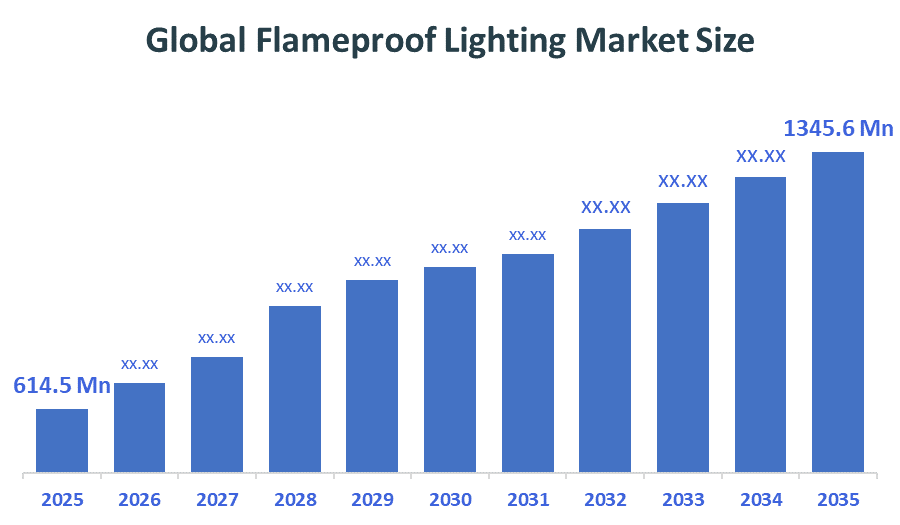
- Global Flameproof Lighting Market Size (2025): USD 614.5 Million
- Projected Global Flameproof Lighting Market Size (2035): USD 1345.6 Million
- Global Flameproof Lighting Compound Annual Growth Rate (CAGR): 8.15%
- Largest Regional Market: Asia pacific
- Fastest Growing Region: North America
- 3rd Largest Region: Europe
- Base Year: 2025
- Historical Period: 2021–2024
- Forecast Period: 2026–2035
Market Overview/ Introduction
Global Flameproof Lighting Market is an industry concerned with manufacturing and supplying light sources that have been developed for areas where explosions caused by flammable gases, vapours, and dust are likely to occur. It refers to special lighting fixtures that are housed in strong cases that are able to contain the explosion and not allow the flames to escape. Flameproof lighting is commonly used in oil & gas, mining, chemical plants, marine, and power generation sectors where there is a higher chance of explosive gases, vapours, and dust being generated in the atmosphere. The use of flameproof lighting helps to ensure safety in such situations. There are several factors driving the growth of the market at the moment. These include technological advances, especially the introduction of LED flameproof lighting that offer significant advantages. There are also regulatory requirements that drive demand in certain markets. Expansion of hazardous zones increases the number of projects where such lighting systems can be deployed. The involvement of governments and safety standards is critical for the success of the market. The implementation of standards and certifications like ATEX and IEX requires the use of certified explosion-proof equipment, which is necessary for compliance and increased adoption.
- In March 2024: ATEX and IECEx safety standards drive demand for flameproof lighting, ensuring compliance in over 70% of oil, gas, and petrochemical hazardous installations across Europe and global industries.
- In March 2024: PESO mandates certification for all flameproof lighting in India’s hazardous zones under the Explosives Act, ensuring compliance across 100% of oil, gas, and chemical industrial installations.
Notable Insights: -
- Asia-Pacific holds the largest regional market share approximately 39% in the global Flameproof lighting market.
- North America is the fastest growing region market share approximately 28% in the global Flameproof lighting market.
- By mounting type, the ceiling mounted segment held a dominant position with 36% in terms of market share in 2025.
- By light source, incandescent & halogen segment is the dominating accounting for market is approximately 40%.
- By end user, industrial segment held a dominant position market is approximately 43%.
- The market is likely to achieve a valuation of USD 1345.6 Million by 2035.
What is role of technology in grooming the market?
The role of technology in the development of the flameproof lighting industry cannot be overstated since it serves as a vital catalyst in increasing safety and effectiveness in operation. LED technology provides better thermal dissipation capabilities, more lumens per watt, and higher lamp lifetimes, reducing the risk of maintenance in harsh environments. In addition, the utilization of Internet of Things technologies and sensors provides for monitoring of fixture condition and energy usage in real-time. Finally, new materials that are used allow for greater protection against corrosion.
How is Recent Developments Helping the Market?
The following trends have been noted to increase the growth of flameproof lighting significantly by helping fill some of the gaps that arise within high-risk industries. First, the launch of fixtures certified by UL, ATEX, and IECEx for use in multiple regions around the world helps reduce the time and costs involved in managing different supplies across countries. LED technology has advanced to be used in areas where very high temperatures exist due to thermal management, which allows LED lights to work even at temperatures of 100 degrees Centigrade. High output lights, such as those with up to 145,000 lumens, as well as easy-to-fit fixtures, have made installation and repair much easier.
Market Drivers
The market growth can be credited to the presence of stringent safety laws in various industrial sectors, including oil and gas, mining, chemicals, and power generation industries. There is a necessity for explosion-proof equipment in order to avoid any untoward incidents; hence, there is an increase in demand for such products. Industrialization along with growth in hazardous working conditions has been driving the market forward. Safety concerns in the workplace and increased risk management have become crucial areas in recent years. The occurrence of many incidents in the industrial environment has increased the demand for flameproof lighting systems. Innovations in technology have resulted in advanced solutions such as LED-based lighting fixtures that ensure durability and long-term value for money. Furthermore, investments in infrastructure construction and energy sector development have provided great potential for growth. Growth in infrastructure construction in developing nations can help propel the market forward. In addition to the above, innovations in smart and corrosion-resistant solutions will aid in expanding the global market reach.
Restrain
The primary restraint is the high initial cost of specialized materials and explosion-proof certifications. Complex installation requirements and strict compliance standards often deter small-scale enterprises. Furthermore, the availability of low-cost, non-certified alternatives in unregulated markets and long product replacement cycles due to fixture durability can hinder rapid market turnover.
Competitive Analysis:
The report offers the appropriate analysis of the key organizations/companies involved within the Flameproof lighting market, along with a comparative evaluation primarily based on their Product of offering, business overviews, geographic presence, enterprise strategies, segment market share, and SWOT analysis. The report also provides an elaborative analysis focusing on the current news and developments of the companies, which includes Product development, innovations, joint ventures, partnerships, mergers & acquisitions, strategic alliances, and Others. This allows for the evaluation of the overall competition within the market.
Top Companies in Global Flameproof lighting Market
- Eaton Corporation
- Hubbell Incorporated
- ABB Ltd.
- Emerson Electric Co.
- Signify N.V.
- GE Current
- Glamox AS
- R. STAHL AG
- Larson Electronics LLC
- Dialight plc
- Phoenix Products Company, Inc.
- Zhejiang Tormin Electrical Co., Ltd.
Government Initiatives
|
Country |
Key Government Initiatives |
|
India
|
In March 2024: India’s PLI scheme for white goods offers 4%–6% incentives on incremental sales of LED components, boosting domestic manufacturing of energy-efficient and flameproof lighting systems. |
|
Germany |
In May 2024: Governments promote industrial upgrades, offering up to 30% subsidies and tax incentives for energy-efficient LED and smart lighting, driving adoption in hazardous flameproof lighting applications globally. |
Study on the Supply, Demand, Distribution, and Market Environment of Flameproof Lighting Market
The market for the flameproof lighting market can be understood through the intricate balance between high-risk applications and changing regulations within the industry. In terms of product developments, there has been a move from traditional lighting to LED and modular lighting systems that are less costly to maintain in hazardous environments. In terms of demand, the key drivers include the growth in energy production and chemical manufacturing, especially in the Asia-Pacific region where new developments are underway. The process of distribution is carried out by industrial specialists or approved distributors who certify installations according to relevant ATEX or IECEx standards.
Price Analysis and Consumer Behaviour Analysis
Pricing follows a high-premium strategy, with LED lamps priced at around $500 each, whereas the non-flameproof version retails at $300 each. Such premium pricing is attributed to the unique material inputs and associated costs of ATEX and IECEx certifications. Buyer behaviour is more inclined towards adherence to regulations than cost considerations. Industrial clients in sectors such as oil, gas, and mining emphasize Total Cost of Ownership (TCO), appreciating the longevity of LEDs and their minimal maintenance requirements in areas with hazardous conditions. While big organizations incorporate smart lighting into their safety budget investments, small enterprises concentrate on meeting minimum regulatory requirements.
Market Segmentation
The Flameproof lighting market share is classified into mounting type, light source, and end user
- The mounting type segment dominated the market in 2025, and is projected to grow at a substantial CAGR of approximately 8.3% during the forecast period.
Based on the type, the flameproof lighting market is divided into wall mounted, pole mounted, hand held and ceiling mounted. Among these, ceiling-mounted flameproof lighting dominates the market. It accounts for around 36% market share in 2025 and is projected to grow at a CAGR of approximately 8.3%. This dominance is due to its ability to provide wide-area illumination, making it ideal for large industrial facilities such as oil & gas plants, warehouses, and chemical units. Ceiling-mounted systems are safer as they remain elevated from hazards, offer uniform light distribution, and comply with strict industrial safety standards, driving higher adoption compared to wall-mounted, pole-mounted, and handheld variants.
Top of Form
- The light source segment accounted for the largest share in 2025, and is anticipated to grow at a significant CAGR of approximately 3% during the forecast period.
Based on the light source, the flameproof lighting market is divided into LED, fluorescent, incandescent & halogen, and HID (high-intensity discharge). Among these, incandescent & halogen-based flameproof lightings currently dominate the market with a share of around 38–42%, mainly due to their extensive use in large-scale thermal Marine & Off shore, especially in Asia Pacific. Incandescent & Halogen remains a widely available and cost-effective fuel for base-load electricity generation. However, its growth is slowing due to environmental regulations. The segment is projected to grow at a CAGR of about 2.5–3.5%, as many countries gradually shift toward cleaner fuels like HID (High-Intensity Discharge) and LED for improved efficiency and lower emissions.
- The end user segment dominated the market in 2025, and is projected to grow at a substantial CAGR of approximately 8.5% during the forecast period.
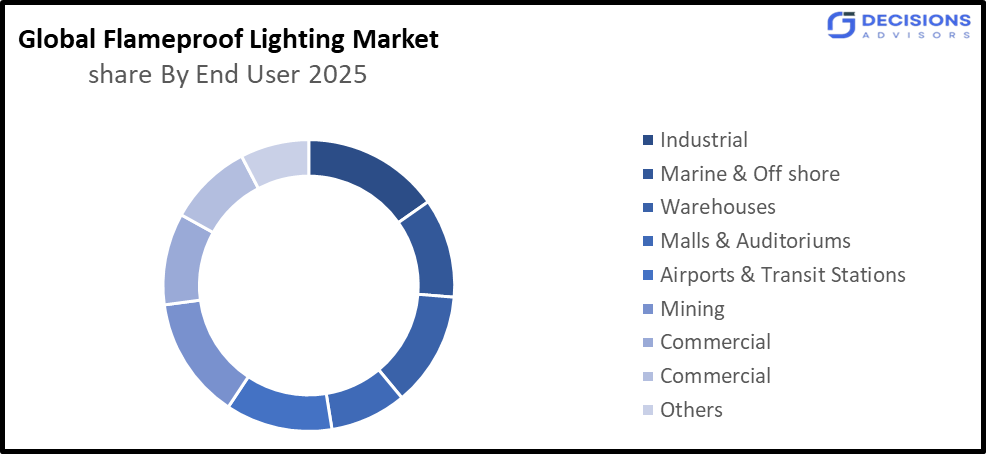
Based on the end user, the flameproof lighting market is divided into mining, marine & off shore, warehouses, malls & auditoriums, airports & transit stations, industrial, commercial, and others. Among these, the industrial segment dominates the flameproof lighting market, accounting for around 38–42% market share in 2025 and projected to grow at a CAGR of approximately 8.5%. This dominance is driven by extensive use in oil & gas, chemical plants, and manufacturing facilities, where hazardous environments require explosion-proof lighting. Strict safety regulations, continuous operations, and high risk of flammable gases and dust further increase demand. Industrial sites also require durable, high-performance lighting solutions, making them the largest and most consistent adopters compared to other segments.
Top of Form
Bottom of Form
Strategies to Implement for Growth of the Market in Non-Leading Regions
For stimulating growth in lagging regions like Southeast Asia, Latin America, and some parts of Africa, companies are changing gears to localize value and finance. The creation of strategic partnerships by manufacturing companies is becoming a trend in overcoming difficult local regulations and import duties. This can be achieved by adopting value-engineered LED lighting which would come with vital certification for safety purposes like ATEX and IECEx but not necessarily with expensive IoT capabilities. Additionally, utilizing subsidies provided by the government on energy efficiency and the implementation of 'Lighting as a Service' allows regional industries to overcome capital investment challenges.
Regional Segment Analysis of the Flameproof lighting Market
- North America (U.S., Canada, Mexico)
- Europe (Germany, France, U.K., Italy, Spain, Rest of Europe)
- Asia-Pacific (China, Japan, India, Rest of APAC)
- South America (Brazil and the Rest of South America)
- The Middle East and Africa (UAE, South Africa, Rest of MEA)
Asia pacific is anticipated to hold the largest share of the flameproof lighting market over the predicted timeframe.
Asia Pacific is anticipated to dominate the flameproof lighting market due to rapid industrialization and expansion of hazardous industries in countries like China, India, and Japan. Strong growth in oil & gas, mining, chemicals, and infrastructure projects drives demand for explosion-proof lighting. Governments are also enforcing strict industrial safety regulations. The region benefits from large manufacturing bases and cost-effective production. Asia Pacific is estimated to hold around 35–40% of the global market share during the forecast period, making it the leading regional contributor.
North America is expected to grow at a rapid CAGR in the flameproof lighting market during the forecast period. North America is expected to grow at a rapid CAGR in the flameproof lighting market due to advanced industrial infrastructure and strict safety standards across sectors such as oil & gas, chemicals, and mining. Countries like United States and Canada are investing heavily in upgrading hazardous area equipment. Strong regulatory frameworks (e.g., OSHA and NEC standards) drive adoption of certified lighting solutions. Increasing focus on workplace safety and technological advancements, especially LED-based systems, further fuel growth. The region is projected to hold approximately 25–30% of the global market share during the forecast period, supporting its rapid expansion.
Europe is the 3rd largest region to grow in the flameproof lighting market during the region. Europe is the third-largest region in the flameproof lighting market, driven by stringent safety regulations and strong industrial presence in countries such as Germany, United Kingdom, and France. The region benefits from well-established oil & gas, chemical, and manufacturing sectors that require certified explosion-proof lighting systems. Compliance with strict standards such as ATEX further supports market growth. Additionally, increasing adoption of energy-efficient LED flameproof lighting enhances demand. Europe is estimated to account for approximately 20–25% of the global market share during the forecast period, maintaining its position as a key regional contributor.
Future Market Trends in Global Flameproof Lighting Market: -
- Growing Adoption of LED-Based Flameproof lighting
LED technology is becoming the dominant trend in flameproof lighting due to its superior energy efficiency, longer lifespan, and low maintenance requirements. Industries are rapidly replacing traditional lighting systems with LED-based solutions to reduce operational costs and improve safety. These lights also offer better illumination quality and durability in harsh environments. As sustainability goals strengthen globally, the demand for eco-friendly and energy-efficient LED flameproof lighting systems is expected to rise significantly.
2. Integration of Smart and IoT-Enabled Lighting Systems
The integration of smart technologies and IoT is transforming flameproof lighting systems. Advanced solutions now include remote monitoring, automated controls, and predictive maintenance capabilities, improving operational efficiency in hazardous areas. These systems help detect faults early, reduce downtime, and enhance safety compliance. Industries are increasingly adopting connected lighting for real-time data insights and better energy management. This trend is expected to accelerate with the growth of Industry 4.0 and digital transformation across industrial sectors.
- Increasing Use of Corrosion-Resistant and Durable Materials
Manufacturers are focusing on developing flameproof lighting using advanced, corrosion-resistant materials such as reinforced aluminium alloys and stainless steel. These innovations enhance product durability, especially in extreme environments like offshore platforms and chemical plants. Improved thermal management and robust designs ensure longer operational life and reliability. As industries demand more rugged and low-maintenance solutions, the development of highly durable flameproof lighting products will continue to gain momentum globally.
Recent Development
- In May 2024: Eaton expanded its LED explosion-proof floodlight range, delivering up to 110 lm/W efficiency and around 100,000-hour lifespan, enhancing safety and energy savings in hazardous industrial environments.
- In January 2023: Wipro Lighting launched BlazeLine flameproof lighting for hazardous zones 1, 2, 21, and 22, offering high-efficiency LED performance and enhancing industrial safety across petrochemical and oil & gas sectors.
Market Segment
This study forecasts revenue at global, regional, and country levels from 2021 to 2035. Decision Advisors has segmented the Flameproof lighting market based on the below-mentioned segments:
Global Flameproof lighting Market, By Mounting Type
- Wall Mounted
- Ceiling Mounted
- Pole Mounted
- Hand Held
Global Flameproof Lighting Market, By Light Source
- LED
- Fluorescent
- Incandescent & Halogen
- HID (High-Intensity Discharge)
Global Flameproof Lighting Market, By End User
- Mining
- Marine & Off shore
- Warehouses
- Malls & Auditoriums
- Airports & Transit Stations
- Industrial
- Commercial
- Others
Global Flameproof Lighting Market, By Regional Analysis
- North America
- US
- Canada
- Mexico
- Europe
- Germany
- UK
- France
- Italy
- Spain
- Russia
- Rest of Europe
- Asia Pacific
- China
- Japan
- India
- South Korea
- Australia
- Rest of Asia Pacific
- South America
- Brazil
- Argentina
- Rest of South America
- Middle East & Africa
- UAE
- Saudi Arabia
- Qatar
- South Africa
- Rest of the Middle East & Africa
Frequently Asked Questions (FAQ)
1. Why is the shift to LED flameproof lighting slower despite its advantages?
Even though LEDs are efficient, high upfront costs and the long lifespan of existing systems make companies delay switching until replacement becomes necessary.
2. How do strict safety regulations both help and challenge the market?
They increase demand for certified lighting, but at the same time, they raise costs and make it harder for smaller companies to enter the market.
3. Why do industrial users focus more on total cost than initial price?
Because maintenance in hazardous areas is risky and expensive, so long-lasting lighting reduces downtime and overall operational costs.
4. What limits faster adoption in developing regions?
High costs, lack of awareness, and availability of cheaper non-certified products slow down adoption despite growing industrialization.
5. How is technology changing maintenance in flameproof lighting?
With IoT and smart systems, companies can monitor lights in real time, detect faults early, and reduce manual inspections in dangerous environments.
Check Licence
Choose the plan that fits you best: Single User, Multi-User, or Enterprise solutions tailored for your needs.
We Have You Covered
- 24/7 Analyst Support
- Clients Across the Globe
- Tailored Insights
- Technology Tracking
- Competitive Intelligence
- Custom Research
- Syndicated Market Studies
- Market Overview
- Market Segmentation
- Growth Drivers
- Market Opportunities
- Regulatory Insights
- Innovation & Sustainability
Report Details
| Scope | Global |
| Pages | 210 |
| Delivery | PDF & Excel via Email |
| Language | English |
| Release | Apr 2026 |
| Access | Download from this page |