
Global Flowable Hemostats Market
 |
Author:
David J
|
Pages:
210
|
Author:
David J
|
Pages:
210
Global Flowable Hemostats Market Size, Share By Product Type (Gelatin-Based Flowable Hemostats, Thrombin-Based Flowable Hemostats, Combination Flowable Hemostats), By Application (General Surgery, Cardiovascular Surgery, Orthopedic Surgery, Neurosurgery, Others), By End User (Hospitals, Ambulatory Surgical Centers, Specialty Clinics), and By Region (North America, Europe, Asia-Pacific, Latin America, Middle East & Africa), Analysis and Forecast 2026-2035.
CAGR
5.87%
REVENUE 2025
USD Million 735.2
FORECAST 2035
USD Million 1299.8
REPORT COVERAGE
Global
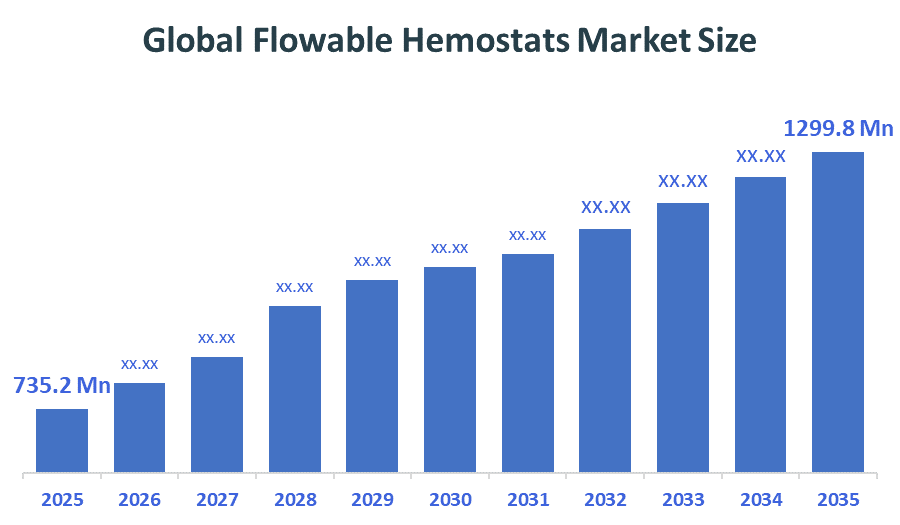
The Global Flowable Hemostats Market Size is foreseen to grow from USD 735.2 Million in 2025 and is govern to reach around USD 1299.8 Million by 2035. According to Decision Advisors, a detailed research report on the global flowable hemostats market is boosted by the rising number of surgical procedures, accounting for nearly up to the 35-40% share of the total share worldwide. Ethicon is the prime player in the market with approximately USD 700 Million in annual turnover and a 20-25% market share, positioning it as the primary driver of the global flowable hemostats market.
Market Snapshot
- Global Flowable Hemostats Market Size (2025): USD 735.2 Million
- Projected Global Flowable Hemostats Market Size (2035): USD 1299.8 Million
- Global Flowable Hemostats Market Compound Annual Growth Rate (CAGR): 5.87%
- Largest Regional Market: North America
- Fastest Growing Region: Asia Pacific
- 2nd Largest Region: Europe
- Base Year: 2025
- Historical Period: 2021–2024
- Forecast Period: 2026–2035
Market Overview/ Introduction
The flowable hemostats market is essentially the business of smart bandages for surgeons. In simple terms, these are high-tech, paste-like materials that doctors use during surgery to stop bleeding in tricky spots where traditional stitches or lasers just won't work. Think of it like a medical-grade caulk, it’s made from a gelatin base mixed with a clotting enzyme (thrombin) that can be squeezed into deep or irregular wounds. Once it's in there, it conforms to the shape of the area and speeds up the body's natural healing process to stop blood flow almost instantly. The reason is pretty straightforward, as we live longer and surgeries like heart bypasses or spinal repairs become more common, surgeons need tools that make their jobs faster and safer. These flowable agents are especially popular in robotic and keyhole surgeries because they can be delivered through a tiny syringe. While big names like Baxter and Johnson & Johnson currently lead the pack, we’re seeing a massive shift toward more user-friendly versions that don't require much prep time in the operating room. Most of the action is in North America, but Asia is catching up quickly as more people gain access to modern surgical care.The flowable hemostats market is essentially the business of "smart bandages" for surgeons. In simple terms, these are high-tech, paste-like materials that doctors use during surgery to stop bleeding in tricky spots where traditional stitches or lasers just won't work. Think of it like a medical-grade caulk, it’s made from a gelatin base mixed with a clotting enzyme (thrombin) that can be squeezed into deep or irregular wounds. Once it's in there, it conforms to the shape of the area and speeds up the body's natural healing process to stop blood flow almost instantly.
Notable Insights: -
- North America is anticipated to hold the largest share, approximately 40% of the Global Flowable Hemostats Market over the predicted timeframe.
- Asia Pacific is expected to grow at the fastest CAGR in the Global Flowable Hemostats Market during the forecast period, with growth rates estimated at around 10.5% CAGR.
- By product type, the electrocautery (hot snares) segment dominated the market in 2025 with approximately 45% share, and is projected to grow at a substantial CAGR during the forecast period.
- By end user, the hospitals segment dominated the market in 2025 with approximately 55.87% share, and is projected to grow at a substantial CAGR during the forecast period.
- The compound annual growth rate of the global flowable hemostats market is 5.87%.
- The market is likely to achieve a valuation of USD 1299.8 Million by 2035.
What is the role of technology in grooming the market?
Technology significantly enhances the performance of flowable hemostats through improved biocompatibility and faster clotting mechanisms. Advanced formulations combining gelatin matrices with thrombin ensure better adhesion to complex surgical sites. Innovations such as synthetic and recombinant thrombin reduce risks associated with human or animal-derived components. Additionally, improved delivery systems allow precise application in minimally invasive surgeries, enhancing surgical outcomes and reducing blood loss.
Market Drivers
The growth of this market is propelled by a perfect storm of ageing populations and a shift toward smarter surgery. As the number of seniors worldwide continues to climb, so does the demand for complex heart, spine, and orthopedic procedures surgeries where managing blood loss is a critical, life-saving priority. Simultaneously, the surgical world is shifting away from huge incisions toward keyhole or robotic-assisted procedures. Flowable hemostats are perfect for this trend because they can be precisely injected through tiny tubes into hard-to-reach spots. Beyond just the tech, hospitals are increasingly focused on operating room efficiency since these agents stop bleeding faster than traditional methods, they reduce the time a patient spends under anesthesia and help clear out surgical suites more quickly. Finally, emerging markets like China and India are seeing a huge upgrade in healthcare infrastructure, making these advanced tools accessible to millions of new patients for the first time. The reason is pretty straight forward, as we live longer and surgeries like heart bypasses or spinal repairs become more common, surgeons need tools that make their jobs faster and safer. These flowable agents are especially popular in robotic and keyhole surgeries because they can be delivered through a tiny syringe. While big names like Baxter and Johnson & Johnson currently lead the pack, we’re seeing a massive shift toward more user-friendly versions that don't require much prep time in the operating room. Most of the action is in North America, but Asia is catching up quickly as more people gain access to modern surgical care.
Restrain
The flowable hemostats market faces limitations due to their relatively high cost compared to conventional hemostatic products, which can restrict adoption in cost-sensitive healthcare settings. Additionally, concerns related to potential allergic reactions, infection risks, and complications arising from improper application may hinder usage. Stringent regulatory approval processes and limited availability in developing regions further act as barriers to market growth.
Competitive Analysis:
The report offers the appropriate analysis of the key organizations/companies involved within the global flowable hemostats market, along with a comparative evaluation primarily based on their product of offering, business overviews, geographic presence, enterprise strategies, segment market share, and SWOT analysis. The report also provides an elaborative analysis focusing on the current news and developments of the companies, which includes product development, innovations, joint ventures, partnerships, mergers & acquisitions, strategic alliances, and others. This allows for the evaluation of the overall competition within the market.
Top Companies in the Global Flowable Hemostats Market
- Ethicon (Johnson & Johnson)
- Baxter International Inc.
- B. Braun Melsungen AG
- Pfizer Inc.
- Medtronic plc
- Integra LifeSciences Corporation
- CryoLife Inc.
- Stryker Corporation
- Teleflex Incorporated
- Hemostasis LLC
Government Initiatives
|
Country |
Key Government Initiatives |
|
US |
FDA Breakthrough Device Program: Accelerates approval of advanced hemostatic agents. NIH & BARDA Funding: approximately USD 48B annually for biomaterials and surgical innovation. Hospital Modernisation Grants: Federal/state investments in surgical infrastructure. Medicare/Medicaid Expansion: Expands access to surgical procedures. |
|
India |
ational Medical Devices Policy (2023): Targets industry growth from USD 11B to USD 50B by 2030. PLI Scheme: ?3,420 crore approved to incentivise domestic surgical consumables including hemostats. SMDI Scheme (2024–27): ?500 crores for MedTech clusters and skill development. Medical Device Parks: 4 approved with ?400 crore each for infrastructure and testing. |
|
Europe |
EU MDR (2021): Stricter compliance standards for surgical consumables. Horizon Europe Program (€95B overall, €31M for biomaterials): R&D funding for advanced surgical devices. National Healthcare Investments: UK & Germany upgrading surgical infrastructure with multi-billion euro allocations. |
Study on the Supply, Demand, Distribution, and Market Environment of the Global Flowable Hemostats Market
The global flowable hemostats market shows a strong supply–demand balance driven by rising surgical volumes, with hospitals accounting for over 57% of total demand and cardiovascular, general, and orthopaedic surgeries contributing nearly 66% of overall usage. On the supply side, around 63% of production is controlled by leading medical device companies, ensuring consistent availability through global distribution networks. Distribution is primarily hospital-based, with growing penetration in ambulatory surgical centres due to faster procedural workflows. Overall, the market environment remains favourable, supported by increasing adoption of minimally invasive surgeries and continuous product innovation.
Price Analysis and Consumer Behaviour Analysis
Flowable hemostats are relatively premium-priced products, with standard gelatin-based variants costing around USD 120–180 per unit, while advanced combination products are priced significantly higher due to faster clotting efficiency and multi-mechanism action. Despite higher costs, nearly 57% of purchases are driven by hospitals, where clinicians prioritise clinical effectiveness, faster hemostasis, and reduced surgical time over price considerations. Additionally, the ability of advanced hemostats to reduce blood transfusion costs by up to USD 1,200 per procedure strongly influences buying behaviour, making them a cost-effective choice in critical surgeries.
Market Segmentation
The Global Flowable Hemostats Market share is classified into product type, application, and end user.
- The combination flowable hemostats segment dominated the market in 2025 with approximately 48% share, and is projected to grow at a substantial CAGR during the forecast period.
Based on the product type, the global flowable hemostats market is divided into gelatin-based flowable hemostats, thrombin-based flowable hemostats, and combination flowable hemostats. Among these, the combination flowable hemostats segment dominated the market in 2025 with approximately 48% share, owing to their dual mechanism of action that enhances clot formation and bleeding control. For instance, these products are widely used in complex surgical procedures where rapid hemostasis is critical. Additionally, advancements in bioengineered materials and thrombin integration (2023–2025) have improved product efficiency and safety, boosting adoption. Gelatin-based hemostats are expected to witness steady growth due to their cost-effectiveness and ease of use.
- The general surgery segment accounted for the largest share in 2025 with approximately 42% share, and is anticipated to grow at a significant CAGR during the forecast period.
Based on the application, the global flowable hemostats market is divided into general surgery, cardiovascular surgery, orthopaedic surgery, neurosurgery, and others. Among these, the general surgery segment accounted for the largest share in 2025 with approximately 42%, driven by the high volume of surgical procedures and the need for effective bleeding control. For example, flowable hemostats are extensively used in abdominal and soft tissue surgeries to control diffuse bleeding. Moreover, increasing adoption of minimally invasive surgical techniques (2023–2025) is enhancing procedural outcomes and driving demand. Cardiovascular and orthopedic segments are also gaining traction due to rising chronic disease cases and trauma surgeries.
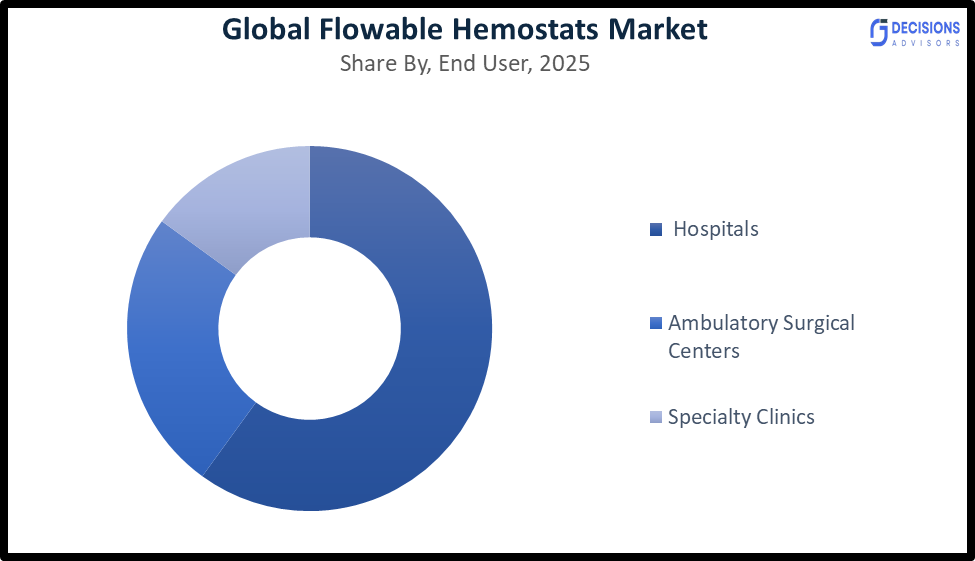
- The hospitals segment dominated the market in 2025 with approximately 62% share, and is projected to grow at a substantial CAGR during the forecast period.
Based on the end user, the global flowable hemostats market is divided into hospitals, ambulatory surgical centers, and specialty clinics. Among these, the hospitals segment dominated the market in 2025 with approximately 62% share, due to high surgical volumes and the availability of advanced surgical infrastructure. For instance, hospitals perform a wide range of complex procedures requiring efficient bleeding management, driving consistent demand for flowable hemostats. Furthermore, increasing healthcare investments and adoption of advanced surgical technologies (2023–2025) are supporting segment growth. Ambulatory surgical centers are expected to grow rapidly due to the rising preference for outpatient and minimally invasive procedures.
Strategies to Implement for Growth of the Market in Non-Leading Regions
To drive growth in non-leading regions, companies should focus on affordability, local partnerships, and clinical training programs to improve the adoption of flowable hemostats. Expanding distribution networks and introducing cost-effective product variants can significantly enhance accessibility in price-sensitive markets, where approximately 65% of hospitals face budget constraints. Additionally, increasing surgeon training and awareness can boost utilisation, as procedural adoption rates can rise by up to 30% with proper clinical education. Government healthcare investments and the expansion of surgical infrastructure in emerging economies are also expected to accelerate market penetration.
Regional Segment Analysis of the Global Flowable Hemostats Market
- North America (U.S., Canada, Mexico)
- Europe (Germany, France, U.K., Italy, Spain, Rest of Europe)
- Asia-Pacific (China, Japan, India, Rest of APAC)
- South America (Brazil and the Rest of South America)
- The Middle East and Africa (UAE, South Africa, Rest of MEA)
North America is anticipated to hold the largest share, approximately 40% of the global flowable hemostats market over the predicted timeframe.
North America is anticipated to hold the largest share, approximately 40% of the global flowable hemostats market over the predicted timeframe. The region dominates due to its advanced healthcare infrastructure and high volume of surgical procedures, particularly in the United States and Canada. Additionally, the U.S. performs a significant number of cardiovascular, orthopedic, and general surgeries annually, creating strong and consistent demand for flowable hemostats. A key recent development includes the launch of advanced combination hemostatic agents and biologics between 2023–2025, improving bleeding control efficiency and patient outcomes. Strict regulatory standards and a strong emphasis on surgical safety are also driving the adoption of advanced hemostatic products, further strengthening market dominance.
Asia Pacific is expected to grow at the fastest CAGR in the global flowable hemostats market during the forecast period, with growth rates estimated at around 10.5% CAGR.
Asia Pacific is expected to grow at the fastest CAGR in the global flowable hemostats market during the forecast period, with growth rates estimated at around 10.5% CAGR. The region has a rapidly expanding patient population and an increasing burden of chronic diseases and trauma cases, with China and India being key contributors. Growth is driven by rising healthcare investments, increasing surgical volumes, and improving access to advanced hemostatic products. For instance, countries like India and China are significantly expanding hospital infrastructure and surgical capabilities, boosting demand for flowable hemostats. Additionally, growing medical tourism and rising awareness about advanced surgical care are accelerating market growth.
Europe is the second largest region in the global flowable hemostats market during the forecast period, holding approximately 28% share.
Europe is the second largest region in the global flowable hemostats market during the forecast period, holding approximately 28% share, supported by well-established healthcare systems and strong adoption of advanced surgical technologies. The region benefits from stringent medical device regulations and high standards of patient care, ensuring the use of safe and effective hemostatic products. Countries such as Germany, France, and the UK lead the market due to high surgical volumes and advanced hospital infrastructure. A recent development includes increased funding for surgical innovation and the adoption of bioengineered hemostatic agents between 2023–2025, promoting market growth. Additionally, the growing elderly population and rising prevalence of chronic diseases are further strengthening demand across the region.
Future Market Trends in the Global Flowable Hemostats Market: -
1. Shift Toward Combination and Advanced Hemostatic Agents
One of the most significant trends is the growing adoption of combination and hybrid flowable hemostats, which provide faster and more effective bleeding control through multi-mechanism action. These products are gaining traction as they reduce time-to-hemostasis and improve surgical efficiency, with combination matrices projected to grow at over 7% CAGR in the coming years.
2. Rising Demand from Minimally Invasive and Robotic Surgeries
The increasing adoption of minimally invasive and robotic-assisted surgeries is driving demand for flowable hemostats, as these procedures require precise bleeding control in hard-to-reach areas. By 2025, nearly 48% of elective surgeries in developed markets are minimally invasive, significantly boosting the use of flowable hemostatic agents.
3. Growing Shift Toward Ambulatory Surgical Centres (ASCs)
Healthcare systems are increasingly shifting surgical procedures from hospitals to outpatient settings, leading to higher demand for ready-to-use, easy-to-apply flowable hemostats. Ambulatory surgical centers are expected to grow at around 8.4% CAGR, driven by faster workflows and cost efficiency, making them a key future growth segment.
Recent Development
- In November 2025, Baxter International Inc. received regulatory clearance under MDR for its FLOSEAL Hemostatic Matrix, strengthening its advanced flowable hemostat portfolio and expanding its use across multiple surgical procedures.
- In March 2025, Ethicon (Johnson & Johnson) enhanced its SURGIFLO Hemostatic Matrix Kit with Thrombin, introducing improved preparation time and application efficiency, making it more suitable for minimally invasive and complex surgeries.
- In April 2025, Baxter International Inc. collaborated with healthcare providers and surgical centres to support the rollout and accessibility of its hemostatic solutions, alongside product advancements in its HEMOPATCH portfolio, strengthening its clinical adoption network.
- In June 2025, major industry players, including Johnson & Johnson (Ethicon) and Baxter International, continued strategic collaborations with hospitals and surgical networks to expand the adoption of advanced hemostatic products, supported by their combined dominance of over 60% market share in the hemostats segment.
- In March 2025, leading manufacturers intensified partnerships with research institutions and surgical training centres to enhance product development and clinical usage of next-generation flowable hemostats, focusing on improving surgical outcomes and efficiency.
Market Segment
This study forecasts revenue at global, regional, and country levels from 2020 to 2035. Decision Advisors has segmented the global flowable hemostats market based on the below-mentioned segments:
Global Flowable Hemostats Market, By Product Type
- Gelatin-Based Flowable Hemostats
- Thrombin-Based Flowable Hemostats
- Combination Flowable Hemostats
Global Flowable Hemostats Market, By Application
- General SurgeryCardiovascular Surgery
- Orthopedic Surgery
- Neurosurgery
- Others
Global Flowable Hemostats Market, By End User
- Hospitals
- Ambulatory Surgical Centres
- Specialty Clinics
Global Flowable Hemostats Market, By Regional Analysis
- North America
- US
- Canada
- Mexico
- Europe
- Germany
- UK
- France
- Italy
- Spain
- Russia
- Rest of Europe
- Asia Pacific
- China
- Japan
- India
- South Korea
- Australia
- Rest of Asia Pacific
- South America
- Brazil
- Argentina
- Rest of South America
- Middle East & Africa
- UAE
- Saudi Arabia
- Qatar
- South Africa
- Rest of the Middle East & Africa
Frequently Asked Questions (FAQ)
1. How do flowable hemostats compare with traditional hemostatic agents in terms of clinical outcomes?
Flowable hemostats generally offer faster and more effective bleeding control compared to traditional agents due to their ability to conform to irregular wound surfaces. This leads to reduced surgical time, lower blood loss, and improved overall patient outcomes, especially in complex procedures.
2. What are the key regulatory challenges faced by manufacturers in launching new flowable hemostats?
Manufacturers face stringent regulatory requirements related to safety, biocompatibility, and clinical efficacy. Approval processes can be time-consuming and costly, particularly for products involving biologics such as thrombin, which must meet strict quality and safety standards.
3. How is the increasing use of biologics influencing innovation in flowable hemostats?
The growing use of biologics is driving innovation toward safer and more effective products, including recombinant thrombin-based hemostats. These advancements reduce the risk of immune reactions and improve clotting efficiency, enhancing product performance.
4. What role do hospital procurement policies and group purchasing organizations (GPOs) play in this market?
Hospital procurement policies and GPOs significantly influence purchasing decisions by negotiating bulk pricing and standardizing product selection. This can impact market competition and encourage manufacturers to offer cost-effective and high-quality solutions.
5. How are sustainability concerns and medical waste management impacting the adoption of flowable hemostats?
The increasing use of single-use hemostatic products has raised concerns about medical waste. As a result, manufacturers are focusing on developing eco-friendly materials and sustainable packaging, which is gradually influencing purchasing decisions in environmentally conscious healthcare systems
Check Licence
Choose the plan that fits you best: Single User, Multi-User, or Enterprise solutions tailored for your needs.
We Have You Covered
- 24/7 Analyst Support
- Clients Across the Globe
- Tailored Insights
- Technology Tracking
- Competitive Intelligence
- Custom Research
- Syndicated Market Studies
- Market Overview
- Market Segmentation
- Growth Drivers
- Market Opportunities
- Regulatory Insights
- Innovation & Sustainability
Report Details
| Scope | Global |
| Pages | 210 |
| Delivery | PDF & Excel via Email |
| Language | English |
| Release | May 2026 |
| Access | Download from this page |