
Global Foodservice Market
 |
Author:
Sayali T
|
Pages:
220
|
Author:
Sayali T
|
Pages:
220
Global Foodservice Market Size, Share By Service Type (Quick Service Restaurants, Full Service Restaurants, Cafés & Bars, Cloud Kitchens, and Institutional Foodservice), By Distribution Channel (Dine-In, Takeaway, Online Delivery, and Drive-Through), By Ownership Model (Chain Outlets and Independent Outlets), and By Region (North America, Europe, Asia-Pacific, Latin America, Middle East & Africa), Analysis and Forecast 2026-2035.
CAGR
5.3%
REVENUE 2025
USD Trillion 3.9
FORECAST 2035
USD Trillion 6.5
REPORT COVERAGE
Global
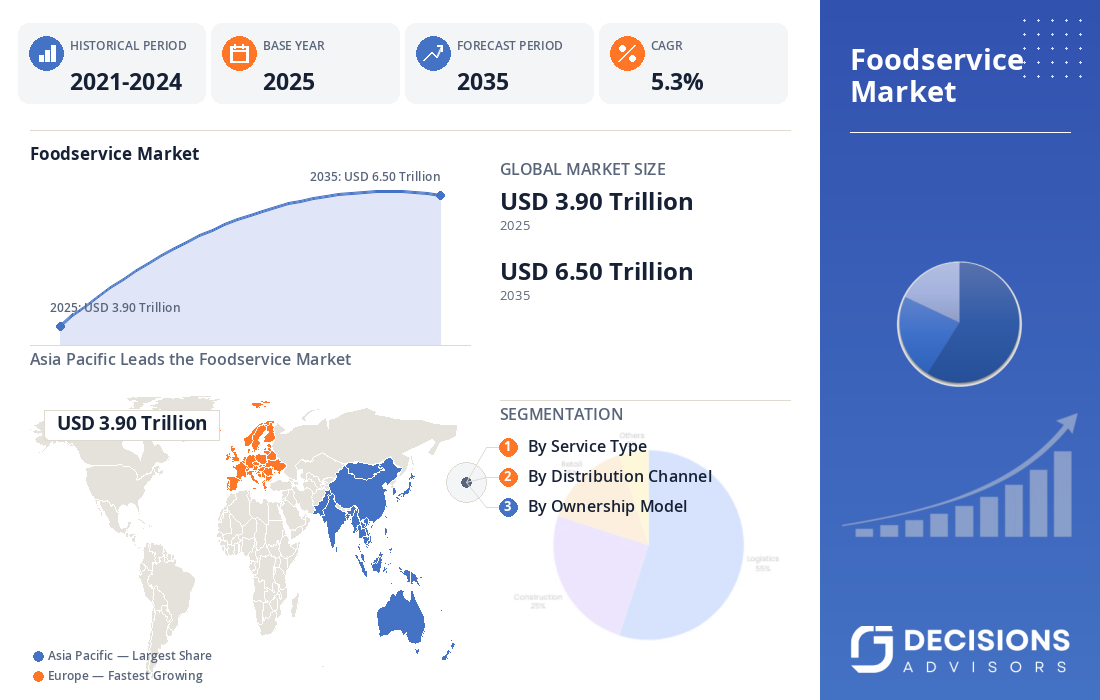
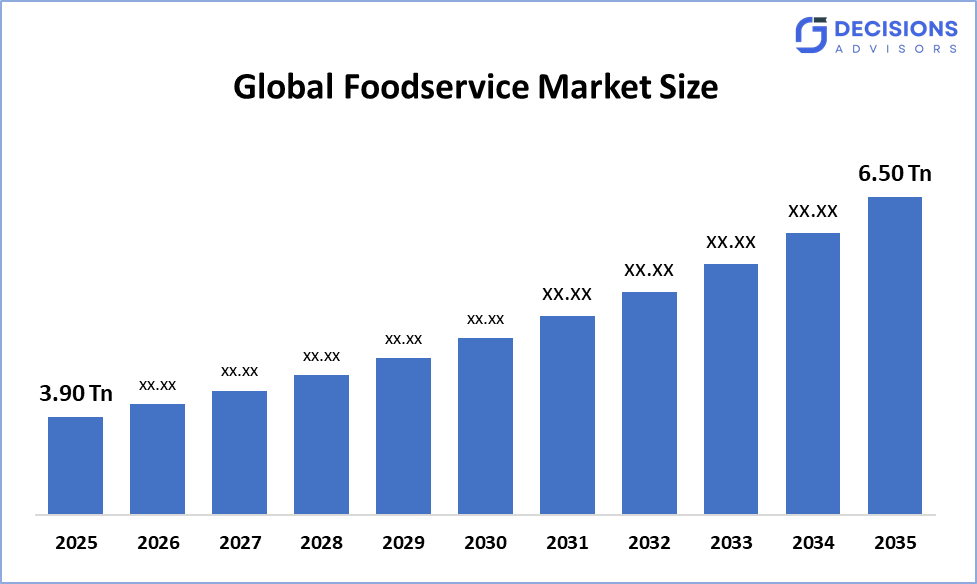
The Global Foodservice Market Size is estimated at USD 3.90 Trillion in 2025 and is projected to reach approximately USD 6.50 Trillion by 2035, expanding at a 5.3% CAGR during 2026-2035. The Decision Advisors estimate is benchmarked against the published Reports and Data Foodservice Market study, which reports USD 3.9 Trillion in 2025 and USD 6.5 Trillion by 2035 with a 5.3% CAGR.
Market Snapshot
- Global Foodservice Market Size (2025): USD 3.90 Trillion
- Projected Global Foodservice Market Size (2035): USD 6.50 Trillion
- Global Foodservice Market CAGR: 5.3%
- Largest Regional Market: Asia-Pacific
- 2nd Largest Region: North America
- Fastest Growing Region: Europe
- Base Year: 2025
- Historical Period: 2021-2024
- Market Forecast Period: 2026-2035.
Market Overview/ Introduction
The global foodservice market represents the broad ecosystem of businesses involved in preparing and providing meals and beverages for immediate or near-immediate consumption. It encompasses quick service restaurants, full-service restaurants, cafés and bars, cloud kitchens, catering operations, institutional foodservice, takeaway establishments, and delivery-oriented businesses. The market is supported by urbanization, rising disposable income, tourism, changing household structures, busier lifestyles, and consumer demand for convenient meal solutions. Digital transformation has become a major structural force. Online ordering, mobile restaurant applications, digital payments, loyalty programs, QR-based menus, self-service kiosks, delivery platforms, cloud kitchens, and AI-supported demand forecasting are changing both customer engagement and restaurant operations. The validated source specifically identifies convenience-led dining and digital ordering adoption as important growth drivers and lists QSRs, full-service restaurants, cafés and bars, cloud kitchens, and institutional foodservice among the principal service categories.
- United States, The FDA Food Code provides a science-based framework for food safety in retail and foodservice establishments, covering food handling, sanitation, equipment, employee health, and food-safety management.
- China, Urban consumption growth, e-commerce integration, delivery infrastructure, and restaurant digitalization are supporting modernization of the country's foodservice ecosystem.
- Japan, Tourism, hospitality modernization, digital ordering, labor-saving technologies, and demand for efficient restaurant operations are supporting technological adoption.
Notable Insights: -
- Asia-Pacific is anticipated to hold approximately 39.0% share of the Global Foodservice Market during the forecast timeframe.
- North America is expected to account for approximately 27.5% of the global market during the forecast period.
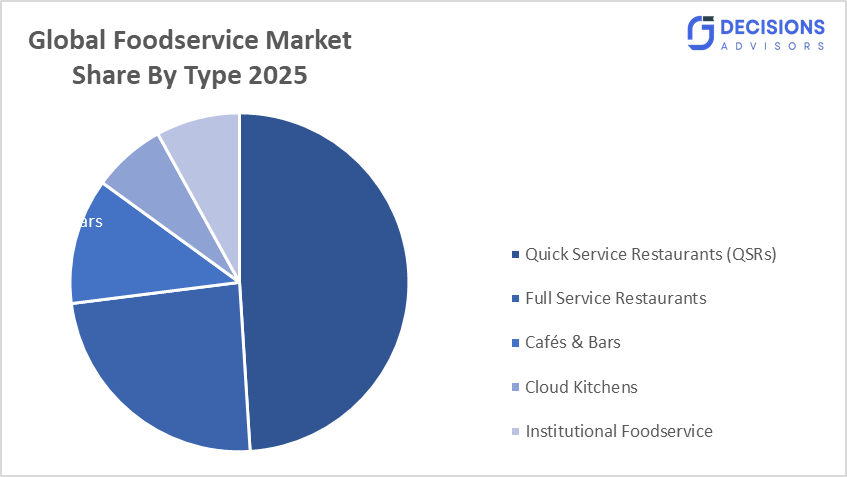
- By Service Type, the Quick Service Restaurants segment dominated the market and holds approximately 49.0% share in 2025.
- By Distribution Channel, Dine-In accounted for approximately 45.5% share in 2025.
- By Ownership Model, Independent Outlets accounted for approximately 54.0% share in 2025.
- The Decision Advisors estimated CAGR of the Global Foodservice Market is 5.3%.
- The market is likely to achieve a valuation of approximately USD 6.50 Trillion by 2035.
Market Drivers
The Global Foodservice Market is being driven by the growing need for convenience, changing eating habits, urban population growth, increasing disposable income, and greater participation of consumers in out-of-home dining. Longer working hours and increasingly busy lifestyles encourage consumers to choose quick-service restaurants, takeaway meals, food delivery, cafés, and ready-to-consume food. Tourism and hospitality expansion additionally create demand for restaurants, catering, and institutional foodservice. Digitalization is accelerating market development. Restaurant applications, online ordering, digital wallets, loyalty programs, QR ordering, self-service kiosks, and delivery-management systems enable businesses to serve customers more efficiently. AI-based demand forecasting and inventory management can help operators reduce food waste and improve purchasing decisions. Cloud kitchens provide another growth avenue because they allow food brands to reach customers without requiring conventional dining-room infrastructure. The institutional segment is also important because workplaces, schools, universities, hospitals, airports, sports venues, and government facilities increasingly use professional foodservice operators. Large contract foodservice companies can benefit from long-term institutional relationships, procurement scale, and integrated facility-management capabilities.
Restrain
The market faces pressure from labor shortages, wage increases, food-price volatility, energy costs, rental expenses, and supply-chain disruptions. Because restaurant profitability can be sensitive to relatively small changes in operating expenses, inflation in ingredients and labor can restrict expansion or force operators to increase menu prices. Independent restaurants face additional challenges because technology investments in ordering platforms, automation, customer relationship management, delivery integration, and data analytics can require substantial capital. Regulatory compliance relating to food safety, sanitation, allergens, packaging, waste management, and employment also adds operating complexity.
Competitive Analysis:
The report offers the appropriate analysis of the key organizations/companies involved within the Global Foodservice Market, along with a comparative evaluation primarily based on their product offerings, business overviews, geographic presence, enterprise strategies, segment market share, and SWOT analysis. The report also provides an elaborative analysis focusing on the current news and developments of the companies, which includes product development, innovations, joint ventures, partnerships, mergers & acquisitions, strategic alliances, and others. This allows for the evaluation of the overall competition within the market.
Top Companies in the Global Foodservice Market
- McDonald's Corporation
- Yum! Brands, Inc.
- Starbucks Corporation
- Restaurant Brands International Inc.
- Domino's Pizza, Inc.
- Compass Group PLC
- Sodexo S.A.
- Aramark
- Darden Restaurants, Inc.
- Jollibee Foods Corporation.
Government Initiatives
|
Country |
Key Government Initiatives |
|
United States |
FDA Food Code establishes science-based food-safety standards for foodservice establishments, covering sanitation, food handling, equipment, employee health, and food-safety management |
|
Japan |
Tourism development, hospitality modernization, food-safety regulation, digitalization, and labor-saving technology adoption are supporting foodservice-sector modernization |
|
China |
Domestic-consumption policies, digital commerce development, urbanization, and smart-business initiatives are supporting restaurant modernization and technology adoption |
Market Segmentation
The Global Foodservice Market share is classified into Service Type, Distribution Channel, and Ownership Model. These categories are consistent with the benchmark source's published segmentation structure.
- The Quick Service Restaurants segment dominated the market and holds approximately 49.0% share in 2025 and is projected to grow at a substantial CAGR during the forecast period.
Based on Service Type, the Global Foodservice Market is divided into Quick Service Restaurants, Full Service Restaurants, Cafés & Bars, Cloud Kitchens, and Institutional Foodservice. Among these, Quick Service Restaurants represent the largest estimated segment. QSRs benefit from rapid service, affordable menus, high outlet density, drive-through facilities, takeaway, and digital ordering. Their franchising models also allow established brands to expand into new markets efficiently. Continued consumer preference for convenience is expected to support QSR growth through 2035.
- The Dine-In segment accounted for approximately 45.5% share in 2025 and is anticipated to grow at a significant CAGR during the forecast period.
Based on Distribution Channel, the market is divided into Dine-In, Takeaway, Online Delivery, and Drive-Through. Dine-in remains a major revenue channel because of the continued importance of full-service restaurants, cafés, premium dining, hotels, and social dining occasions. However, online delivery and takeaway are expected to increase their contribution as consumers prioritize convenience. Restaurants are increasingly integrating dine-in with digital ordering and pickup capabilities.
- The Independent Outlets segment accounted for approximately 54.0% share in 2025 and is anticipated to grow at a significant CAGR during the forecast period.
Based on Ownership Model, the market is divided into Chain Outlets and Independent Outlets. Independent outlets maintain a broad global presence because they can customize menus, prices, service styles, and product offerings according to local preferences. Their flexibility gives them an advantage in highly localized markets. Nevertheless, chain outlets are expected to gain share because of their purchasing power, established brands, standardized systems, franchising capabilities, and stronger technology infrastructure.
Regional Segment Analysis of the Global Foodservice Market
- North America (U.S., Canada, Mexico)?
- Europe (Germany, U.K., France, Italy, Spain, Netherlands, Rest of Europe).
- Asia-Pacific (China, Japan, India, Australia, South Korea, Rest of Asia-Pacific).
- South America (Brazil, Argentina, Rest of South America).
- Middle East & Africa (UAE, Saudi Arabia, South Africa, Rest of MEA).
Asia Pacific is anticipated to hold approximately 39.0% share of the Global Foodservice Market over the predicted timeframe.
The region benefits from its large population, rapid urbanization, expanding middle class, tourism, digital-payment adoption, and growing restaurant-chain penetration. China, India, Japan, South Korea, and Australia are major contributors. India represents an especially attractive growth market because of increasing disposable income and the expansion of cloud kitchens, delivery platforms, organized QSRs, and digital payments. The country's foodservice market is projected by another current industry source to grow rapidly through 2034, reflecting the structural growth opportunity in the Indian market.
North America is expected to hold approximately 27.5% share of the Global Foodservice Market during the forecast period.
The United States remains a highly developed foodservice market characterized by strong QSR penetration, restaurant franchising, drive-through formats, delivery, mobile ordering, and loyalty programs. Restaurant operators are increasingly adopting automation, digital payment, self-ordering kiosks, AI-based personalization, and integrated restaurant-management platforms. Canada and Mexico are also benefiting from chain expansion, tourism, urbanization, and increased digital ordering.
Europe is expected to account for approximately 20.0% of the Global Foodservice Market during the forecast period and remains an important mature foodservice region.
Germany, France, the U.K., Italy, and Spain represent major markets supported by tourism, café culture, premium dining, workplace catering, takeaway, and delivery. Sustainability requirements and rising operating costs are encouraging restaurants to adopt energy-efficient equipment, food-waste reduction systems, digital ordering, and automation. European operators are also increasingly using technology to compensate for labor shortages and improve productivity.
Future Market Trends in Global Foodservice Market: -
- ???????AI-Powered Restaurant Operations.
AI is expected to increasingly support demand forecasting, inventory planning, workforce scheduling, customer segmentation, personalized marketing, and menu optimization. These capabilities can improve operational efficiency and help restaurants respond to changing demand.
- ???????Expansion of Digital Ordering and Delivery.
Mobile ordering, restaurant applications, digital payments, QR menus, loyalty platforms, and delivery-management systems will continue to become core components of restaurant operations. Online delivery is expected to remain particularly important in densely populated urban markets.
- ???????Growth of Cloud Kitchens.
Cloud kitchens and delivery-only restaurant concepts are expected to expand as operators seek lower-cost formats and flexible market entry. Multiple virtual brands can operate from a shared kitchen, allowing companies to test menus and target different consumer segments.
- ???????Automation and Sustainable Foodservice.
Automated cooking systems, smart refrigeration, robotics, energy-efficient equipment, food-waste monitoring, sustainable packaging, and resource-efficient kitchen technologies will become increasingly important as restaurants face labor and environmental pressures.
Recent Development
- In March 2026, McDonald's launched a global KPop Demon Hunters collaboration featuring themed meals and customer experiences across participating restaurants.
- In February 2026, Compass Group completed its acquisition of Vermaat, strengthening its European foodservice and hospitality presence.
- In March 2026, Starbucks introduced a new UK licensee model to support long-term market growth through partnerships.
Market Segment
This study forecasts revenue at global, regional, and country levels from 2021 to 2035. Decision Advisors has segmented the global foodservice market based on the below-mentioned segment:
Global Foodservice Market, By Service Type.
- Quick Service Restaurants
- Full Service Restaurants
- Cafés & Bars
- Cloud Kitchens
- Institutional Foodservice.
Global Foodservice Market, By Distribution Channel.
- Dine-In
- Takeaway
- Online Delivery
- Drive-Through.
Global Foodservice Market, By Ownership Model.
- Chain Outlets
- Independent Outlets.
Global Foodservice Market, By Regional Analysis.
North America
- US
- Canada
- Mexico
Europe
- Germany
- UK
- France
- Italy
- Spain
- Russia
- Rest of Europe
Asia Pacific
- China
- Japan
- India
- South Korea
- Australia
- Rest of Asia Pacific
South America
- Brazil
- Argentina
- Rest of South America
Middle East & Africa
- UAE
- Saudi Arabia
- Qatar
- South Africa
- Rest of the Middle East & Africa
Frequently Asked Questions (FAQ)
Q. What is driving the Global Foodservice Market?
A. The principal growth drivers include urbanization, rising disposable income, changing lifestyles, convenience-oriented dining, restaurant-chain expansion, tourism, online ordering, and food delivery. Digital technologies are also improving restaurant productivity and customer engagement.
Q. Why are Quick Service Restaurants expected to remain dominant?
A. QSRs combine affordability, speed, standardized menus, takeaway, drive-through, and digital ordering. Franchising allows major QSR brands to expand rapidly while maintaining standardized operating models.
Q. How is digital technology changing foodservice?
A. Mobile ordering, digital payments, loyalty programs, self-service kiosks, online delivery, AI-supported forecasting, and automated kitchen systems are improving convenience and operational efficiency.
Q. What are the major restraints in the foodservice industry?
A. Labor shortages, wage inflation, food-price volatility, energy costs, rental expenses, supply-chain disruptions, regulatory requirements, and delivery-platform commissions can pressure restaurant profitability.
Check Licence
Choose the plan that fits you best: Single User, Multi-User, or Enterprise solutions tailored for your needs.
We Have You Covered
- 24/7 Analyst Support
- Clients Across the Globe
- Tailored Insights
- Technology Tracking
- Competitive Intelligence
- Custom Research
- Syndicated Market Studies
- Market Overview
- Market Segmentation
- Growth Drivers
- Market Opportunities
- Regulatory Insights
- Innovation & Sustainability
Report Details
| Scope | Global |
| Pages | 220 |
| Delivery | PDF & Excel via Email |
| Language | English |
| Release | Aug 2026 |
| Access | Download from this page |