
Global Furniture Retail Market
 |
Author:
Nikita K
|
Pages:
250
|
Author:
Nikita K
|
Pages:
250
Global Furniture Retail Market Size, Share By Product Type (Living Room Furniture, Bedroom Furniture, Kitchen & Dining Furniture, Office Furniture, Outdoor Furniture, and Others), By Distribution Channel (Offline Stores, Online Retail, and Omnichannel), By End Use (Residential, Commercial, Hospitality, and Institutional), and By Region (North America, Europe, Asia-Pacific, Latin America, Middle East & Africa), Analysis and Forecast 2026-2035.
CAGR
5.77%
REVENUE 2025
USD Billion 581.4
FORECAST 2035
USD Billion 1018.7
REPORT COVERAGE
Global
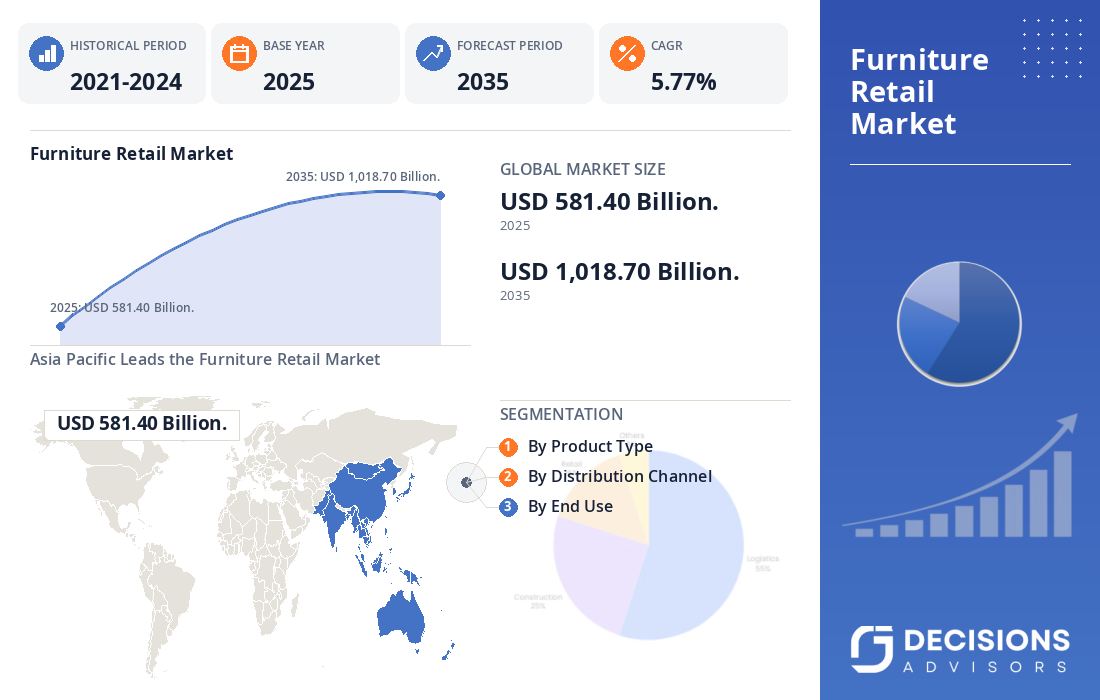
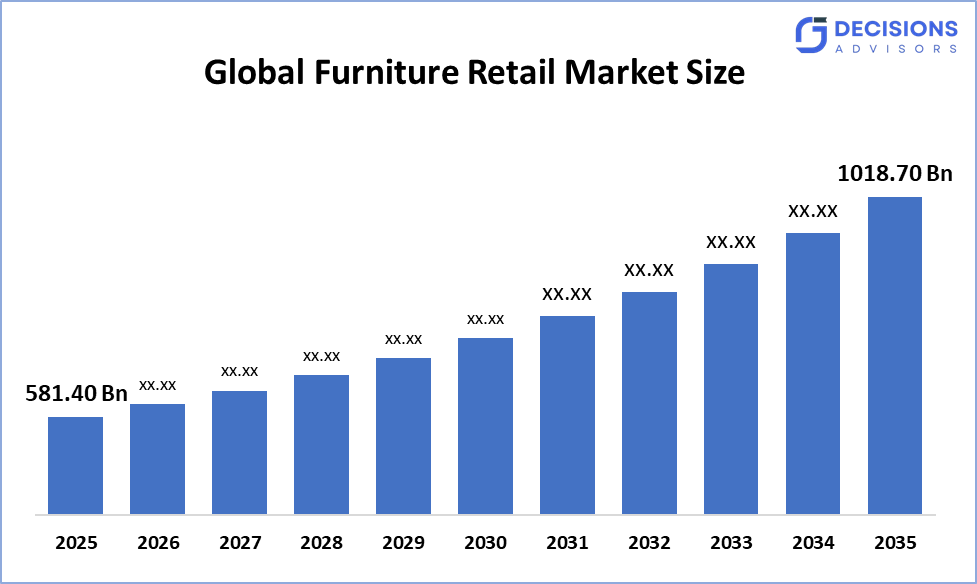
The global furniture retail market size is predicted to grow from USD 581.40 Billion in 2025 and is likely to reach around USD 1,018.70 Billion by 2035 with a CAGR of 5.77%. According to Decision Advisors, the market is being shaped by rising household formation, urbanization, housing activity, renovation spending, e-commerce adoption, and increasing demand for affordable and customizable furnishings. The residential segment dominates global furniture retail demand, supported by replacement purchases, new-home furnishing, remodeling, and growing consumer interest in functional interior design. IKEA remains one of the most influential global furniture retailers, reporting EUR 44.6 billion in total IKEA retail sales in FY2025.
Market Snapshot
- Global Furniture Retail Market Size (2025): USD 581.40 Billion.
- Projected Global Furniture Retail Market Size (2035): USD 1,018.70 Billion.
- Global Furniture Retail Market CAGR: 5.77%.
- Largest Regional Market: Asia Pacific
- 2nd Largest Region: America
- Fastest Growing Region: Asia Pacific
- Base Year: 2025
- Historical Period: 2021-2024
- Market Forecast Period: 2026-2035
Market Overview/ Introduction
The Global Furniture Retail Market comprises retailers, furniture chains, specialty stores, home-improvement retailers, department stores, online marketplaces, direct-to-consumer brands, and omnichannel businesses selling residential, office, outdoor, hospitality, and institutional furniture. Market expansion is being supported by urbanization, rising household formation, residential construction, renovation activity, replacement demand, and increasing consumer spending on home interiors. Furniture retail is also shifting from traditional showroom-based purchasing toward integrated online and offline experiences, with consumers increasingly researching dimensions, materials, reviews, prices, delivery options, and customization before purchase. Current market research estimates place the broader furniture-retailing market at approximately USD 581.40 billion in 2025.Digital transformation is becoming a central competitive factor. Retailers are investing in mobile commerce, personalized recommendations, augmented-reality visualization, digital room planning, warehouse automation, last-mile delivery, and customer loyalty programs.
- India, IKEA has expanded its omnichannel strategy through online delivery across Delhi-NCR and surrounding markets and introduced a Plan & Order Point format in Bengaluru, combining personalized planning, ordering, delivery, and installation services.
- United States, Changes in timber and furniture import policy have increased cost and sourcing considerations for furniture retailers. A December 2025 U.S. proclamation maintained a 25% tariff on certain upholstered furniture, kitchen cabinets, and vanities for an additional year.
- Asia-Pacific, Rapid urbanization, expanding middle-class populations, residential development, and increasing digital commerce are creating significant opportunities for furniture chains and online furniture platforms.
Notable Insights: -
- Asia Pacific is anticipated to hold approximately 38% share of the Global Furniture Retail Market over the predicted timeframe.
- North America is expected to maintain approximately 27% share during the forecast period, supported by high furniture replacement spending and established retail networks.
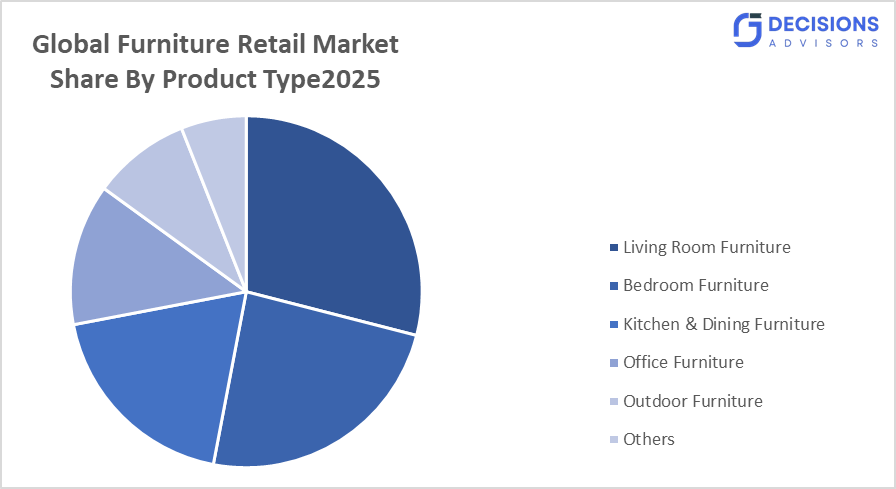
- By Product Type, the Living Room Furniture segment dominated the market and holds approximately 29% share in 2025 and is projected to grow at a substantial CAGR during the forecast period.
- By Distribution Channel, the Offline Stores segment dominated the market and holds approximately 61% share in 2025, although online and omnichannel channels are expected to grow considerably faster.
- The compound annual growth rate of the Global Furniture Retail Market is 5.77%.
- The market is likely to achieve a valuation of USD 1,018.70 Billion by 2035.
Market Drivers
The Global Furniture Retail Market is driven by rising residential construction, urbanization, household formation, renovation spending, and increasing consumer focus on home aesthetics and functionality. The expansion of middle-income populations in emerging economies is encouraging consumers to purchase sofas, beds, dining sets, wardrobes, desks, and other household furnishings. E-commerce has further expanded furniture accessibility by allowing consumers to compare extensive product ranges without visiting physical stores. At the same time, retailers are adopting AI-driven recommendations, AR-based room visualization, digital configuration tools, and omnichannel inventory systems to reduce purchase uncertainty. Demand from home offices, flexible working environments, hospitality properties, restaurants, and commercial buildings also supports market growth.
Restrain
The market faces several constraints, including high logistics and transportation costs, bulky product dimensions, inventory-management complexity, and relatively high return costs for online furniture purchases. Furniture demand is also sensitive to housing cycles, mortgage rates, inflation, and consumer confidence because many purchases are discretionary and relatively high value. In addition, timber, metal, foam, fabrics, and other raw-material costs can create margin pressure.
Competitive Analysis:
The report offers the appropriate analysis of the key organizations/companies involved within the Global Furniture Retail Market, along with a comparative evaluation primarily based on their product offerings, business overviews, geographic presence, enterprise strategies, segment market share, and SWOT analysis. The report also provides an elaborative analysis focusing on the current news and developments of the companies, which includes product development, innovations, joint ventures, partnerships, mergers & acquisitions, strategic alliances, and others. This allows for the evaluation of the overall competition within the market.
Top Companies in the Global Furniture Retail Market
- IKEA
- Ashley Furniture Industries
- Wayfair Inc.
- Williams-Sonoma, Inc.
- RH
- JYSK
- Nitori Holdings Co., Ltd.
- La-Z-Boy Incorporated
- HNI Corporation
- Home24 SE.
Government Initiatives
|
Country |
Key Government Initiatives |
|
United States |
Trade and domestic-wood policies affecting furniture imports, including Section 232 measures on certain upholstered furniture, cabinets and vanities, are influencing sourcing and pricing strategies |
|
Japan |
Housing renovation, urban redevelopment, smart-home adoption and energy-efficient building initiatives indirectly support demand for residential furniture and connected home products |
|
China |
Policies supporting consumption, urban redevelopment, home renovation and digital commerce are creating opportunities for furniture retailers, particularly in major urban markets |
Market Segmentation
The Global Furniture Retail Market share is classified into product type, distribution channel, and end use.
- The living room furniture segment dominated the market and holds approximately 29% share in 2025 and is projected to grow at a substantial CAGR during the forecast period.
Based on product type, the global furniture retail market is divided into living room furniture, bedroom furniture, kitchen & dining furniture, office furniture, outdoor furniture, and others. Living room furniture represents a major spending category because sofas, chairs, coffee tables, entertainment units, and storage products are frequently purchased during home furnishing and renovation projects. Growing apartment living and demand for modular, multifunctional products are also encouraging retailers to expand compact living-room collections. Online visualization and customization capabilities are further increasing consumer confidence in purchasing these products.
- The offline stores segment accounted for the largest share of approximately 61% in 2025 and is anticipated to grow at a significant CAGR during the forecast period.
Based on distribution channel, the market is divided into offline stores, online retail, and omnichannel retail. Physical stores continue to dominate because furniture is a tactile product category in which customers often want to test comfort, assess materials, inspect finishes, and understand dimensions before purchasing. Large-format showrooms also provide room displays that encourage cross-category purchases. However, online and omnichannel retail are growing rapidly as retailers improve delivery networks, digital catalogs, AR visualization, reviews, financing, and click-and-collect services.
- The Residential segment accounted for the largest share of approximately 68% in 2025 and is anticipated to grow at a significant CAGR during the forecast period.
Based on end use, the market is divided into residential, commercial, hospitality, and institutional. residential demand remains dominant because furniture is purchased for new homes, apartments, renovations, replacements, and lifestyle upgrades. Increasing urban household formation and smaller living spaces are generating demand for modular and space-saving furniture. Rising consumer interest in interior aesthetics and home-office setups is also supporting replacement and discretionary purchases.
Regional Segment Analysis of the Global Furniture Retail Market
- North America (U.S., Canada, Mexico)?
- Europe (Germany, U.K., France, Italy, Spain, Netherlands, Rest of Europe).
- Asia-Pacific (China, Japan, India, Australia, South Korea, Rest of Asia-Pacific).
- South America (Brazil, Argentina, Rest of South America).
- Middle East & Africa (UAE, Saudi Arabia, South Africa, Rest of MEA).
Asia Pacific is anticipated to hold approximately 38% share of the Global Furniture Retail Market over the predicted timeframe.
Asia Pacific represents the largest regional market because of its large consumer population, expanding middle class, rapid urbanization, residential construction, and strong furniture manufacturing ecosystem. China remains a major contributor because of its enormous domestic consumer base and established furniture supply chain, while India represents an increasingly important growth market. IKEA's expansion in India illustrates the region's retail opportunity: the company launched online delivery across Delhi-NCR and nine satellite markets and expanded its physical and planning formats.
North America is expected to grow at a rapid CAGR in the Global Furniture Retail Market, holding approximately 27% of the share during the forecast period.
North America benefits from high household purchasing power, established furniture chains, strong home-improvement activity, and widespread e-commerce adoption. The United States represents the largest regional contributor, with major retailers competing through online marketplaces, large-format showrooms, direct-to-consumer brands, financing, delivery services, and premium furniture offerings. Wayfair's recent results also indicate improving U.S. furniture demand, with U.S. sales increasing 9% in its latest reported quarter and overall revenue reaching USD 3.52 billion.
Europe is expected to hold approximately 22% share of the Global Furniture Retail Market during the forecast period.
Europe is characterized by mature furniture markets, strong design traditions, established retail chains, sustainability awareness, and growing interest in circular consumption. Germany, the U.K., France, Italy, and Spain represent important markets. Retailers are increasingly emphasizing recycled materials, repair, resale, responsible sourcing, and product longevity. IKEA's expansion of its U.S. buyback and resale model also reflects the broader industry movement toward circular furniture models, with the program focused on returning used products for store credit and reselling them.
Future Market Trends in Global Furniture Retail Market: -
- Expansion of Online and Omnichannel Furniture Retail
Furniture purchasing is increasingly moving toward integrated digital and physical experiences. Consumers can research products online, use visualization tools, visit showrooms, order digitally, and receive home delivery or click-and-collect services.
- AI, AR and 3D Furniture Visualization
Artificial intelligence, augmented reality, 3D room planning, and personalized recommendation systems are becoming important tools for reducing uncertainty in furniture purchases. Customers can increasingly visualize sofas, tables, beds, and storage units in their own spaces before completing transactions.
- ???????Growth of Sustainable and Circular Furniture
Sustainability is moving from a niche consideration to an important purchasing and brand-positioning factor. Retailers are introducing responsibly sourced materials, recycled components, repair programs, resale channels, and take-back schemes.
?????? - Compact, Modular and Multifunctional Furniture
Urbanization and smaller residential spaces are increasing demand for furniture that can perform multiple functions. Modular sofas, expandable dining tables, storage beds, foldable desks, and multifunctional shelving systems are expected to gain popularity. Retailers are responding by offering configurable products that can adapt to changing household needs.
Recent Development
- In February 2025, IKEA launched online deliveries across Delhi-NCR and nine surrounding Indian markets, expanding its omnichannel presence with more than 7,000 products and services including remote planning, interior design, assembly, and installation.
- In April 2025, IKEA launched its first Plan & Order Point in Bengaluru, offering personalized home-design planning, product ordering, delivery, and installation services as part of its smaller-format expansion strategy.
- In 2026, IKEA expanded its U.S. furniture buyback and resale program, moving toward broader availability across full-format stores and strengthening its circular retail model.
Market Segment
This study forecasts revenue at global, regional, and country levels from 2021 to 2035. Decision Advisors has segmented the global furniture retail market based on the below-mentioned segment:
Global Furniture Retail Market, By Product Type
- Living Room Furniture
- Bedroom Furniture
- Kitchen & Dining Furniture
- Office Furniture
- Outdoor Furniture
- Others.
Global Furniture Retail Market, By Distribution Channel
- Offline Stores
- Online Retail
- Omnichannel Retail.
Global Furniture Retail Market, By End Use
- Residential
- Commercial
- Hospitality
- Institutional.
Global Furniture Retail Market, By Regional Analysis
North America
- US
- Canada
- Mexico
Europe
- Germany
- UK
- France
- Italy
- Spain
- Russia
- Rest of Europe
Asia Pacific
- China
- Japan
- India
- South Korea
- Australia
- Rest of Asia Pacific
South America
- Brazil
- Argentina
- Rest of South America
Middle East & Africa
- UAE
- Saudi Arabia
- Qatar
- South Africa
- Rest of the Middle East & Africa
Frequently Asked Questions (FAQ)
Q. What are the major factors driving the Global Furniture Retail Market?
A. The primary drivers include urbanization, household formation, residential construction, renovation spending, rising disposable income, e-commerce adoption, and growing consumer interest in home aesthetics. Omnichannel retail and digital visualization are also improving furniture purchasing convenience.
Q. Why is Asia Pacific the largest regional market for furniture retail?
A. Asia Pacific benefits from its large population, expanding middle class, rapid urbanization, residential development, and strong furniture manufacturing ecosystem. China, India, Japan, and South Korea are particularly important contributors to regional demand.
Q. How is e-commerce changing furniture retail?
A. E-commerce enables consumers to compare extensive furniture catalogs, prices, reviews, materials, dimensions, and delivery options without visiting multiple stores. AR visualization, 3D room planning, digital financing, and improved logistics are helping overcome traditional barriers to online furniture purchasing.
Q. What is the role of sustainability in furniture retail?
A. Retailers are increasingly adopting responsibly sourced materials, recycled components, repair services, resale programs, and furniture take-back schemes. Circular models can reduce waste while creating additional customer engagement and affordable secondhand product channels.
Check Licence
Choose the plan that fits you best: Single User, Multi-User, or Enterprise solutions tailored for your needs.
We Have You Covered
- 24/7 Analyst Support
- Clients Across the Globe
- Tailored Insights
- Technology Tracking
- Competitive Intelligence
- Custom Research
- Syndicated Market Studies
- Market Overview
- Market Segmentation
- Growth Drivers
- Market Opportunities
- Regulatory Insights
- Innovation & Sustainability
Report Details
| Scope | Global |
| Pages | 250 |
| Delivery | PDF & Excel via Email |
| Language | English |
| Release | Aug 2026 |
| Access | Download from this page |