
Global Gastric Ulcers Market
 |
Pages:
230
|
Pages:
230
Global Gastric Ulcers Market Size, Share, and COVID-19 Impact Analysis, By Diagnosis (Stool Test, Endoscopy, Imaging Tests, Blood Tests, and Others), By Drug Class (Proton Pump Inhibitors (PPI), H2 Antagonists, Antacids, Antibiotics, Cytoprotective Agents, and Others), By Route of Administration (Oral, Parenteral, and Others) and By Region (North America, Europe, Asia-Pacific, Latin America, Middle East, and Africa), Analysis and Forecast 2025-2035
REPORT COVERAGE
Global
Global Gastric Ulcers Market Size Insights Forecasts to 2035
- The Global Gastric Ulcers Market Size Was valued at USD 4.42 Billion in 2024
- The Global Gastric Ulcers Market Size is Expected to Grow at a CAGR of around 4.69% from 2025 to 2035
- The Worldwide Gastric Ulcers Market Size is Expected to Reach USD 7.32 Billion by 2035
- Asia-Pacific is expected to grow the fastest during the forecast period.
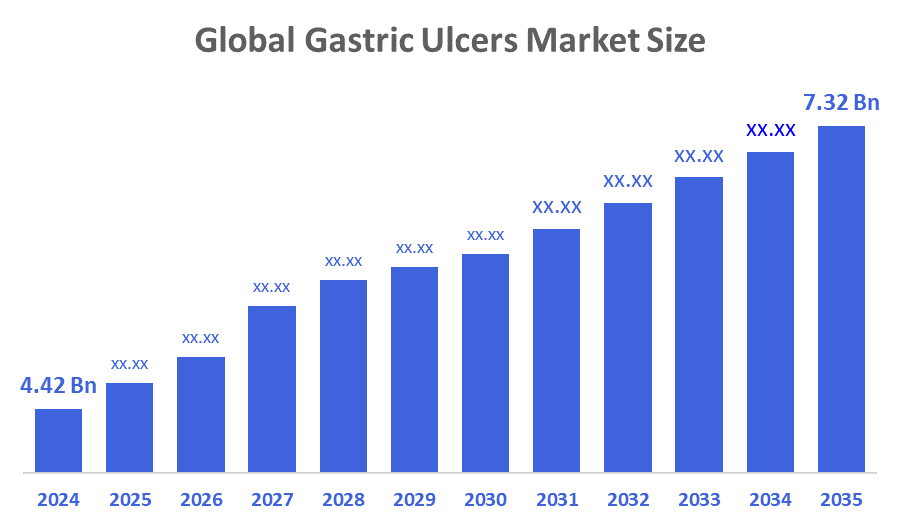
According to a research report published by Decisions Advisors and Consulting, The Global Gastric Ulcers Market Size Was Worth Around USD 4.42 Billion In 2024 And Is Predicted To Grow To Around USD 7.32 Billion By 2035 With A Compound Annual Growth Rate (CAGR) Of 4.69% From 2025 To 2035. The period of historical development experienced its growth because of four main factors which include the increased presence of helicobacter pylori infections, the higher consumption of nonsteroidal anti-inflammatory drugs NSAIDs, the expanding elderly population throughout the world and the rising public awareness campaigns about gastric ulcer prevention and the presence of stress-related disorders.
Market Overview
The Global Gastric Ulcers Market Size refers to the worldwide healthcare industry focused on the diagnosis, treatment, and management of gastric ulcer conditions open sores that develop on the stomach lining due to acid damage, infections, or prolonged medication use. The market expands because of increased gastrointestinal disorders together with people who have unhealthy eating habits and growing knowledge about detecting illnesses at earlier stages. The World Health Organization provides data which shows that digestive diseases continue to cause significant health problems around the world thus compelling governments to improve screening methods and treatment facilities. The development of proton pump inhibitors together with minimally invasive diagnostic methods and combination therapies results in better health results for patients. The development of healthcare systems together with new pharmaceutical products enables the market to grow because it makes gastric ulcer treatment more effective and available to patients throughout the world.
Report Coverage
This research report categorizes the gastric ulcers market based on various segments and regions, forecasts revenue growth, and analyzes trends in each submarket. The report analyses the key growth drivers, opportunities, and challenges influencing the gastric ulcers market. Recent market developments and competitive strategies such as expansion, type launch, development, partnership, merger, and acquisition, have been included to draw the competitive landscape in the market. The report strategically identifies and profiles the key market players and analyses their core competencies in each sub-segment of the gastric ulcers market.
Driving Factors
The rising prevalence of gastric ulcers across the globe is expected to drive market expansion. A stomach ulcer develops when gastric acid eats away at your stomach's protective lining. The acid produces open stomach wounds which result in bleeding and painful symptoms. Gastric ulcer disease shows itself through multiple symptoms which include stomach ulcers as one of its manifestations. Peptic ulcers are treated with drugs that decrease gastric ulcer secretion through their use of PPIs and H2 receptor antagonists and their combination with antacids and antibiotics used to treat H. pylori infection. The medicines require combination use for their treatment to work effectively.
Restraining Factors
The expensive treatment costs will create a barrier that prevents the market from growing. The gastric ulcers market in developing countries will face difficulties because there are no qualified workers and the healthcare system is not developed. The market will experience growth restrictions during the 2025-2032 period because of two factors which include strict regulatory policies and public lack of awareness.
Market Segmentation
The gastric ulcers market share is classified into diagnosis, drug class, and route of administration.
- The endoscopy segment dominated the market in 2024, approximately 45% and is projected to grow at a substantial CAGR during the forecast period.
Based on the diagnosis, the gastric ulcers market is divided into stool test, endoscopy, imaging tests, blood tests, and others. Among these, the endoscopy segment dominated the market in 2024, approximately 45% and is projected to grow at a substantial CAGR during the forecast period. Endoscopy continues to be the most accurate method for diagnosing gastric ulcers because it can directly visualize the stomach lining. The system provides capabilities for early detection and enables doctors to take biopsies while it delivers accurate ulcer severity measurements. The increasing presence of minimally invasive endoscopic systems and the expertise of trained specialists together with the diagnostic capabilities of hospitals, make it easier to adopt these systems which will help doctors make accurate medical decisions, while maintaining their usage in all healthcare environments.
- The proton pump inhibitors (PPI) segment accounted for the largest share in 2024, approximately 48% and is anticipated to grow at a significant CAGR during the forecast period.
Based on the drug class, the gastric ulcers market is divided into proton pump inhibitors (PPI), H2 antagonists, antacids, antibiotics, cytoprotective agents, and others. Among these, the proton pump inhibitors (PPI) segment accounted for the largest share in 2024, approximately 48% and is anticipated to grow at a significant CAGR during the forecast period. Proton pump inhibitors become the first choice for treating gastric ulcers because they deliver strong acid suppression and fast healing results. The treatment provides long-lasting symptom relief while decreasing the chances of recurrence and assisting with combination therapy. The combination of strong clinical guidelines and physician knowledge and widespread drug availability enables hospitals and outpatient gastrointestinal facilities to implement these practices consistently.
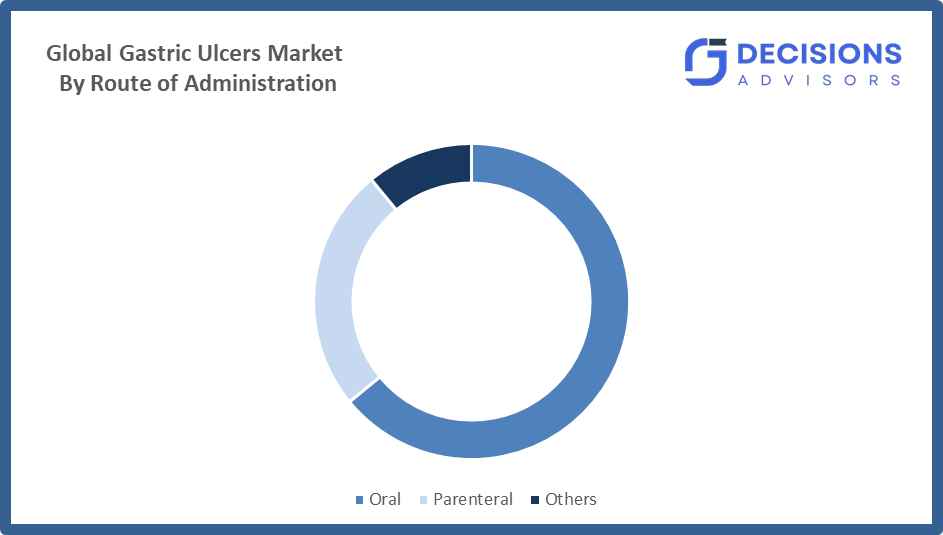
- The oral segment accounted for the highest market revenue in 2024, approximately 72% and is anticipated to grow at a significant CAGR during the forecast period.
Based on the route of administration, the gastric ulcers market is divided into oral, parenteral, and others. Among these, the oral segment accounted for the highest market revenue in 2024, approximately 72% and is anticipated to grow at a significant CAGR during the forecast period. Oral therapies lead gastric ulcer treatment because they require simple administration and patients follow treatment plans and the treatment costs remain affordable. The treatment allows doctors to manage patients at home while they achieve quick relief from symptoms throughout their entire treatment period. The widespread availability of oral medications combined with doctors' preference for these options results in their continuing use as the main treatment method in different medical environments.
Regional Segment Analysis of the Gastric Ulcers Market
- North America (U.S., Canada, Mexico)
- Europe (Germany, France, U.K., Italy, Spain, Rest of Europe)
- Asia-Pacific (China, Japan, India, Rest of APAC)
- South America (Brazil and the Rest of South America)
- The Middle East and Africa (UAE, South Africa, Rest of MEA)
North America is anticipated to hold the largest share of the Gastric Ulcers market over the predicted timeframe.
North America is anticipated to hold the largest share of the gastric ulcers market over the predicted timeframe. The diagnosis rates in the region together with its advanced healthcare system and its broad use of cutting-edge ulcer treatments and its increasing public awareness of medical conditions, which drive their healthcare needs. The region gains beneficial pharmaceutical access together with its implementation of early screening methods and its establishment of clinical management standards, which create a situation where customers constantly demand treatment services and the company maintains market dominance, especially in the United States, which represents about 35 to 40 percent of the worldwide market.
Asia-Pacific is expected to grow at a rapid CAGR in the gastric ulcers market during the forecast period. The rising rates of gastrointestinal diseases together with better healthcare access and increased access to pharmaceutical products and enhanced public knowledge about early disease detection. The combination of lifestyle modifications and rising infection-related ulcer cases together with increased healthcare funding leads to the rapid implementation of contemporary medical treatments which spread throughout developing nations especially in China and India who account for approximately 25 to 30 percent of the market.
Competitive Analysis:
The report offers the appropriate analysis of the key organizations/companies involved within the gastric ulcers market, along with a comparative evaluation primarily based on their type of offering, business overviews, geographic presence, enterprise strategies, segment market share, and SWOT analysis. The report also provides an elaborative analysis focusing on the current news and developments of the companies, which includes type development, innovations, joint ventures, partnerships, mergers & acquisitions, strategic alliances, and others. This allows for the evaluation of the overall competition within the market.
List of Key Companies
- F. Hoffmann-La Roche Ltd.
- Mylan N.V.
- Teva Pharmaceutical Industries Ltd.
- Sanofi
- Pfizer Inc.
- GlaxoSmithKline plc
- Novartis AG
- Merck & Co., Inc.
- Allergan
- AstraZeneca
- Others
Key Target Audience
- Market Players
- Investors
- End-users
- Government Authorities
- Consulting and Research Firm
- Venture capitalists
- Value-Added Resellers (VARs)
Market Segment
This study forecasts revenue at global, regional, and country levels from 2020 to 2035. Decisions Advisors has segmented the gastric ulcers market based on the below-mentioned segments:
Global Gastric Ulcers Market, By Diagnosis
- Stool Test
- Endoscopy
- Imaging Tests
- Blood Tests
- Others
Global Gastric Ulcers Market, By Drug Class
- Proton Pump Inhibitors (PPI)
- H2 Antagonists
- Antacids
- Antibiotics
- Cytoprotective Agents
- Others
Global Gastric Ulcers Market, By Route of Administration
- Oral
- Parenteral
- Others
Global Gastric Ulcers Market, By Regional Analysis
- North America
- US
- Canada
- Mexico
- Europe
- Germany
- UK
- France
- Italy
- Spain
- Russia
- Rest of Europe
- Asia Pacific
- China
- Japan
- India
- South Korea
- Australia
- Rest of Asia Pacific
- South America
- Brazil
- Argentina
- Rest of South America
- Middle East & Africa
- UAE
- Saudi Arabia
- Qatar
- South Africa
- Rest of the Middle East & Africa
Frequently Asked Questions (FAQ)
Q1. What historical factors contributed to the gastric ulcers market growth?
A: Growth historically stemmed from rising H. pylori infections, higher NSAID consumption, aging populations, stress-related disorders, and expanding awareness campaigns promoting early diagnosis and preventive gastric healthcare globally.
Q2. Why is endoscopy central to gastric ulcer diagnosis?
A: Endoscopy dominates diagnosis because it allows direct stomach visualization, biopsy capability, early ulcer detection, and severity assessment, improving clinical accuracy and supporting faster treatment decisions across modern healthcare systems
.
Q3. What makes proton pump inhibitors the preferred drug class?
A: PPIs lead treatment due to powerful acid suppression, rapid ulcer healing, recurrence prevention, and compatibility with combination therapies, reinforced by clinical guidelines and physician confidence in gastrointestinal care management.
Q4. How do regional dynamics influence gastric ulcer treatment demand?
A: Regional demand varies with healthcare access, disease prevalence, and awareness. Strong infrastructure in North America and rising treatment adoption in Asia-Pacific accelerate global expansion, supported by guidance from the World Health Organization.
Check Licence
Choose the plan that fits you best: Single User, Multi-User, or Enterprise solutions tailored for your needs.
We Have You Covered
- 24/7 Analyst Support
- Clients Across the Globe
- Tailored Insights
- Technology Tracking
- Competitive Intelligence
- Custom Research
- Syndicated Market Studies
- Market Overview
- Market Segmentation
- Growth Drivers
- Market Opportunities
- Regulatory Insights
- Innovation & Sustainability
Report Details
| Scope | Global |
| Pages | 230 |
| Delivery | PDF & Excel via Email |
| Language | English |
| Release | Feb 2026 |
| Access | Download from this page |