
Global Gastritis Market
 |
Pages:
240
|
Pages:
240
Global Gastritis Market Size, Share, and COVID-19 Impact Analysis, By Treatment (Acid Blocking Medications, Acid Reducing Medications, Antacids, Antibiotics, and Others), By Type (Acute Gastritis, Chronic Gastritis, Erosive Gastritis, and Non-Erosive Gastritis), By Route of Administration (Oral and Parenteral) and By Region (North America, Europe, Asia-Pacific, Latin America, Middle East, and Africa), Analysis and Forecast 2025-2035
REPORT COVERAGE
Global
Global Gastritis Market Size Insights Forecasts to 2035
- The Global Gastritis Market Size Was valued at USD 192.20 Million in 2024
- The Global Gastritis Market Size is Expected to Grow at a CAGR of around 4.49% from 2025 to 2035
- The Worldwide Gastritis Market Size is Expected to Reach USD 311.68 Million by 2035
- Asia-Pacific is expected to grow the fastest during the forecast period.
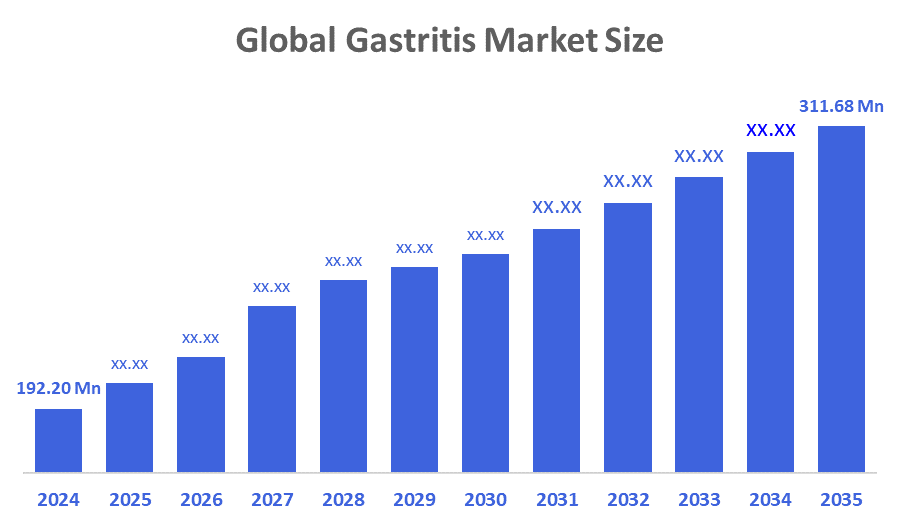
According to a research report published by Decisions Advisors and Consulting, The Global Gastritis Market Size Was Worth Around USD 192.20 Million In 2024 And Is Predicted To Grow To Around USD 311.68 Million By 2035 With A Compound Annual Growth Rate (CAGR) Of 4.49% From 2025 To 2035. The global gastritis market will experience future growth through microbiome-based treatments and personalized medicine and increased healthcare access and better diagnostic methods and digital health monitoring systems and new pharmaceutical research that develops treatments which help patients receive timely medical care.
Market Overview
The global gastritis market refers to the healthcare sector focused on the diagnosis, treatment, and management of gastritis which is an inflammatory condition that affects the stomach lining because of infections or drugs or lifestyle choices or autoimmune diseases. The market is driven by rising gastrointestinal disease prevalence and increasing awareness and improved access to healthcare services which have become available across the globe. The market keeps growing because people want better treatments which include acid-suppressing medications and specialized medical solutions. Innovation plays a key role because microbiome research and personalized medicine and minimally invasive diagnostic methods and digital health monitoring create better methods for early detection and precise treatment. Pharmaceutical companies are developing new drug combinations and treatment approaches to improve patient outcomes. The combination of healthcare facility growth in developing countries with reimbursement systems that support medical services creates conditions that drive medical service usage. The combination of these elements creates a foundation for the gastritis market which will experience steady growth while delivering better patient outcomes through ongoing development of medical treatments.
Report Coverage
This research report categorizes the gastritis market based on various segments and regions, forecasts revenue growth, and analyzes trends in each submarket. The report analyses the key growth drivers, opportunities, and challenges influencing the gastritis market. Recent market developments and competitive strategies such as expansion, type launch, development, partnership, merger, and acquisition, have been included to draw the competitive landscape in the market. The report strategically identifies and profiles the key market players and analyses their core competencies in each sub-segment of the gastritis market.
Driving Factors
The worldwide increase in gastritis cases leads to market growth for the gastritis industry. The United States experiences annual gastritis diagnosis for about 8 million people which demonstrates how common the disorder has become. The rise in gastritis cases results from multiple factors which include poor dietary choices and increasing stress levels and the common presence of Helicobacter pylori infections. The market growth directly relates to rising gastritis cases because increased patient demand for diagnostic and treatment solutions drives the need for healthcare products and services.
The current trend needs effective management solutions while it creates widespread consequences for the healthcare sector which includes pharmaceutical companies and diagnostic equipment and treatment methods. The rising number of gastritis cases drives research and development activities which aim to create better treatment methods that will lead to increased market expansion.
Restraining Factors
The market growth is being obstructed by expensive costs which drug manufacturing and development process require. The gastritis treatment market experiences growth limitations because vaccine and drug development research and development activities demand high initial funding.
Market Segmentation
The gastritis market share is classified into treatment, type, and route of administration.
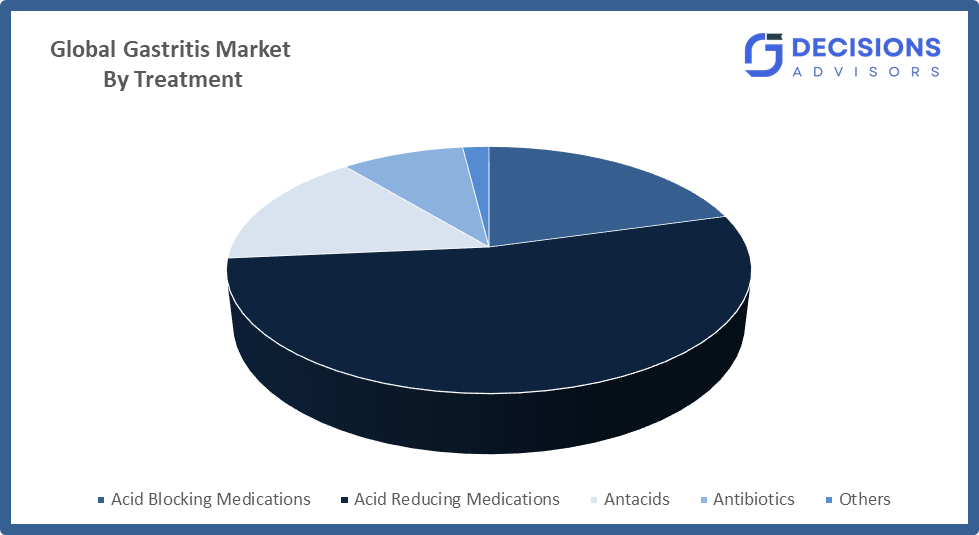
- The acid reducing segment dominated the market in 2024, approximately 41% and is projected to grow at a substantial CAGR during the forecast period.
Based on the treatment, the gastritis market is divided into acid blocking medications, acid reducing medications, antacids, antibiotics, and others. Among these, the acid reducing segment dominated the market in 2024, approximately 41% and is projected to grow at a substantial CAGR during the forecast period. The combination of effective gastric acid control and extensive clinical evidence and doctor preference and patient acceptance and advanced product availability led to the current market situation. The rising incidence of gastritis and the need for ongoing symptom relief drive continuous product usage which results in both market segment leadership and business expansion during the upcoming forecast period.
- The chronic gastritis segment accounted for the largest share in 2024, approximately 46% and is anticipated to grow at a significant CAGR during the forecast period.
Based on the type, the gastritis market is divided into acute gastritis, chronic gastritis, erosive gastritis, and non-erosive gastritis. Among these, the chronic gastritis segment accounted for the largest share in 2024, approximately 46% and is anticipated to grow at a significant CAGR during the forecast period. The condition exists because it requires ongoing treatment which needs constant medical supervision. The demand for healthcare services will increase because people now understand health conditions better and doctors can diagnose them more accurately while they treat more patients who develop health issues because of their way of living and their exposure to infections.
- The oral segment accounted for the highest market revenue in 2024, approximately 85% and is anticipated to grow at a significant CAGR during the forecast period.
Based on the route of administration, the gastritis market is divided into oral and parenteral. Among these, the oral segment accounted for the highest market revenue in 2024, approximately 85% and is anticipated to grow at a significant CAGR during the forecast period. The gastrointestinal disorder treatment shows better patient compliance because oral medications are more accessible and affordable and patients can take them without help at home. The treatment is preferred for extended gastritis management because it enables patients to take their medication without needing medical assistance. The treatment method generates ongoing demand which results in steady revenue increases for the entire period of the forecast.
Regional Segment Analysis of the Gastritis Market
- North America (U.S., Canada, Mexico)
- Europe (Germany, France, U.K., Italy, Spain, Rest of Europe)
- Asia-Pacific (China, Japan, India, Rest of APAC)
- South America (Brazil and the Rest of South America)
- The Middle East and Africa (UAE, South Africa, Rest of MEA)
North America is anticipated to hold the largest share of the gastritis market over the predicted timeframe.
North America is anticipated to hold the largest share of the gastritis market over the predicted timeframe. The region maintains its leading market position because both its healthcare infrastructure and its diagnosis capabilities and its treatment accessibility and its pharmaceutical industry presence create continuous demand for gastrointestinal disorders which home delivery services and therapy reimbursement programs and new treatment methods establish. North America is estimated to account for about 38% of the global gastritis market share.
Asia-Pacific is expected to grow at a rapid CAGR in the gastritis market during the forecast period. The escalating rates of gastrointestinal diseases, which require expanding healthcare facilities, need increased healthcare expenditures, which are required to enhance diagnosis capabilities, and which need to raise public health awareness to improve healthcare system effectiveness. Urban areas need to develop more medical facilities because they create higher disease treatment needs through their population growth and increased healthcare access. The Asia-Pacific region is projected to control approximately 27% of the market share.
Competitive Analysis:
The report offers the appropriate analysis of the key organizations/companies involved within the gastritis market, along with a comparative evaluation primarily based on their type of offering, business overviews, geographic presence, enterprise strategies, segment market share, and SWOT analysis. The report also provides an elaborative analysis focusing on the current news and developments of the companies, which includes type development, innovations, joint ventures, partnerships, mergers & acquisitions, strategic alliances, and others. This allows for the evaluation of the overall competition within the market.
List of Key Companies
- F. Hoffmann-La Roche Ltd.
- Mylan N.V.
- Teva Pharmaceutical Industries Ltd.
- Sanofi
- Pfizer Inc.
- GSK plc
- Novartis AG
- AstraZeneca
- Johnson & Johnson Private Limited
- Sun Pharmaceutical Industries Ltd.
- Others
Key Target Audience
- Market Players
- Investors
- End-users
- Government Authorities
- Consulting and Research Firm
- Venture capitalists
- Value-Added Resellers (VARs)
Recent Development
- In July 2025, a Scientific Reports study found that the gastric microbiota of patients with autoimmune gastritis (AIG) differed significantly from that of those with atrophic gastritis after Helicobacter pylori eradication, showing lower bacterial diversity and shifts in key bacterial genera, and suggesting distinct microbial patterns linked to AIG pathogenesis.
Market Segment
This study forecasts revenue at global, regional, and country levels from 2020 to 2035. Decisions Advisors has segmented the gastritis market based on the below-mentioned segments:
Global Gastritis Market, By Treatment
- Acid Blocking Medications
- Acid Reducing Medications
- Antacids
- Antibiotics
- Others
Global Gastritis Market, By Type
- Acute Gastritis
- Chronic Gastritis
- Erosive Gastritis
- Non-Erosive Gastritis
Global Gastritis Market, By Route of Administration
- Oral
- Parenteral
Global Gastritis Market, By Regional Analysis
- North America
- US
- Canada
- Mexico
- Europe
- Germany
- UK
- France
- Italy
- Spain
- Russia
- Rest of Europe
- Asia Pacific
- China
- Japan
- India
- South Korea
- Australia
- Rest of Asia Pacific
- South America
- Brazil
- Argentina
- Rest of South America
- Middle East & Africa
- UAE
- Saudi Arabia
- Qatar
- South Africa
- Rest of the Middle East & Africa
Frequently Asked Questions (FAQ)
Q1: What is the estimated growth of the global gastritis market from 2024 to 2035?
A: The global gastritis market is projected to grow from USD 192.20 Million in 2024 to USD 311.68 Million by 2035, at a CAGR of 4.49%.
Q2: Which treatment segment dominated the gastritis market in 2024 and why?
A: Acid-reducing medications dominated in 2024 (41%) due to strong clinical effectiveness, high doctor preference, patient acceptance, and availability of advanced formulations, driving sustained demand.
Q3: Which type of gastritis held the largest market share in 2024?
A: Chronic gastritis accounted for the largest share (46%) because it requires ongoing treatment, continuous medical supervision, and rising awareness, increasing demand for healthcare services.
Q4: Which route of administration generated the highest revenue in 2024?
A: The oral segment generated 85% revenue due to convenience, affordability, higher patient compliance, and suitability for long-term gastritis management at home.
Q5: What future opportunities are expected in the gastritis market?
A: Opportunities include microbiome-based treatments, personalized medicine, improved diagnostics, digital health monitoring, and novel pharmaceutical research enhancing early detection and effective patient care.
Check Licence
Choose the plan that fits you best: Single User, Multi-User, or Enterprise solutions tailored for your needs.
We Have You Covered
- 24/7 Analyst Support
- Clients Across the Globe
- Tailored Insights
- Technology Tracking
- Competitive Intelligence
- Custom Research
- Syndicated Market Studies
- Market Overview
- Market Segmentation
- Growth Drivers
- Market Opportunities
- Regulatory Insights
- Innovation & Sustainability
Report Details
| Scope | Global |
| Pages | 240 |
| Delivery | PDF & Excel via Email |
| Language | English |
| Release | Feb 2026 |
| Access | Download from this page |