
Global Gastrointestinal Stromal Tumor Market
 |
Pages:
250
|
Pages:
250
Global Gastrointestinal Stromal Tumor Market Size, Share, and COVID-19 Impact Analysis, By Treatment Type (Chemotherapy, Targeted Therapy, and Others), By Route of Administration (Oral, Parenteral, and Others), By End-Users (Hospitals, Homecare, Speciality Centres, and Others) and By Region (North America, Europe, Asia-Pacific, Latin America, Middle East, and Africa), Analysis and Forecast 2025-2035
REPORT COVERAGE
Global
Global Gastrointestinal Stromal Tumor Market Size Insights Forecasts to 2035
- The Global Gastrointestinal Stromal Tumor Market Size Was valued at USD 874.0 Million in 2024
- The Global Gastrointestinal Stromal Tumor Market Size is Expected to Grow at a CAGR of around 10.02% from 2025 to 2035
- The Worldwide Gastrointestinal Stromal Tumor Market Size is Expected to Reach USD 2499.1 Million by 2035
- Asia-Pacific is expected to grow the fastest during the forecast period.
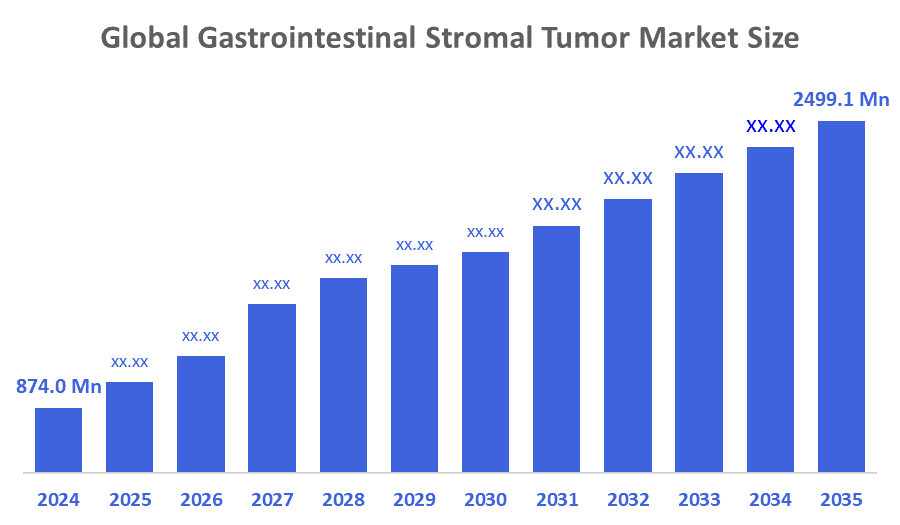
According to a research report published by Decisions Advisors and Consulting, The Global Gastrointestinal Stromal Tumor Market Size Was Worth Around USD 874.0 Million In 2024 And Is Predicted To Grow To Around USD 2499.1 Million By 2035 With A Compound Annual Growth Rate (CAGR) Of 10.02% From 2025 To 2035. The Global gastrointestinal stromal tumor (GIST) market will experience future growth through targeted therapies and personalized therapies together with increased diagnostic capabilities and genomic profiling and rising disease rates and public comprehension and additional clinical research and wider implementation of treatment across different regions.
Market Overview
The Global Gastrointestinal Stromal Tumor Market Size refers to the industry which develops methods for diagnosing and treating and managing gastrointestinal stromal tumors which are uncommon mesenchymal tumors that mainly affect the stomach and small intestine. The market grows because more people develop the disease and people know more about the condition and medical professionals create better targeted treatment options. Tyrosine kinase inhibitors (TKIs) have transformed treatment results because they increase patient survival rates. The ongoing development of precision medicine together with biomarker-based diagnostic methods and next-generation sequencing technology brings about new ways to manage patient care. The companies Novartis AG and Pfizer Inc. are funding their development of new targeted treatment methods through their active clinical research programs. The field of immunotherapy research and combination treatment studies is expected to drive major business expansion in the upcoming years.
Report Coverage
This research report categorizes the gastrointestinal stromal tumor market based on various segments and regions, forecasts revenue growth, and analyzes trends in each submarket. The report analyses the key growth drivers, opportunities, and challenges influencing the gastrointestinal stromal tumor market. Recent market developments and competitive strategies such as expansion, type launch, development, partnership, merger, and acquisition, have been included to draw the competitive landscape in the market. The report strategically identifies and profiles the key market players and analyses their core competencies in each sub-segment of the gastrointestinal stromal tumor market.
Driving Factors
The Global Gastrointestinal Stromal Tumor Market Size experiences growth because rare gastrointestinal cancers become more common and people become more aware of cancer symptoms which leads to early detection and targeted therapies gain popularity through tyrosine kinase inhibitors. The development of molecular diagnostics together with genetic testing enables doctors to select appropriate treatments for their patients. The market expands because Novartis AG and Bayer AG develop their research programs while conducting clinical studies.
Restraining Factors
The Global Gastrointestinal Stromal Tumor Market Size growth faces multiple hindrances because of high treatment costs, limited patient population, drug resistance to tyrosine kinase inhibitors, strict regulatory approval processes, and developing regions' restricted access to advanced diagnostic systems.
Market Segmentation
The gastrointestinal stromal tumor market share is classified into treatment type, route of administration, and end-users.
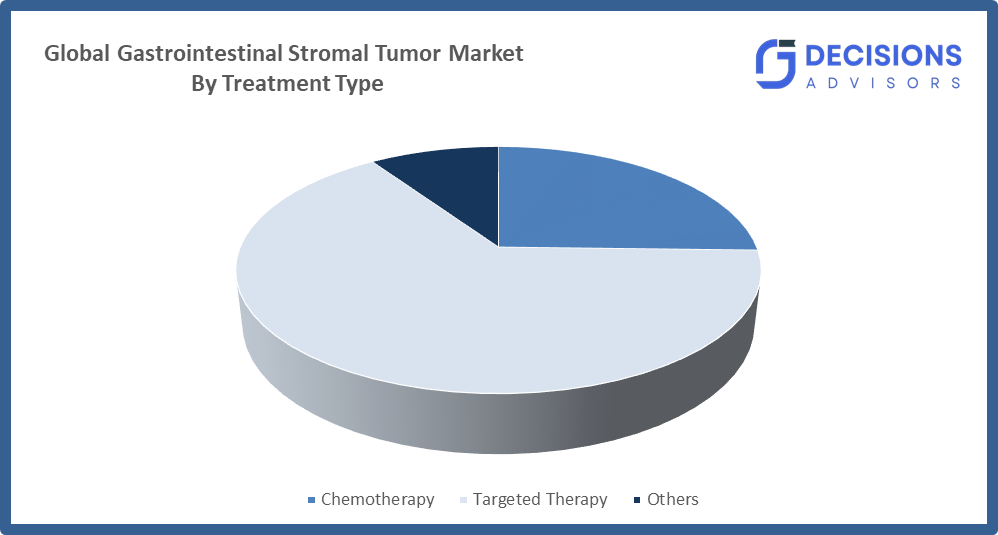
- The targeted therapy segment dominated the market in 2024, approximately 63% and is projected to grow at a substantial CAGR during the forecast period.
Based on the treatment type, the gastrointestinal stromal tumor market is divided into chemotherapy, targeted therapy, and others. Among these, the targeted therapy segment dominated the market in 2024, approximately 63% and is projected to grow at a substantial CAGR during the forecast period. The successful treatment of KIT and PDGFRA-mutant GISTs through tyrosine kinase inhibitors (TKIs) which include imatinib sunitinib and regorafenib. The current standard treatment for advanced and metastatic GIST employs these therapies which provide extended progression-free survival through their acceptably manageable adverse effects.
- The oral segment accounted for the largest share in 2024, approximately 70% and is anticipated to grow at a significant CAGR during the forecast period.
Based on the route of administration, the gastrointestinal stromal tumor market is divided into oral, parenteral, and others. Among these, the oral segment accounted for the largest share in 2024, approximately 70% and is anticipated to grow at a significant CAGR during the forecast period. The medical community prefers oral tyrosine kinase inhibitors because imatinib and avapritinib serve as most common treatments for extended patient therapy. The use of oral medications increased because they provide patients with better treatment adherence and greater ease of use, which results in reduced hospital admissions.
- The hospitals segment accounted for the highest market revenue in 2024, approximately 60% and is anticipated to grow at a significant CAGR during the forecast period.
Based on the end-users, the gastrointestinal stromal tumor market is divided into hospitals, homecare, speciality centres, and others. Among these, the hospitals segment accounted for the highest market revenue in 2024, approximately 60% and is anticipated to grow at a significant CAGR during the forecast period. The concentration of diagnostic facilities together with surgical interventions and advanced treatment methods creates a situation where hospitals serve as the initial medical contact point. Patients who need biopsy procedures or surgical operations or who want to start systemic therapy typically visit hospitals first.
Regional Segment Analysis of the Gastrointestinal Stromal Tumor Market
- North America (U.S., Canada, Mexico)
- Europe (Germany, France, U.K., Italy, Spain, Rest of Europe)
- Asia-Pacific (China, Japan, India, Rest of APAC)
- South America (Brazil and the Rest of South America)
- The Middle East and Africa (UAE, South Africa, Rest of MEA)
North America is anticipated to hold the largest share of the gastrointestinal stromal tumor market over the predicted timeframe.
North America is anticipated to hold the largest share of the gastrointestinal stromal tumor market over the predicted timeframe. The advanced healthcare infrastructure together with the strong reimbursement policies and high awareness levels and early adoption of targeted therapies. The existence of major pharmaceutical companies together with active clinical trials will boost the economy. The region is expected to account for approximately 40–45% of the total market share.
Asia-Pacific is expected to grow at a rapid CAGR in the gastrointestinal stromal tumor market during the forecast period. The combination of rising cancer awareness broken diagnostic systems and increased healthcare spending in China Japan and India. The government-supported oncology programs together with increased availability of generic TKIs provide more treatment options for patients. The growing financial support for cancer genomics research combined with the spread of clinical trials in different regions enables emerging markets to quickly adopt new medical treatments.
Competitive Analysis:
The report offers the appropriate analysis of the key organizations/companies involved within the gastrointestinal stromal tumor market, along with a comparative evaluation primarily based on their type of offering, business overviews, geographic presence, enterprise strategies, segment market share, and SWOT analysis. The report also provides an elaborative analysis focusing on the current news and developments of the companies, which includes type development, innovations, joint ventures, partnerships, mergers & acquisitions, strategic alliances, and others. This allows for the evaluation of the overall competition within the market.
List of Key Companies
- Pfizer Inc.
- Novartis AG
- Merck & Co., Inc.
- F. Hoffmann-La Roche Ltd.
- Bayer AG
- Bristol-Myers Squibb Company
- Sanofi
- AbbVie Inc.
- Lilly
- AstraZeneca
- Others
Key Target Audience
- Market Players
- Investors
- End-users
- Government Authorities
- Consulting and Research Firm
- Venture capitalists
- Value-Added Resellers (VARs)
Recent Development
- In January 2026, the U.S. Food and Drug Administration granted Breakthrough Therapy Designation to the combination of bezuclastinib and sunitinib for treating gastrointestinal stromal tumors (GIST) in patients who were resistant or intolerant to imatinib, aiming to accelerate its development and review.
Market Segment
This study forecasts revenue at global, regional, and country levels from 2020 to 2035. Decisions Advisors has segmented the gastrointestinal stromal tumor market based on the below-mentioned segments:
Global Gastrointestinal Stromal Tumor Market, By Treatment Type
- Chemotherapy
- Targeted Therapy
- Others
Global Gastrointestinal Stromal Tumor Market, By Route of Administration
- Oral
- Parenteral
- Others
Global Gastrointestinal Stromal Tumor Market, By End-Users
- Hospitals
- Homecare
- Speciality Centres
- Others
Global Gastrointestinal Stromal Tumor Market, By Regional Analysis
- North America
- US
- Canada
- Mexico
- Europe
- Germany
- UK
- France
- Italy
- Spain
- Russia
- Rest of Europe
- Asia Pacific
- China
- Japan
- India
- South Korea
- Australia
- Rest of Asia Pacific
- South America
- Brazil
- Argentina
- Rest of South America
- Middle East & Africa
- UAE
- Saudi Arabia
- Qatar
- South Africa
- Rest of the Middle East & Africa
Frequently Asked Questions (FAQ)
1. What is the projected growth of the Global gastrointestinal stromal tumor market by 2035?
A: The market is projected to grow from USD 874.0 million in 2024 to USD 2499.1 million by 2035, registering a CAGR of 10.02% during 2025–2035.
2. Which treatment segment dominated the GIST market in 2024 and why?
A: Targeted therapy dominated with approximately 63% share in 2024 due to widespread use of tyrosine kinase inhibitors like imatinib, improving survival rates and becoming standard treatment.
3. Why does the oral route hold the largest market share?
A: The oral segment held around 70% share because oral TKIs improve patient compliance, reduce hospital visits, support long-term therapy, and offer convenient administration compared to parenteral treatments.
4. Which end-user segment generated the highest revenue in 2024?
A: Hospitals generated nearly 60% revenue share in 2024 due to advanced diagnostic infrastructure, surgical procedures, systemic therapy initiation, and being primary treatment centers for GIST patients.
5. Why is North America leading the Global GIST Market?
A: North America holds 40–45% market share due to strong reimbursement policies, advanced oncology infrastructure, active clinical trials, high awareness levels, and presence of major pharmaceutical companies.
Check Licence
Choose the plan that fits you best: Single User, Multi-User, or Enterprise solutions tailored for your needs.
We Have You Covered
- 24/7 Analyst Support
- Clients Across the Globe
- Tailored Insights
- Technology Tracking
- Competitive Intelligence
- Custom Research
- Syndicated Market Studies
- Market Overview
- Market Segmentation
- Growth Drivers
- Market Opportunities
- Regulatory Insights
- Innovation & Sustainability
Report Details
| Scope | Global |
| Pages | 250 |
| Delivery | PDF & Excel via Email |
| Language | English |
| Release | Feb 2026 |
| Access | Download from this page |