
Global Gel Dryer Market
 |
Author:
Shruti G
|
Pages:
180
|
Author:
Shruti G
|
Pages:
180
Global Gel Dryer Market Size, Share, By Product Type (Vacuum Gel Dryers, Infrared Gel Dryers, Convection Gel Dryers, Others), By System (Vacuum Drying Systems, and Passive Evaporation (Air-Drying) Systems), By Application (Laboratories, Research Institutes, Pharmaceutical Companies, and Others) By End User (Academic & Research Institutions, Biotechnology & Pharmaceutical Companies, Diagnostic Laboratories, and Others), and By Region (North America, Europe, Asia-Pacific, Latin America, Middle East, and Africa), Analysis and Forecast 2026-2035
CAGR
10.67%
REVENUE 2025
USD Billion 1939.6
FORECAST 2035
USD Billion 703.9
REPORT COVERAGE
Global
Market Snapshot
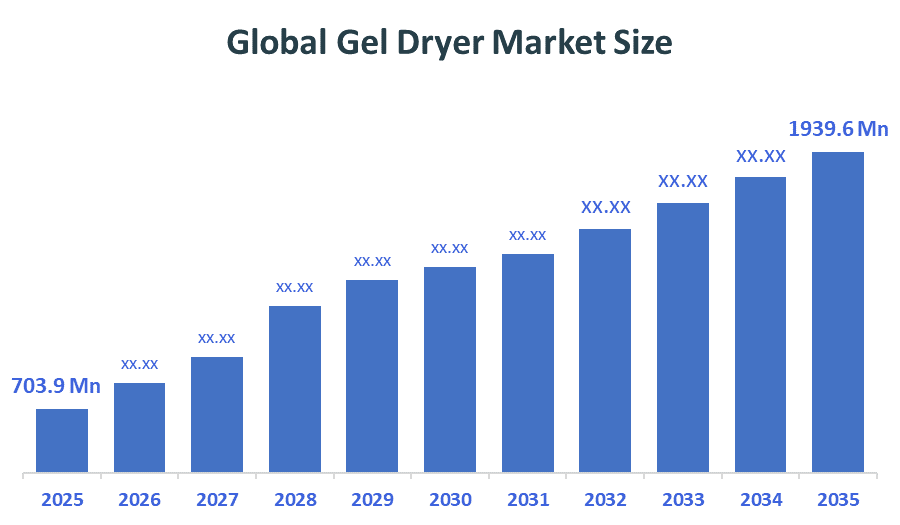
- Global Gel Dryer Market Size (2025): USD 703.9 Million
- Projected Global Gel Dryer Market Size (2035): USD 1939.6 Million
- Global Gel Dryer Compound Annual Growth Rate (CAGR): 10.67%
- Largest Regional Market: Asia pacific
- Fastest Growing Region: North America
- 3rd Largest Region: Europe
- Base Year: 2025
- Historical Period: 2021–2024
- Forecast Period: 2026–2035
Market Overview/ Introduction
The Global Gel Dryer Market is the industry involved in the production and distribution of laboratory equipment used for drying electrophoresis gels once biological material such as DNA, RNA, and proteins have been separated from each other. The gel Dryer, also called electrophoretic gel Dryer, is an equipment which dries agarose and polyacrylamide gels through a number of controlled means such as vacuum drying, heat drying, or infrared technology. This equipment ensures that biological samples maintain their structures so that imaging can be done. Gel Dryers are used for various applications such as molecular biology, biotechnology, genomics, proteomics, forensics, and clinical diagnoses in different settings like research laboratories, pharmaceutical companies, and universities. Some of the major driving forces include increased research funding for life sciences, growing need for genetic and proteomics studies, and expansion of the pharmaceutical and biotechnology industries. Molecular diagnostics and personalized medicine have become major areas contributing to market growth. Some of the major innovations in this market include vacuum drying systems, automation of temperature and pressure controls, and energy-efficient compact designs. Hybrid gel Dryers based on both vacuum and infrared drying technology have also become available in this market. Gel Dryer market growth will be further boosted by government efforts toward the development of biotechnology research, genomics, and laboratory infrastructures. The gel Dryer market is currently growing steadily due to technological advancements and the rising worldwide interest in biomedical research.
- In April 2026, India’s laboratory equipment demand is rising as GeM and CPPP tenders from IITs, CSIR, and medical colleges expand procurement. Continued funding from DBT, DST, ICMR, and UGC supports molecular biology infrastructure, indirectly boosting demand for gel Dryers.
- In March 2026, the EU held Horizon Europe Research Infrastructures Info Days under its €93.5 billion (2021–2027) framework programme. The initiative supports modernization of European laboratories, including genomics and proteomics facilities, driving demand for advanced laboratory instrumentation such as sample preparation and drying systems.
- Launched in September 2023, India’s PRIP Scheme (Promotion of Research and Innovation in Pharma-MedTech Sector) promotes innovation in pharma and MedTech by providing financial support to MSMEs, startups, and institutions, strengthening R&D in diagnostics, biotechnology, and advanced laboratory technologies.
Notable Insights: -
- Asia-Pacific holds the largest regional market share approximately 39% in the global Gel Dryer market.
- North America is the fastest growing region market share approximately 32% in the global Gel Dryer market.
- By type, the vacuum gel Dryers segment held a dominant position with 47% in terms of market share in 2025.
- By application, laboratory research segment is the dominating accounting for market is approximately 43%.
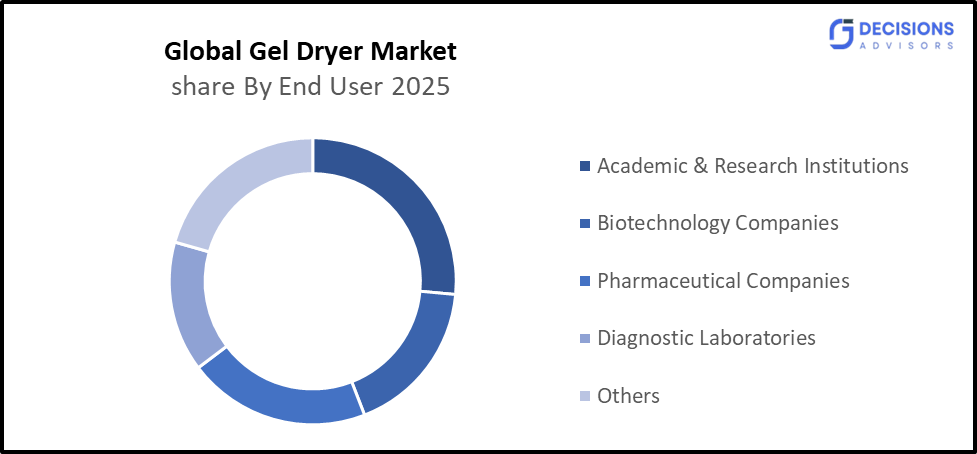
- By end user, academic & research Institutions segment held a dominant position market is approximately 37%.
- The market is likely to achieve a valuation of USD 1939.6 Million by 2035.
What is role of technology in grooming the market?
Technology is fundamentally reshaping the gel Dryer market by transitioning equipment from basic heating tools into high-precision analytical instruments. Through the implementation of microprocessor-driven controls, modern Dryers provide exact temperature regulation and automated vacuum cycles, which are critical for preserving the structural integrity of delicate protein and nucleic acid gels. Furthermore, the development of chemical-resistant, oil-free vacuum systems has enhanced durability and reduced laboratory downtime. These technological leaps, alongside the integration of digital interfaces for real-time monitoring, have increased the reliability of results in specialized sectors like drug discovery and clinical forensics, effectively expanding the market's reach into more sophisticated industrial applications.
How is Recent Developments Helping the Market?
Recent developments in gel Dryer technology are transforming the market by enhancing laboratory efficiency and data integrity. Modern units now feature automated vacuum control and microprocessor-based temperature regulation, which prevent overheating and ensure uniform drying of sensitive polyacrylamide gels. The integration of IoT-enabled monitoring allows researchers to track progress remotely, reducing manual oversight. Furthermore, the shift toward oil-free chemical-resistant pumps has lowered maintenance costs and environmental impact. These advancements significantly reduce the risk of gel cracking, ensuring high-quality, preservation-ready results for forensic, pharmaceutical, and academic research, thereby driving market growth through increased reliability.
Market Drivers
The market for gel Dryers is experiencing a steady expansion, primarily driven by the intensification of proteomics and genomics research. As laboratories shift toward high-throughput workflows, there is an escalating demand for reliable sample preservation techniques. The need for high-resolution imaging and precise downstream analysis, such as mass spectrometry, mandates the use of gel Dryers to ensure that delicate polyacrylamide and agarose gels are dried without cracking or distortion. Furthermore, the surge in biopharmaceutical R&D and molecular diagnostics is fuelling growth. Increasingly stringent regulatory standards (such as GLP and GMP) push labs to adopt automated Dryers that offer reproducible temperature and vacuum controls, ensuring data integrity. Additionally, technological advancements—including IoT integration for remote monitoring and the development of energy-efficient, oil-free vacuum systems are lowering long-term operational costs. This makes modern units highly attractive to both academic institutions and industrial biotechnology firms looking to modernize their infrastructure.
Restrain
Key restraints of the gel Dryer market include high initial investment and maintenance costs, which limit adoption in small laboratories. Complex operating procedures require skilled personnel, increasing training expenses. Limited awareness in developing regions also slows growth. Additionally, alternative drying methods like air-drying and vacuum drying systems offer lower-cost substitutes, restricting wider market expansion and adoption across end-user industries.
Competitive Analysis:
The report offers the appropriate analysis of the key organizations/companies involved within the gel dryer market, along with a comparative evaluation primarily based on their Product of offering, business overviews, geographic presence, enterprise strategies, segment market share, and SWOT analysis. The report also provides an elaborative analysis focusing on the current news and developments of the companies, which includes Product development, innovations, joint ventures, partnerships, mergers & acquisitions, strategic alliances, and others. This allows for the evaluation of the overall competition within the market.
Top Companies in Global Gel Dryer Market
- Bio-Rad Laboratories, Inc.
- Thermo Fisher Scientific Inc.
- GE Healthcare
- Danaher Corporation
- Agilent Technologies, Inc.
- Labconco Corporation
- Cleaver Scientific Ltd
- Hoefer Inc.
- Major Science Co., Ltd.
- Consort bvba
- Others
Study on the Supply, Demand, Distribution, and Market Environment of Gel Dryer Market
The market for gel Dryer is characterized by a balance between supply, demand, distribution channels, and the market environment that is defined by laboratory automation and biotechnology advancements. On the supply side, leading players include international suppliers such as Bio-Rad, Thermon Fisher, and Lab Conco who provide sophisticated vacuum and automatic gel Dryers. The supply chain focuses on accuracy, efficiency, and integration into laboratory systems. The driving force behind demand for gel Dryers includes pharmaceutical organizations, research institutions, and biotechnology corporations that require effective and precise processing of gels. On the distribution side, the channel may include direct sale, distribution of scientific equipment, and increasingly, online retail of products to laboratories across the world. The market environment is very competitive and innovative due to the involvement of research and development efforts, as well as growing budgets for life sciences.
Price Analysis and Consumer Behaviour Analysis
There exists a broad spectrum of pricing based on technology, capacity, and level of automation among other features in the gel Dryer market. The cheaper ones are those that can be found in academic labs while the expensive ones are vacuum and automated gel Dryers that are utilized in the pharmaceutical and biotechnology industry due to precision and effectiveness. Price is among the major limitations experienced in emerging markets, hence hindering adoption rates. Consumer's purchasing habits are highly driven by the desire to obtain products that will provide them with accurate results within a shorter period of time. The academic community prefers cheaper products while the pharmaceutical industry is interested in products that are fast and efficient. Rising awareness about energy-efficient equipment is motivating customers to adopt better technologies.
Market Segmentation
The Gel Dryer market share is classified into product type, system, application, and end user
- The product type segment dominated the market in 2025, and is projected to grow at a substantial CAGR of approximately 10.6 % during the forecast period.
Based on the product type, the Gel Dryer market is divided into vacuum gel Dryers, microwave / hybrid gel Dryers, convection gel Dryers, and infrared gel Dryers. Among these, Vacuum Gel Dryers dominate the global gel Dryer market, accounting for approximately 45–50% of total worldwide market share. Their leadership is driven by extensive use in molecular biology applications such as DNA and protein electrophoresis, where precise and uniform drying is essential. Vacuum gel Dryers are preferred in pharmaceutical, biotechnology, and academic research laboratories due to their ability to remove moisture at low temperatures without damaging sensitive samples. Their superior efficiency, high accuracy, and consistent results make them the most widely adopted and commercially significant segment in the global gel Dryer market. The global gel Dryer market is growing at a CAGR of approximately 10.6% during the forecast period 2025–2035,
- The application segment accounted for the largest share in 2025, and is anticipated to grow at a significant CAGR of approximately 10.7% during the forecast period.
Based on the applications, the gel Dryer market is divided into laboratory research, protein & DNA analysis, pharmaceutical research & development, and biotechnology companies. Among these, protein & DNA analysis is the dominant segment in the global gel Dryer market, accounting for approximately 40–45% of total market share worldwide. This dominance is driven by extensive use in electrophoresis, genomics, and proteomics research, where precise gel drying is essential for accurate results. The segment also benefits from rising demand in biotechnology and pharmaceutical R&D for genetic testing and drug development. Overall, protein & DNA analysis applications are expected to grow at a CAGR of around 10–11% during 2025–2035, supported by rapid expansion in life science research globally.
- The end user segment dominated the market in 2025, and is projected to grow at a substantial CAGR of approximately 9.6% during the forecast period.
Based on the end user, the gel Dryer market is divided into academic & research institutions, biotechnology companies, pharmaceutical companies, diagnostic laboratories, and others. Among these, Academic & Research Institutions dominate the global gel Dryer market, accounting for approximately 35–40% of total worldwide market share. This leadership is driven by extensive use of gel Dryers in molecular biology, genetics, and biochemical research activities conducted in universities and public research centres. Rising government funding for life sciences and increasing focus on advanced research infrastructure further support demand. This segment is projected to grow at a CAGR of around 9–10% from 2025 to 2035, driven by expanding academic research output and increasing adoption of advanced laboratory equipment globally.
- The system segment dominated the market in 2025, and is projected to grow at a substantial CAGR of approximately 9.6% during the forecast period.
Based on the system, the gel Dryer market is divided into Vacuum Drying Systems, and Passive Evaporation (Air-Drying) Systems. Among these, Vacuum Drying Systems dominate the global gel Dryer market, accounting for approximately 60–65% of total worldwide market share. This dominance is driven by their superior efficiency in rapid moisture removal, prevention of gel distortion, and high-precision drying required in DNA and protein analysis. Vacuum systems are widely preferred in biotechnology, pharmaceutical R&D, and academic laboratories due to consistent and high-quality results. This segment is projected to grow at a CAGR of around 10–11% during 2025–2035, supported by increasing demand for advanced molecular research and automated laboratory workflows globally.
Strategies to Implement for Growth of the Market in Non-Leading Regions
Strategic measures that can be used to boost the growth of gel Dryer market in nonleading regions include the following. Manufacturers should seek to introduce cheaper and modular gel Dryers to overcome the problem of expensive initial setup that discourages purchase by small and medium-size laboratories. Another strategy that should be considered includes setting up manufacturing units in those regions to lower the cost of imports. Development of an effective distribution network through partnership with laboratory equipment suppliers operating in the regions in question is equally important. Training and development of skills to effectively use the equipment is also an important consideration. Partnership between the private sector and government will aid in research and development, as well as in developing the necessary infrastructure. Raising awareness about the benefits of the gel Dryers and their application in the biotechnology and pharmaceutical industries will also be helpful. Expansion of electronic sales networks will aid in reaching out to remote regions.
Regional Segment Analysis of the Gel Dryer Market
- North America (U.S., Canada, Mexico)
- Europe (Germany, France, U.K., Italy, Spain, Rest of Europe)
- Asia-Pacific (China, Japan, India, Rest of APAC)
- South America (Brazil and the Rest of South America)
- The Middle East and Africa (UAE, South Africa, Rest of MEA)
Asia pacific is anticipated to hold the largest share of the Gel Dryer market over the predicted timeframe.
Asia Pacific is expected to dominate the gel Dryer market due to strong growth in biotechnology, pharmaceuticals, and academic research infrastructure. Countries like China, India, Japan, and South Korea are investing heavily in R&D and laboratory modernization, boosting demand for advanced equipment. The region accounts for around 35–40% market share and is projected to grow at a CAGR of 6–8%. Cost-effective manufacturing, rising biotech startups, and government support for healthcare innovation further strengthen its leading position globally.
North America is expected to grow at a rapid CAGR in the Gel Dryer market during the forecast period. North America is expected to grow at a rapid CAGR in the gel Dryer market due to strong expansion in biotechnology, pharmaceutical R&D, and advanced laboratory infrastructure. The region has high adoption of automated and high-precision laboratory equipment, driven by leading research institutes and biotech companies. Increasing investment in drug discovery and genomics further strengthens demand. North America accounted for around 30–35% of global gel Dryer market revenue, with estimated market revenue of approximately USD 80–110 million in recent years, and is projected to grow at a CAGR of about 5–7% during the forecast period, supporting steady market expansion.
Europe is the 3rd largest region to grow in the Gel Dryer market during the region. Europe is expected to be the third-largest region in the gel Dryer market during the forecast period, supported by strong pharmaceutical, biotechnology, and academic research sectors. Countries such as Germany, the UK, France, and Italy contribute significantly due to advanced laboratory infrastructure and high R&D spending. The region benefits from strict regulatory standards that encourage the use of precise and reliable laboratory equipment. Europe accounts for approximately 20–25% of global market share and is projected to grow at a CAGR of around 4–6%, driven by continuous innovation and growing life sciences research activities.
Future Market Trends in Global Gel Dryer Market: -
1. Automation and Digital Integration
A key future trend in the global gel Dryer market is increasing automation and digital integration. Modern gel Dryers are being equipped with programmable controls, touchscreen interfaces, and real-time monitoring systems to improve accuracy and reduce manual errors. Integration with laboratory information management systems (LIMS) is also enhancing workflow efficiency. This trend is driven by the need for higher reproducibility in research and faster processing times. Automation reduces labor dependency and improves consistency, making it highly attractive for pharmaceutical and biotechnology laboratories worldwide.
2. Energy-Efficient and Eco-Friendly Designs
Sustainability is becoming a major focus in the gel Dryer market, leading to the development of energy-efficient and eco-friendly systems. Manufacturers are designing equipment that consumes less power while maintaining high performance. Features such as optimized vacuum systems and low-heat drying technologies help reduce energy consumption. This trend is supported by strict environmental regulations and growing demand for green laboratory practices. Laboratories are increasingly adopting sustainable equipment to reduce operational costs and meet global environmental compliance standards.
3. Growth in Biotechnology and Genomics Research
Rapid expansion in biotechnology, genomics, and proteomics research is significantly driving gel Dryer demand. Increasing applications in DNA analysis, protein studies, and molecular diagnostics are boosting the need for precise gel drying systems. Government funding and private investments in life sciences R&D are further accelerating adoption. Emerging economies are also strengthening their research infrastructure, increasing global demand. This trend highlights the critical role of gel Dryers in advanced scientific research, making them essential tools in modern laboratories.
Recent Development
In August 2024, Changsung Softgel System advanced softgel drying technology with automated drying tunnels featuring humidity control and process optimization. These innovations reflect broader trends in smart drying systems, improving efficiency and productivity in pharmaceutical manufacturing and moisture-sensitive production processes.
In May 2024, GEA Group advanced modular softgel drying tunnel technology designed for plant-based gelatin applications. These systems enhance process flexibility, automation, and efficiency, reflecting broader pharmaceutical trends in improved drying performance and consistent batch quality in production environments.
Market Segment
This study forecasts revenue at global, regional, and country levels from 2021 to 2035. Decision Advisors has segmented the Gel Dryer market based on the below-mentioned segments:
Global Gel Dryer Market, By Type
- Vacuum Gel Dryers
- Infrared Gel Dryers
- Convection Gel Dryers
Global Gel Dryer Market, By System
- Vacuum Drying Systems
- Passive Evaporation (Air-Drying) Systems
Global Gel Dryer Market, By Application
- Laboratory
- Research Institute
- Pharmaceutical Companies
- Others
Global Gel Dryer Market, By End User
- Academic & Research Institutions
- Biotechnology Companies
- Pharmaceutical Companies
- Diagnostic Laboratories
- Others
Global Gel Dryer Market, By Regional Analysis
- North America
- US
- Canada
- Mexico
- Europe
- Germany
- UK
- France
- Italy
- Spain
- Russia
- Rest of Europe
- Asia Pacific
- China
- Japan
- India
- South Korea
- Australia
- Rest of Asia Pacific
- South America
- Brazil
- Argentina
- Rest of South America
- Middle East & Africa
- UAE
- Saudi Arabia
- Qatar
- South Africa
- Rest of the Middle East & Africa
Frequently Asked Questions (FAQ)
Q1. Can gel drying processes affect the molecular integrity of biomolecules, and how is this controlled?
Yes, improper drying conditions may lead to structural distortion of biomolecules. This is controlled through precise regulation of temperature, vacuum pressure, and drying time to maintain sample stability.
Q2. Is it possible for gel drying systems to introduce variability in experimental outcomes?
Variability can occur if equipment calibration is inconsistent. Modern gel Dryers minimize this risk through automated controls and standardized operating protocols that ensure reproducibility.
Q3. Why is vacuum-based gel drying often preferred over conventional air-drying methods?
Vacuum-based systems reduce oxidation risk, accelerate moisture removal, and prevent gel cracking, making them more suitable for sensitive biochemical and molecular biology applications.
Q4. How do advancements in laboratory drying technology influence data reliability in proteomics research?
Advanced drying systems improve sample preservation and uniformity, which directly enhances imaging accuracy and downstream analytical reliability in proteomics workflows.
Q5. Could energy-efficient gel Dryers compromise performance in high-throughput laboratories?
Not necessarily. Modern energy-efficient systems are designed to balance reduced power consumption with optimized performance, ensuring suitability even for high-throughput research environm
Check Licence
Choose the plan that fits you best: Single User, Multi-User, or Enterprise solutions tailored for your needs.
We Have You Covered
- 24/7 Analyst Support
- Clients Across the Globe
- Tailored Insights
- Technology Tracking
- Competitive Intelligence
- Custom Research
- Syndicated Market Studies
- Market Overview
- Market Segmentation
- Growth Drivers
- Market Opportunities
- Regulatory Insights
- Innovation & Sustainability
Report Details
| Scope | Global |
| Pages | 180 |
| Delivery | PDF & Excel via Email |
| Language | English |
| Release | Apr 2026 |
| Access | Download from this page |