
Global General Aviation Market
 |
Author:
Atul K
|
Pages:
240
|
Author:
Atul K
|
Pages:
240
Global General Aviation Market Size, Share, By Aircraft Type (Business Jets, Turboprop Aircraft, Piston Aircraft, Helicopters, and Others), By Application (Business & Corporate Aviation, Personal & Leisure Aviation, Flight Training, Agricultural Aviation, Emergency Medical Services, Aerial Surveying & Mapping, Charter & Air Taxi Services, and Others), By Propulsion Type (Turbine, Piston, Hybrid-Electric, and Electric), By Ownership Model (Private Ownership, Fractional Ownership, Charter Operators, and Others), and By Region (North America, Europe, Asia-Pacific, South America, and Middle East & Africa), Analysis and Forecast 2026?2035.
CAGR
4.4%
REVENUE 2025
USD Billion 32.1
FORECAST 2035
USD Billion 50.0
REPORT COVERAGE
Global
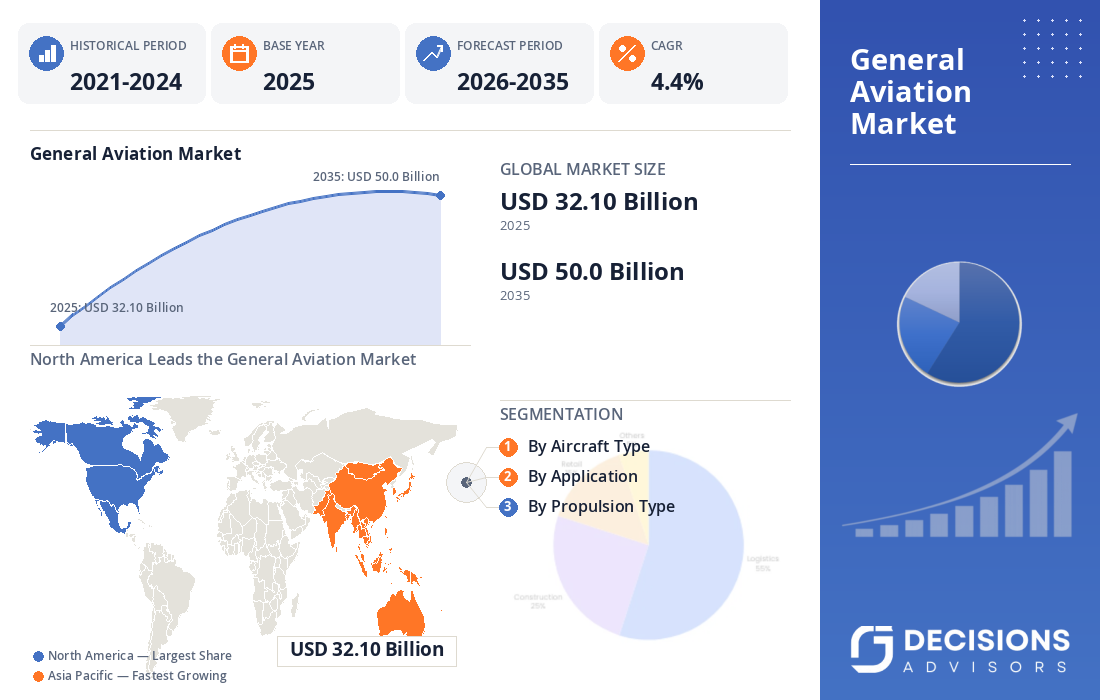
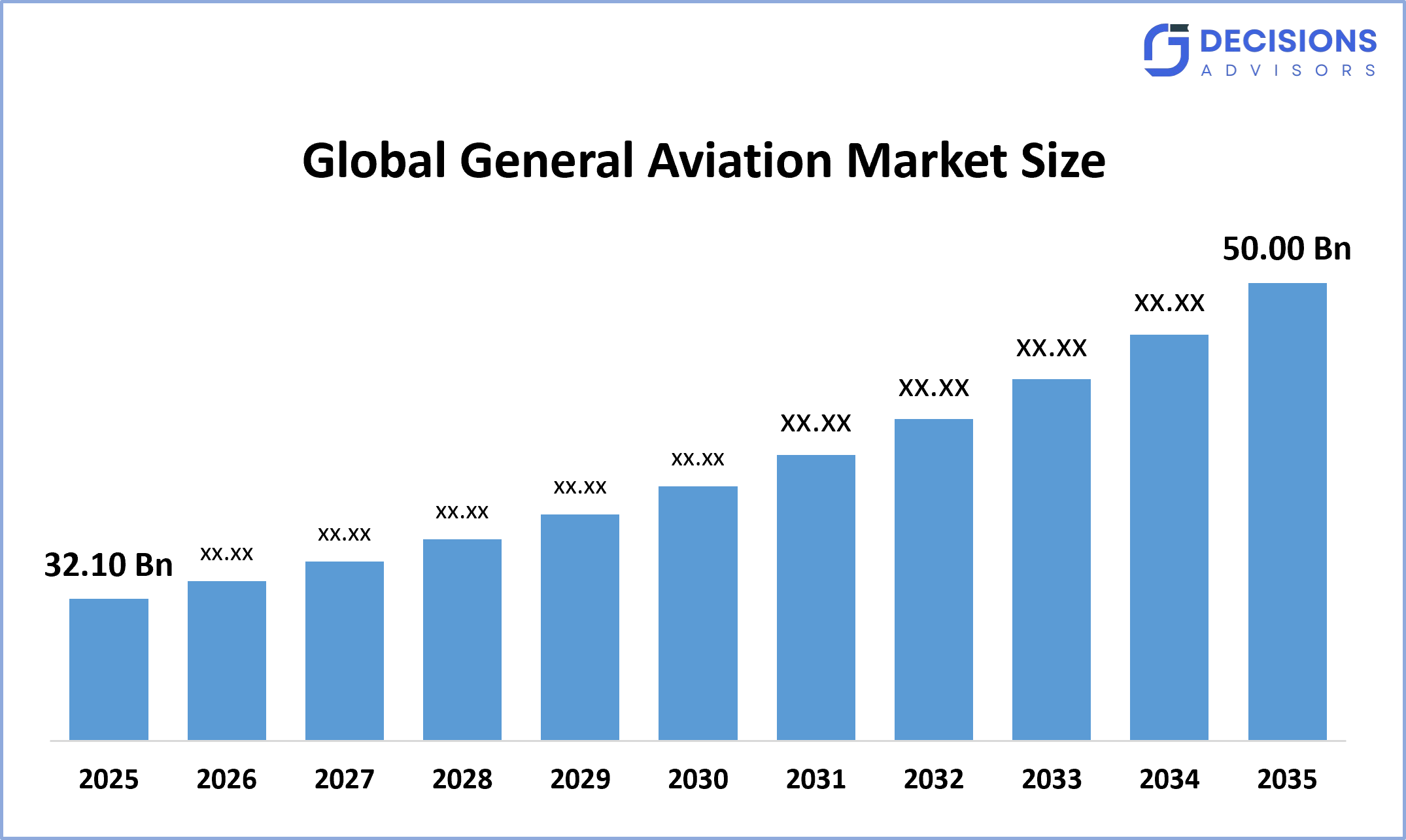
The Global General Aviation Market Size was valued at approximately USD 32.10 Billion in 2025 and is expected to reach approximately USD 50.00 Billion by 2035, expanding at a CAGR of approximately 4.40% during the forecast period. The market is experiencing steady growth due to increasing demand for business aviation, rising private aircraft ownership, expansion of charter and fractional ownership models, growth in flight training activities, increasing use of aircraft for medical and emergency services, agricultural applications, aerial surveying, and technological advancements in avionics, aircraft connectivity, automation, and low-emission propulsion systems.
Market Snapshot
- Global General Aviation Market Size (2025): USD 32.10 Billion
- Projected Market Size (2035): USD 50.00 Billion
- Global Market CAGR (2026–2035): Approximately 4.40%
- Largest Regional Market: North America
- 2nd Largest Region: Europe
- Fastest Growing Region: Asia-Pacific
- Base Year: 2025
- Historical Period: 2021–2024
- Forecast Period: 2026–2035
Market Overview/ Introduction
The Global General Aviation Market encompasses aircraft and aviation activities outside scheduled commercial airline and military operations. General aviation includes business and private aviation, flight training, charter operations, agricultural aviation, emergency medical services, aerial surveying, recreational flying, and other specialized aviation activities.
The market includes business jets, turboprops, piston aircraft, helicopters, and emerging aircraft such as electric and hybrid-electric aircraft. General aviation provides flexible transportation, corporate connectivity, medical evacuation, agricultural services, training, surveillance, tourism, and other specialized services.
The U.S. governments corporate customers are increasingly adopting modern aircraft equipped with advanced avionics, connectivity, improved fuel efficiency, and enhanced cabin technologies.
- Several Asia-Pacific is training organizations are generating demand for piston aircraft and other cost-efficient training platforms as the aviation industry addresses the need for additional pilots.
Notable Insights: -
- North America maintains a leading position in the Global General Aviation Market because of its large active aircraft fleet, extensive airport infrastructure, mature business aviation ecosystem, established financing channels, and strong maintenance and service networks. A recent estimate puts North America's 2025 share at approximately 51.12%.
- Asia-Pacific is expected to be the fastest-growing region, supported by rising business activity, increasing high-net-worth populations, improving aviation infrastructure, growing flight-training activities, and increasing demand for private and charter aviation.
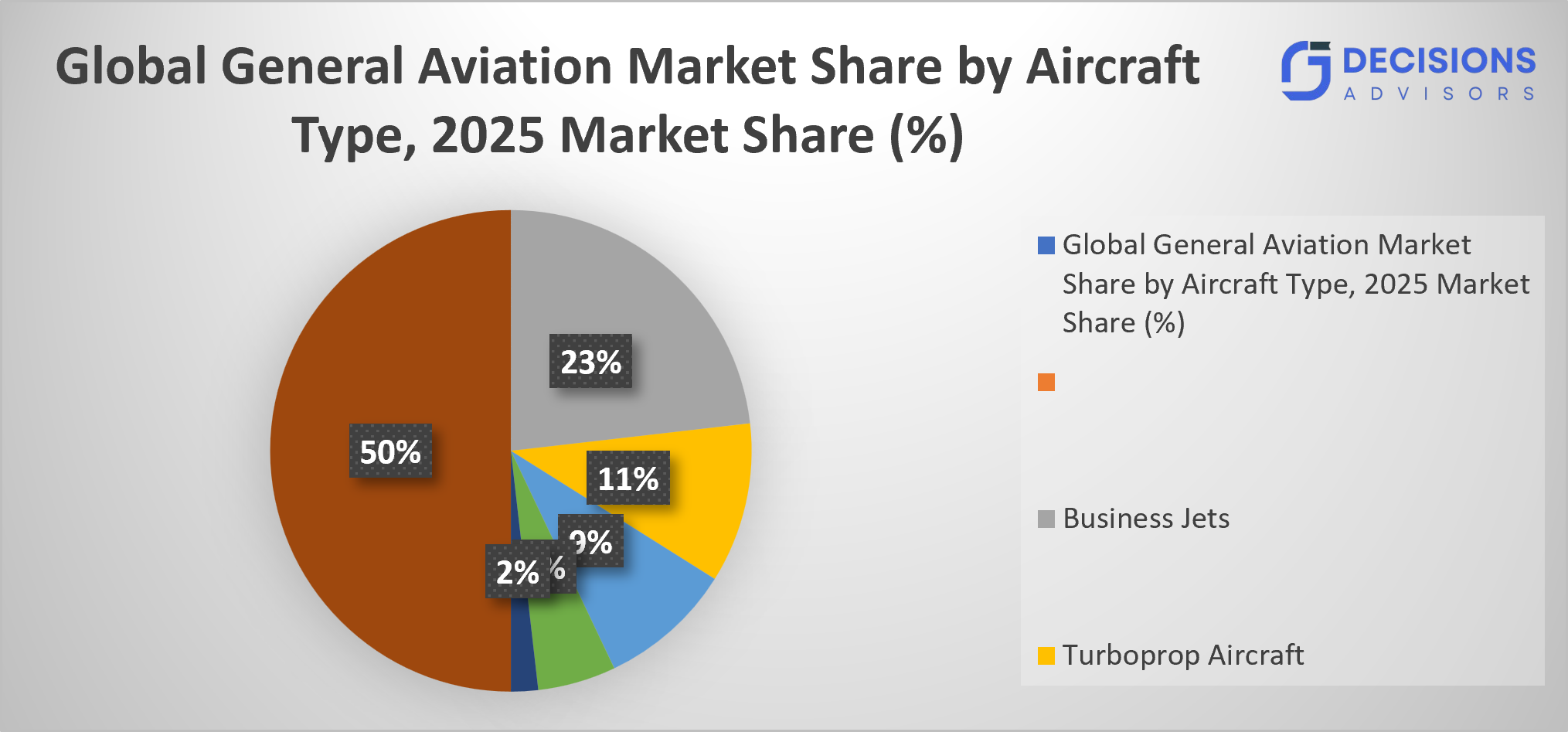
- Business jets represent a major aircraft category, supported by corporate travel, private ownership, charter services, fractional ownership, and demand for flexible point-to-point transportation. Business jets accounted for approximately 46.36% of the market in 2025 in one recent industry estimate.
- Business and corporate transport represents a major application segment, driven by demand for time-efficient transportation, executive mobility, and access to destinations with limited commercial airline connectivity.
- Electric and hybrid-electric propulsion is emerging as an important technology trend, although conventional piston and turbine propulsion continues to dominate the current market. Conventional piston and turbine systems represented approximately 90.98% of the market in 2025 according to one industry estimate.
Market Drivers
The Global General Aviation Market is primarily driven by increasing demand for flexible and time-efficient private and business transportation. Corporate executives and high-net-worth individuals increasingly use business jets and charter services to reduce travel time and improve connectivity between major business centers. Growth in fractional ownership and aircraft charter models is also expanding access to general aviation by reducing the financial burden associated with full aircraft ownership. Another important driver is the increasing use of general aviation aircraft for specialized applications, including flight training, emergency medical services, agricultural aviation, aerial surveying, mapping, law enforcement, and remote-area transportation.
Restrain
The Global General Aviation Market faces challenges including high aircraft acquisition costs, expensive maintenance requirements, fuel-price volatility, pilot shortages, stringent certification requirements, limited airport infrastructure in some regions, and high operating costs. The adoption of electric and hybrid-electric aircraft is also constrained by battery energy density, aircraft range, charging infrastructure, certification requirements, and technology costs. Regulatory differences between countries can further increase the complexity and cost of aircraft certification, operation, maintenance, and cross-border deployment.
Competitive Analysis:
The report offers the appropriate analysis of the key organizations/companies involved within the Global General Aviation Market, along with a comparative evaluation primarily based on their product offerings, business overviews, geographic presence, enterprise strategies, segment market share, and SWOT analysis. The report also provides an elaborative analysis focusing on the current news and developments of the companies, which includes product development, innovations, joint ventures, partnerships, mergers & acquisitions, strategic alliances, and others. This allows for the evaluation of the overall competition within the market.
Top Companies in the Global General Aviation Market
- Textron Aviation Inc.
- Bombardier Inc.
- Gulfstream Aerospace Corporation
- Dassault Aviation
- Embraer S.A.
- Honda Aircraft Company
- Pilatus Aircraft Ltd.
- Daher
- Piper Aircraft, Inc.
- Airbus SE
Government Initiatives
|
Country |
Key Government Initiatives |
|
Us |
FAA modernization of light-sport aircraft certification and operating rules through the MOSAIC final rule, which was signed in July 2025 and expanded opportunities for sport pilots, flight training, limited aerial work, and personal travel. |
|
Germany |
European aviation authorities continue to promote proportionate certification frameworks, safety improvements, digitalization, and regulatory modernization for light and general aviation aircraft. EASA's 2025 regulatory updates included provisions affecting European Light Aircraft categories. |
|
China |
Government initiatives supporting low-altitude aviation, aviation infrastructure, aircraft manufacturing, and emerging low-altitude economy applications are creating opportunities for general aviation services and aircraft. |
Market Segmentation
The Global General Aviation Market is classified into aircraft type, application, propulsion type, ownership model, and region.
- The Business Jets Segment Accounts for a Significant Share
Based on aircraft type, the market is divided into Business Jets, Turboprop Aircraft, Piston Aircraft, Helicopters, and Others. Business jets represent a major segment because they provide flexible point-to-point transportation for corporate executives, private owners, charter operators, and fractional ownership companies. The segment benefits from demand for time-efficient travel, increased business activity, and growing private aviation services.
- Business & Corporate Aviation Represents a Major Application Category
Based on application, the market is divided into Business & Corporate Aviation, Personal & Leisure Aviation, Flight Training, Agricultural Aviation, Emergency Medical Services, Aerial Surveying & Mapping, Charter & Air Taxi Services, and Others. Business and corporate aviation represents a major application because companies increasingly value flexible transportation, reduced travel time, and access to destinations that may have limited commercial air service.
- Conventional Turbine & Piston Propulsion Dominates the Market
Based on propulsion type, the market is divided into Turbine, Piston, Hybrid-Electric, and Electric. Conventional propulsion remains dominant because of established technology, mature maintenance infrastructure, proven reliability, and greater range. However, hybrid-electric and electric propulsion technologies are expected to gain importance as battery technology, aircraft efficiency, and certification frameworks advance.
Regional Segment Analysis of the Global General Aviation Market
- North America (U.S., Canada, Mexico)
- Europe (Germany, U.K., France, Italy, Spain, Netherlands, Rest of Europe)
- Asia-Pacific (China, Japan, India, Australia, South Korea, Rest of Asia-Pacific)
- South America (Brazil, Argentina, Rest of South America)
- Middle East & Africa (UAE, Saudi Arabia, South Africa, Rest of MEA)
North America Maintains a Leading Share of the Global General Aviation Market
North America maintains the leading position in the Global General Aviation Market due to its extensive airport network, large active general aviation fleet, strong business aviation ecosystem, established aircraft financing, developed maintenance infrastructure, and high demand for private and corporate aviation. The United States represents the largest market in the region. Business jets, piston aircraft, turboprops, helicopters, flight-training aircraft, charter aircraft, and specialized aircraft are widely used throughout the country.
Europe Holds a Significant Share of the Global General Aviation Market
Europe represents an important general aviation market due to strong business aviation demand, established aircraft manufacturers, extensive airport infrastructure, flight-training activities, charter services, and demand for specialized aviation. Germany, France, the U.K., Italy, Switzerland, Spain, and the Netherlands are important markets. European regulators are also working on proportionate certification and operational frameworks for smaller and lighter aircraft, supporting innovation within general aviation.
Asia-Pacific is the Fastest-Growing Region in the Global General Aviation Market
Asia-Pacific is expected to record the fastest growth during the forecast period due to increasing economic activity, rising demand for business aviation, growing high-net-worth populations, development of aviation infrastructure, expansion of flight schools, and increasing adoption of charter and private aviation. China, India, Japan, Australia, and South Korea are key markets. The region also offers significant long-term opportunities for low-altitude aviation, advanced air mobility, aircraft manufacturing, and specialized aviation services.
Future Market Trends in Global General Aviation Market: -
-
- Expansion of Electric and Hybrid-Electric Aircraft
Aircraft manufacturers are increasingly developing electric and hybrid-electric propulsion systems designed to reduce fuel consumption, emissions, and operating costs. These technologies are expected to become increasingly relevant for short-range general aviation and training applications.
-
- Growth of Advanced Avionics and Connectivity
Next-generation avionics, satellite connectivity, flight-data monitoring, digital cockpits, enhanced vision systems, and automated flight-management technologies are expected to become increasingly common in general aviation aircraft.
-
- Increasing Adoption of Fractional Ownership and Charter Services
Fractional ownership, aircraft management, air taxi, and on-demand charter models are expected to expand because they provide users with access to private aviation without requiring full aircraft ownership.
-
- Rising Demand for Flight Training Aircraft
Growing global demand for pilots is expected to support flight-training activities and demand for piston aircraft, turboprops, flight simulators, and training services.
Recent Development
- In November 2025, business aviation activity continued to expand, with industry data indicating global business-jet activity was approximately 3.9% higher year-to-date, led by North America. This reflects sustained utilization of private and corporate aircraft.
- In July 2025, Bombardier projected more than 157 business-jet deliveries for 2026 and revenue exceeding USD 10 billion, supported by strong demand from affluent buyers. The company also reported that supply-chain issues affecting an engine supplier had constrained production during 2025.
- In March 2025, the FAA proposed changes to modernize aircraft certification and align certain requirements more closely with EASA standards. While the proposal primarily targets commercial aircraft certification, broader regulatory modernization could help reduce certification complexity and costs across the aviation industry.
Market Segment
This study forecasts revenue at global, regional, and country levels from 2026 to 2035. Decision Advisors has segmented the Global General Aviation Market based on the below-mentioned segments:
Global General Aviation Market, By Aircraft Type
- Business Jets
- Turboprop Aircraft
- Piston Aircraft
- Helicopters
- Others
Global General Aviation Market, By Application
- Business & Corporate Aviation
- Personal & Leisure Aviation
- Flight Training
- Agricultural Aviation
- Emergency Medical Services
- Aerial Surveying & Mapping
- Charter & Air Taxi Services
- Others
Global General Aviation Market, By Propulsion Type
- Turbine
- Piston
- Hybrid-Electric
- Electric
Global General Aviation Market, By Regional Analysis
- North America
- US
- Canada
- Mexico
- Europe
- Germany
- UK
- France
- Italy
- Spain
- Russia
- Rest of Europe
- Asia Pacific
- China
- Japan
- India
- South Korea
- Australia
- Rest of Asia Pacific
- South America
- Brazil
- Argentina
- Rest of South America
- Middle East & Africa
- UAE
- Saudi Arabia
- Qatar
- South Africa
- Rest of the Middle East & Africa
Frequently Asked Questions (FAQ)
Q. What is driving the growth of the Global General Aviation Market?
A. The market is primarily driven by increasing demand for business and private aviation, growth in charter and fractional ownership, rising flight-training activities, increasing use of aircraft for specialized applications, and advancements in aircraft technology.
Q. Which aircraft type holds a significant share of the General Aviation Market?
A. Business jets represent a major aircraft category, supported by corporate travel, private aviation, charter services, and fractional ownership. One recent industry estimate placed business jets at approximately 46.36% of the 2025 market.
Q. What role does technology play in the General Aviation Market?
A. Advanced avionics, digital cockpits, connectivity, flight-data monitoring, enhanced vision systems, automation, and emerging electric and hybrid-electric propulsion technologies are improving aircraft performance, safety, efficiency, and the overall ownership experience.
Q. Which region is expected to grow fastest in the General Aviation Market?
A. Asia-Pacific is expected to be the fastest-growing region, supported by economic development, rising business aviation demand, aviation infrastructure development, increasing flight training, and expanding private and charter aviation. One recent market estimate projects Asia-Pacific to grow at approximately 6.33% annually through 2035.
Check Licence
Choose the plan that fits you best: Single User, Multi-User, or Enterprise solutions tailored for your needs.
We Have You Covered
- 24/7 Analyst Support
- Clients Across the Globe
- Tailored Insights
- Technology Tracking
- Competitive Intelligence
- Custom Research
- Syndicated Market Studies
- Market Overview
- Market Segmentation
- Growth Drivers
- Market Opportunities
- Regulatory Insights
- Innovation & Sustainability
Report Details
| Scope | Global |
| Pages | 240 |
| Delivery | PDF & Excel via Email |
| Language | English |
| Release | Aug 2026 |
| Access | Download from this page |