
Global Generalized Anxiety Disorder Market
 |
Pages:
250
|
Pages:
250
Global Generalized Anxiety Disorder Market Size, Share, and COVID-19 Impact Analysis, By Drug Class (Antidepressants, Benzodiazepines, and Buspirone), By Therapy (Interpersonal Therapy, Behavioural Therapy, Cognitive Behaviour Therapy, and Mindfulness Based Cognitive Therapy), and By Distribution Channel (Hospital Pharmacy, Online Pharmacy, and Retail Pharmacy), and By Region (North America, Europe, Asia-Pacific, Latin America, Middle East, and Africa), Analysis and Forecast 2025-2035
REPORT COVERAGE
Global
Global Generalized Anxiety Disorder Market Size Insights Forecasts to 2035
- The Global Generalized Anxiety Disorder Market Size Was Estimated at USD 1.97 Billion in 2024
- The Market Size is Expected to Grow at a CAGR of around 6.31 % from 2025 to 2035
- The Worldwide Generalized Anxiety Disorder Market Size is Expected to Reach USD 3.86 Billion by 2035
- North America is expected to grow the fastest during the forecast period.
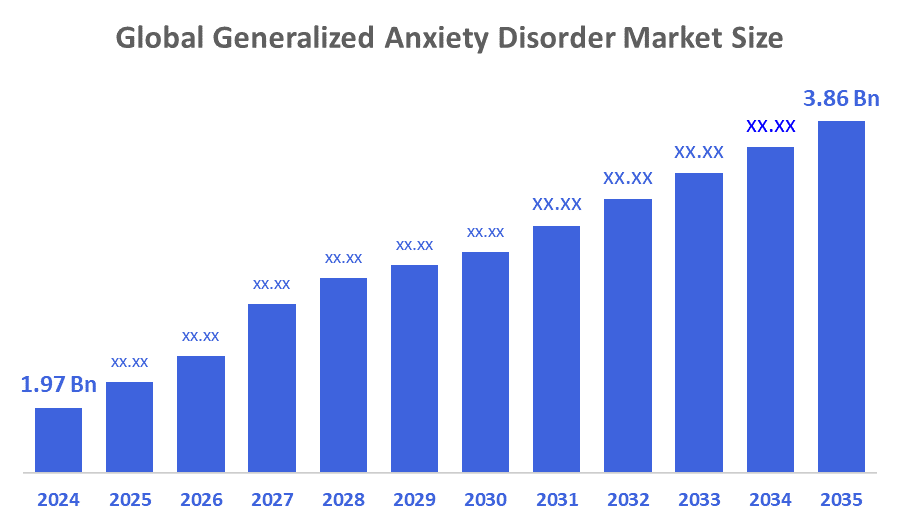
According to a research report published by Decisions Advisors and Consulting, The Global Generalized Anxiety Disorder Market Size Was Worth Around USD 1.97 Billion In 2024 And Is Predicted To Grow To Around USD 3.86 Billion By 2035 With A Compound Annual Growth Rate (CAGR) Of 6.31 % From 2025 To 2035. The primary factors for the growth are due to digital mental health, genetic research, global mental health awareness, and integrated models of care. Trends that will occur influencing the industry, include holistic approaches to mental illness, AI for diagnosing mental illnesses, early interventions for mental illnesses, increased stress on people, culturally competent treatment options for all patients, and increasing access to healthcare services.
Market Overview
Generalized anxiety disorder (GAD) refers to a mental health condition that causes people to experience excessive and continuous worries about all aspects of their existence. Individuals suffering from the ailment experience ongoing and irrational fears which they maintain about everything from their work to their health, family and financial matters and other daily activities, even when no valid cause exists for their distress. The anxiety condition leads to symptoms that the person finds hard to manage because it disrupts their ability to work and enjoy life. The common symptoms of the illness include restlessness, fatigue, muscle tension, irritability, difficulty sleeping or concentrating, overthinking, indecisiveness, a constant feeling of tension, sweating, gastrointestinal problems, trembling, shortness of breath, etc. The process of diagnosing GAD requires doctors to conduct clinical assessments together with medical record evaluations and psychological assessment procedures. The diagnostic guidelines, which are outlined in the Diagnostic and Statistical Manual of Mental Disorders DSM-5 guide mental health professionals in assessing the intensity and existence of specific disease symptoms. The Generalized Anxiety Disorder 7-item scale GAD-7 and the Penn State Worry Questionnaire PSWQ serve as standardised questionnaires to help health professionals determine whether their patients have medical conditions that need to be treated.
Big Health announced new $23.7 M funding to accelerate the adoption of its digital mental health treatments. The investment will support broader access to clinically validated digital therapeutics, helping expand their reach to patients and healthcare providers, and reinforcing the company’s mission to deliver scalable solutions for mental health care.
Reunion Neuroscience announced a $133 million investment to support the advancement of its psychedelic-inspired therapeutic candidate RE104. The company plans to initiate the RECLAIM Phase 2 trial in the first quarter of 2026, evaluating RE104 for the treatment of Generalized Anxiety Disorder (GAD).
Report Coverage
This research report categorizes the generalized anxiety disorder market based on various segments and regions, forecasts revenue growth, and analyzes trends in each submarket. The report analyses the key growth drivers, opportunities, and challenges influencing the generalized anxiety disorder market. Recent market developments and competitive strategies, such as expansion, product launch, development, partnership, merger, and acquisition, have been included to draw the competitive landscape in the market. The report strategically identifies and profiles the key market players and analyzes their core competencies in each sub-segment of the generalized anxiety disorder market.
Driving Factors
The generalized anxiety disorder market experiences growth because of increasing numbers of patients who suffer from neurotransmitter disorders, which affect their serotonin, norepinephrine and dopamine levels, among other neurotransmitters. The market shows positive growth because people now experience more risk factors, which include enduring stress, their genetic makeup, traumatic events, harmful treatment and major life transitions. The market experiences growth because more people start using effective treatments, which include benzodiazepines and selective serotonin reuptake inhibitors (SSRIs) to manage their symptoms. The rising use of cognitive behavioural therapy, which helps people recognise and challenge their negative thought patterns while building positive and realistic thinking skills, has become an important factor that drives market growth.
Researchers are increasingly exploring how artificial intelligence (AI) can help clinicians personalise treatment for Generalized Anxiety Disorder (GAD). A recent study from Penn State demonstrated that machine learning models can analyse more than 80 baseline factors—including psychological, sociodemographic, health, and lifestyle variables—to predict recovery outcomes in patients with GAD. This approach allows clinicians to identify which individuals are more likely to benefit from specific therapies, improving treatment precision and reducing relapse rates. By tailoring interventions based on patient profiles, AI could enhance long-term recovery and optimise the use of cognitive-behavioural therapy and pharmacological options.
Restraining Factors
The market is hampered by several factors, including high relapse rates, negative drug side effects, stigma-driven underdiagnosis, restricted access to psychotherapy, and strict regulatory barriers. Adoption is further constrained by regional differences in healthcare infrastructure, particularly in emerging economies, which impedes innovation and patient access.
Market Segmentation
The Generalized Anxiety Disorder market share is classified into drug class, therapy, and distribution channel.
- The antidepressants segment accounted for the largest market share in 2024 and is projected to grow at a substantial CAGR over the forecast period.
Based on the drug class, the generalized anxiety disorder market is segmented into antidepressants, benzodiazepines, and buspirone. Among these, the antidepressants segment accounted for the largest market share in 2024 and is projected to grow at a substantial CAGR over the forecast period. Antidepressants continue to hold a dominant position in the treatment of generalized anxiety disorder (GAD) by medication class due to their widespread prescribing and demonstrated effectiveness. The future of the GAD medicine industry is anticipated to be shaped by non-addictive and fast-acting therapeutic options as research into novel pharmacological remedies advances.
In January 2026, China’s National Medical Products Administration accepted Luye Pharma’s New Drug Application for Ruoxinlin, a Class 1 innovative drug, as a treatment for generalized anxiety disorder. This marks a potential expansion of its therapeutic use beyond major depressive disorder.
- The cognitive behaviour therapy segment accounted for the highest market revenue in 2024 and is anticipated to grow at a significant CAGR during the forecast period.
Based on the therapy, the generalized anxiety disorder market is differentiated into interpersonal therapy, behavioural therapy, cognitive behaviour therapy, and mindfulness-based cognitive therapy. Among these, the cognitive behaviour therapy segment accounted for the highest market revenue in 2024 and is anticipated to grow at a significant CAGR during the forecast period. The standard choice is still cognitive behavioural therapy (CBT), which is becoming increasingly well-liked as digital resources make therapy easier to find. The requirement for treatment will likely rise as a result, particularly among urban dwellers and younger individuals.
A recent randomised controlled trial explored the impact of an AI-enabled conversational agent on engagement with cognitive-behavioural therapy (CBT). The study tested Limbic Care, a generative AI companion app, against traditional digital workbooks delivering CBT content. Results showed that participants using the AI agent were 2.4 times more engaged and spent 3.8 times longer interacting with therapy materials compared to workbook users. Importantly, the AI agent was found to be as safe and effective as digital workbooks over six weeks of self-directed treatment.
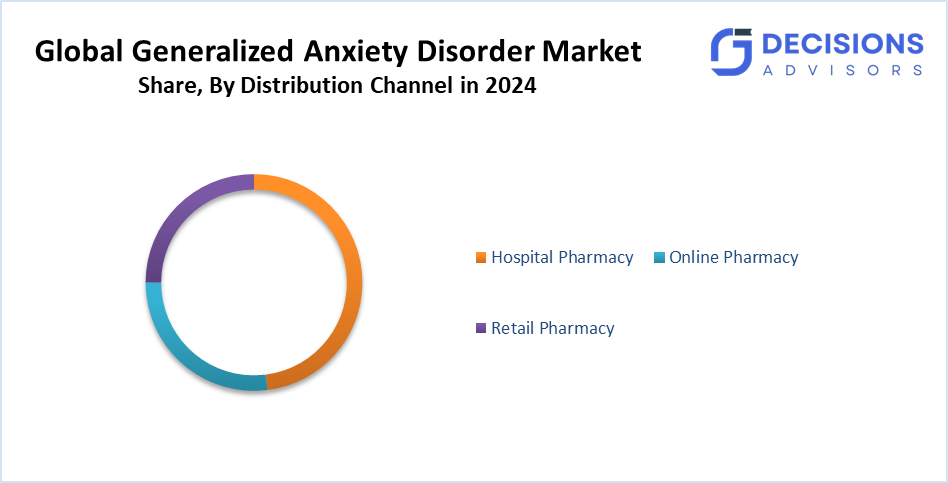
- The hospital pharmacy segment accounted for the largest share in 2024 and is anticipated to grow at a significant CAGR during the forecast period.
Based on the distribution channel, the generalized anxiety disorder market is divided into hospital pharmacy, online pharmacy, and retail pharmacy. Among these, the hospital pharmacy segment accounted for the largest share in 2024 and is anticipated to grow at a significant CAGR during the forecast period. Hospital pharmacies still contribute significantly and will likely expand as a consequence of structured treatment plans and inpatient mental healthcare.
Regional Segment Analysis of the Generalized Anxiety Disorder Market
- North America (U.S., Canada, Mexico)
- Europe (Germany, France, U.K., Italy, Spain, Rest of Europe)
- Asia-Pacific (China, Japan, India, Rest of APAC)
- South America (Brazil and the Rest of South America)
- The Middle East and Africa (UAE, South Africa, Rest of MEA)
Asia Pacific is anticipated to hold the largest share of the generalized anxiety disorder market over the predicted timeframe.
Asia Pacific is anticipated to hold the largest share of the generalized anxiety disorder market over the predicted timeframe. The Asia-Pacific market for generalized anxiety disorder (gad) shows continuous growth because people now understand mental health better, the number of anxiety disorders has increased, and people can access healthcare services more easily. The primary markets for this demand include China, India, Japan, South Korea, and Australia because both drug treatments and therapeutic methods drive demand in these countries. The development of psychiatric care depends on three main factors, which include changing cultural attitudes toward mental health treatment, government psychiatric care development programs and new treatment methods. Digital health solutions and online treatment platforms create new ways for patients to interact with their healthcare providers. The market in this area faces multiple challenges, which include stigma, healthcare system disparities and high treatment costs, which prevent market growth.
The WHO South-East Asia Region launched a new mental health dashboard to accelerate evidence-based planning, monitoring, and evaluation of services and policies. This program must assist countries in strategically scaling up interventions and reducing the dispersion of mental health data.
Hai’s digital therapeutic (DTx) “Anzeilax” for Generalized Anxiety Disorder been confirmed for deferred evaluation under China’s New Medical Technology framework.
North America is expected to grow at a rapid CAGR in the generalized anxiety disorder market during the forecast period. The North American market for generalized anxiety disorder (gad) is expanding due to rising prevalence of anxiety-related conditions, strong healthcare infrastructure, and high awareness of mental health issues. The u.s. Leads the region, supported by advanced therapeutic options, widespread adoption of cognitive behavioural therapy, and availability of innovative devices such as transcranial magnetic stimulation. Key influencing factors include government initiatives, collaborations among pharmaceutical companies and ngos to reduce stigma, and increasing demand for digital health solutions.
The Trump administration abruptly reversed its cancellation and investing upto $2 billion in federal grants for addiction and mental health services. They targeted 2,706 discretionary grants administered by the Substance Abuse and Mental Health Services Administration, threatened to disrupt critical programs nationwide before being reinstated.
Competitive Analysis:
The report offers the appropriate analysis of the key organizations/companies involved within the generalized anxiety disorder market, along with a comparative evaluation primarily based on their product offering, business overviews, geographic presence, enterprise strategies, segment market share, and SWOT analysis. The report also provides an elaborative analysis focusing on the current news and developments of the companies, which includes product development, innovations, joint ventures, partnerships, mergers & acquisitions, strategic alliances, and others. This allows for the evaluation of the overall competition within the market.
List of Key Companies
- Allergan (AbbVie Inc.)
- AstraZeneca
- Bristol-Myers Squibb
- Eli Lilly and Company
- GlaxoSmithKline (GSK)
- H. Lundbeck A/S
- Johnson & Johnson
- Merck & Co., Inc.
- MindMed Inc.
- Otsuka Pharmaceutical Co., Ltd.
- Pfizer Inc.
- Roche Holding AG
- Sanofi S.A.
- Sun Pharmaceutical Industries Ltd.
- Others
Key Target Audience
- Market Players
- Investors
- End-users
- Government Authorities
- Consulting and Research Firm
- Venture capitalists
- Value-Added Resellers (VARs)
Recent Development
- In February 2026, the NHS launched a landmark national campaign to support millions of adults facing anxiety conditions. The initiative emphasises NHS Talking Therapies, encouraging people to self-refer for treatment rather than struggling alone. New NHS data shows that over 670,000 people accessed talking therapies in 2025, a 12% increase compared to pre-pandemic levels, while 83,000 received employment support through the program—a 20% rise from 2024.
- In October 2025, Viatris officially completed its acquisition of Aculys Pharma, strengthening its presence in Japan and the broader Asia-Pacific region. Through this deal, Viatris gains exclusive rights to Pitolisant in Japan and Spydia® (diazepam nasal spray) in Japan and select Asia-Pacific markets.
- In December 2024, MindMed officially dosed the first subject in its Phase III clinical trial program for MM120 orally disintegrating tablets (ODT), a proprietary formulation of lysergide D?tartrate (LSD), being developed for Generalized Anxiety Disorder (GAD). This marks a significant step forward in evaluating psychedelic-derived therapies for anxiety disorders, building on positive Phase IIb results that showed strong efficacy and tolerability.
Market Segment
This study forecasts revenue at global, regional, and country levels from 2020 to 2035. Decisions Advisors has segmented the generalized anxiety disorder market based on the below-mentioned segments:
Global Generalized Anxiety Disorder Market, By Drug Class
- Antidepressants
- Benzodiazepines
- Buspirone
Global Generalized Anxiety Disorder Market, By Therapy
- Interpersonal Therapy
- Behavioural Therapy
- Cognitive Behaviour Therapy
- Mindfulness-Based Cognitive Therapy
Global Generalized Anxiety Disorder Market, By Distribution Channel
- Hospital Pharmacy
- Online Pharmacy
- Retail Pharmacy
Global Generalized Anxiety Disorder Market, By Regional Analysis
- North America
- US
- Canada
- Mexico
- Europe
- Germany
- UK
- France
- Italy
- Spain
- Russia
- Rest of Europe
- Asia Pacific
- China
- Japan
- India
- South Korea
- Australia
- Rest of Asia Pacific
- South America
- Brazil
- Argentina
- Rest of South America
- Middle East & Africa
- UAE
- Saudi Arabia
- Qatar
- South Africa
- Rest of the Middle East & Africa
Frequently Asked Questions (FAQ)
1. What are the key factors influencing long-term demand in the Global Generalized Anxiety Disorder Market?
Long-term demand is influenced by increasing urbanisation, rising workplace stress, growing mental health awareness campaigns, expanding insurance coverage for psychiatric services, and improved diagnostic screening tools. Additionally, technological integration in mental healthcare is reshaping treatment accessibility and patient engagement.
2. How is digital transformation reshaping the Generalised Anxiety Disorder treatment landscape?
Digital transformation is enabling remote therapy sessions, AI-driven symptom monitoring, app-based cognitive behavioural interventions, and digital therapeutics. These tools improve accessibility, reduce stigma barriers, and enhance patient adherence, particularly among younger and tech-savvy populations.
3. Why is early diagnosis becoming a strategic focus area in the GAD market?
Early diagnosis allows healthcare providers to intervene before symptoms become severe or chronic. It reduces long-term healthcare costs, improves treatment outcomes, and lowers relapse rates, thereby supporting sustainable market growth and better patient management strategies.
4. What role do government initiatives play in expanding the GAD market?
Government policies that promote mental health awareness, increase funding for psychiatric services, integrate mental health into primary care systems, and support reimbursement for therapy and medications significantly contribute to market expansion.
5. How are pharmaceutical innovations impacting competitive dynamics in this market?
The development of novel non-addictive medications, faster-acting therapies, and personalised treatment options is intensifying competition. Companies investing in clinical trials and innovative drug formulations are gaining strategic advantages in market positioning.
6. What challenges limit treatment penetration in emerging economies?
Barriers include limited psychiatric infrastructure, a shortage of trained mental health professionals, affordability issues, cultural stigma, and inconsistent regulatory frameworks. These factors restrict access to advanced therapies and modern treatment modalities.
7. How is patient preference influencing therapy segment growth?
Patients increasingly prefer non-invasive, structured, and skills-based therapies that empower self-management. Demand is rising for therapies that offer flexibility, digital access, and measurable progress tracking, which is shaping service delivery models.
8. What investment opportunities exist in the Global GAD market?
Investment opportunities lie in digital therapeutics, AI-enabled mental health platforms, personalised medicine, expansion into high-growth regional markets, and partnerships between pharmaceutical companies and technology firms to enhance treatment innovation.
Check Licence
Choose the plan that fits you best: Single User, Multi-User, or Enterprise solutions tailored for your needs.
We Have You Covered
- 24/7 Analyst Support
- Clients Across the Globe
- Tailored Insights
- Technology Tracking
- Competitive Intelligence
- Custom Research
- Syndicated Market Studies
- Market Overview
- Market Segmentation
- Growth Drivers
- Market Opportunities
- Regulatory Insights
- Innovation & Sustainability
Report Details
| Scope | Global |
| Pages | 250 |
| Delivery | PDF & Excel via Email |
| Language | English |
| Release | Feb 2026 |
| Access | Download from this page |