
Global Genomics Market
 |
Author:
Disha B
|
Pages:
258
|
Author:
Disha B
|
Pages:
258
Global Genomics Market Size, Share, and COVID-19 Impact Analysis, By Application (Drug Discovery, Clinical Diagnostics, Personalized Medicine, Genetic Testing), By Technology (PCR (Polymerase Chain Reaction), Sequencing, Microarray, Nucleic Acid Extraction and Purification, Other), By Deliverable (Products, Services), and By Region (North America, Europe, Asia-Pacific, Latin America, Middle East, and Africa), Analysis and Forecast 2025 - 2035
CAGR
16.81%
REVENUE 2024
USD Billion 35.45
FORECAST 2035
USD Billion 195.78
REPORT COVERAGE
Global
Global Genomics Market Size Insights Forecasts to 2035
- The Global Genomics Market Size Was Estimated at USD 35.45 Billion in 2024
- The Market Size is Expected to Grow at a CAGR of around 16.81% from 2025 to 2035
- The Worldwide Genomics Market Size is Expected to Reach USD 195.78 Billion by 2035
- Europe is expected to Grow the fastest during the forecast period.
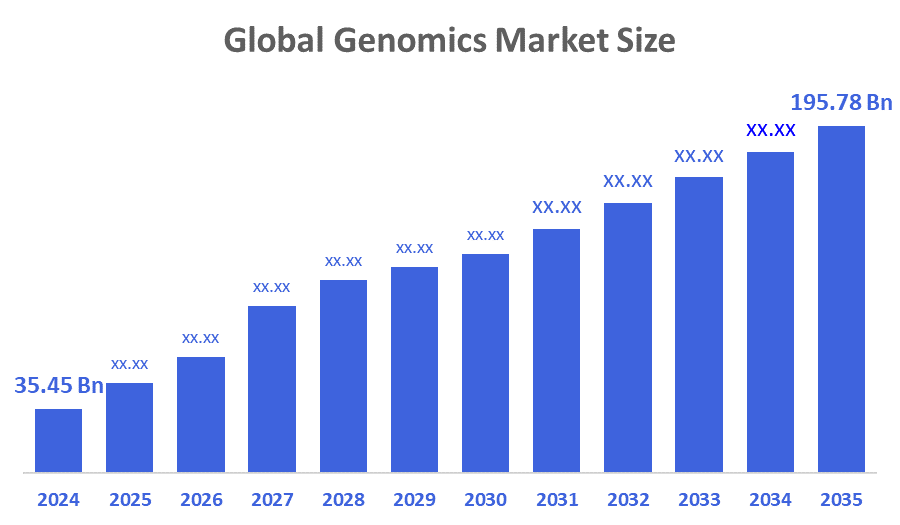
According to a Research Report Published by Decisions Advisors and Consulting, The Global Genomics Market Size was worth around USD 35.45 Billion in 2024 and is predicted to Grow to around USD 195.78 Billion by 2035 with a compound annual growth rate (CAGR) of 16.81% from 2025 to 2035. A rising evolution and the need to safeguard the biological ecosystem, which aids in the creation of novel diagnostics, treatments, and vaccinations, are the reasons behind the growing demand in the genomics market. Emerging genomics applications, which facilitate sophisticated genetic design, pathway engineering, and data-driven biological innovation in industrial biotechnology, healthcare, and research applications, are driving this increase.
Market Overview
The field of genomics involves studying an organism's entire genetic (genomic) sequence, both its structure and function (phenotypic information), as well as how this information evolves and why. Genomics uses techniques developed in the disciplines of genetics, molecular biology, and bioinformatics to generate data from sequencing, assembling, and interpreting an organism's genetic material for application in diagnostics, drug development, precision medicine, agriculture, forensic science, and research conducted in aquaculture. Genomics also includes next-generation sequencing (NGS), polymerase chain reaction (PCR), bioinformatics using artificial intelligence (AI), and the study of biomarkers. Genomics will continue to grow in importance as chronic diseases and cancer become more prevalent and genetic disorders increase. As genomics continues to gain acceptance in the agricultural biotechnology and environmental sciences sectors, there will be additional growth opportunities for the genomics market. In particular, innovations such as genomic-assisted breeding and environmental genomics are becoming increasingly popular and feasible.
The emergence of new service providers and start-up companies providing DTC sequencing, ancestry services, and other offerings has also fueled the growth of this market.
In November 2025, GEN-IMPACT is a £10 million, five-year Africa-led initiative launched to close the genomic data gap and harness Africa’s unparalleled genetic diversity for better health outcomes. Funded by Wellcome and led by the Science for Africa Foundation, it aims to transform global research equity by ensuring African populations are fully represented in genomic discovery.
Enhanced Genomics extended its Series A funding to a total of $19 million, backed by investors BGF, Parkwalk, and Meltwind, to accelerate its therapeutics pipeline in autoimmune and other common diseases.
MedGenome successfully raised $47.5 million (?400 crore) in its Series E funding round to expand access to genomic and integrated diagnostics across India and other emerging markets.
Report Coverage
This research report categorises the Genomics market based on various segments and regions, forecasts revenue growth, and analyzes trends in each submarket. The report analyses the key growth drivers, opportunities, and challenges influencing the Genomics market. Recent market developments and competitive strategies, such as expansion, product launch, development, partnership, merger, and acquisition, have been included to draw the competitive landscape in the market. The report strategically identifies and profiles the key market players and analyzes their core competencies in each sub-segment of the Genomics market.
Driving Factors
With technological advances and growing uses in multiple sectors, the genomics market is going through a revolutionary period. By incorporating genomic-based solutions into traditional practices in the health sector, agriculture, and environmental science, genomic information is now allowing for greater precision and efficiency. As genomic research continues to illustrate the vast complexity of this form of genetic information, stakeholders within the genomics market are increasingly starting to harness this potential for innovative solutions and improved results. This ongoing transformation is much more than a trend; it's a major transformation that will likely continue to be the foundation for multiple industries. In addition, there is currently a growing collaboration among academia, private companies, and governments within the genomics market. These collaborations are creating an environment that is ripe for research and development and are helping to speed up the pace of discovery for genomics. As the focus on individualised medicine continues to increase and advances in sequencing technologies are made, strong future growth is anticipated for this particular market.
Restraining Factors
A lack of qualified technicians is holding back the growth of the market in developing countries, despite offering great promise. Many emerging markets do not have enough trained technicians or do not have trained technicians with the required skills to utilise complex sequencing technologies. In addition to this, the high price of all of the necessary equipment will also inhibit the growth of this market. In addition, there are concerns about how to safely store the large volumes of data generated by such equipment, which is another limit on growth in the market.
Market Segmentation
The genomics market share is classified into application, technology, and deliverables.
- The clinical diagnostics segment accounted for the largest market share in 2024 and is projected to grow at a substantial CAGR over the forecast period.
Based on the application, the genomics market is segmented into drug discovery, clinical diagnostics, personalised medicine, and genetic testing. Among these, the clinical diagnostics segment accounted for the largest market share in 2024 and is projected to grow at a substantial CAGR over the forecast period. The diagnostic segment's declining costs are the driving force behind the market's expansion. Additionally, expanding genomics research and development contributes to synergy in the sales of genomics-based goods and services.
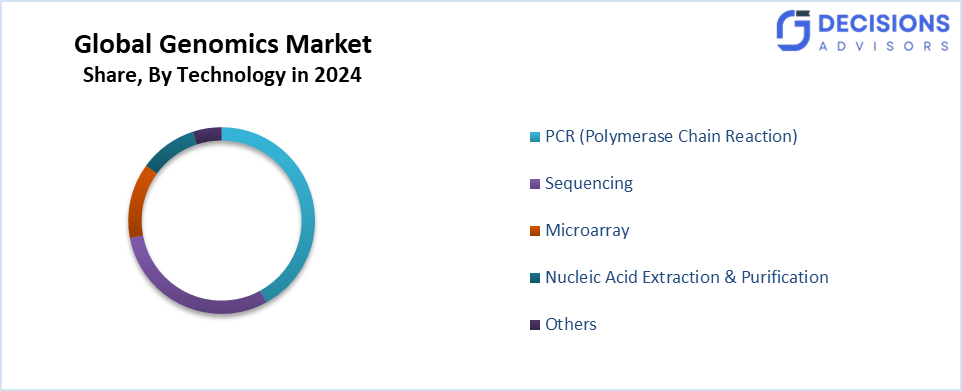
- The PCR (polymerase chain reaction) segment dominated the market in 2024 and is anticipated to grow at a significant CAGR during the forecast period.
Based on the technology, the genomics market is divided into PCR (polymerase chain reaction), sequencing, microarray, nucleic acid extraction and purification, and others. Among these, the PCR (polymerase chain reaction) segment dominated the market in 2024 and is anticipated to grow at a significant CAGR during the forecast period. One of the main aspects driving the market's growth is the high prevalence of infectious diseases combined with the advancement of PCR technology. Reducing the cost of cell implication is the primary factor for its importance and growth.
- The products segment accounted for the highest revenue share in 2024 and is projected to grow at a substantial CAGR during the forecast period.
Based on the deliverable, the genomics market is differentiated into products, and services. Among these, the products segment accounted for the highest revenue share in 2024 and is projected to grow at a substantial CAGR during the forecast period. The products used in genomics can be broadly divided into two categories: consumables and reagents, and apparatus or systems needed for the synthesis and sequencing of nucleic acid sequences. The introduction of NGS technology led to a decrease in DNA sequencing prices and a rise in the demand for customised medications, which in turn led to the creation of new systems or products.
Regional Segment Analysis of the Genomics Market
- North America (U.S., Canada, Mexico)
- Europe (Germany, France, U.K., Italy, Spain, Rest of Europe)
- Asia-Pacific (China, Japan, India, Rest of APAC)
- South America (Brazil and the Rest of South America)
- The Middle East and Africa (UAE, South Africa, Rest of MEA)
Asia Pacific is anticipated to hold the largest share of the genomics market over the predicted timeframe.
Asia Pacific is anticipated to hold the largest share of the genomics market over the predicted timeframe. The region continues to grow, investments are being made in healthcare infrastructure, and as a result, personalised medicine and biotech government initiatives are becoming increasingly popular. Countries such as China and Japan are the two leaders in the industry, with both countries providing a great deal of funding for genomic R&D. Additionally, the BGI Genomics Market in China continues to drive the growth of the genomic market throughout Asia-Pacific, while Japan also supports the development of the industry through its highly advanced technology and research capabilities. Furthermore, each of the regions has a very different population base that creates unique opportunities to create new genomic products based on genetic variation and the effects of these genetic variations on human health.
The Government of India has inaugurated its first extensive Indian Genomic Data Set and Indian Biological Data Centre (IBDC) website with the ability to share 10,000 complete genomic samples of individuals from many distinct ethnic groups found in different parts of India. Consequently, this development has established India as the leader of genomics and has provided India with self-sufficiency for its own genetic data while enhancing opportunities for foreign researchers to work collaboratively with researchers in India.
Europe is expected to grow at a rapid CAGR in the genomics market during the forecast period. The region is experiencing an increase in growth due to the development of genomic research on an increasing scale, increased focus on personalised medicine and increased investment in the support of regulatory frameworks. The European Union's support to enhance genomic research and funding within the EU represents one of the main driving forces for the expansion of this market. The key European countries in the region include Germany, the United Kingdom and France, which are home to the majority of the European biotech industry and many of the world's leading genomic research institutions. Additionally, there are a number of leading companies in the area of genomics within Europe, including Roche and Qiagen, and a number of innovative startups developing genomic products.
Competitive Analysis:
The report offers the appropriate analysis of the key organizations/companies involved within the Genomics market, along with a comparative evaluation primarily based on their product offering, business overviews, geographic presence, enterprise strategies, segment market share, and SWOT analysis. The report also provides an elaborative analysis focusing on the current news and developments of the companies, which includes product development, innovations, joint ventures, partnerships, mergers & acquisitions, strategic alliances, and others. This allows for the evaluation of the overall competition within the market.
List of Key Companies
- Agilent Technologies, Inc.
- BGI
- Bio-Rad Laboratories, Inc.
- Eurofins Scientific
- GE Healthcare
- Hoffmann-La Roche Ltd.
- Illumina, Inc.
- Oxford Nanopore Technologies
- QIAGEN N.V.
- Thermo Fisher Scientific, Inc.
- Others
Key Target Audience
- Market Players
- Investors
- End-users
- Government Authorities
- Consulting and Research Firm
- Venture capitalists
- Value-Added Resellers (VARs)
Recent Development
- In January 2026, Metropolis Healthcare launched its Centre of Genomics to expand advanced genomic diagnostics, precision medicine, and research capabilities across India. The initiative integrates CAP-accredited laboratories in Mumbai and Delhi NCR, strengthening national infrastructure for oncology, reproductive health, neurology, transplant immunology, and rare disease diagnostics.
- In October 2025, Purdue University’s Department of Biological Sciences launched the Genomics, Multiomics & AI (GEM?AI) Research Area in uniting biology, computation, and data science to accelerate discoveries in health, disease, and evolution. This initiative positions Purdue as a leader in data-driven life sciences research, integrating experimental and computational approaches to analyse massive biological datasets.
.
Market Segment
This study forecasts revenue at global, regional, and country levels from 2020 to 2035. Decisions Advisors has segmented the genomics market based on the below-mentioned segments:
Global Genomics Market, By Application
- Drug Discovery
- Clinical Diagnostics
- Personalised Medicine
- Genetic Testing
Global Genomics Market, By Technology
- PCR (Polymerase Chain Reaction)
- Sequencing
- Microarray
- Nucleic Acid Extraction and Purification
- Other
Global Genomics Market, By Derivable
- Products
- Services
Global Genomics Market, By Regional Analysis
- North America
- US
- Canada
- Mexico
- Europe
- Germany
- UK
- France
- Italy
- Spain
- Russia
- Rest of Europe
- Asia Pacific
- China
- Japan
- India
- South Korea
- Australia
- Rest of Asia Pacific
- South America
- Brazil
- Argentina
- Rest of South America
- Middle East & Africa
- UAE
- Saudi Arabia
- Qatar
- South Africa
- Rest of the Middle East & Africa
Frequently Asked Questions (FAQ)
- What is the current size of the global genomics market?
The market was valued at USD 35.45 billion in 2024.
- What is the projected market size by 2035?
It is expected to reach USD 195.78 billion by 2035.
- What is the CAGR for the genomics market from 2025 to 2035?
The market is forecasted to grow at a CAGR of 16.81% during this period.
- Which region holds the largest market share?
Asia-Pacific is anticipated to hold the largest share, driven by investments in China, Japan, and India.
- Which application segment led the market in 2024?
Clinical diagnostics accounted for the largest share and is projected to grow substantially.
- What technology dominated the market in 2024?
PCR (Polymerase Chain Reaction) held the top position due to advancements and demand for infectious disease testing.
- What are the main driving factors for market growth?
Key drivers include technological advances in sequencing, rising demand for personalised medicine, and collaborations across academia, industry, and governments.
Check Licence
Choose the plan that fits you best: Single User, Multi-User, or Enterprise solutions tailored for your needs.
We Have You Covered
- 24/7 Analyst Support
- Clients Across the Globe
- Tailored Insights
- Technology Tracking
- Competitive Intelligence
- Custom Research
- Syndicated Market Studies
- Market Overview
- Market Segmentation
- Growth Drivers
- Market Opportunities
- Regulatory Insights
- Innovation & Sustainability
Report Details
| Scope | Global |
| Pages | 258 |
| Delivery | PDF & Excel via Email |
| Language | English |
| Release | Feb 2026 |
| Access | Download from this page |