
Germany Clot Retrievers Market
 |
Author:
David J
|
Pages:
240
|
Author:
David J
|
Pages:
240
Germany Clot Retrievers Market Size, Share, By Product Type (Stent Retrievers, Aspiration Devices), By Application (Ischemic Stroke, Others), By End User (Hospitals, Specialty Clinics), Analysis and Forecast 2025-2035
CAGR
5.33%
REVENUE 2025
USD Million 131.5
FORECAST 2035
USD Million 221.1
REPORT COVERAGE
country
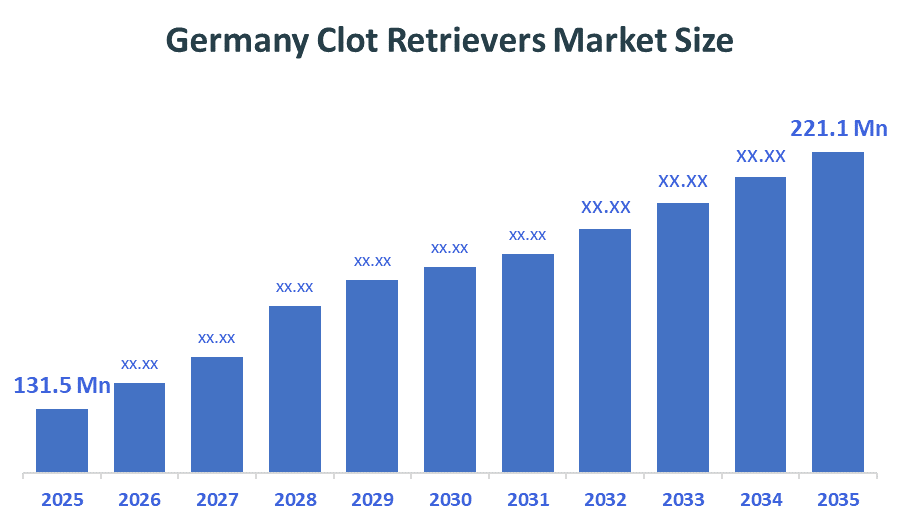
The Germany Clot Retrievers Market Size is foreseen to grow from USD 131.5 Million in 2025 and is govern to reach around USD 221.1 Million by 2035. According to Decision Advisors, a detailed research report on the Germany Clot Retrievers Market is boosted by the integration of Artificial Intelligence, accounting for nearly upto the 50% to 60% share of the total share. Phenox GmbH is the prime player in the market with approximately USD 75 million in annual turnover and a 20-30% market share, positioning it as the primary driver of the Germany Clot Retrievers Market.
Market Snapshot
- Germany Clot Retrievers Market Size (2025): USD 131.5 Million
- Projected Germany Clot Retrievers Market Size (2035): USD 221.1 Million
- Germany Clot Retrievers Market Compound Annual Growth Rate (CAGR): 5.33%
- Market Base Year: 2025
- Historical Period: 2021-2024
- Forecast Period: 2026-2035s
Market Overview/Introduction
The Germany clot retriever market is a critical medical device sector focused on mechanical thrombectomy tools used to remove blood clots from the neurovasculature. Defined primarily by stent retrievers and aspiration catheters. The German government plays a huge role in making this possible. They don’t just leave hospitals to figure it out, they provide innovation funding (known as NUB) that pays hospitals extra for using the latest, most effective tools. They have also built a massive nationwide network of certified stroke centres so that no matter where you live, you are never too far from a specialist. On the corporate side, companies like Germany’s own phenox and Acandis are locked in a friendly but fierce race with global giants to make these tools smarter. They are now baking Artificial Intelligence into the process, using software that can spot a clot on a scan in seconds and text the surgeon's phone before the patient even leaves the ER. Looking at the future, the momentum isn't slowing down. As AI becomes a standard teammate in the operating room, we expect the number of successful procedures to jump significantly, some estimates say by over 60%.
Notable Insights: -
- By product type, the stent retrievers segment dominated the market in 2025, accounting for approximately 62% of market share, and is projected to grow at a substantial CAGR during the forecast period.
- By end user, the hospitals segment dominated the market in 2025, accounting for approximately 70% of market share, and is projected to grow at a substantial CAGR during the forecast period.
- The compound annual growth rate of the Germany clot retrievers market is 5.33%.
- The Market is likely to achieve a valuation of USD 221.1 Million by 2035.
What is the role of technology in grooming the market?
Technology plays a vital role in advancing the Germany clot retriever’s market. Innovations in stent retriever design, such as improved flexibility, radial force, and clot integration, are enhancing procedural efficiency. Advanced imaging technologies, including CT angiography and AI-assisted diagnostics, enable faster identification of stroke patients eligible for thrombectomy. Additionally, the development of combined approaches using aspiration catheters alongside stent retrievers is improving success rates. Robotics and navigation systems are also emerging, enabling precise and minimally invasive interventions
Market Drivers
What’s really pushing this market forward isn't just better hardware, it’s a mix of demographics, better timing, and smarter tech. First, there’s the simple reality of an ageing population, as more Germans enter their 60s and 70s, the risk of stroke naturally climbs, making these life-saving tools a constant necessity. At the same time, medical rulebooks have changed for the better. Doctors used to have only a tiny 6-hour window to act, but now they can successfully clear clots up to 24 hours after symptoms start. This change alone has opened the door for thousands more people to receive treatment. On top of that, AI has become the ultimate wingman for surgeons. Instead of waiting for a radiologist to manually spot a blockage, AI software now flags clot the second a scan is finished, often texting the surgical team before the patient even leaves the CT room. This speed-to-save is backed by a government that actually pays for innovation. Because Germany’s insurance system offers extra funding for high-tech tools, hospitals can afford to stay on the cutting edge without worrying about the bill. Finally, the country’s massive network of specialised stroke units means that this elite level of care isn't just a big city luxury, it’s becoming a standard of care available to almost everyone, regardless of where they live.
Study on the Supply, Demand, Distribution, and Market Environment of the Germany Clot Retrievers Market
The Germany clot retrievers market operates within a well-established and highly regulated healthcare ecosystem. On the supply side, global medical device manufacturers ensure a steady flow of advanced thrombectomy devices compliant with European regulatory standards. Demand is primarily driven by hospitals and specialized stroke centers, supported by the rising incidence of ischemic stroke and increasing adoption of mechanical thrombectomy procedures. Distribution is efficiently managed through direct sales channels and authorized distributors, ensuring timely availability across healthcare facilities. The market environment is characterized by strong reimbursement policies, high clinical standards, and continuous technological innovation, all of which support market growth and adoption.
Price Analysis and Consumer Behaviour Analysis
Pricing in the Germany clot retrievers’ market is largely influenced by product innovation, clinical performance, and brand positioning, with advanced stent retrievers typically priced at a premium due to their higher success rates and safety profiles. From a consumer behavior perspective, hospitals and neurointerventional specialists prioritize device efficacy, reliability, and patient outcomes over cost considerations. Additionally, strong reimbursement support in Germany reduces price sensitivity, leading to increased adoption of high-quality and technologically advanced clot retrieval devices.
Market Segmentation
- The stent retrievers segment dominated the market in 2025, accounting for approximately 62% of market share, and is projected to grow at a substantial CAGR during the forecast period.
Based on the product type, the Germany clot retrievers market is divided into stent retrievers and aspiration devices. Among these, the stent retrievers segment dominated the market in 2025, accounting for approximately 62% of the market share, and is projected to grow at a substantial CAGR during the forecast period. This segment dominates due to its high effectiveness in restoring blood flow and strong clinical outcomes in mechanical thrombectomy procedures. Stent retrievers are widely preferred by neurointerventionalists because of their ability to capture and remove clots efficiently. Additionally, continuous advancements in device design, such as improved flexibility and clot integration, are further driving adoption, while aspiration devices continue to witness steady demand as complementary solutions.
- The ischemic stroke segment accounted for the largest share in 2025 and is anticipated to grow at a significant CAGR during the forecast period.
Based on the application, the Germany clot retrievers market is divided into ischemic stroke and others. Among these, the ischemic stroke segment accounted for the largest share in 2025 and is anticipated to grow at a significant CAGR during the forecast period. This segment dominates due to the high prevalence of ischemic stroke cases and the increasing adoption of mechanical thrombectomy as a standard treatment. Clot retrievers are primarily used for large vessel occlusions, making them essential in acute stroke management. Additionally, rising awareness regarding early stroke treatment and improvements in diagnostic imaging are further boosting segment growth, while other applications maintain limited but steady demand.
- The hospitals segment dominated the market in 2025, accounting for approximately 70% of market share, and is projected to grow at a substantial CAGR during the forecast period.
Based on the end user, the Germany clot retrievers market is divided into hospitals and specialty clinics. Among these, the hospitals segment dominated the market in 2025, accounting for approximately 70% of the market share, and is projected to grow at a substantial CAGR during the forecast period. This dominance is driven by the presence of advanced infrastructure, dedicated stroke centers, and availability of skilled neurointerventional specialists in hospitals across Germany. Hospitals handle a high volume of emergency stroke cases and are well-equipped for performing mechanical thrombectomy procedures. Specialty clinics also contribute to the market, particularly in elective and follow-up care, but remain secondary compared to hospitals.
Recent Development
- In July 2024, Gravity Medical Technology launched the Supernova stent retriever and Neutron aspiration catheter, introducing next-generation stroke treatment solutions aimed at improving clot removal efficiency and clinical success rates. The devices demonstrated promising early adoption in global clinical settings.
- In April 2024, CERENOVUS (Johnson & Johnson MedTech) launched the CEREGLIDE 71 aspiration catheter in Europe, designed for revascularisation in acute ischemic stroke patients. The device supports both direct clot aspiration and delivery of stent retrievers, improving procedural efficiency and outcomes in neurovascular thrombectomy
Competitive Analysis
The report offers the appropriate analysis of the key organisations/companies involved within the Germany clot retrievers market, along with a comparative evaluation primarily based on their product offering, business overviews, geographic presence, enterprise strategies, segment Market share, and SWOT analysis. The report also provides an elaborative analysis focusing on the current news and developments of the companies, which includes product development, innovations, joint ventures, partnerships, mergers & acquisitions, strategic alliances, and others. This allows for the evaluation of the overall competition within the Market.
Top Key Companies in the Germany Clot Retrievers Market
- Medtronic
- Stryker
- Penumbra Inc.
- Acandis GmbH
- phenox GmbH
Key Target Audience
- Market Players
- Investors
- End-users
- Government Authorities
- Consulting and Research Firm
- Venture capitalists
- Value-Added Resellers (VARs)
Market Segment
This study forecasts revenue at the Japan, regional, and country levels from 2020 to 2035. Decision Advisors has segmented the Germany clot retrievers market based on the below-mentioned segments
Germany Clot Retrievers Market, By Product Type
- Stent Retrievers
- Aspiration Devices
Germany Clot Retrievers Market, By Application
- Ischemic Stroke
- Others
Germany Clot Retrievers Market, By End User
- Hospitals
- Specialty Clinics
Frequently Asked Questions (FAQ)
Q1. What is the average procedure time for mechanical thrombectomy using clot retrievers in Germany?
A. The procedure typically takes between 30 minutes to 2 hours depending on clot complexity, patient condition, and hospital expertise, though exact timing varies across institutions.
Q2. How do patient eligibility criteria impact the use of clot retrievers in Germany?
A. Patient eligibility based on factors like time since stroke onset, clot location, and imaging results—plays a critical role in determining whether mechanical thrombectomy with clot retrievers can be performed.
Q3. What are the risks or complications associated with clot retriever procedures?
A. Potential risks include vessel damage, bleeding (hemorrhage), incomplete clot removal, or distal embolization, although advancements in device technology have reduced complication rates.
Q4. How is training and certification managed for neurointerventionalists in Germany?
A. Physicians must undergo specialized training in neuroradiology or neurointervention, often supported by certified stroke centers and professional medical societies, ensuring high procedural standards.
Q5. What role do emergency medical services (EMS) play in the clot retrievers market in Germany?
A. EMS systems are crucial in early stroke identification and rapid patient transport to stroke-ready hospitals, directly influencing the timely use and effectiveness of clot retrieval procedures.
Q5. How is data integration shaping the future of veterinary diagnostics?
A. Integration of diagnostic data with electronic veterinary health records and analytics platforms is improving disease tracking, enabling predictive diagnostics, and enhancing overall clinical efficiency in veterinary care.
Check Licence
Choose the plan that fits you best: Single User, Multi-User, or Enterprise solutions tailored for your needs.
We Have You Covered
- 24/7 Analyst Support
- Clients Across the Globe
- Tailored Insights
- Technology Tracking
- Competitive Intelligence
- Custom Research
- Syndicated Market Studies
- Market Overview
- Market Segmentation
- Growth Drivers
- Market Opportunities
- Regulatory Insights
- Innovation & Sustainability
Report Details
| Scope | country |
| Pages | 240 |
| Delivery | PDF & Excel via Email |
| Language | English |
| Release | Apr 2026 |
| Access | Download from this page |