
Germany Fresh Fruits and Vegetables Market
 |
Author:
Anurag B
|
Pages:
220
|
Author:
Anurag B
|
Pages:
220
Germany Fresh Fruits and Vegetables Market Size, Share, By Product Type (Fresh Fruits, Fresh Vegetables), By Fruit Type (Citrus fruits, Berries, Bananas & tropical fruits, Apples & pears, Grapes, Stone fruits, Exotic fruits), and By Vegetable Type (Leafy vegetables, Root & tuber vegetables, Bulb vegetables, Cruciferous vegetables, Fruiting vegetables), and Analysis and Forecast 2025 ? 2035
CAGR
4.57%
REVENUE 2025
USD Million 40.25
FORECAST 2035
USD Million 62.95
REPORT COVERAGE
Country
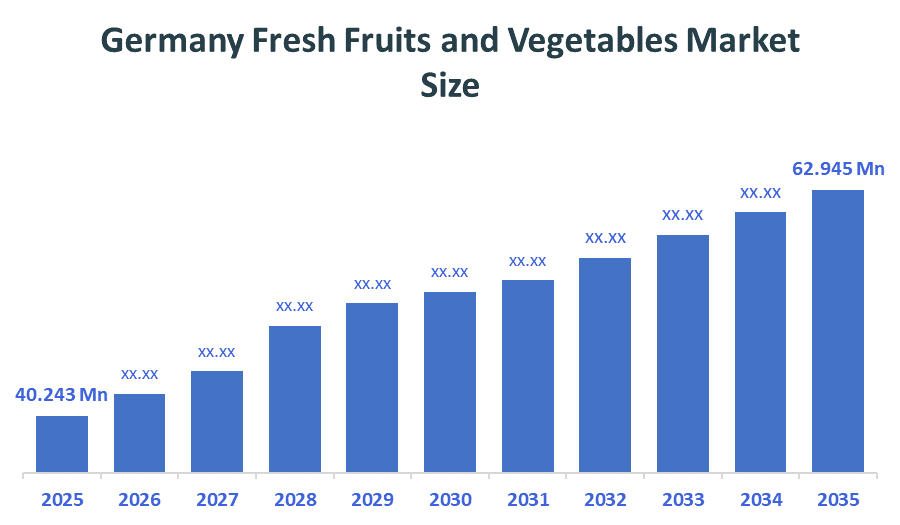
The Germany Fresh Fruits and Vegetables Market Size is anticipated to grow from USD 40.243 Million in 2025 and is expected to reach around USD 62.945 Million by 2035. According to Decision Advisors, market insights point to organics the core force redefining Germany fresh fruits and vegetables sector, holding an estimated 35-40% share globally. EDEKA Group holds a leading position with nearly USD 16.5-19.4 Billion in annual revenue and a 25-30% Germany market share, impacting growth momentum and strategic orientation across the Germany market.
Market Snapshot
- Germany Fresh Fruits and Vegetables Market Size (2025): USD 40.243 Million
- Projected Germany Fresh Fruits and Vegetables Market Size (2035): 62.945 Million
- Germany Fresh Fruits and Vegetables Market Compound Annual Growth Rate (CAGR): 4.57%
- Base Year: 2025
- Historical Period: 2021–2024
- Forecast Period: 2026–2035
Market Overview/Introduction
The Germany fresh fruits and vegetables market, industry represents the processes involved in the production, import, distribution, and sale of horticultural products in their original form meant for consumption. The uses range from retail sales in supermarkets and discount stores to foodservice sales in restaurants and institutions, and as raw materials in the processing industry. Some of the innovations in the industry include the use of Internet-of-things (IoT) technology in cold chain logistics, ethylene control post-harvest technology, precision horticulture in greenhouses, and biodegradable packaging technology that meets the environmental regulations of the European Union (EU). Future trends include the availability of the world's biggest organic food market, growing demands for tropical exotic fruits, adoption of plant-based diets, and increasing penetration of natural foods.
- Germany fresh fruits and vegetables market benefits from BMEL food waste strategy, driving €10–15 billion investments in agri-tech, cold chain, and retail efficiency, boosting sustainability, reducing losses, and strengthening Germany agricultural value chain.
Notable Insights: -
- By product type, the fresh vegetables segment held a dominant position with 57.4% in terms of market share in 2025.
- By fruit type, bananas & tropical fruits segment is the dominating accounting for over 29.8% of the Germany market share in 2025.
- The compound annual growth rate of the Germany Fresh Fruits and Vegetables Market is 4.57%.
- The market is likely to achieve a valuation of USD 62.945 Million by 2035.
What is role of technology in grooming the market?
The Germany fresh fruits and vegetables market experiences its technological intervention acts as a revolution in improving efficiency and productivity. Innovative agri-tech tools like precision agriculture, use of IoT to monitor crops, and AI for demand prediction help in ensuring quality production and reduction of post-harvest wastage. Technologies like cold chain optimization and smart logistics increase the shelf life of the products when they are brought from a distant location. The use of blockchain and traceability technologies helps in meeting food safety regulations according to EU standards and digital platforms for direct sales increase efficiency in the process.
Market Drivers
The Germany fresh fruits and vegetables market arises due to the changing consumer preferences and macroeconomic conditions. The increasing awareness about health among consumers has been driving the consumption of plant-based products, vegetarian and healthy food, which in turn is raising the per capita consumption of fresh fruits and vegetables. There has been rapid development in the organic food industry because of the leadership role played by Germany in sustainable farming practices, with consumers preferring food products that have been labelled organic, free from pesticides and traceable throughout the chain. There is increasing prevalence of convenience-based lifestyles among consumers who prefer buying fresh produce in processed forms. High disposable income levels will help in the diversification of fruit and vegetable consumption.
Restrain
The Germany fresh fruits and vegetables market faces structural limitations include high perishability of the fresh produce necessitating efficient cold chain processes and fast distribution channels. Other limitations include high logistics and energy costs which create difficulties in running operations efficiently. The stringent regulatory environment in the European Union creates numerous challenges for compliance on all produce whether imported or locally produced.
Strategies to Implement for Growth of the Market
The Germany Fresh Fruits and Vegetables Market is capable of achieving growth from strategic actions related to modernization and sustainability practices. Improvements in the cold chain process and use of technology for logistic purposes increase efficiency and minimize wastage after harvest. Use of precision farming techniques along with IoT and artificial intelligence for forecasting demands maximizes yield and optimizes supplies.
Market Segmentation
The Germany Fresh Fruits and Vegetables Market share is classified into product, fruit, and vegetables
- The fresh vegetables segment dominated the market in 2024, and is projected to grow at a substantial CAGR of approximately 4.7% during the forecast period.
Based on the product type, the fresh fruits and vegetables market is divided into fresh fruits, fresh vegetables. Among these, the fresh vegetables segment dominated the market in 2024, and is projected to grow at a substantial CAGR of approximately 4.7% during the forecast period. It is due to the strong domestic production, high per-capita consumption, and retail demand. Staple crops like potatoes and tomatoes drive volume leadership, reinforcing stable growth, food security trends, and supply chain efficiency across Germany.
- The bananas & tropical fruits segment accounted for the largest share in 2024, and is anticipated to grow at a significant CAGR of approximately 7.3% during the forecast period.
Based on the fruit, the fresh fruits and vegetables market is divided into citrus fruits, berries, bananas & tropical fruits, apples & pears, grapes, stone fruits, exotic fruits. Among these, the bananas & tropical fruits segment accounted for the largest share in 2024, and is anticipated to grow at a significant CAGR of approximately 7.3% during the forecast period. It is dominating because the strong import dependence, year-round availability, and high retail demand. Consumer preference for affordable exotic nutrition supports dominance, expanding supermarket sales, trade flows, and stable consumption patterns across Germany.
- The root & tuber vegetables segment dominated the market in 2024, and is projected to grow at a substantial CAGR during the forecast period.
Based on the vegetables, the fresh fruits and vegetables market is divided into leafy vegetables, root & tuber vegetables, bulb vegetables, cruciferous vegetables, fruiting vegetables. Among these, the root & tuber vegetables segment dominated the market in 2024, and is projected to grow at a substantial CAGR during the forecast period. The high potato consumption, strong domestic production, and staple dietary dependence. This segment supports stable retail demand, food security, and consistent supply chain performance across Germany’s agricultural economy.
Recent Development
- In June 2025, Germany fresh fruits and vegetables market reflects gut-health functional snacks trend, highlighted by chicory-inulin fruit bar innovations (2023–2024 launches), driving €8–12 billion investments in wellness food innovation, plant-based nutrition, and fiber-rich convenience products across Germany.
- In March 2024, Germany fresh fruits and vegetables market is supported by 2024 imports of USD 91.9B and grocery retail sales of USD 293.1B, attracting €12–18B investments in supply chains, logistics, and agri-tech expansion across Germany.
Competitive Analysis
The report offers the appropriate analysis of the key organisations/companies involved within the Germany fresh fruits and vegetables market, along with a comparative evaluation primarily based on their product offering, business overviews, geographic presence, enterprise strategies, segment market share, and SWOT analysis. The report also provides an elaborative analysis focusing on the current news and developments of the companies, which includes product development, innovations, joint ventures, partnerships, mergers & acquisitions, strategic alliances, and others. This allows for the evaluation of the overall competition within the market.
Top Key Companies in Germany Fresh Fruits and Vegetables Market
- BayWa AG
- REWE Group
- EDEKA Group
- Lidl Stiftung & Co. KG
- ALDI Nord Group
- ALDI Süd Group
- Dole Europe GmbH
Key Target Audience
- Market Players
- Investors
- End-users
- Government Authorities
- Consulting and Research Firm
- Venture capitalists
- Value-Added Resellers (VARs)
Market Segment
This study forecasts revenue at the Germany, regional, and country levels from 2020 to 2035. Decision Advisors has segmented the Germany fresh fruits and vegetables market based on the below-mentioned segments
Germany Fresh Fruits and Vegetables Market, By Product Type
- Fresh Fruits
- Fresh Vegetables
Germany Fresh Fruits and Vegetables Market, By Fruit Type
- Citrus fruits
- Berries
- Bananas & tropical fruits
- Apples & pears
- Grapes
- Stone fruits
- Exotic fruits
Germany Fresh Fruits and Vegetables Market, By Vegetable Type
- Leafy vegetables
- Root & tuber vegetables
- Bulb vegetables
- Cruciferous vegetables
- Fruiting vegetables
Frequently Asked Questions (FAQ)
1. Which product segment holds the leading position in the Germany fresh produce market?
Fresh vegetables have taken the leading position in Germany because of regular consumer consumption of potatoes, tomatoes, and carrots, as well as efficient production within the country. In addition, stable demand from households also ensures the market leadership.
2. Why is Germany important for fruit imports?
Germany is an important import market due to the high demand for bananas, citrus fruits, and exotics because they cannot be produced in sufficient volumes domestically, coupled with well-developed supermarkets that generate significant revenues.
3. How relevant is organic produce in Germany?
The relevance of organic produce can be explained by current trends related to sustainability, increased focus on healthy living, and high prices on organic fruits and vegetables, ensuring effective distribution through retail networks.
5. What are the main difficulties with this market?
Among the difficulties that have been identified in this market is the presence of EU quality standards and pesticide restrictions, price volatility, and reliance on imports. Therefore, export of products must comply with GLOBALG.A.P. standards.
Check Licence
Choose the plan that fits you best: Single User, Multi-User, or Enterprise solutions tailored for your needs.
We Have You Covered
- 24/7 Analyst Support
- Clients Across the Globe
- Tailored Insights
- Technology Tracking
- Competitive Intelligence
- Custom Research
- Syndicated Market Studies
- Market Overview
- Market Segmentation
- Growth Drivers
- Market Opportunities
- Regulatory Insights
- Innovation & Sustainability
Report Details
| Scope | Country |
| Pages | 220 |
| Delivery | PDF & Excel via Email |
| Language | English |
| Release | Jun 2026 |
| Access | Download from this page |