
Germany Heating Equipment Market
 |
Author:
Pranali P
|
Pages:
240
|
Author:
Pranali P
|
Pages:
240
Germany Heating Equipment Market Size, Share, By Product (Boilers, Heat Pumps, Furnaces, District Heating Systems, Radiators, Others), By Energy Source (Electric, Gas, Oil, Renewable), By Application (Residential, Commercial, Industrial) and, Analysis and Forecast 2025-2035
CAGR
6.39%
REVENUE 2025
USD Million 4698.7
FORECAST 2035
USD Million 8729.6
REPORT COVERAGE
country
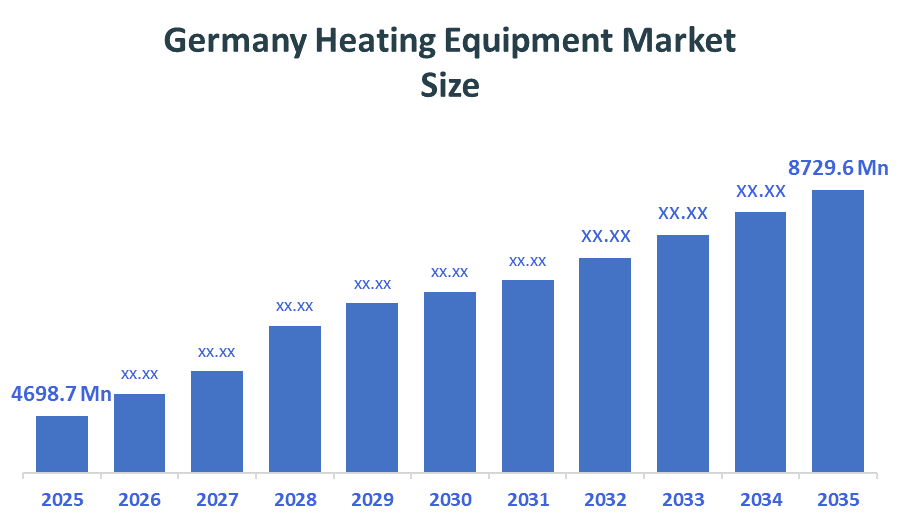
The Germany Heating Equipment Market Size is forecasted to grow from USD 4698.7 Million in 2025 and going to reach approx. USD 8729.6 Million by 2035. According to Decision Advisors, there is a detailed research report on the Germany Heating Equipment Market highlights that heat pumps dominate the global market, accounting for approximately 17% of the total share worldwide. Viessmann Group generates strong revenue through their its heating and climate solutions segment, which accounts for approximately 10–12% market share, thus acting as a main driving innovation in smart, energy-efficient, and hybrid heating technologies across Germany.
Market Snapshot
- Market Size (2025): USD 4698.7 Million
- Projected Market Size (2035): USD 8729.6 Million
- Compound Annual Growth Rate (CAGR): 6.39%
- Base Year: 2025
- Historical Period: 2021–2025
- Forecast Period: 2026–2035
Market Overview/Introduction
The Germany Heating Equipment Market includes technologies such as boilers, heat pumps, furnaces, and district heating systems which are used in residential and commercial and industrial applications with residential needs driving 55 to 60% of total demand because of their high space heating requirements in colder regions. The market undergoes its current structural transformation because Germany aims for climate neutrality by 2045 and EU energy performance regulations become more stringent and new installations stop using fossil-fuel heating systems. The government provides subsidies which cover 30 to 40% of installation expenses to support heat pumps which represent the most rapidly expanding market segment. The adoption of efficient systems is accelerating because rising energy prices have increased household heating costs by more than 20 to 25% during the past few years. The combination of smart heating solutions with IoT thermostats and BEMS enables energy savings between 20 and 35% while building renovations create new demand for hybrid and renewable-based heating solutions.
- “Germany Makes It Efficient” is a government campaign promoting energy efficiency in buildings and heating systems, offering guidance via hotline 0800 0115 000 to support citizens and businesses in adopting low-carbon solutions.
- Germany is investing heavily in heating system transformation through subsidies, R&D, and policy support to accelerate heat pump adoption, district heating expansion, and low-carbon technologies under its national energy transition strategy.
Notable Insights: -
- By product, the boilers held a dominant position with 8% in terms of market share in 2025.
- By energy source, gas is the dominating accounting for over 9% of the United Kingdom market share in 2025.
- The compound annual growth rate of the Germany Heating Equipment Market is 6.39%.
- The market is likely to achieve a valuation of USD 8729.6 Million by 2035.
What is role of Technology in grooming the market?
The German Heating Equipment Market experiences its main transformational driver from modern technology because it boosts operational efficiency and environmental sustainability and enables automated processes. Heat pump systems deliver 3–5x higher energy efficiency (COP 3–5) compared to conventional boilers, which leads to substantial reductions in carbon emissions. Homeowners can save 20 to 35% of their energy use through the temperature control optimization offered by IoT-enabled smart thermostats and connected HVAC systems, while smart building energy management systems (BEMS) provide building efficiency improvements of up to 25%. The transition phase sees widespread use of hybrid heating systems which combine gas and renewable electricity, with these systems now constituting almost 30% of new installations in urban retrofit projects. The AI-based predictive heating solutions provide real-time load forecasting and energy optimization capabilities. The Viessmann Group and Bosch Thermotechnology lead the development of low-GWP refrigerants and smart heat pumps and integrated hybrid heating systems which help their clients meet EU climate compliance targets.
Market Drivers
Regulatory economic and technological factors serve as the primary drivers for the Germany Heating Equipment Market. The national climate programs provide government subsidies which cover between 30% and 40% of heat pump installation costs thus promoting fast market growth. The EU Green Deal together with Germany's climate neutrality goal for 2045 acts as a catalyst for the transition to electrified heating systems. Recent energy price increases have resulted in more than 20-25% higher heating costs for households pushing consumers to seek efficient heating solutions. Smart home technology now reaches 35% adoption in urban households which leads to automatic heating system upgrades during residential renovations that make up 60% of total heating system improvements. The industrial sector needs efficient process heating systems because decarbonization efforts require reduced energy consumption. The growing smart city development and green building movement in Germany has increased demand for innovative heating systems which produce low emissions.
Restrain
The Germany Heating Equipment Market faces several structural restraints that may slow down its growth despite strong policy support and rising demand for efficient heating systems. The main obstacle for heat pump adoption exists because price-sensitive households and small businesses find it difficult to pay the high initial costs of heat pumps and advanced heating technologies which they need to install. The shortage of HVAC installation professionals who possess the necessary skills to handle system deployment work results in decreased operational efficiency and extended deployment time. The integration process faces obstacles because all German buildings need extensive retrofitting work to accommodate contemporary heating technology standards. The market transition process stays restricted because existing gas heating systems follow a slow replacement pattern which results in users continuing with their outdated systems. The increasing use of electrified heating systems creates problems because it increases the demand for electrical power from the grid during peak winter periods which puts strain on both energy security and infrastructure resources.
Study on the Supply, Demand, Distribution, and Market Environment Germany Heating Equipment Market
The Germany Heating Equipment Market operates through a well-structured supply chain that includes OEM manufacturers and distributors together with HVAC contractors and energy service companies (ESCOs). European OEMs dominate supply because they control about 65 to 70% of equipment stock while their domestic manufacturing capabilities remain strong. Residential heating system upgrades account for approximately 55 to 60% of total market demand, which commercial building retrofits and industrial heating system upgrades follow. The distribution channels for products include direct OEM sales together with retail outlets and contractor networks and digital platforms, which online HVAC procurement shows an annual growth rate of 18 to 22%. After-sales service and maintenance contracts generate between 25 to 30% of total system revenue throughout the system lifecycle, which applies mainly to heat pump systems. The rising number of urban renovation projects together with energy-efficient infrastructure development increases demand-supply balance within Germany's heating ecosystem.
Price Analysis and Healthcare Facilities Behaviour Analysis
Pricing in the Germany Heating Equipment Market varies significantly depending on technology type, efficiency level, and installation complexity. Standard gas boilers typically range between USD 2,000-5,000, making them the most affordable option but less efficient long term. Heat pump systems are more expensive, costing between USD 8,000–20,000+ including installation, but deliver long-term energy savings of 30-60%, making them increasingly preferred under subsidy programs. District heating connection costs vary widely, often exceeding USD 5,000-15,000 depending on infrastructure availability. S2mart thermostats and IoT-based control systems range from USD 100-500, offering energy savings of up to 20-35%. Despite high upfront costs, lifecycle cost analysis shows heat pumps reduce total heating expenditure by nearly 40% over 10-15 years, driving strong adoption across residential and commercial sectors in Germany.
Strategies to Implement for Growth of the Market
German industry needs to use specific strategies based on electrification and efficiency improvements and digital technologies to create their heating equipment market. Manufacturers need to increase their production of high-efficiency heat pumps which currently achieve 3-5 times energy efficiency improvements because the demand from Germany's climate neutrality roadmap requires it. Supply chain localization allows installation costs to decrease by 10 to 15% which makes products more affordable. Companies need to promote IoT-based smart heating systems which enable energy savings between 20 and 35% to enhance their smart home systems. Strategic partnerships with construction firms and ESCOs will support large-scale retrofit projects, especially as over 40% of German housing stock requires modernization. Installer shortages require workforce training programs as an essential solution. The leading companies Viessmann Group and Bosch Thermotechnology concentrate their efforts on developing hybrid systems through their innovative projects.
Market Segmentation
The Germany Heating Equipment Market share is classified into product, energy source, and application
- The boilers dominated the market in 2018, and is projected to grow at a substantial CAGR of approximately 8% during the forecast period.
Based on the product, the Germany heating equipment market is divided into boilers, heat pumps, furnaces, district heating systems, radiators, others. Among these, the boilers dominated the market in 2018, and is projected to grow at a substantial CAGR of approximately 8 % during the forecast period. The system used today gained popularity because people found it easy to install and use in their homes and business establishments. The market experienced structural changes which led to heat pumps growing at a high compound annual growth rate 8% during the forecast period because of strong government incentives and energy efficiency regulations and Germany's decarbonization policies under the Energiewende strategy.
- The gas accounted for the largest share in 2018, and is anticipated to grow at a significant CAGR of approximately 9% during the forecast period.
Based on the energy source, the Germany heating equipment market is divided into electric, gas, oil, renewable. Among these, the gas accounted for the largest share in 2018, and is anticipated to grow at a significant CAGR of approximately 9% during the forecast period. The heating systems achieve good market presence in Germany because their systems can be installed at lower costs and their equipment operates in residential areas throughout the country. The market segment shows decreasing demand because of the implementation of decarbonization policies and the enforcement of regulatory rules. Renewable-based heating systems, particularly heat pumps, will experience an annual growth rate 9% during the forecast period because of Germany's Energiewende strategy and EU Green Deal targets and government subsidies and the country's transition to electric heating systems that produce low carbon emissions
- The residential segment dominated the market in 2018, and is projected to grow at a substantial CAGR approximately 7% during the forecast period.
Based on the application, the Germany heating equipment market is divided into residential, commercial, and industrial. Among these, the residential segment dominated the market in 2018, and is projected to grow at a substantial CAGR approximately 7% during the forecast period. Because of Germany's cold weather conditions, people in the country use heating systems and boilers for their homes throughout the year, which creates high demand for household heating. The residential segment is expected to increase at a compound annual growth rate 7% during the upcoming time period because of growing heat pump usage and energy efficiency regulations and government financial support and active renovation efforts in older residential properties.
Recent Development
- In April 2026, Uniper and Evonik commissioned a high-temperature heat pump in North Rhine-Westphalia supplying waste heat to 1,000 households, saving 1,750 tons of CO2 annually project completed successfully initiative.
- In April 2026, Henkel and Iqony commenced the integration of waste heat from a natural gas combined heat and power (CHP) plant at Henkel’s headquarters in Düsseldorf into the municipal district heating network, supplying approximately 35% of the heating demand for two surrounding districts and improving overall urban energy efficiency and carbon reduction performance.
- In April 2026, Hyca Heat, a start-up originating from Forschungszentrum Jülich, launched an innovative hybrid electric and catalytic heating technology designed to decarbonize industrial heat applications across a wide temperature range of 30°C to 1,000°C, aiming to replace fossil fuels and enable scalable low-carbon industrial heating solutions.
- In March 2026, Viessmann Climate Solutions partnered with NHW (a subsidiary of MET) to introduce an efficiency guarantee for heat pump systems in residential rental buildings, supporting faster adoption of renewable heating in existing housing stock across Germany and improving long-term building energy performance and sustainability outcomes.
- In September 2024, Mitsubishi Electric re-released advanced water-to-water heat pump systems designed for commercial and industrial applications, capable of delivering high-temperature water output up to 78°C, enhancing efficiency, supporting decarbonization of heating processes, and enabling wider adoption of electrified heating solutions in industrial and large-scale building infrastructure.
Competitive Analysis
The report offers the appropriate analysis of the key organisations/companies involved within the Germany Heating Equipment Market, along with a comparative evaluation primarily based on their technology offering, business overviews, geographic presence, enterprise strategies, segment market share, and SWOT analysis. The report also provides an elaborative analysis focusing on the current news and developments of the companies, which includes technology development, innovations, joint ventures, partnerships, mergers & acquisitions, strategic alliances, and others. This allows for the evaluation of the overall competition within the market.
Top Key Companies in Germany Heating Equipment Market
- Viessmann Group
- Bosch Thermotechnology
- Vaillant Group
- Stiebel Eltron
- Danfoss
- Bosch
- Siemens
- Others
Key Target Audience
- Market Players
- Investors
- End-users
- Government Authorities
- Consulting and Research Firm
- Venture capitalists
- Value-Added Resellers (VARs)
Market Segment
This study forecasts revenue at the Germany, regional, and country levels from 2020 to 2035. Decision Advisors has segmented the Germany Heating Equipment Market, based on the below-mentioned segments
Germany Heating Equipment Market, By Product
- Boilers
- Heat Pumps
- Furnaces
- District Heating Systems
- Radiators
- Others
Germany Heating Equipment Market, By Energy Source
- Electric
- Gas
- Oil
- Renewable
Germany Heating Equipment Market, By application
- Residential
- Commercial
- Industrial
Frequently Asked Questions (FAQ)
1. How is Germany’s Building Energy Act (GEG) reshaping heating equipment selection in new installations?
The GEG mandates a high share of renewable energy use in new heating systems, accelerating the shift toward heat pumps and hybrid systems over fossil-fuel boilers.
2. Why are hybrid heating systems gaining faster adoption in Germany compared to full electrification?
Hybrid systems allow gradual transition by combining gas and renewable electricity, making them more suitable for Germany’s existing housing stock and reducing retrofit complexity.
3. How does Germany’s housing age structure influence heating equipment demand?
With a large proportion of pre-1990 buildings, Germany has high retrofit demand, increasing adoption of compact, modular, and easy-to-install heating solutions.
4. What role do district heating systems play in Germany’s urban decarbonization strategy?
District heating is becoming a key solution in dense cities, enabling efficient use of industrial waste heat and renewable energy integration at scale.
5. How are heat pump manufacturers addressing performance challenges in colder German winters?
Manufacturers are developing high-temperature and cold-climate heat pumps capable of stable operation at sub-zero temperatures with improved COP efficiency.
6. Why is installer shortage considered a critical bottleneck in Germany’s heating transition?
Limited availability of certified HVAC technicians slows down heat pump installation rates and delays large-scale retrofit programs.
Check Licence
Choose the plan that fits you best: Single User, Multi-User, or Enterprise solutions tailored for your needs.
We Have You Covered
- 24/7 Analyst Support
- Clients Across the Globe
- Tailored Insights
- Technology Tracking
- Competitive Intelligence
- Custom Research
- Syndicated Market Studies
- Market Overview
- Market Segmentation
- Growth Drivers
- Market Opportunities
- Regulatory Insights
- Innovation & Sustainability
Report Details
| Scope | country |
| Pages | 240 |
| Delivery | PDF & Excel via Email |
| Language | English |
| Release | Apr 2026 |
| Access | Download from this page |