
Germany Neurostimulation Devices Market
 |
Author:
David J
|
Pages:
210
|
Author:
David J
|
Pages:
210
Germany Neurostimulation Devices Market Size, Share, By Type (Spinal Cord Stimulation, Deep Brain Stimulation, Vagus Nerve Stimulation, Sacral Nerve Stimulation), By Application (Chronic Pain, Parkinson?s Disease, Epilepsy, Depression, Others), By End User (Hospitals, Specialty Clinics, Ambulatory Surgical Centers), Analysis and Forecast 2025?2035.
CAGR
14.13%
REVENUE 2025
USD Million 272.4
FORECAST 2035
USD Million 1021.1
REPORT COVERAGE
Country
Market Snapshot
- Germany Neurostimulation Devices Market Size (2025): USD 272.4 Million
- Projected Germany Neurostimulation Devices Market Size (2035): USD 1021.1 Million
- Germany Neurostimulation Devices Market Compound Annual Growth Rate (CAGR): 14.13%
- Market Base Year: 2025
- Historical Period: 2021–2024
- Forecast Period: 2026–2035
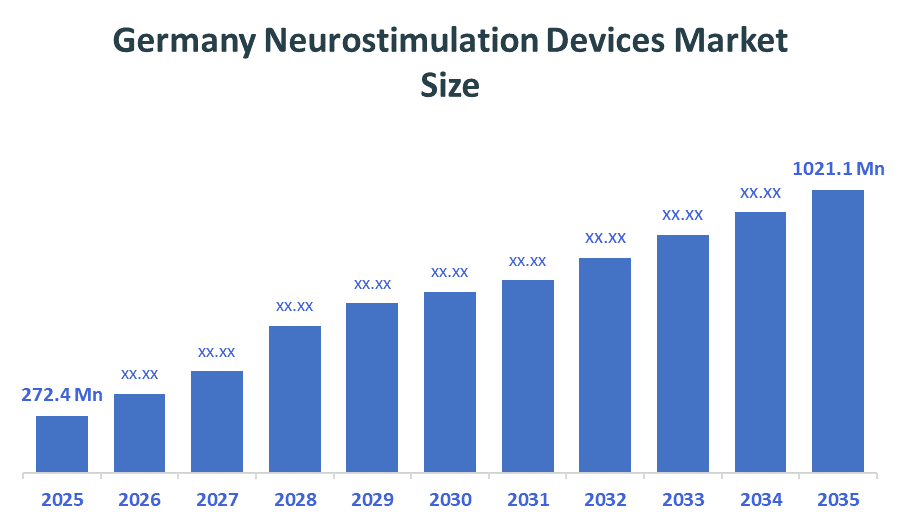
According to Decision Advisors, the Germany Neurostimulation Devices Market Size is expected to grow from USD 272.4 Million in 2025 to USD 1021.1 Million by 2035, at a CAGR of 14.13% during the forecast period 2025-2035. The Germany Neurostimulation Devices Market is projected to grow significantly over the next decade. The market is projected to grow significantly due to rising neurological disorders, increasing geriatric population, and growing adoption of minimally invasive neuromodulation therapies.
Market Overview/Introduction
The German neurostimulation devices market encompasses a sophisticated range of implantable and non-invasive technologies, including spinal cord stimulators, deep brain stimulators, and vagus nerve stimulators, designed to modulate the nervous system for treating chronic pain, movement disorders, and psychiatric conditions. Industry leaders such as Medtronic, Boston Scientific, and Germany’s own B. Braun Melsungen are stepping up their game, pouring significant R&D into making devices smaller, more efficient, and smarter through closed-loop sensing. Looking ahead, the real potential lies in moving beyond traditional treatments into "bioelectronic medicine" for autoimmune diseases. By pairing these breakthroughs with AI-driven remote monitoring, Germany is quickly becoming the go-to global hub for the next generation of neurotechnology. This growth is largely fuelled by the rising need for treatment among an aging population facing neurological challenges. It’s also getting a major boost from forward-thinking government policies like the Digital Healthcare Act (DVG). By cutting through the usual red tape and streamlining insurance payouts for DiGA (digital health apps), these initiatives are making it much faster and easier for cutting-edge medical tech to actually reach the patients who need it most.
- Around 5.3 million people in Germany suffer from depression, driving demand for neurostimulation therapies.
- Germany spends over 11% of its GDP on healthcare, supporting advanced device adoption.
Notable Insights: -
- By type, the spinal cord stimulation segment dominated the market in 2025, accounting for approximately 45% of market share, and is projected to grow at a substantial CAGR during the forecast period.
- By end user, the hospitals segment dominated the market in 2025, accounting for approximately 72% of market share, and is projected to grow at a substantial CAGR during the forecast period.
- The compound annual growth rate of the Germany Neurostimulation Devices Market is 14.13%.
- The market is likely to achieve a valuation of USD 1021.1 Million by 2035.
What is role of technology in grooming the market?
Technology plays a crucial role in advancing the Germany neurostimulation devices market through innovations in implantable pulse generators, electrode design, and wireless programming systems. Modern neurostimulators offer closed-loop systems that can adjust stimulation levels in real time, improving treatment outcomes by nearly 30% Rechargeable batteries and miniaturized devices enhance patient comfort and longevity. Additionally, integration with digital health platforms allows physicians to monitor and adjust therapies remotely. The rise of non-invasive neurostimulation devices is also expanding treatment accessibility.
Market Drivers
A major driving force behind this shift is Germany’s rapidly changing demographic, where more than 22% of the population is now over the age of 65. As we live longer, neurological conditions naturally become more common, placing a much heavier demand on the healthcare system to find sustainable solutions for the elderly. This has led to a noticeable surge in the preference for minimally invasive treatments; more and more patients are looking for ways to regain their quality of life without the risks of major surgery or the side effects that often come with long-term pharmaceutical use. Neurostimulation is a perfect fit here because it offers a high-tech, direct way to manage these conditions without the usual downsides. When you take that real-world patient demand and pair it with a government that’s actually willing to fund healthcare and keep insurance policies updated to cover these advanced therapies, you get something special. It creates the kind of environment where cutting-edge medical tech doesn't just sit on a shelf—it actually flourishes and gets into the hands of the people who need it most.
Study on the Supply, Demand, Distribution, and Market Environment of the Germany Neurostimulation Device Market.
The Germany neurostimulation devices market is characterized by a well-established healthcare infrastructure, strong reimbursement policies, and increasing adoption of advanced neuromodulation technologies. On the supply side, the market is supported by global medical device manufacturers and a structured supply chain involving component suppliers, distributors, and healthcare providers. However, stringent regulatory requirements under EU MDR and high manufacturing complexity pose moderate challenges to supply expansion. In terms of demand, the market is driven by the rising prevalence of neurological disorders such as Parkinson’s disease, epilepsy, and chronic pain, along with a growing aging population and preference for minimally invasive, drug-free treatments. Hospitals and specialized neurology centers account for the majority of device usage, supported by centralized procurement systems and direct distribution channels from manufacturers. The market environment remains highly favorable due to strong government healthcare spending, technological innovation such as AI-enabled and closed-loop neurostimulation systems, and Germany’s position as a key European hub for clinical research and early technology adoption. Overall, the market demonstrates a balanced ecosystem of robust demand, technologically advanced supply, efficient distribution networks, and a supportive regulatory and economic environment, ensuring steady growth in the coming years.
Price Analysis and Consumer Behaviour Analysis
The price analysis of the Germany neurostimulation devices market shows a premium pricing structure due to high technology, surgical complexity, and regulatory costs. Implantable devices such as spinal cord and deep brain stimulators typically range from USD 25,000 to USD 75,000, with total treatment costs sometimes exceeding USD 100,000 depending on therapy and care requirements. Prices vary based on device type, innovation level, and hospital infrastructure, while Germany’s strong reimbursement system helps improve affordability despite high upfront costs. From a consumer behaviour perspective, purchasing decisions are primarily outcome-driven rather than cost-driven. Hospitals and physicians focus on clinical effectiveness, safety, and long-term benefits, especially for chronic conditions. There is a growing preference for minimally invasive and implantable solutions, supported by physician recommendations and brand reputation. However, high costs still influence adoption, making usage more prominent in well-funded healthcare settings.
Market Segmentation
The Germany Neurostimulation Devices Market share is classified into type, application, and end user.
- The spinal cord stimulation segment dominated the market in 2025, accounting for approximately 45% of market share, and is projected to grow at a substantial CAGR during the forecast period.
Based on the type, the Germany Neurostimulation Devices Market is divided into spinal cord stimulation, deep brain stimulation, vagus nerve stimulation, and sacral nerve stimulation. Among these, the spinal cord stimulation segment dominated the market in 2025, accounting for approximately 45% of market share, and is projected to grow at a substantial CAGR during the forecast period. Spinal cord stimulation dominates due to its widespread use in managing chronic pain conditions and its proven clinical effectiveness. However, deep brain stimulation is gaining traction, particularly for treating Parkinson’s disease, due to increasing prevalence of neurological disorders and technological advancements.
- The chronic pain segment accounted for the largest share in 2025 and is anticipated to grow at a significant CAGR of approximately 10.2% during the forecast period.
Based on the application, the Germany Neurostimulation Devices Marketis divided into chronic pain, Parkinson’s disease, epilepsy, depression, and others. Among these, the chronic pain segment accounted for the largest share in 2025 and is anticipated to grow at a significant CAGR of approximately 10.2% during the forecast period. Neurostimulation devices are extensively used in chronic pain management due to their ability to reduce dependency on long-term medications. Increasing cases of age-related disorders and musculoskeletal conditions in Germany are significantly driving this segment. Additionally, their use in Parkinson’s disease and epilepsy is expanding due to improved treatment outcomes.
- The hospitals segment dominated the market in 2025, accounting for approximately 72% of market share, and is projected to grow at a substantial CAGR during the forecast period.
Based on the end user, the Neurostimulation Devices Market is divided into hospitals, specialty clinics, and ambulatory surgical centers. Among these, the hospitals segment dominated the market in 2025, accounting for approximately 72% of market share, and is projected to grow at a substantial CAGR during the forecast period. Hospitals dominate due to the availability of advanced surgical infrastructure, skilled professionals, and high patient inflow. In Germany, a significant proportion of complex neurostimulation procedures are performed in large hospitals, reinforcing their leading position. Specialty clinics and ambulatory surgical centers are gradually expanding but remain secondary contributors.
Recent Development
- In February 2026, German neurotechnology firm CorTec is advancing a closed-loop brain-computer interface currently under clinical evaluation, highlighting Germany’s leadership in next-generation neurostimulation innovation.
- In December 2025, A major European clinical study, EASEE4YOU, was launched in the UK to evaluate a novel neurostimulation therapy for adolescents with drug-resistant focal epilepsy. The study includes participation from Great Ormond Street Hospital, marking a significant step in expanding treatment options for young patients. The trial focuses on the EASEE System, a minimally invasive brain stimulation device designed to reduce seizure frequency by delivering targeted electrical pulses without the need for traditional open-brain surgery.
Competitive Analysis
The report offers the appropriate analysis of the key organisations/companies involved within the Germany Neurostimulation Devices Market, along with a comparative evaluation primarily based on their product offering, business overviews, geographic presence, enterprise strategies, segment market share, and SWOT analysis. The report also provides an elaborative analysis focusing on the current news and developments of the companies, which includes product development, innovations, joint ventures, partnerships, mergers & acquisitions, strategic alliances, and others. This allows for the evaluation of the overall competition within the market.
Top Key Companies in the Germany Neurostimulation Devices Market
- Medtronic GmbH
- LivaNova Deutschland GmbH
- Boston Scientific GmbH
- Abbott Laboratories
- Braun Melsungen AG
Key Target Audience
- Market Players
- Investors
- End-users
- Government Authorities
- Consulting and Research Firm
- Venture capitalists
- Value-Added Resellers (VARs)
Market Segment
This study forecasts revenue at the United Kingdom, regional, and country levels from 2020 to 2035. Decision Advisors has segmented the Germany Neurostimulation Devices Market based on the below-mentioned segments
Germany Neurostimulation Devices Market, By Type
- Spinal Cord Stimulation
- Deep Brain Stimulation
- Vagus Nerve Stimulation
- Sacral Nerve Stimulation
Germany Neurostimulation Devices Market, By Application
- Chronic Pain
- Parkinson’s Disease
- Epilepsy
- Depression
- Others
Germany Neurostimulation Devices Market, By End User
- Hospitals
- Specialty Clinics
- Ambulatory Surgical Centers
Frequently Asked Questions (FAQ)
Q. How does patient eligibility criteria impact the adoption of neurostimulation devices in Germany?
A. Strict clinical eligibility criteria limit device usage to specific patient groups, influencing overall adoption rates.
Q. What role does post-implantation maintenance play in long-term device usage?
A. Regular follow-ups, battery replacements, and device reprogramming are essential, impacting overall treatment costs and patient compliance.
Q. How does competition from non-invasive therapies affect market growth?
A. Availability of alternative treatments like physiotherapy and drug therapies can slow down adoption of implantable neurostimulation devices.
Q. What impact does surgeon expertise have on market expansion?
A. Higher adoption is seen in centers with skilled neurosurgeons, as procedure complexity requires specialized training.
Q. How are technological upgrades influencing replacement demand in this market?
A. Continuous innovations encourage patients and hospitals to upgrade to advanced devices, driving replacement and repeat demand.
Check Licence
Choose the plan that fits you best: Single User, Multi-User, or Enterprise solutions tailored for your needs.
We Have You Covered
- 24/7 Analyst Support
- Clients Across the Globe
- Tailored Insights
- Technology Tracking
- Competitive Intelligence
- Custom Research
- Syndicated Market Studies
- Market Overview
- Market Segmentation
- Growth Drivers
- Market Opportunities
- Regulatory Insights
- Innovation & Sustainability
Report Details
| Scope | Country |
| Pages | 210 |
| Delivery | PDF & Excel via Email |
| Language | English |
| Release | Apr 2026 |
| Access | Download from this page |