
Germany Veterinary Anti-Infectives Market
 |
Author:
David J
|
Pages:
167
|
Author:
David J
|
Pages:
167
Germany Veterinary Anti-Infectives Market Size, Share, And COVID-19 Impact Analysis, By Animal (Livestock Animal and Companion Animal), By Product (Antimicrobials and Antifungals), By Route of Administration (Oral, Injectable, and Topical), and Germany Veterinary Anti-Infectives Market Insights, Industry Trend, Forecasts To 2035
CAGR
5.11%
REVENUE 2024
USD Million 360.45
FORECAST 2035
USD Million 623.67
REPORT COVERAGE
country
Germany Veterinary Anti-Infectives Market Insights Forecasts to 2035
- The Germany Veterinary Anti-Infectives Market Size Was Estimated at USD 360.45 Million in 2024
- The Market Size is Expected to Grow at a CAGR of around 5.11% from 2025 to 2035
- The Germany Veterinary Anti-Infectives Market Size is Expected to Reach USD 623.67 Million by 2035
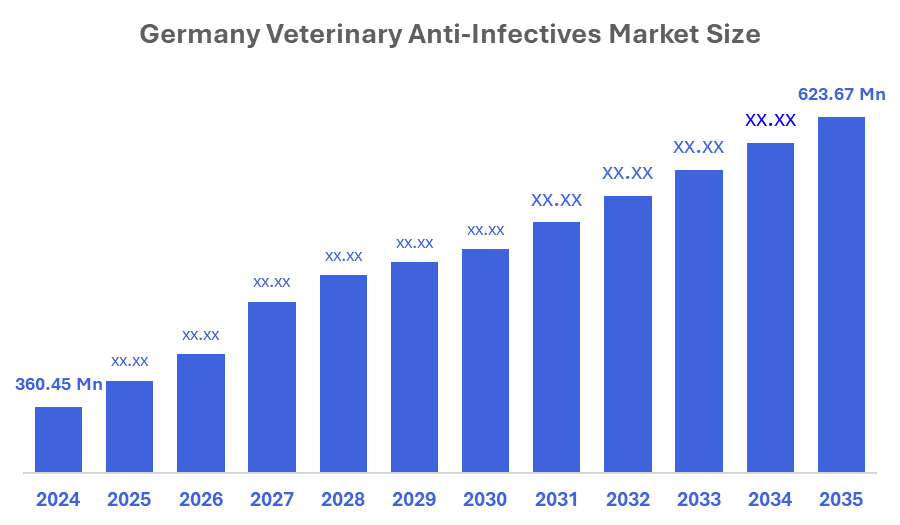
According to a research report published by Decision Advisors & Consulting, the Germany Veterinary Anti-Infectives market?is anticipated to reach USD 623.67 million by 2035, growing at a CAGR of 5.11% from 2025 to 2035. The Germany veterinary anti-infectives market growth is mainly driven by the growing concern about antibiotic resistance and the need for alternative treatments are driving pharmaceutical companies to focus on innovation and the development of new drugs.
Market Overview
Anti-infections drug agents are the main instruments that a veterinarian is using in the prevention, control, and treatment of infections in animals caused by bacteria, viruses, fungi, and parasites. These medicines are the most important in the management of animal health, increasing the productivity of the stock, and also ensuring world food security by reducing the spread of infectious diseases. They consist of the groups of antibiotics, antivirals, antifungals, and antiparasitics, which, upon application, directly attack the targeted pathagone
On the veterinary front, the use of anti-infectives remains a must for both companion animals, e.g., dogs, cats, horses, and food-producing animals, e.g., cattle, poultry, swine, and aquaculture species. Besides their direct protective role for animal welfare, these medications, in fact, constitute a barrier to the expansion of zoonoses, thus, next to animal welfare, human health benefits as well. Furthermore, as infections in the farm sector get under control, animal products such as meat, milk, and eggs become more abundant, which in turn accelerates the agricultural economy and facilitates the food supply chain.
Delivery of veterinary anti-infectious agents may be oral, injectable, topical, or through medicated feed and water, depending on the infection type and animal species. In addition to veterinary professionals' current efforts for prudent prescribing and preventive health care, the use of anti-infectives will be further reduced by alternatives such as vaccines and probiotics.
Germany's government initiatives in the veterinary anti-infectives market are mainly influenced by the German Antimicrobial Resistance Strategy (DART 2030) and the new EU Veterinary Medicines Regulation, which require a "One Health" approach to decrease antibiotic resistance
Report Coverage
This research report categorizes the Germany veterinary anti-infective market based on various segments and regions, and forecasts revenue growth and analyses trends in each submarket. The report analyses the key growth drivers, opportunities, and challenges influencing the Germany veterinary anti-infectives market. Recent market developments and competitive strategies, such as expansion, type launch, development, partnership, merger, and acquisition, have been included to draw the competitive landscape in the market. The report strategically identifies and profiles the key market players and analyses their core competencies in each sub-segment of the Germany veterinary anti-infectives market.
Driving Factor
The market for veterinary anti-infectives is influenced by factors such as the rise in animal infectious diseases, the growth in the number of pets, and the increase in livestock production. Growing awareness of zoonotic threats, regulations favoring the use of antimicrobials, and the promotion of AI integration in diagnostics are some of the factors contributing to the market. The use of R&D and precise therapy to raise effectiveness is supported by the rest of the world, while global trade and food security issues are driving the demand for advanced anti infective solution
Restraining Factor
The veterinary anti-infectives market is restricted by the presence of obstacles like the emergence of antibiotic resistance, tightly regulated frameworks, and increasing worries about the low level of awareness in remote areas. Moreover, the challenges such as high research and development costs, long approval times, and increasing inclination towards alternatite treatments are causing a slowdown in the market growth and the veterinary anti-infectious products adoption rate.
Market Segmentation
The Germany veterinary anti-infectives market share is classified into animal, product, and route of administration.
- The livestock animals segment held the largest market share in 2024 and is expected to grow at a significant CAGR during the forecast period.
The Germany veterinary anti-infectives market is segmented by animal into livestock animals and companion animals. Among these, the livestock animals segment held the largest market share in 2024 and is expected to grow at a significant CAGR during the forecast period. This is due to the burden of high disease among livestock such as cattle, boar, hen, and sheep, and anti-infectious diseases require frequent preventive and medical use. Animal protein, especially the increasing demand for beef, pork, and poultry, confirms the need for strong disease management.
- The antimicrobials segment dominated the market in 2024 and is anticipated to grow at a remarkable CAGR during the forecast period.
The Germany veterinary anti-infectives market has been divided on the basis of product into antimicrobials and antifungals. Among these, the antimicrobials segment dominated the market in 2024 and is anticipated to grow at a remarkable CAGR during the forecast period. The prime factor behind this is the widespread occurrence of bacterial infections in farm animals and pets. Diseases of the respiration and digestive systems, which are caused by bacteria, are made easy to treat with the most popular classes like tetracyclines and penicillins that continue to be the most importance
- The oral segment dominated the market in 2024 and is expected to grow at a significant CAGR during the forecast period.
The German veterinary anti-infectives market has been segmented based on the route of administration into oral, injectable, and topical segments. Among these, the oral segment oral segment dominated the market in 2024 and is expected to grow at a significant CAGR during the forecast period. It results from the simple administration of the dose in companion animals and food-producing livestock. Moreover, to limit the use of medicated feed additives, animal compliance, and treatment costs without veterinary supervision have been arised
Competitive Analysis
The report offers the appropriate analysis of the key organizations/companies involved within the Germany veterinary anti-infectives market, along with a comparative evaluation primarily based on their type of offering, business overviews, geographic presence, enterprise strategies, segment market share, and SWOT analysis. The report also provides an elaborative analysis focusing on the current news and developments of the companies, which includes type development, innovations, joint ventures, partnerships, mergers & acquisitions, strategic alliances, and others. This allows for the evaluation of the overall competition within the market.
List of Key Companies
- Boehringer Ingelheim
- Zoetis
- Elanco
- Ceva Santé Animale
- Merck
- Other
Key Target Audience
- Market Players
- Investors
- End-users
- Government Authorities
- Consulting and Research Firm
- Venture capitalists
- Value-Added Resellers (VARs)
Market Segment
This study forecasts revenue at the Germany, regional, and country levels from 2020 to 2035. Decision Advisors has segmented the Germany veterinary anti-infectives market based on the below-mentioned segments:
Germany Veterinary Anti-Infectives Market, By Animal
- Livestock Animal
- Companion Animal
Germany Veterinary Anti-Infectives Market, By Product
- Antimicrobials
- Antifungals
Germany Veterinary Anti-Infectives Market, By Route of Administration
- Oral
- Injectable
- Topical
FAQ’s
Q: What are veterinary anti-infectives?
A: Veterinary anti-infectives are drugs used to prevent, control, and treat infections in animals caused by bacteria, viruses, fungi, or parasites. They include antibiotics, antivirals, antifungals, and antiparasitics.
Q: What are the key drivers of Germany veterinary anti-infectives market growth?
A: Drivers include rising animal infectious diseases, increasing pet adoption, livestock production expansion, awareness of zoonotic hazards, and investments in R&D and advanced therapies.
Q: What factors restrain market growth?
A: Market restraints include antibiotic resistance, strict regulations, high R&D costs, slow approval processes, and growing interest in alternative therapies.
Q: Which animal segment dominates the Germany veterinary anti-infectives market?
A: Livestock animals (cattle, poultry, swine, etc.) held the largest market share in 2024 due to higher disease prevalence and frequent preventive treatment needs.
Q: Which product segment leads the Germany veterinary anti-infectives market?
A: Antimicrobials dominate the market because bacterial infections are common in both livestock and companion animals.
Q: Which route of administration is most commonly used?
A: Oral administration dominates due to ease of use, lower treatment costs, and compliance, especially in livestock and companion animals.
Q: What are the main routes of administration for veterinary anti-infectives?
A: The main routes include oral, injectable, and topical.
Q: What is the report’s base year and historical data range?
A: The base year is 2024, with historical data analysed from 2020–2023.
Check Licence
Choose the plan that fits you best: Single User, Multi-User, or Enterprise solutions tailored for your needs.
We Have You Covered
- 24/7 Analyst Support
- Clients Across the Globe
- Tailored Insights
- Technology Tracking
- Competitive Intelligence
- Custom Research
- Syndicated Market Studies
- Market Overview
- Market Segmentation
- Growth Drivers
- Market Opportunities
- Regulatory Insights
- Innovation & Sustainability
Report Details
| Scope | country |
| Pages | 167 |
| Delivery | PDF & Excel via Email |
| Language | English |
| Release | Dec 2025 |
| Access | Download from this page |