
Global Glioblastoma Multiforme Treatment Market
 |
Pages:
245
|
Pages:
245
Global Glioblastoma Multiforme Treatment Market Size, Share, and COVID-19 Impact Analysis, By Treatment (Surgery, Radiation Therapy, Chemotherapy, Targeted Therapy, Tumor Treating Field Therapy), By End-use (Hospitals, Clinics / Outpatient Centers, Ambulatory Surgical Centers, and Others), and By Region (North America, Europe, Asia-Pacific, Latin America, Middle East, and Africa), Analysis and Forecast 2025 - 2035
REPORT COVERAGE
Global
Global Glioblastoma Multiforme Treatment Market Size Insights Forecasts to 2035
- The Global Glioblastoma Multiforme Treatment Market Size Was Estimated at USD 3.66 Billion in 2024
- The Market Size is Expected to Grow at a CAGR of around 9.25% from 2025 to 2035
- The Worldwide Glioblastoma Multiforme Treatment Market Size is Expected to Reach USD 9.69 Billion by 2035
- North America is expected to Grow the fastest during the forecast period.
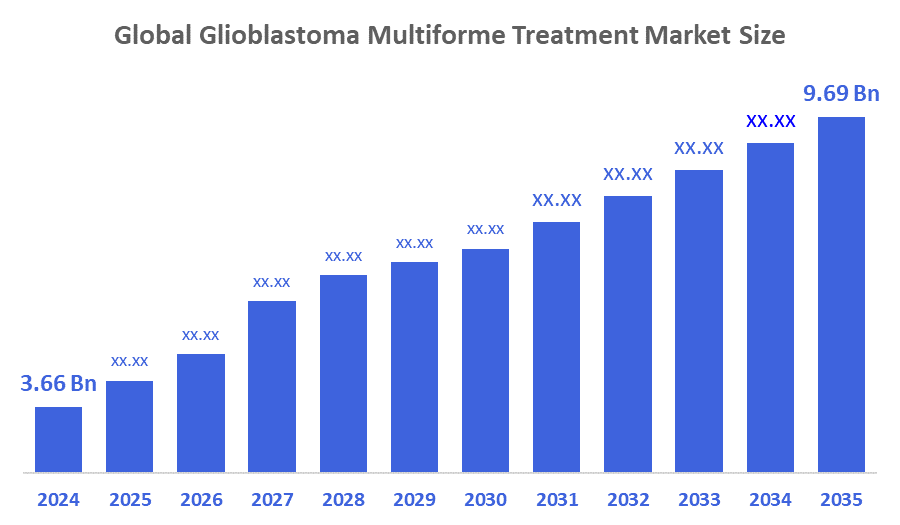
According to a Research Report Published by Decisions Advisors and Consulting, The Global Glioblastoma Multiforme Treatment Market Size was worth around USD 3.66 Billion in 2024 and is predicted to Grow to around USD 9.69 Billion by 2035 with a compound annual growth rate (CAGR) of 9.25% from 2025 to 2035. The rising incidence of Glioblastoma Multiforme (GBM) and its heavy clinical burden are the main factors that fuel the GBM treatment market. This growth has been influenced by better diagnostic capabilities and a real increase in the number of cases. The trend of GBM reaching older populations is especially worrying, as the risk of developing the disease increases with age.
Market Overview
The glioblastoma multiforme (GBM) treatment market represents the worldwide industry dealing with therapies, technologies, and services aimed at diagnosing, managing, and treating glioblastoma multiforme, a very aggressive malignant brain tumour. Glioma is the umbrella term for primary brain tumours and is also classified based on the presumed cell of origin. Glioblastoma Multiforme is the most common type of primary tumour of the central nervous system (CNS), mostly in adults, and its poor prognosis has not been improved significantly despite the development of innovative diagnostic strategies and new therapies. Cancer progression, somatic evolution, is the process by which the cancer cell genome deviates from that of the healthy cell due to the accumulation of mutations. There has been significant progress in Glioblastoma Multiforme because it involves a complex network of different molecular and genetic aberrations, which ultimately leads to drastic changes in the main signalling pathways. Glioblastoma Multiformes, as they widely infiltrate the parenchyma, thus making maximal surgical resection impossible and having a high level of vascularisation, are fatal.
Approximately 52% of primary malignant brain tumours are glioblastoma multiforme (GBM), with an estimated annual incidence of 2-3 occurrences per 100,000 persons worldwide. GBM is the most severe primary brain cancer, classified by the World Health Organisation (WHO) as a grade 4 diffuse astrocytic glioma. In 2022, there will be over 322,000 new instances of brain and CNS tumours worldwide, with GBM accounting for a sizable fraction of these cases.
In June 2025, Diakonos Oncology raised $20 million to accelerate its Phase II clinical trial of dubodencel (DOC1021), a dendritic cell-based immunotherapy for glioblastoma, one of the most aggressive brain cancers. The financing will also support the expansion of its dendritic cell platform into other cancer indications.
Report Coverage
This research report categorises the glioblastoma multiforme treatment market based on various segments and regions, forecasts revenue growth, and analyses trends in each submarket. The report analyses the key growth drivers, opportunities, and challenges influencing the glioblastoma multiforme treatment market. Recent market developments and competitive strategies, such as expansion, product launch, development, partnership, merger, and acquisition, have been included to draw the competitive landscape in the market. The report strategically identifies and profiles the key market players and analyses their core competencies in each sub-segment of the glioblastoma multiforme treatment market.
Driving Factors
The escalating prevalence of aggressive brain tumours is a major factor behind the expansion of the glioblastoma multiforme (GBM) treatment market. The high unmet medical need and poor prognosis associated with GBM contribute to this scenario, which requires ongoing therapeutic innovation. The breakthrough in targeted therapies, immunotherapy, tumour treating fields (TTF), and personalised medicine is not only revolutionising the treatment modalities but also stimulating the market growth. The infusion of funds into oncology research, clinical trials, and drug development, coupled with the regulatory support for orphan drugs, is ushering in a new era of rapid therapy introductions. Awareness campaigns, better diagnostic tools, and the growth of healthcare sectors, especially in the developed regions, are also playing their part in the market expansion by allowing early diagnosis and the wider utilisation of advanced GBM therapy.
In November 2021, the world’s first approved oncolytic virus drug for malignant brain tumours (glioblastoma, GBM) is Delytact (teserpaturev), developed by Daiichi Sankyo and launched in Japan in 2021. It is a genetically engineered herpes simplex virus (HSV-1) designed to selectively infect and kill glioblastoma cells while stimulating anti-tumour immunity.
Restraining Factors
Significant financial obstacles arise due to high treatment costs associated with advanced GBM therapies, such as immunotherapy, targeted treatments, and TTFields, for supportive care. Moreover, the limited efficacy of treatments and the development of resistance continue to pose problems for the GBM market. The tumour's aggressive adaptation, blood-brain barrier, and recurrence contribute to very low survival rates despite the availability of treatments such as surgery, chemo, and radiation.
Market Segmentation
The glioblastoma multiforme treatment market share is classified into treatment and end use.
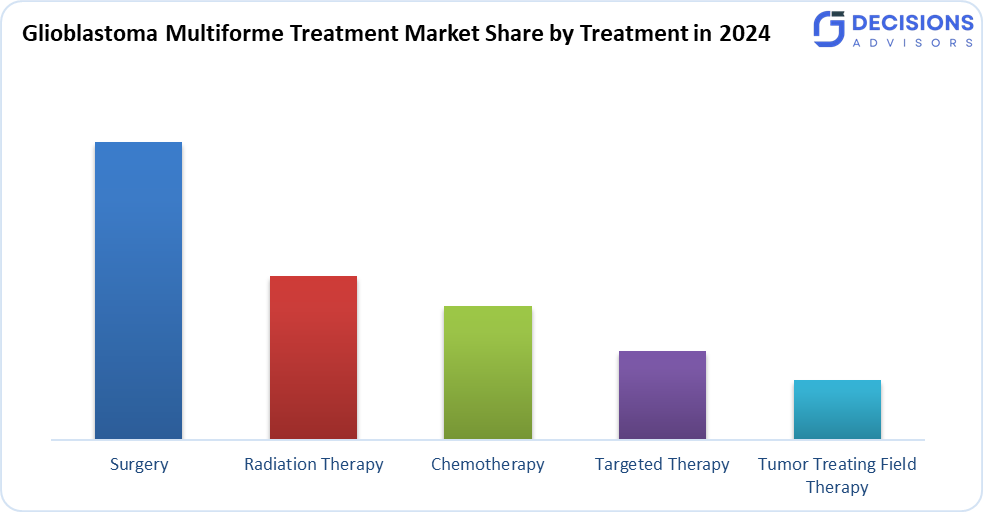
- The surgery segment accounted for the largest share in 2024 and is anticipated to grow at a significant CAGR during the forecast period.
Based on the treatment, the glioblastoma multiforme treatment market is segmented into surgery, radiation therapy, chemotherapy, targeted therapy, and tumour treating field therapy. Among these, the surgery segment accounted for the largest share in 2024 and is anticipated to grow at a significant CAGR during the forecast period. This is because of its vital function in lowering the burden of tumours and enhancing survival rates. For eligible patients, surgical resection continues to be the first-line treatment, providing instant relief from intracranial pressure and mass effect symptoms. The accuracy and safety of tumour removal have greatly improved thanks to developments in image-guided and minimally invasive neurosurgery procedures.
- The hospitals segment accounted for the highest market revenue in 2024 and is anticipated to grow at a significant CAGR during the forecast period.
Based on the end use, the glioblastoma multiforme treatment market is divided into hospitals, clinics/outpatient centres, ambulatory surgical centres, and others. Among these, the hospitals segment accounted for the highest market revenue in 2024 and is anticipated to grow at a significant CAGR during the forecast period. This is because of the availability of interdisciplinary neuro-oncology care and sophisticated surgical facilities. For glioblastoma patients, hospitals are the main treatment facilities because they provide access to neurosurgery, radiation, chemotherapy, and supportive care all under one roof. Comprehensive illness management is ensured by the presence of highly qualified neurosurgeons, oncologists, and specialised nursing staff.
Regional Segment Analysis of the Glioblastoma Multiforme Treatment Market
- North America (U.S., Canada, Mexico)
- Europe (Germany, France, U.K., Italy, Spain, Rest of Europe)
- Asia-Pacific (China, Japan, India, Rest of APAC)
- South America (Brazil and the Rest of South America)
- The Middle East and Africa (UAE, South Africa, Rest of MEA)
Asia Pacific is anticipated to hold the largest share of the glioblastoma multiforme treatment market over the predicted timeframe.
Asia Pacific is anticipated to hold the largest share of the glioblastoma multiforme treatment market over the predicted timeframe. Glioblastoma multiforme is growing increasingly prevalent in the Asia-Pacific region as a result of improved diagnosis and an ageing population. The demand for effective treatments is being impacted by this expansion. Through awareness efforts, governments and nonprofits are educating the public about brain diseases like glioblastoma. Patient outcomes have been enhanced by early diagnosis and therapy. Moreover, to bring state-of-the-art GBM treatments to the region, Asian countries are collaborating more closely with global pharmaceutical companies. These collaborations often include local treatment production, technological transfer, and clinical studies.
North America is expected to grow at a rapid CAGR in the glioblastoma multiforme treatment market during the forecast period. The government's increasing funding and initiatives to improve human health and aid in the prevention and eradication of cancer are to blame for this. In May 2022, the U.S. The Health Resources and Services Administration announced that community health centres would be able to raise $5 million to ensure fair access to potentially life-saving cancer screenings. This funding is part of the Administration's Cancer Moonshot commitment to eradicate cancer and supports action on early cancer diagnosis and screening.
The FDA has granted Orphan Drug Designation (ODD) to an exosome-based therapy for glioblastoma multiforme (GBM), recognising its potential to address one of the most aggressive and deadly brain cancers. This designation provides regulatory and financial incentives to accelerate development.
Competitive Analysis:
The report offers the appropriate analysis of the key organisations/companies involved within the glioblastoma multiforme treatment market, along with a comparative evaluation primarily based on their product offering, business overviews, geographic presence, enterprise strategies, segment market share, and SWOT analysis. The report also provides an elaborate analysis focusing on the current news and developments of the companies, which includes product development, innovations, joint ventures, partnerships, mergers & acquisitions, strategic alliances, and others. This allows for the evaluation of the overall competition within the market.
List of Key Companies
- Aivita Biomedical
- Bayer
- Daiichi Sankyo
- Denovo Biopharma
- Eli Lilly and Company
- Laminar Pharmaceuticals
- Merck
- Northwest Therapeutics
- Novartis
- Novocure
- Orbus Therapeutics
- Roche (Genentech)
- TVAX Biomedical
- Vigeo Therapeutics
- Others
Key Target Audience
- Market Players
- Investors
- End-users
- Government Authorities
- Consulting and Research Firm
- Venture capitalists
- Value-Added Resellers (VARs)
Recent Development
- In November 2024, Kazia Therapeutics granted a Type C meeting with the FDA to discuss regulatory pathways for its investigational drug Paxalisib in newly diagnosed glioblastoma multiforme (GBM). This meeting is a key step toward determining whether Paxalisib could move forward under accelerated or traditional approval pathways.
- In June 2023, Chimeric Therapeutics announced the launch of a Phase 1B clinical trial for its CHM 1101 (CLTX CAR T cell therapy) in patients with recurrent or progressive glioblastoma multiforme (GBM). The trial is now open for enrollment at the Sarah Cannon Research Institute in Austin, Texas.
Market Segment
This study forecasts revenue at global, regional, and country levels from 2020 to 2035. Decisions Advisors has segmented the glioblastoma multiforme treatment market based on the below-mentioned segments:
Global Glioblastoma Multiforme Treatment Market, By Treatment
- Surgery
- Radiation Therapy
- Chemotherapy
- Targeted Therapy
- Tumour Treating Field Therapy
Global Glioblastoma Multiforme Treatment Market, By End Use
- Hospitals
- Clinics / Outpatient Centres
- Ambulatory Surgical Centres
- Others
Global Glioblastoma Multiforme Treatment Market, By Regional Analysis
- North America
- US
- Canada
- Mexico
- Europe
- Germany
- UK
- France
- Italy
- Spain
- Russia
- Rest of Europe
- Asia Pacific
- China
- Japan
- India
- South Korea
- Australia
- Rest of Asia Pacific
- South America
- Brazil
- Argentina
- Rest of South America
- Middle East & Africa
- UAE
- Saudi Arabia
- Qatar
- South Africa
- Rest of the Middle East & Africa
Frequently Asked Questions (FAQ)
- What is the current size and growth forecast for the GBM treatment market?
The market was valued at USD 3.66 billion in 2024 and is projected to reach USD 9.69 billion by 2035, growing at a CAGR of 9.25% from 2025-2035.
- What are the main treatments for glioblastoma multiforme (GBM)?
Key treatments include surgery (the largest segment), radiation therapy, chemotherapy, targeted therapy, and tumour-treating field therapy.
- Which end-use segment leads the market?
Hospitals hold the highest revenue share in 2024 due to comprehensive neuro-oncology care, advanced facilities, and multidisciplinary teams.
- Which region dominates or grows fastest?
Asia-Pacific holds the largest market share, driven by rising cases, ageing populations, and collaborations; North America is expected to grow fastest with strong funding and initiatives.
- What drives growth in the GBM treatment market?
Rising GBM incidence (2-3 cases per 100,000 people annually), ageing populations, advances in targeted therapies/immunotherapy, and increased R&D funding fuel expansion.
- What challenges restrain the market?
High costs of advanced therapies, treatment resistance, the blood-brain barrier, tumour recurrence, and low survival rates limit progress.
- Who are the key companies in this market?
Major players include Novocure, Roche (Genentech), Merck, Novartis, Bayer, Eli Lilly, Daiichi Sankyo, and emerging firms like Diakonos Oncology and Kazia Therapeutics.
- Introduction
- Objectives of the Study
- Market Definition
- Research Scope
- Research Methodology and Assumptions
- Executive Summary
- Premium Insights
- Porter’s Five Forces Analysis
- Value Chain Analysis
- Top Investment Pockets
- Market Attractiveness Analysis By Treatment
- Market Attractiveness Analysis By End Use
- Market Attractiveness Analysis By Region
- Industry Trends
- Market Dynamics
- Market Evaluation
- Drivers
- Increase in health consciousness
- Restraints
- Strict adherence to regulations required for sugar substitute products
- Opportunities
- Increased investment in R&D activities by manufacturers
- Challenges
- Product labeling and claims issues
- Global Glioblastoma Multiforme Treatment Market Analysis and Projection, By Treatment
- Segment Overview
- Surgery
- Radiation Therapy
- Chemotherapy
- Targeted Therapy
- Tumour Treating Field Therapy
- Global Glioblastoma Multiforme Treatment Market Analysis and Projection, By End Use
- Segment Overview
- Hospitals
- Clinics / Outpatient Centres
- Ambulatory Surgical Centres
- Others
- Global Glioblastoma Multiforme Treatment Market Analysis and Projection, By Regional Analysis
- Segment Overview
- North America
- U.S.
- Canada
- Mexico
- Europe
- Germany
- France
- U.K.
- Italy
- Spain
- Asia-Pacific
- Japan
- China
- India
- South America
- Brazil
- Middle East and Africa
- UAE
- South Africa
- Global Glioblastoma Multiforme Treatment Market-Competitive Landscape
- Overview
- Market Share of Key Players in the Glioblastoma Multiforme Treatment Market
- Global Company Market Share
- North America Company Market Share
- Europe Company Market Share
- APAC Company Market Share
- Competitive Situations and Trends
- Coverage Launches and Developments
- Partnerships, Collaborations, and Agreements
- Mergers & Acquisitions
- Expansions
- Company Profiles
- Aivita Biomedical
- Business Overview
- Company Snapshot
- Company Market Share Analysis
- Company Coverage Portfolio
- Recent Developments
- SWOT Analysis
- Bayer
- Business Overview
- Company Snapshot
- Company Market Share Analysis
- Company Coverage Portfolio
- Recent Developments
- SWOT Analysis
- Daiichi Sankyo
- Business Overview
- Company Snapshot
- Company Market Share Analysis
- Company Coverage Portfolio
- Recent Developments
- SWOT Analysis
- Denovo Biopharma
- Business Overview
- Company Snapshot
- Company Market Share Analysis
- Company Coverage Portfolio
- Recent Developments
- SWOT Analysis
- Eli Lilly and Company
- Business Overview
- Company Snapshot
- Company Market Share Analysis
- Company Coverage Portfolio
- Recent Developments
- SWOT Analysis
- Laminar Pharmaceuticals
- Business Overview
- Company Snapshot
- Company Market Share Analysis
- Company Coverage Portfolio
- Recent Developments
- SWOT Analysis
- Merck
- Business Overview
- Company Snapshot
- Company Market Share Analysis
- Company Coverage Portfolio
- Recent Developments
- SWOT Analysis
- Northwest Therapeutics
- Business Overview
- Company Snapshot
- Company Market Share Analysis
- Company Coverage Portfolio
- Recent Developments
- SWOT Analysis
- Novartis
- Business Overview
- Company Snapshot
- Company Market Share Analysis
- Company Coverage Portfolio
- Recent Developments
- SWOT Analysis
- Novocure
- Business Overview
- Company Snapshot
- Company Market Share Analysis
- Company Coverage Portfolio
- Recent Developments
- SWOT Analysis
- Orbus Therapeutics
- Business Overview
- Company Snapshot
- Company Market Share Analysis
- Company Coverage Portfolio
- Recent Developments
- SWOT Analysis
- Roche (Genentech)
- Business Overview
- Company Snapshot
- Company Market Share Analysis
- Company Coverage Portfolio
- Recent Developments
- SWOT Analysis
- TVAX Biomedical
- Business Overview
- Company Snapshot
- Company Market Share Analysis
- Company Coverage Portfolio
- Recent Developments
- SWOT Analysis
- Vigeo Therapeutics
- Business Overview
- Company Snapshot
- Company Market Share Analysis
- Company Coverage Portfolio
- Recent Developments
- SWOT Analysis
- Others
- Business Overview
- Company Snapshot
- Company Market Share Analysis
- Company Coverage Portfolio
- Recent Developments
- SWOT Analysis
- Aivita Biomedical
List of Table
- Global Glioblastoma Multiforme Treatment Market, By Treatment, 2024-2035(USD Billion)
- Global Surgery, Glioblastoma Multiforme Treatment Market, By Region, 2024-2035(USD Billion)
- Global Radiation Therapy, Glioblastoma Multiforme Treatment Market, By Region, 2024-2035(USD Billion)
- Global Chemotherapy, Glioblastoma Multiforme Treatment Market, By Region, 2024-2035(USD Billion)
- Global Targeted Therapy, Glioblastoma Multiforme Treatment Market, By Region, 2024-2035(USD Billion)
- Global Tumour Treating Field Therapy, Glioblastoma Multiforme Treatment Market, By Region, 2024-2035(USD Billion)
- Global Glioblastoma Multiforme Treatment Market, By End Use, 2024-2035(USD Billion)
- Global Hospitals, Glioblastoma Multiforme Treatment Market, By Region, 2024-2035(USD Billion)
- Global Clinics / Outpatient Centres, Glioblastoma Multiforme Treatment Market, By Region, 2024-2035(USD Billion)
- Global Ambulatory Surgical Centres, Glioblastoma Multiforme Treatment Market, By Region, 2024-2035(USD Billion)
- Global Others, Glioblastoma Multiforme Treatment Market, By Region, 2024-2035(USD Billion)
- North America Glioblastoma Multiforme Treatment Market, By Treatment, 2024-2035(USD Billion)
- North America Glioblastoma Multiforme Treatment Market, By End Use, 2024-2035(USD Billion)
- U.S. Glioblastoma Multiforme Treatment Market, By Treatment, 2024-2035(USD Billion)
- U.S. Glioblastoma Multiforme Treatment Market, By End Use, 2024-2035(USD Billion)
- Canada Glioblastoma Multiforme Treatment Market, By Treatment, 2024-2035(USD Billion)
- Canada Glioblastoma Multiforme Treatment Market, By End Use, 2024-2035(USD Billion)
- Mexico Glioblastoma Multiforme Treatment Market, By Treatment, 2024-2035(USD Billion)
- Mexico Glioblastoma Multiforme Treatment Market, By End Use, 2024-2035(USD Billion)
- Europe Glioblastoma Multiforme Treatment Market, By Treatment, 2024-2035(USD Billion)
- Europe Glioblastoma Multiforme Treatment Market, By End Use, 2024-2035(USD Billion)
- Germany Glioblastoma Multiforme Treatment Market, By Treatment, 2024-2035(USD Billion)
- Germany Glioblastoma Multiforme Treatment Market, By End Use, 2024-2035(USD Billion)
- France Glioblastoma Multiforme Treatment Market, By Treatment, 2024-2035(USD Billion)
- France Glioblastoma Multiforme Treatment Market, By End Use, 2024-2035(USD Billion)
- U.K. Glioblastoma Multiforme Treatment Market, By Treatment, 2024-2035(USD Billion)
- U.K. Glioblastoma Multiforme Treatment Market, By End Use, 2024-2035(USD Billion)
- Italy Glioblastoma Multiforme Treatment Market, By Treatment, 2024-2035(USD Billion)
- Italy Glioblastoma Multiforme Treatment Market, By End Use, 2024-2035(USD Billion)
- Spain Glioblastoma Multiforme Treatment Market, By Treatment, 2024-2035(USD Billion)
- Spain Glioblastoma Multiforme Treatment Market, By End Use, 2024-2035(USD Billion)
- Asia Pacific Glioblastoma Multiforme Treatment Market, By Treatment, 2024-2035(USD Billion)
- Asia Pacific Glioblastoma Multiforme Treatment Market, By End Use, 2024-2035(USD Billion)
- Japan Glioblastoma Multiforme Treatment Market, By Treatment, 2024-2035(USD Billion)
- Japan Glioblastoma Multiforme Treatment Market, By End Use, 2024-2035(USD Billion)
- China Glioblastoma Multiforme Treatment Market, By Treatment, 2024-2035(USD Billion)
- China Glioblastoma Multiforme Treatment Market, By End Use, 2024-2035(USD Billion)
- India Glioblastoma Multiforme Treatment Market, By Treatment, 2024-2035(USD Billion)
- India Glioblastoma Multiforme Treatment Market, By End Use, 2024-2035(USD Billion)
- South America Glioblastoma Multiforme Treatment Market, By Treatment, 2024-2035(USD Billion)
- South America Glioblastoma Multiforme Treatment Market, By End Use, 2024-2035(USD Billion)
- Brazil Glioblastoma Multiforme Treatment Market, By Treatment, 2024-2035(USD Billion)
- Brazil Glioblastoma Multiforme Treatment Market, By End Use, 2024-2035(USD Billion)
- The Middle East and Africa Glioblastoma Multiforme Treatment Market, By Treatment, 2024-2035(USD Billion)
- The Middle East and Africa Glioblastoma Multiforme Treatment Market, By End Use, 2024-2035(USD Billion)
- UAE Glioblastoma Multiforme Treatment Market, By Treatment, 2024-2035(USD Billion)
- UAE Glioblastoma Multiforme Treatment Market, By End Use, 2024-2035(USD Billion)
- South Africa Glioblastoma Multiforme Treatment Market, By Treatment, 2024-2035(USD Billion)
- South Africa Glioblastoma Multiforme Treatment Market, By End Use, 2024-2035(USD Billion)
List of Figures
- Global Glioblastoma Multiforme Treatment Market Segmentation
- Glioblastoma Multiforme Treatment Market: Research Methodology
- Market Size Estimation Methodology: Bottom-Up Approach
- Market Size Estimation Methodology: Top-down Approach
- Data Triangulation
- Porter’s Five Forces Analysis
- Value Chain Analysis
- Top investment pocket in the Glioblastoma Multiforme Treatment Market
- Top Winning Strategies, 2024-2035
- Top Winning Strategies, By Development, 2024-2035(%)
- Top Winning Strategies, By Company, 2024-2035
- Moderate Bargaining power of Buyers
- Moderate Bargaining power of Suppliers
- Moderate Bargaining power of New Entrants
- Low threat of Substitution
- High Competitive Rivalry
- Top Player Positioning, 2024
- Market Share Analysis, 2024
- Restraint and Drivers: Glioblastoma Multiforme Treatment Market
- Glioblastoma Multiforme Treatment Market Segmentation, By Treatment
- Glioblastoma Multiforme Treatment Market For Surgery, By Region, 2024-2035 ($ Billion)
- Glioblastoma Multiforme Treatment Market For Radiation Therapy, By Region, 2024-2035 ($ Billion)
- Glioblastoma Multiforme Treatment Market For Chemotherapy, By Region, 2024-2035 ($ Billion)
- Glioblastoma Multiforme Treatment Market For Targeted Therapy, By Region, 2024-2035 ($ Billion)
- Glioblastoma Multiforme Treatment Market For Tumour Treating Field Therapy, By Region, 2024-2035 ($ Billion)
- Glioblastoma Multiforme Treatment Market Segmentation, By End Use
- Glioblastoma Multiforme Treatment Market For Hospitals, By Region, 2024-2035 ($ Billion)
- Glioblastoma Multiforme Treatment Market For Clinics / Outpatient Centres, By Region, 2024-2035 ($ Billion)
- Glioblastoma Multiforme Treatment Market For Ambulatory Surgical Centres, By Region, 2024-2035 ($ Billion)
- Glioblastoma Multiforme Treatment Market For Others, By Region, 2024-2035 ($ Billion)
- Aivita Biomedical: Net Sales, 2024-2035 ($ Billion)
- Aivita Biomedical: Revenue Share, By Segment, 2024 (%)
- Aivita Biomedical: Revenue Share, By Region, 2024 (%)
- Bayer: Net Sales, 2024-2035 ($ Billion)
- Bayer: Revenue Share, By Segment, 2024 (%)
- Bayer: Revenue Share, By Region, 2024 (%)
- Daiichi Sankyo: Net Sales, 2024-2035 ($ Billion)
- Daiichi Sankyo: Revenue Share, By Segment, 2024 (%)
- Daiichi Sankyo: Revenue Share, By Region, 2024 (%)
- Denovo Biopharma: Net Sales, 2024-2035 ($ Billion)
- Denovo Biopharma: Revenue Share, By Segment, 2024 (%)
- Denovo Biopharma: Revenue Share, By Region, 2024 (%)
- Eli Lilly and Company: Net Sales, 2024-2035 ($ Billion)
- Eli Lilly and Company: Revenue Share, By Segment, 2024 (%)
- Eli Lilly and Company: Revenue Share, By Region, 2024 (%)
- Laminar Pharmaceuticals: Net Sales, 2024-2035 ($ Billion)
- Laminar Pharmaceuticals: Revenue Share, By Segment, 2024 (%)
- Laminar Pharmaceuticals: Revenue Share, By Region, 2024 (%)
- Merck: Net Sales, 2024-2035 ($ Billion)
- Merck: Revenue Share, By Segment, 2024 (%)
- Merck: Revenue Share, By Region, 2024 (%)
- Northwest Therapeutics: Net Sales, 2024-2035 ($ Billion)
- Northwest Therapeutics: Revenue Share, By Segment, 2024 (%)
- Northwest Therapeutics: Revenue Share, By Region, 2024 (%)
- Novartis.: Net Sales, 2024-2035 ($ Billion)
- Novartis.: Revenue Share, By Segment, 2024 (%)
- Novartis.: Revenue Share, By Region, 2024 (%)
- Novocure: Net Sales, 2024-2035 ($ Billion)
- Novocure: Revenue Share, By Segment, 2024 (%)
- Novocure: Revenue Share, By Region, 2024 (%)
- Orbus Therapeutics: Net Sales, 2024-2035 ($ Billion)
- Orbus Therapeutics: Revenue Share, By Segment, 2024 (%)
- Orbus Therapeutics: Revenue Share, By Region, 2024 (%)
- Roche (Genentech): Net Sales, 2024-2035 ($ Billion)
- Roche (Genentech): Revenue Share, By Segment, 2024 (%)
- Roche (Genentech): Revenue Share, By Region, 2024 (%)
- TVAX Biomedical: Net Sales, 2024-2035 ($ Billion)
- TVAX Biomedical: Revenue Share, By Segment, 2024 (%)
- TVAX Biomedical: Revenue Share, By Region, 2024 (%)
- Vigeo Therapeutics: Net Sales, 2024-2035 ($ Billion)
- Vigeo Therapeutics: Revenue Share, By Segment, 2024 (%)
- Vigeo Therapeutics: Revenue Share, By Region, 2024 (%)
- Others: Net Sales, 2024-2035 ($ Billion)
- Others: Revenue Share, By Segment, 2024 (%)
- Others: Revenue Share, By Region, 2024 (%)
Check Licence
Choose the plan that fits you best: Single User, Multi-User, or Enterprise solutions tailored for your needs.
We Have You Covered
- 24/7 Analyst Support
- Clients Across the Globe
- Tailored Insights
- Technology Tracking
- Competitive Intelligence
- Custom Research
- Syndicated Market Studies
- Market Overview
- Market Segmentation
- Growth Drivers
- Market Opportunities
- Regulatory Insights
- Innovation & Sustainability
Report Details
| Scope | Global |
| Pages | 245 |
| Delivery | PDF & Excel via Email |
| Language | English |
| Release | Jan 2026 |
| Access | Download from this page |