
Global Idiopathic Pulmonary Fibrosis Market
Global Idiopathic Pulmonary Fibrosis Market Size, Share, and COVID-19 Impact Analysis, By Drug Type (Nintedanib, Pirfenidone, and Others), By Mode of Action (Antifibrotic Agents, Tyrosine Kinase Inhibitors, and Others), By End-User (Hospitals and Clinics, Pharmacies, and Others), and By Region (North America, Europe, Asia-Pacific, Latin America, Middle East, and Africa), Analysis and Forecast 2025 - 2035

Report Overview
Table of Contents
Global Idiopathic Pulmonary Fibrosis Market Size Insights Forecasts to 2035
- The Global Idiopathic Pulmonary Fibrosis Market Size Was Estimated at USD 4.35 Billion in 2024
- The Market Size is Expected to Grow at a CAGR of around 6.43% from 2025 to 2035
- The Worldwide Idiopathic Pulmonary Fibrosis Market Size is Expected to Reach USD 8.63 Billion by 2035
- North America is expected to Grow the fastest during the forecast period.
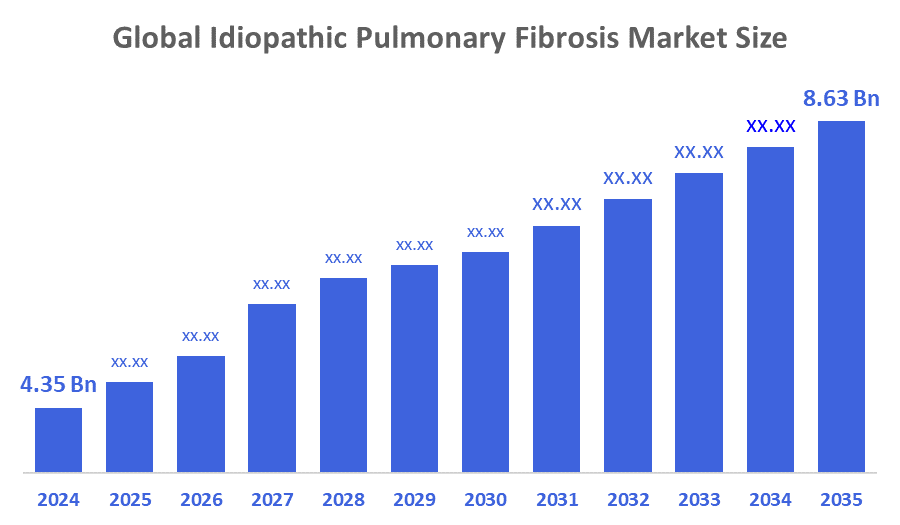
According to a Research Report Published by Decisions Advisors and Consulting, The Global Idiopathic Pulmonary Fibrosis Market Size was worth around USD 4.35 Billion in 2024 and is predicted to Grow to around USD 8.63 Billion by 2035 with a compound annual growth rate (CAGR) of 6.43% from 2025 to 2035. The growing incidence of idiopathic pulmonary fibrosis (IPF) globally, growing awareness of uncommon respiratory conditions, developments in antifibrotic treatments, and robust investment and regulatory support for the development of orphan drugs are the main factors driving the market for IPF treatments.
Market Overview
The subsegment business of the global healthcare industry that is devoted to the diagnosis, treatment, and management of idiopathic pulmonary fibrosis (IPF), a chronic, progressive lung illness marked by lung tissue scarring without a known cause, is commonly referred to as the IPF market. The market encompasses authorised antifibrotic medications, new treatments undergoing clinical trials, diagnostic equipment, and medical services supporting patient care and disease monitoring. The environmental risk factor with the strongest correlation is cigarette smoking, especially when it involves overpack years. Also, environmental exposures, including wood dust, metal dust, and vehicle emissions, have been associated with an increased risk of IPF. IPF has also been connected to jobs in agriculture and animal management. There is a substantial need for innovative therapeutics to treat IPF since conventional medications have poor safety profiles or limited efficacy.
Idiopathic pulmonary fibrosis (IPF) affects an estimated 1 billion persons globally, with regional differences influenced by demographics and diagnosis. Prevalence ranges from 3.3 to 29.8 per 100,000 per year, with higher rates in North America and growing rates in Asia-Pacific. Incidence ranges from 4.6 to 16.3 per 100,000 per year.
Research on pulmonary fibrosis (PF) will be severely and permanently encouraged by the current administration's severe cuts to National Institutes of Health (NIH) medical research grants. The NIH is the main source of funding for PF research, contributing more than $120 billion a year to promote innovative studies through grants given to small enterprises, colleges, and research centres.
Report Coverage
This research report categorises the idiopathic pulmonary fibrosis market based on various segments and regions, forecasts revenue growth, and analyses trends in each submarket. The report analyses the key growth drivers, opportunities, and challenges influencing the idiopathic pulmonary fibrosis market. Recent market developments and competitive strategies, such as expansion, product launch, development, partnership, merger, and acquisition, have been included to draw the competitive landscape in the market. The report strategically identifies and profiles the key market players and analyses their core competencies in each sub-segment of the idiopathic pulmonary fibrosis market.
Driving Factors
The market for treatments for idiopathic pulmonary fibrosis is expanding as a result of shifting lifestyle choices, including higher rates of smoking and exposure to environmental contaminants. Idiopathic pulmonary fibrosis (IPF) is becoming more prevalent as a consequence of riskier behaviours, including smoking tobacco and recreational drug use, in addition to industrial exposure to hazardous materials like asbestos and chemical products. The market is expanding as a result of the growing awareness of these lifestyle-related risk factors, which is raising demand for efficient IPF therapies. Further, the growing number of patients is looking for effective treatments as a result of earlier disease identification brought about by more knowledge and better diagnostic techniques, which open up new market opportunities. The market for treatments for idiopathic pulmonary fibrosis is expanding as a result of the disease's rising incidence and better diagnostic techniques. The market for treatments for idiopathic pulmonary fibrosis (IPF) is growing rapidly due to improvements in diagnostic techniques. High-resolution computed tomography (HRCT) and other improved imaging methods allow for the earlier and more precise detection of IPF, allowing for prompt intervention.
According to the United Nations Department of Economic and Social Affairs' World Population Ageing Report 2020, 727 million people worldwide were 65 years of age or older in 2020. It is anticipated that by 2050, there will be more than 1.5 billion. Consequently, it is anticipated that the burden of IPF would rise as the population ages, driving market expansion.
Restraining Factors
The market for treating idiopathic pulmonary fibrosis (IPF) is being hammered by high drug costs, a lack of therapeutic choices, delayed diagnosis, and unfavourable side effects of existing antifibrotic medicines, all of which hinder patient access and inhibit uptake.
Market Segmentation
The idiopathic pulmonary fibrosis market share is classified into drug type, mode of action, and application.
- The nintedanib segment accounted for the largest share in 2024 and is projected to grow at a substantial CAGR over the forecast period.
Based on the drug type, the idiopathic pulmonary fibrosis market is divided into nintedanib, pirfenidone, and others. Among these, the nintedanib segment accounted for the largest share in 2024 and is projected to grow at a substantial CAGR over the forecast period. The medication is widely used to treat the illness all over the world. Additionally, until the transplantation process is completed, nintedanib helps stabilise lung function. After lung transplantation, this medication has not been shown to increase surgical complications or post-operative mortality. According to the Pulmonary Fibrosis Foundation 2020, nintedanib is presently approved for the treatment of idiopathic pulmonary fibrosis in more than 70 countries.
- The antifibrotic agents segment accounted for a significant share in 2024 and is anticipated to grow at a rapid pace over the forecast period.
Based on the mode of action, the idiopathic pulmonary fibrosis market is segmented into antifibrotic agents, tyrosine kinase inhibitors, and others. Among these, the antifibrotic agents segment accounted for a significant share in 2024 and is anticipated to grow at a rapid pace over the forecast period. These medications reduce the risk of acute respiratory deterioration linked to high morbidity and death and decrease the degradation of lung function. According to the study, the antifibrotic drugs are used in the treatment of progressive pulmonary fibrosis in both idiopathic pulmonary fibrosis. The antifibrotic therapy protects against the rate of decline in FVC (Forced Vital Capacity) in progressive lung fibrosis, and the antifibrotic agent is currently in clinical use.
- The hospitals and clinics segment dominated the market in 2024 and is anticipated to grow at a significant CAGR during the forecast period.
Based on the end user, the idiopathic pulmonary fibrosis market is divided into hospitals and clinics, pharmacies, and others. Among these, the hospitals and clinics segment dominated the market in 2024 and is anticipated to grow at a significant CAGR during the forecast period. This segment's importance in the treatment of idiopathic pulmonary fibrosis is further reinforced by the emphasis on patient-centred care in hospitals. Multidisciplinary teams are being used by hospitals more frequently to handle complicated cases and guarantee that patients receive thorough care. Both therapy results and patient satisfaction are improved by this cooperative strategy. Furthermore, hospital pharmacists are better suited to handle and administer drugs for cutting-edge treatments, like antifibrotic drugs, which frequently require close observation and modification.
Regional Segment Analysis of the Idiopathic Pulmonary Fibrosis Market
- North America (U.S., Canada, Mexico)
- Europe (Germany, France, U.K., Italy, Spain, Rest of Europe)
- Asia-Pacific (China, Japan, India, Rest of APAC)
- South America (Brazil and the Rest of South America)
- The Middle East and Africa (UAE, South Africa, Rest of MEA)
Asia Pacific is anticipated to hold the largest share of the idiopathic pulmonary fibrosis market over the predicted timeframe.
Asia Pacific is projected to hold the largest share of the idiopathic pulmonary fibrosis market over the predicted timeframe. The main reason for the Asia Pacific region's leading position is its management of idiopathic pulmonary fibrosis, with well established at a rapid pace due to rising illness prevalence, better access to healthcare services, and an increasing focus on early detection. China, Japan, India, and South Korea, especially Japan, which is at the forefront of both advanced medication development and lung transplant programs, will also pose significant competition for Australia.
In April 2025, an extensive report on the state of clinical trials for Idiopathic Pulmonary Fibrosis (IPF) was published by Novotech, a well-known full-service clinical research organisation (CRO) and scientific advisory partner for biotech and small- to mid-sized pharmaceutical companies looking to advance drug development. The paper provides thorough analysis and strategic insights that are essential for biotech and pharmaceutical businesses navigating the challenges of IPF clinical research and drug development.
North America is expected to grow at a rapid CAGR in the idiopathic pulmonary fibrosis market during the forecast period. For idiopathic pulmonary fibrosis (IPF) management, North America accounts for a high-value opportunity due to the advancement in healthcare infrastructure, significant R&D programs, and numerous leading pharmaceutical and biotechnology companies in the region. The United States, in particular, has the highest awareness of the disease, the earliest rates of diagnosis, and universal access to advanced treatments like anti-fibrotic medications and lung transplant programs in the region and Canada is taking note as the government healthcare funding enables wider uptake of cutting-edge therapy. The presence of regulatory agencies such as the FDA and the rising investment in personalised medicine and biomarkers are expected to boost the regional market.
In March 2025, Insilico Medicine’s AI-designed drug Rentosertib (formerly ISM001-055) was officially granted its generic name by the United States Adopted Names (USAN) Council. Rentosertib is the first experimental medication where generative AI was used to identify both the therapeutic molecule and the biological target.
Competitive Analysis:
The report offers the appropriate analysis of the key organisations/companies involved within the idiopathic pulmonary fibrosis market, along with a comparative evaluation primarily based on their product offering, business overviews, geographic presence, enterprise strategies, segment market share, and SWOT analysis. The report also provides an elaborative analysis focusing on the current news and developments of the companies, which includes product development, innovations, joint ventures, partnerships, mergers & acquisitions, strategic alliances, and others. This allows for the evaluation of the overall competition within the market.
List of Key Companies
- Boehringer Ingelheim International GmbH
- United Therapeutics Corporation
- Cipla Inc.
- Bristol-Myers Squibb Company
- Hoffmann-La Roche Ltd
- FibroGen Inc.
- Galapagos NV
- Jubilant Pharma Limited (Jubliant Cadista Limited)
- MediciNova Inc.
- Merck & Co. Inc.
- Horizon Therapeutics Public Limited Company.
- Biogen
- Avalyn Pharma Inc.
- Promedior, Inc.
- Horizon Therapeutics
- CSL Behring
- Kadmon Corporation LLCs
- Others
Key Target Audience
- Market Players
- Investors
- End-users
- Government Authorities
- Consulting and Research Firm
- Venture capitalists
- Value-Added Resellers (VARs)
Recent Development
- In December 2025, GRI Bio announced that its Phase 2a trial of GRI-0621 in idiopathic pulmonary fibrosis (IPF) met key goals, showing the drug was well tolerated, improved lung function (FVC), and demonstrated biomarker changes suggesting fibrosis resolution and lung repair.
- In May 2025, Cumberland Pharmaceuticals partnered with Qureight, a Cambridge-based imaging and AI company, to enhance data analysis in its Phase II FIGHTING FIBROSIS clinical trial of ifetroban for idiopathic pulmonary fibrosis (IPF). The collaboration leverages Qureight’s deep-learning imaging platform to improve trial outcomes and accelerate innovative IPF treatment research.
Market Segment
This study forecasts revenue at global, regional, and country levels from 2020 to 2035. Decisions Advisors has segmented the idiopathic pulmonary fibrosis market based on the below-mentioned segments:
Global Idiopathic Pulmonary Fibrosis Market, By Drug Type
- Nintedanib
- Pirfenidone
- Other
Global Idiopathic Pulmonary Fibrosis Market, By Mode of Action
- Antifibrotic Agents
- Tyrosine Kinase Inhibitors
- Other
Global Idiopathic Pulmonary Fibrosis Market, By End User
- Hospitals and Clinics
- Pharmacies
- Other
Global Idiopathic Pulmonary Fibrosis Market, By Regional Analysis
- North America
- US
- Canada
- Mexico
- Europe
- Germany
- UK
- France
- Italy
- Spain
- Russia
- Rest of Europe
- Asia Pacific
- China
- Japan
- India
- South Korea
- Australia
- Rest of Asia Pacific
- South America
- Brazil
- Argentina
- Rest of South America
- Middle East & Africa
- UAE
- Saudi Arabia
- Qatar
- South Africa
- Rest of the Middle East & Africa
Frequently Asked Questions (FAQ)
- What is the CAGR of the idiopathic pulmonary fibrosis market over the forecast period?
The global idiopathic pulmonary fibrosis market is projected to expand at a CAGR of 6.43% during the forecast period.
- What is the market size of the idiopathic pulmonary fibrosis market?
The global idiopathic pulmonary fibrosis market size is expected to grow from USD 4.35 billion in 2024 to USD 8.63 billion by 2035, at a CAGR of 6.43 % during the forecast period 2025-2035.
- What is idiopathic pulmonary fibrosis (IPF)?
IPF is a chronic, progressive lung disease characterised by scarring (fibrosis) of lung tissue without a known cause. It leads to declining lung function and respiratory failure.
- What are the main factors driving the growth of the IPF market?
Key drivers include increasing incidence of IPF, growing awareness of rare respiratory diseases, advances in antifibrotic treatments, and regulatory support for orphan drug development.
- Which drug types dominate the IPF market?
Nintedanib holds the largest market share and is widely used globally for IPF treatment, followed by Pirfenidone and other drug types.
- What are the key modes of action for drugs in the IPF market?
The market includes antifibrotic agents, tyrosine kinase inhibitors, and others, with antifibrotic agents holding a significant share due to their effectiveness in slowing disease progression.
- Which end-user segment leads the market?
Hospitals and clinics dominate the market as they provide comprehensive, patient-centred care and have the infrastructure to administer advanced therapies.
- Which regions have the highest market share and growth potential?
Asia Pacific holds the largest market share due to rising disease prevalence and improved healthcare access. North America is expected to grow rapidly due to advanced healthcare infrastructure and R&D.
- Who are the leading companies in the global IPF market?
Key players include Boehringer Ingelheim, United Therapeutics, Cipla, Bristol-Myers Squibb, Hoffmann-La Roche, FibroGen, Galapagos NV, Jubilant Pharma, and others.
- How is technology impacting IPF drug development?
Innovations such as AI-designed drugs (e.g., Insilico Medicine’s Rentosertib) and AI-powered imaging platforms (e.g., Qureight collaboration) are enhancing clinical trial efficiency and drug discovery.
Check Licence
Choose the plan that fits you best: Single User, Multi-User, or Enterprise solutions tailored for your needs.
We Have You Covered
- 24/7 Analyst Support
- Clients Across the Globe
- Tailored Insights
- Technology Tracking
- Competitive Intelligence
- Custom Research
- Syndicated Market Studies
- Market Overview
- Market Segmentation
- Growth Drivers
- Market Opportunities
- Regulatory Insights
- Innovation & Sustainability
Report Details
| Scope | Global |
| Pages | 289 |
| Delivery | PDF & Excel via Email |
| Language | English |
| Release | Dec 2025 |
| Access | Download from this page |