
Global Glucagon-Like Peptide-1 (GLP-1) Agonists Market
 |
Author:
David J
|
Pages:
210
|
Author:
David J
|
Pages:
210
Global Glucagon-Like Peptide-1 (GLP-1) Agonists Market Size, Share By Drug Type (Semaglutide, Tirzepatide, Dulaglutide, Liraglutide, and Others), By Application (Type 2 Diabetes, Obesity & Weight Management, Cardiovascular Disease, and Other Metabolic Conditions), By Route of Administration (Injectable and Oral), and By Region (North America, Europe, Asia-Pacific, Latin America, Middle East & Africa), Analysis and Forecast 2026-2035
CAGR
13.3%
REVENUE 2025
USD Billion 64.52
FORECAST 2035
USD Billion 224.9
REPORT COVERAGE
Global
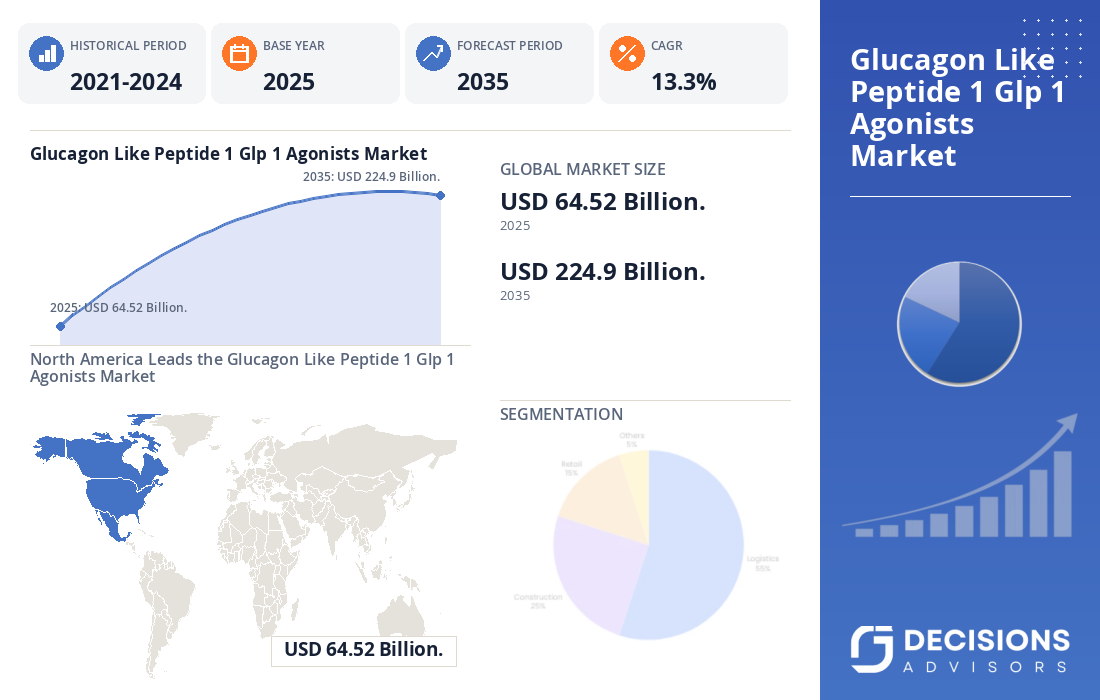
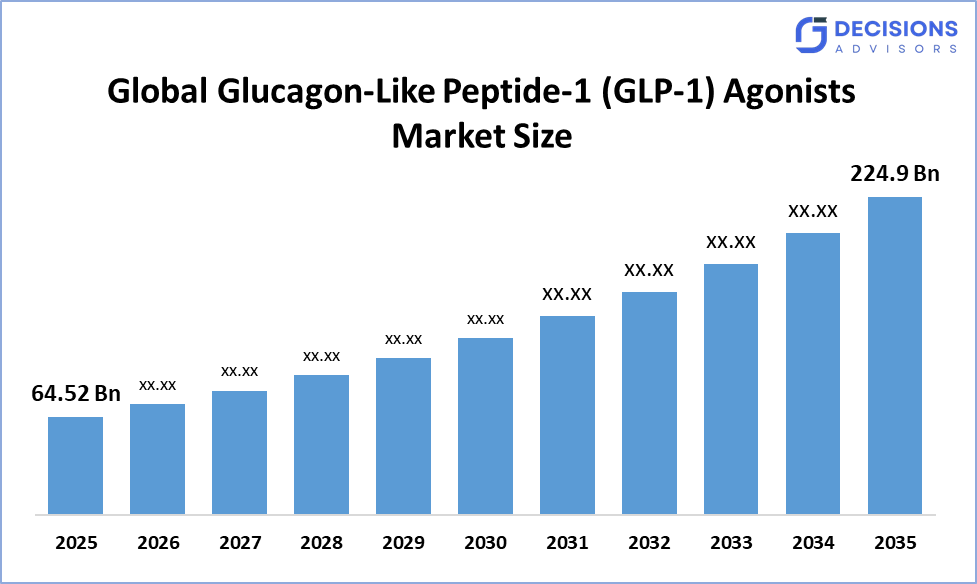
The Global Glucagon-Like Peptide-1 (GLP-1) Agonists Market Size is predicted to grow from USD 64.52 Billion in 2025 and is likely to reach around USD 224.9 Billion by 2035 with a CAGR of 13.3%. According to Decision Advisors, increasing demand for effective diabetes and obesity therapies, expanding clinical applications, and the development of oral and next-generation incretin therapies are major factors supporting market growth. Semaglutide remains one of the leading products, while tirzepatide is rapidly strengthening competition across diabetes and obesity treatment.
Market Snapshot
- Global Glucagon-Like Peptide-1 (GLP-1) Agonists Market Size (2025): USD 64.52 Billion.
- Projected Global Glucagon-Like Peptide-1 (GLP-1) Agonists Market Size (2035): USD 224.9 Billion.
- Global Glucagon-Like Peptide-1 (GLP-1) Agonists Market CAGR: 13.3%.
- Largest Regional Market: North America
- 2nd Largest Region: Europe
- Fastest Growing Region: Asia-Pacific
- Base Year: 2025
- Historical Period: 2021-2024
- Market Forecast Period: 2026-2035
Market Overview/ Introduction
The global glucagon-like peptide-1 (GLP-1) Agonists Market includes pharmaceutical therapies that activate GLP-1 receptors to regulate blood glucose, reduce appetite, delay gastric emptying, and support weight management. Originally established primarily for type 2 diabetes treatment, GLP-1-based therapies have expanded significantly into obesity and weight-management applications. Leading companies including Novo Nordisk, Eli Lilly, AstraZeneca, Amgen, Sanofi, Pfizer, and other pharmaceutical developers are investing in injectable, oral, and next-generation metabolic therapies. The market is benefiting from the growing prevalence of diabetes and obesity, increasing physician awareness, improved clinical evidence, and the development of more convenient drug-delivery options. Oral GLP-1 medicines are becoming an important area of competition, while multi-receptor therapies are being developed to deliver stronger weight-loss and metabolic outcomes. Novo Nordisk and Eli Lilly remain central to the competitive landscape through semaglutide and tirzepatide franchises.
- Japan, Increasing focus on diabetes and metabolic disease management, combined with an advanced healthcare infrastructure, supports adoption of innovative therapies.
- China, Rising chronic disease prevalence, healthcare modernization, and pharmaceutical innovation initiatives are creating opportunities for advanced metabolic treatments.
- India, Increasing diabetes and obesity prevalence and improving access to specialty pharmaceuticals are expected to support long-term GLP-1 adoption.
Notable Insights: -
- North America is anticipated to hold approximately 55% share of the Global Glucagon-Like Peptide-1 (GLP-1) Agonists Market over the predicted timeframe.
- Asia-Pacific is expected to grow at a rapid CAGR in the Global Glucagon-Like Peptide-1 (GLP-1) Agonists Market, reaching approximately 14% share during the forecast period.
- By Drug Type, the Semaglutide segment dominated the market and holds approximately 41% share in 2025 and is projected to grow at a substantial CAGR during the forecast period.
- By Application, the Type 2 Diabetes segment dominated the market and holds approximately 55% share in 2025 and is projected to grow at a substantial CAGR during the forecast period.
- The compound annual growth rate of the Global Glucagon-Like Peptide-1 (GLP-1) Agonists Market is 13.3%.
- The market is likely to achieve a valuation of USD 224.9 Billion by 2035.
Market Drivers
The increasing prevalence of type 2 diabetes and obesity is the primary growth driver for the GLP-1 agonists market. GLP-1 therapies offer simultaneous glucose-control and weight-management benefits, increasing their value in chronic metabolic disease treatment. Growing recognition of obesity as a chronic disease is encouraging the adoption of pharmacological interventions alongside lifestyle modification. The expansion of cardiovascular and broader cardiometabolic indications is further increasing the addressable patient population. Product innovation is another important factor, with pharmaceutical companies developing oral formulations, longer-acting medicines, and multi-receptor agonists. The growing availability of digital healthcare, telemedicine, specialty pharmacies, and patient-support programs is also improving access and treatment continuity.
Restrain
The market faces constraints related to high treatment costs, reimbursement limitations, manufacturing capacity, regulatory requirements, and long-term treatment adherence. GLP-1 therapies can involve significant recurring expenses, particularly for obesity treatment where insurance coverage differs substantially across markets. Rapid demand growth can also create manufacturing and supply-chain pressures. In addition, the emergence of compounded or unauthorized GLP-1 products creates quality, safety, and regulatory concerns. Pharmaceutical companies must also demonstrate long-term safety and efficacy as these therapies move into increasingly broad patient populations.
Competitive Analysis:
The report offers the appropriate analysis of the key organizations/companies involved within the global glucagon-like peptide-1 (GLP-1) agonists market, along with a comparative evaluation primarily based on their product offerings, business overviews, geographic presence, enterprise strategies, segment market share, and SWOT analysis. The report also provides an elaborative analysis focusing on the current news and developments of the companies, which includes product development, innovations, joint ventures, partnerships, mergers & acquisitions, strategic alliances, and others. This allows for the evaluation of the overall competition within the market.
Top Companies in the Global Glucagon-Like Peptide-1 (GLP-1) Agonists Market
- Novo Nordisk A/S
- Eli Lilly and Company
- AstraZeneca PLC
- Amgen Inc.
- Sanofi
- Boehringer Ingelheim
- Pfizer Inc.
- Roche Holding AG
- Merck & Co., Inc.
- Hanmi Pharmaceutical Co., Ltd.
Government Initiatives
|
Country |
Key Government Initiatives |
|
United States |
U.S. healthcare initiatives are increasingly focused on diabetes and obesity treatment affordability and access. Government and industry agreements have also targeted lower GLP-1 prices and expanded access through Medicare and Medicaid channels |
|
Japan |
Japan's healthcare system emphasizes chronic disease management, diabetes care, and prevention of metabolic complications, supporting the adoption of advanced diabetes therapies |
|
China |
China's healthcare modernization and pharmaceutical innovation policies support development, manufacturing, and adoption of innovative medicines for chronic diseases |
Market Segmentation
The Global Glucagon-Like Peptide-1 (GLP-1) Agonists Market share is classified into drug type, application, and route of administration.
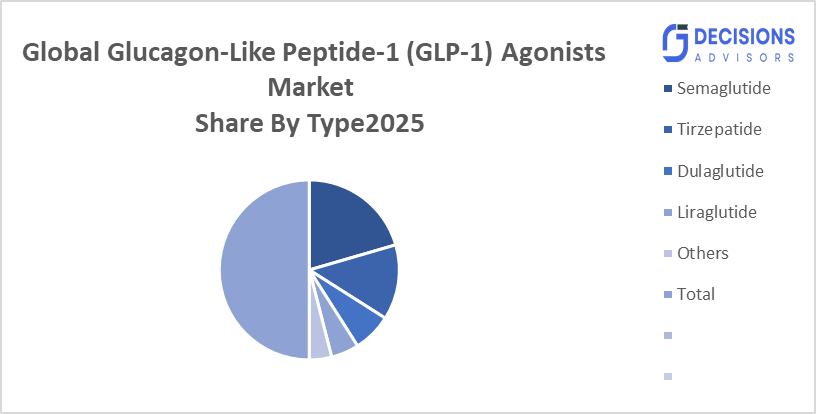
- The Semaglutide segment dominated the market and holds approximately 41% share in 2025 and is projected to grow at a substantial CAGR during the forecast period.
Based on Drug Type, the global glucagon-like peptide-1 (GLP-1) agonists market is divided into Semaglutide, Tirzepatide, Dulaglutide, Liraglutide, and Others. Among these, Semaglutide dominates the market because of its established presence across diabetes and obesity treatment. Ozempic and Wegovy have significantly increased awareness of GLP-1-based treatment, while Rybelsus provides an oral semaglutide option. Continued clinical development and broader therapeutic applications are expected to maintain strong demand.
- The Type 2 Diabetes segment accounted for the largest share of approximately 55% in 2025 and is anticipated to grow at a significant CAGR during the forecast period.
Based on Application, the market is divided into Type 2 Diabetes, Obesity & Weight Management, Cardiovascular Disease, and Other Metabolic Conditions. Type 2 diabetes remains the largest application because GLP-1 therapies have an established role in glycemic control. The large global diabetic population provides a substantial existing treatment base. Increasing clinical evidence around cardiovascular and metabolic benefits is also supporting continued physician adoption.
- The Injectable segment accounted for the largest share of approximately 72% in 2025 and is anticipated to grow at a significant CAGR during the forecast period.
Based on Route of Administration, the market is divided into Injectable and Oral. Injectable therapies continue to dominate because weekly injectable products have established clinical efficacy and strong physician familiarity. However, oral GLP-1 therapies are expected to record faster growth as patients increasingly seek convenient, needle-free treatment options. Novo Nordisk's oral Wegovy and Eli Lilly's oral orforglipron have accelerated competition within this emerging segment.
Regional Segment Analysis of the Global Glucagon-Like Peptide-1 (GLP-1) Agonists Market
- North America (U.S., Canada, Mexico)?
- Europe (Germany, U.K., France, Italy, Spain, Netherlands, Rest of Europe).
- Asia-Pacific (China, Japan, India, Australia, South Korea, Rest of Asia-Pacific).
- South America (Brazil, Argentina, Rest of South America).
- Middle East & Africa (UAE, Saudi Arabia, South Africa, Rest of MEA).
North America is anticipated to hold approximately 55% share of the Global Glucagon-Like Peptide-1 (GLP-1) Agonists Market over the predicted timeframe.
North America is anticipated to hold approximately 55% share of the Global Glucagon-Like Peptide-1 (GLP-1) Agonists Market over the predicted timeframe. The United States remains the principal contributor due to high diabetes and obesity prevalence, substantial healthcare expenditure, strong pharmaceutical R&D, and rapid adoption of innovative metabolic medicines. The presence of Novo Nordisk and Eli Lilly also strengthens the region's competitive position. Increasing obesity-treatment demand and initiatives focused on improving medicine affordability are expected to support continued growt.
Europe is expected to hold approximately 23% share of the Global GLP-1 Agonists Market during the forecast period.
Europe is expected to hold approximately 23% share of the Global GLP-1 Agonists Market during the forecast period. Germany, the United Kingdom, France, Italy, Spain, and Denmark are important markets because of their established healthcare infrastructure and pharmaceutical capabilities. Increasing obesity awareness, diabetes prevalence, and demand for advanced metabolic therapies will support market expansion. Healthcare reimbursement and cost-effectiveness assessments will remain important factors influencing adoption.
Asia-Pacific is expected to be the fastest-growing region, holding approximately 14% share during the forecast period.
Asia-Pacific is expected to be the fastest-growing region, holding approximately 14% share during the forecast period. China, Japan, India, South Korea, and Australia represent major growth markets. Increasing diabetes and obesity prevalence, improving diagnosis, expanding healthcare expenditure, and growing availability of innovative medicines are supporting demand. India is expected to offer particularly strong long-term opportunities because of its large diabetic population and expanding specialty-pharmaceutical market.
Future Market Trends in Global Glucagon-Like Peptide-1 (GLP-1) Agonists Market: -
-
- Expansion of Oral GLP-1 Therapies
Oral GLP-1 medicines are expected to become a major competitive segment because they eliminate the need for injections and can improve treatment convenience. Novo Nordisk launched its Wegovy pill in the U.S. in January 2026, while Eli Lilly launched Foundayo in April 2026. These launches are expected to accelerate competition in oral metabolic treatments.
-
- Development of Multi-Receptor Agonists
The market is moving toward therapies that target multiple metabolic pathways. Tirzepatide combines GIP and GLP-1 activity, while investigational compounds such as retatrutide target GIP, GLP-1, and glucagon receptors. These therapies could provide greater weight reduction and broader metabolic benefits.
-
- Longer-Acting Treatment Options
Pharmaceutical companies are increasingly developing therapies that can reduce dosing frequency. Amgen's MariTide is being investigated as a monthly or less-frequently administered therapy, illustrating the industry's focus on improving convenience and treatment adherence.
-
- Expansion into Cardiometabolic Indications
Future GLP-1 therapies are expected to address a wider range of metabolic and cardiovascular conditions. Research is increasingly evaluating GLP-1 and related incretin therapies for cardiovascular, kidney, liver, sleep-related, and other obesity-associated conditions.
Recent Development
- In January 2026, Novo Nordisk launched the Wegovy pill in the United States, providing an oral semaglutide option for weight management.
- In April 2026, Eli Lilly launched Foundayo (orforglipron), an oral GLP-1 medicine for weight management in the United States.
- In July 2026, Eli Lilly announced positive Phase 3 results for retatrutide, its investigational GIP/GLP-1/glucagon triple agonist, and stated plans for an FDA submission in Q1 2027.
Market Segment
This study forecasts revenue at global, regional, and country levels from 2021 to 2035. Decision Advisors has segmented the global glucagon-like peptide-1 (GLP-1) agonists market based on the below-mentioned segment:
Global Glucagon-Like Peptide-1 (GLP-1) Agonists Market, By Drug Type.
- Semaglutide
- Tirzepatide
- Dulaglutide
- Liraglutide
- Others.
Global Glucagon-Like Peptide-1 (GLP-1) Agonists Market, By Application.
- Type 2 Diabetes
- Obesity & Weight Management
- Cardiovascular Disease
- Other Metabolic Conditions.
Global Glucagon-Like Peptide-1 (GLP-1) Agonists Market, By Route of Administration.
- Injectable
- Oral.
Global Glucagon-Like Peptide-1 (GLP-1) Agonists Market, By Regional Analysis.
- North America
- US
- Canada
- Mexico
- Europe
- Germany
- UK
- France
- Italy
- Spain
- Russia
- Rest of Europe
- Asia Pacific
- China
- Japan
- India
- South Korea
- Australia
- Rest of Asia Pacific
- South America
- Brazil
- Argentina
- Rest of South America
- Middle East & Africa
- UAE
- Saudi Arabia
- Qatar
- South Africa
- Rest of the Middle East & Africa
Frequently Asked Questions (FAQ)
Q. What are GLP-1 agonists used for?
A. GLP-1 agonists are primarily used for type 2 diabetes and obesity/weight management. Certain GLP-1 therapies have also demonstrated cardiovascular and other metabolic benefits, expanding their therapeutic importance.
Q. Which companies are leading the Global GLP-1 Agonists Market?
A. Novo Nordisk and Eli Lilly are the two leading companies, with semaglutide and tirzepatide-based products respectively forming major commercial franchises. Other pharmaceutical companies are developing competing GLP-1 and multi-receptor therapies.
Q. Why are oral GLP-1 medicines important for the market?
A. Oral formulations provide an alternative to injectable treatment and may improve convenience and patient acceptance. The 2026 launches of oral Wegovy and Foundayo have significantly increased competitive activity in this segment.
Q. Which region dominates the Global GLP-1 Agonists Market?
A. North America is expected to remain the largest regional market because of strong demand for diabetes and obesity treatments, high healthcare spending, established pharmaceutical infrastructure, and rapid adoption of innovative therapies.
Check Licence
Choose the plan that fits you best: Single User, Multi-User, or Enterprise solutions tailored for your needs.
We Have You Covered
- 24/7 Analyst Support
- Clients Across the Globe
- Tailored Insights
- Technology Tracking
- Competitive Intelligence
- Custom Research
- Syndicated Market Studies
- Market Overview
- Market Segmentation
- Growth Drivers
- Market Opportunities
- Regulatory Insights
- Innovation & Sustainability
Report Details
| Scope | Global |
| Pages | 210 |
| Delivery | PDF & Excel via Email |
| Language | English |
| Release | Aug 2026 |
| Access | Download from this page |