
Global Gravity Purifiers Market
 |
Author:
Rahul B
|
Pages:
210
|
Author:
Rahul B
|
Pages:
210
Global Gravity Purifiers Market Size, Share, By Material Type (Plastic, Stainless Steel, and Glass) By Capacity (Below 10 Liters, 10-20 Liters, and Above 20 Liters) By Application (Residential, Commercial, Outdoor & Emergency, and Others) By Distribution Channel (Online Retail, Offline Retail, and Direct Sales) and By Region (North America, Europe, Asia-Pacific, Latin America, Middle East and Africa), Analysis and Forecast 2026-2035
CAGR
9.94%
REVENUE 2025
USD Billion 5.72
FORECAST 2035
USD Billion 14.76
REPORT COVERAGE
Global
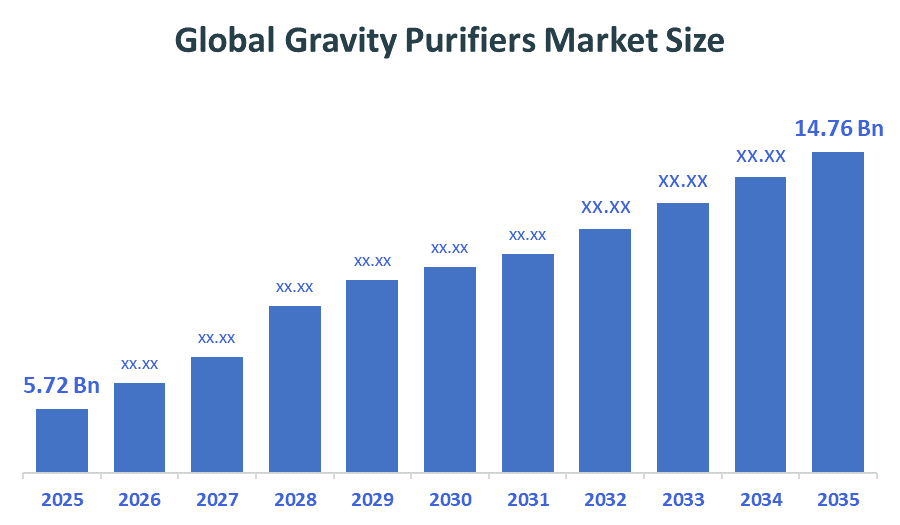
The Global Gravity Purifiers Market Size was predicted to grow from USD 5.72 Billion in 2025 and is projected to reach around USD 14.76 Billion by 2035. According to Decision Advisors, a detailed research report on the gravity purifiers market shows that the plastic material segment dominates the global gravity purifiers market, holding approximately 60-70% of the total share worldwide. Kent RO Systems leads the market with an annual revenue of ?1,310 crores, making it one of the major market drivers for shaping the industry.
Market Snapshot
- Global Gravity Purifiers Market Size (2025): USD 5.72 Billion
- Global Gravity Purifiers Projected Market Size (2035): USD 14.76 Billion
- Global Gravity Purifiers Compound Annual Growth Rate (CAGR): 9.94%
- Largest Regional Market: Asia-Pacific
- Fastest Growing Region: Middle East & Africa
- 3rd Largest Region: Latin America
- Base Year: 2025
- Historical Period: 2021 - 2024
- Forecast Period: 2026 - 2035
Market Overview / Introduction
The gravity purifiers are an assembly of filtration systems that function in the removal of contaminants from water using natural gravitational force. The gravity purifiers act as crucial intermediaries between raw, untreated water and safe potable water, using cutting-edge hollow fiber membranes and ceramic filtration techniques to attain maximum purification capacity without the need for electricity. The modern gravity purifiers have various characteristics, including antimicrobial chemical resistance and high sediment retention, so as to perform optimally and minimise chances of waterborne diseases. The gravity purifiers have evolved from being simple cloth filters to advanced high-tech systems that are equipped with activated carbon blocks, ultrafiltration membranes, and used in remote disaster relief operations. The increase in the use of gravity purifiers can be attributed to the increasing need for affordable clean water and sustainable living within modernising rural areas and urban households. This is because gravity purifiers provide protection to human health from pathogens and chemical pollutants caused by lack of infrastructure, since there is no need for complex electrical installations.
- The residential and humanitarian segments contribute to approximately 72% of the application-based use in the market, driven by the increasing demand for decentralised water solutions, rural health initiatives, and the maintenance of essential clean water access in remote regions.
- There is an exponential rise in the development of high-tech stainless steel purifiers in the commercial industry, and the CAGR is predicted to exceed 7% because of the growing application of plastic-free filtration in next-generation sustainable offices due to their ability to offer optimised durability and safety.
Notable Insights: -
- Plastic gravity purifier modules make up about 60-70% of the total market share of this sector. They have gained a reputation for low-cost requirements, particularly in rural households, temporary shelters, and entry-level consumer markets.
- Applications of gravity purifiers in the sphere of disaster relief and emergency response account for almost 22.5% of all demand. The rapid development of portable filtration kits for NGOs and military use is driving this trend.
- Multi-stage ultrafiltration systems show an annual increase above 6.8%. The rise in micro-pollutant concerns and frequent occurrences of water contamination create the conditions that encourage households to invest more money in advanced gravity-based filtration solutions.
What is the Role of Technology in Shaping the Market?
The advancements in technology have made some major changes in the water treatment industry regarding filtration efficiency, pore size precision, and material safety. Gravity purifier technology of the current generation has evolved beyond being mere plastic containers to sophisticated filtration devices that can operate in harsh environments because they are able to use nano-silver impregnation, hollow fiber UF membranes, and food-grade non-leaching polymers for construction.
How are Recent Developments Helping the Market?
They involve the use of integrated mineral cartridges, high-flux membrane systems, and self-cleaning filter mechanisms. These innovations have played an important role in facilitating growth and development within the market. There have been innovations involving the development of purifiers that are able to resist chemical leaching, and which are able to protect all types of users from those in urban apartments to fully remote field researchers. Such innovations would facilitate the production of high-volume safe water using the physical properties of modern-day membranes, without breaking down due to clogging or biological growth.
Market Drivers
The market demand for global gravity purifiers is on the rise due to higher investments in health organizations and governments into water sanitation infrastructure and sustainable filtration capable of meeting UN Sustainable Development Goals in the current era. Modern gravity purifiers have enjoyed significant market popularity because of their advantages of combining multiple properties in one durable system, such as zero electricity consumption, low maintenance, and effective bacterial removal. On the other hand, the establishment of eco-conscious residential projects has brought about greater demands for non-electric solutions to address the trend of shifting from carbon-heavy boiling to passive gravity filtration, which require highly efficient filtration media.
Restraints
However, the development of the global market for the gravity purifier industry is limited by the complexities involved in maintaining the stability of the price of raw materials such as high-grade stainless steel and specialized membranes, considering that the market may be characterised by fluctuations that may lead to higher end-user prices.
Competitive Analysis:
The report offers the appropriate analysis of the key organisations/companies involved within the gravity purifiers market, along with a comparative evaluation primarily based on their product offerings, business overviews, geographic presence, enterprise strategies, segment market share, and SWOT analysis. The report also provides an elaborate analysis focusing on the current news and developments of the companies, which includes product development, innovations, joint ventures, partnerships, and strategic alliances.
Top 10 Companies in the Global Gravity Purifiers Market
- Kent RO Systems Ltd.
- Hindustan Unilever Limited (Pureit)
- Eureka Forbes Ltd.
- Tata Chemicals Ltd.
- Vestergaard Frandsen (LifeStraw)
- Katadyn Group
- Sawyer Products, Inc.
- Brita SE
- Doulton Water Filters
- Aquaguard (Eureka Forbes)
Government Initiatives
|
Country |
Key Government Initiatives |
|
India |
Under the Jal Jeevan Mission (2024-2026), the Ministry of Jal Shakti has prioritised decentralised water solutions. The government has targeted an expansion of non-electric filtration access in rural schools and Anganwadi centres. |
|
Kenya |
The Water Services Regulatory Board (WASREB) notified an outlay for rural water safety through 2026, mandating point-of-use (POU) filtration for households in water-stressed counties. |
|
US |
The EPA's Clean Water Act updates in 2026 have expanded funding for emergency water preparedness, securing the supply of portable gravity-based filtration for disaster response and resilient infrastructure. |
Study on the Supply, Demand, Distribution, and Market Environment
It is necessary for the gravity purifiers market to strike a balance between operating at optimal filtration efficiency and the increased demand for systems that are both effective and inexpensive. The production of gravity purifiers involves the manufacture of specialised membranes and food-grade polymers that can offer sustained biological protection without the risk of re-contamination inherent to older storage methods.
Price Analysis and Consumer Behaviour Analysis
The cost of purifiers is influenced by the quality of the filter media, the storage capacity, and the material of the body. The more sophisticated materials, such as the use of stainless steel or high-grade UF membranes, are expensive due to their inclusion of advanced coatings or silver-impregnated carbon. On the other hand, ordinary plastic gravity units used in rural homes and by budget-conscious consumers can be considered cheap and provide an excellent chance for localised health improvement and usage in temporary camps. Consumers have shown interest in durability and chemical-free purification; thus, manufacturers should aim at providing long-lasting and easily replaceable filter cartridges.
Market Segmentation
The Global Gravity Purifiers Market share is classified into material type, capacity, application, and end user.
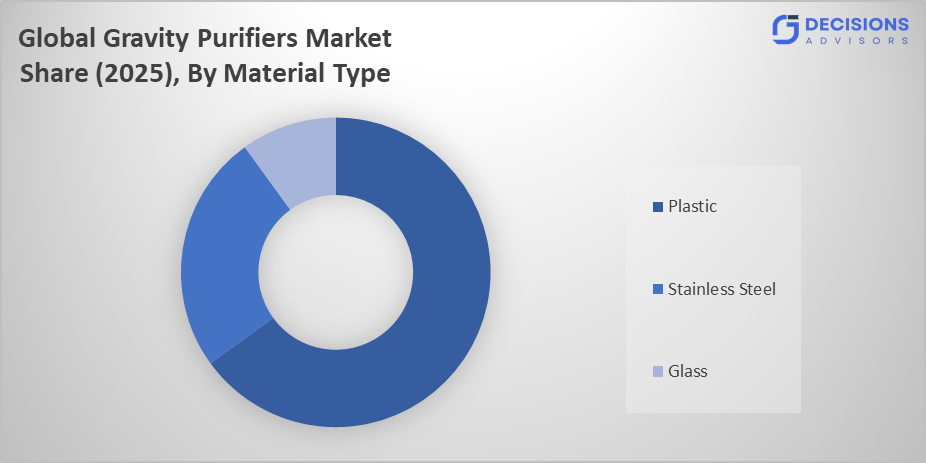
The Plastic segment holds the largest share, contributing approximately 65% of the market in 2025.
Based on the Material Type, the global gravity purifiers market is divided into Plastic, Stainless Steel, and Glass. Among these, the Plastic segment holds the largest share, contributing approximately 65% of the market in 2025. The reason for this dominance lies in their lightweight nature and affordability in emerging markets, allowing for widespread distribution without the high logistical costs required by heavier alternatives.
The 10-20 Litres segment accounts for the largest share, representing over 60% of the global market in 2025.
Based on the Capacity, the global gravity purifiers market is divided into below 10 Litres, 10-20 Liters, and above 20 Litres. Among these, the 10-20 Litres segment accounts for the largest share, representing over 60% of the global market in 2025. These purifiers are critical for family-sized daily water needs, providing ease of use and sufficient storage for a typical household without the need for constant refilling.
Residential applications dominate the global market, accounting for approximately 75% of the total revenue in 2025.
Based on the Application, the global gravity purifiers market is divided into Residential, Commercial, and Outdoor & Emergency. Among these, the Residential applications dominate the global market, accounting for approximately 75% of the total revenue in 2025. This segment is preferred by households that require reliable, clean water without ongoing electricity bills.
The Offline Retail segment dominates the global market, accounting for approximately 55% of the total revenue in 2025.
Based on the Distribution Channel, the global gravity purifiers market is divided into Online Retail, Offline Retail, and Direct Sales. Among these, the Offline Retail segment dominates the global market, accounting for approximately 55% of the total revenue in 2025. This segment is preferred in regions where consumers value physical product verification and local after-sales support for filter replacements.
Strategies to Implement for Growth of the Market in Non-Leading Regions
The possibilities of growth for the gravity purifiers industry in the emerging regions can be enhanced through the creation of efficient localised assembly facilities for the use of regional NGOs, as well as local bodies responsible for managing the water safety of rural regions. The initiatives from the government focused on public health, together with an increase in the awareness of waterborne diseases, play a major role in creating a demand in those regions that face difficulties regarding the availability of consistent electrical power.
Regional Segment Analysis of the Global Gravity Purifiers Market
- North America (U.S., Canada, Mexico)
- Europe (Germany, France, U.K., Italy, Spain, Rest of Europe)
- Asia-Pacific (China, Japan, India, South Korea, Rest of APAC)
- Latin America (Brazil and the Rest of Latin America)
- The Middle East and Africa (UAE, South Africa, Rest of MEA)
Asia-Pacific is projected to be the largest region over the forecast period. This region is anticipated to witness a growth rate of around 7.10% CAGR, maintaining a dominant market share within the global industry. In 2025, the Asia-Pacific region already accounts for approximately 48.2% of global revenue. This is owing to the vast population base in rural areas where consistent electrical power is scarce, coupled with the growing demand for affordable water treatment in countries such as India, China, and Vietnam. Other reasons for the same include greater investments made toward public health infrastructure, state-supported indigenous manufacturing projects for non-electric household appliances, and the widespread adoption of multi-stage filtration standards to combat waterborne diseases.
The Middle East and Africa are expected to be the fastest-growing regions during the forecast period. This region is witnessing a surge in demand due to extensive humanitarian projects, rapid urbanisation in developing nations, and the high cost of bottled water. Governments in this region are increasingly partnering with NGOs to distribute gravity-fed membrane filters in water-stressed counties. The market's rapid expansion is further supported by the growing awareness of water-borne illnesses and the urgent need for portable, zero-maintenance purification solutions in remote and disaster-prone areas.
Latin America is anticipated to hold a substantial share, contributing as the 3rd largest region in the global market. There is a competitive advantage in the region owing to increasing urbanization and a growing middle class that prioritizes health-conscious purchases. Countries like Brazil and Mexico are seeing a steady rise in the adoption of gravity purifiers as reliable secondary filtration systems in urban apartments and primary systems in rural households. Moreover, the shift toward sustainable, plastic-reduced household solutions and the emergence of local distribution networks for filter replacements further give this region a strong market position.
Recent Developments
- In March 2026, Kent RO Systems announced a definitive agreement to expand its gravity-based product line with a focus on Zero-Plastic stainless steel models.
- In October 2025, Hindustan Unilever (Pureit) approved the acquisition of a strategic stake in a startup specializing in biodegradable filter membranes to enhance sustainability.
- In May 2024, Vestergaard (LifeStraw) successfully completed the rollout of its new Max system, a high-capacity gravity purifier designed for community centers and health clinics in developing regions.
- In November 2021, a breakthrough in ceramic filter coating was launched, improving the flow rate of gravity purifiers by 25% while maintaining 99.99% bacterial removal efficiency.
Market Segmentation
This study forecasts revenue at global, regional, and country levels from 2021 to 2035.
Global Gravity Purifiers Market, By Material Type
- Plastic
- Stainless Steel
- Glass
Global Gravity Purifiers Market, By Capacity
- Below 10 Liters
- 10-20 Liters
- Above 20 Liters
Global Gravity Purifiers Market, By Application
- Residential
- Commercial
- Outdoor & Emergency
Global Gravity Purifiers Market, By Distribution Channel
- Online Retail
- Offline Retail
- Direct Sales
Global Gravity Purifiers Market, By Regional Analysis
- North America
- United States
- Canada
- Mexico
- Europe
- Germany
- United Kingdom
- France
- Italy
- Spain
- Russia
- Rest of Europe
- Asia Pacific
- China
- Japan
- India
- South Korea
- Australia
- Rest of Asia Pacific
- Latin America
- Brazil
- Argentina
- Rest of Latin America
- Middle East & Africa
- United Arab Emirates
- Saudi Arabia
- Qatar
- South Africa
- Rest of Middle East & Africa
Frequently Asked Questions (FAQ)
What is the significance of ultrafiltration (UF) membranes in gravity purifiers?
Gravity-based systems often rely on pore-sized barriers to remove pathogens. Ultrafiltration membranes have pores so small (typically 0.1 to 0.01 microns) that they can physically block bacteria and cysts without needing chemicals like chlorine. This is necessary for providing safe water in areas where the biological quality of water is unreliable.
How does the rise in eco-conscious consumerism affect gravity purifier specifications?
While plastic was the standard, many consumers are now demanding stainless steel or glass housings to reduce their environmental footprint. This shift requires manufacturers to design durable, non-leaching gravity systems that maintain a high aesthetic appeal while ensuring the same level of microbiological safety.
What role does activated carbon play in gravity-based filtration?
Activated carbon is manufactured to have a massive surface area, which allows it to adsorb chemical impurities like chlorine, pesticides, and volatile organic compounds (VOCs). In gravity purifiers, it is often used as a secondary stage to improve the taste and odor of the water after the primary sediment or membrane filter has removed physical contaminants.
What are the primary differences in the application of gravity purifiers versus RO purifiers in 2026?
While RO remains the standard for areas with high TDS (Total Dissolved Solids) or heavy metal contamination, gravity purifiers are seeing increased adoption in areas with low TDS but high biological risk. Gravity purifiers' zero-electricity requirement makes them ideal for rural electrification gaps or urban households looking for a backup water source during power outages.
Check Licence
Choose the plan that fits you best: Single User, Multi-User, or Enterprise solutions tailored for your needs.
We Have You Covered
- 24/7 Analyst Support
- Clients Across the Globe
- Tailored Insights
- Technology Tracking
- Competitive Intelligence
- Custom Research
- Syndicated Market Studies
- Market Overview
- Market Segmentation
- Growth Drivers
- Market Opportunities
- Regulatory Insights
- Innovation & Sustainability
Report Details
| Scope | Global |
| Pages | 210 |
| Delivery | PDF & Excel via Email |
| Language | English |
| Release | Apr 2026 |
| Access | Download from this page |