
Global Head and Neck Squamous Cell Carcinoma Market
 |
Author:
David J
|
Pages:
241
|
Author:
David J
|
Pages:
241
Global Head and Neck Squamous Cell Carcinoma Market Size, Share, and COVID-19 Impact Analysis, By Drug Class (Immunotherapy, Chemotherapy, and Targeted Therapy), By Distribution Channel (Hospital Pharmacies, Retail Store, and Online Pharmacies), and By Region (North America, Europe, Asia-Pacific, Latin America, Middle East, and Africa), Analysis and Forecast 2025 - 2035
CAGR
8.3%
REVENUE 2024
USD Billion 2.35
FORECAST 2035
USD Billion 5.65
REPORT COVERAGE
Global
Global Head and Neck Squamous Cell Carcinoma Market Size Insights Forecasts to 2035
- The Global Head and Neck Squamous Cell Carcinoma Market Size Was Estimated at USD 2.35 Billion in 2024
- The Market Size is Expected to Grow at a CAGR of around 8.30% from 2025 to 2035
- The Worldwide Head and Neck Squamous Cell Carcinoma Market Size is Expected to Reach USD 5.65 Billion by 2035
- North America is expected to Grow the fastest during the forecast period.
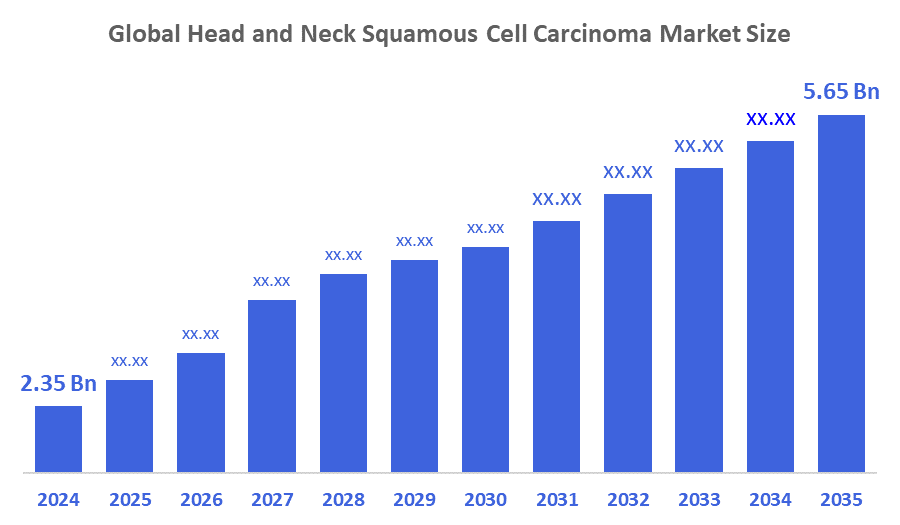
According to a Research Report Published by Decisions Advisors and Consulting, The Global Head and Neck Squamous Cell Carcinoma Market Size was worth around USD 2.35 Billion in 2024 and is predicted to Grow to around USD 5.65 Billion by 2035 with a compound annual growth rate (CAGR) of 8.30 % from 2025 to 2035. The market for HNSCC is expected to grow steadily due to the rising disease incidence from tobacco, alcohol, and HPV, as well as increased adoption of immunotherapies, targeted therapies, and advancements in precision medicine, all of which are supported by strong R&D and expanding healthcare infrastructure.
Market Overview
The global ecosystem of epidemiology, treatment methods, drug classes, and healthcare delivery channels that are specifically focused on squamous cell carcinoma that occurs in the head and neck region is referred to as the head and neck squamous cell carcinoma (HNSCC) market. It includes pipeline treatments, clinical procedures, in-market medications, and international business dynamics. This illness usually starts in the mouth, throat, and voice box, but it can also manifest in different regions, like the nasal passages, sinuses, salivary glands, etc. The signs of the condition may differ based on the exact location of the tumour. Typical symptoms linked to this condition consist of a continual sore throat, alterations in the voice or hoarseness, trouble with swallowing or chewing, a noticeable lump in the neck, mouth sores, pain in the ears, unexplained weight loss, and similar issues. Various imaging methods, including positron emission tomography scans, X-rays, and magnetic resonance imaging, are employed to determine the tumour's location and extent. In certain situations, the healthcare provider might conduct an endoscopy to examine the throat, larynx, and additional regions of the upper digestive system. Furthermore, the market is expanding due to the growing use of targeted medications like cetuximab and pembrolizumab, which are made to selectively target and block certain molecules or pathways involved in the spread of cancer. Aside from this, another important growth-inducing aspect is the increasing use of brachytherapy, which involves inserting radioactive sources into or close to the tumour site to administer a precise dose of radiation.
Merck KGaA licensed xevinapant from Debiopharm for exclusive HNSCC development rights, paying $237 billion up front and potentially earning over $1 billion in royalties and milestones.
Genmab paid $8 billion to purchase Merus N.V. in order to bolster its cancer pipeline, concentrating on petosemtamab, a bispecific antibody that is undergoing Phase 3 studies for head and neck squamous cell carcinoma (HNSCC) and has been designated as an FDA breakthrough therapy.
Report Coverage
This research report categorises the head and neck squamous cell carcinoma market based on various segments and regions, forecasts revenue growth, and analyses trends in each submarket. The report analyses the key growth drivers, opportunities, and challenges influencing the head and neck squamous cell carcinoma market. Recent market developments and competitive strategies, such as expansion, product launch, development, partnership, merger, and acquisition, have been included to draw the competitive landscape in the market. The report strategically identifies and profiles the key market players and analyses their core competencies in each sub-segment of the head and neck squamous cell carcinoma market.
Driving Factors
The market for treating head and neck squamous cell carcinoma (HNSCC) is growing because of various important reasons. Moreover, increasing alcohol consumption drives demand, as high intake harms organs, raises blood pressure and cholesterol levels, and increases the likelihood of mouth and other cancers. In the UK (2019), 49% of adults aged 16 and over consumed alcohol weekly, including 57% of men and 44% of women. Initially, increasing R&D funding and regulatory endorsements, such as FDA approvals for medications, together with continuous clinical trials for cancer vaccines, are speeding up treatment advancements for various cancer forms. Besides, increasing acceptance of immune treatments (immunotherapy) provides enhanced advantages by utilising the body's defences to stop cancer growth and dissemination. Additionally, a favourable outlook for the industry is being created by the increasing incidence of chronic oral irritation and inflammation, which is frequently linked to inadequate hygiene practices.
Restraining Factors
The factor that hinders market growth is with high cost of treatment and medications for particularly for those with poor and moderate incomes. Furthermore, the lack of appropriate healthcare standards in some regions of the world will reduce the need for medications and therapy for head and neck squamous cell carcinoma (HNSCC).
Market Segmentation
The head and neck squamous cell carcinoma market share is classified into drug class and distribution channel.
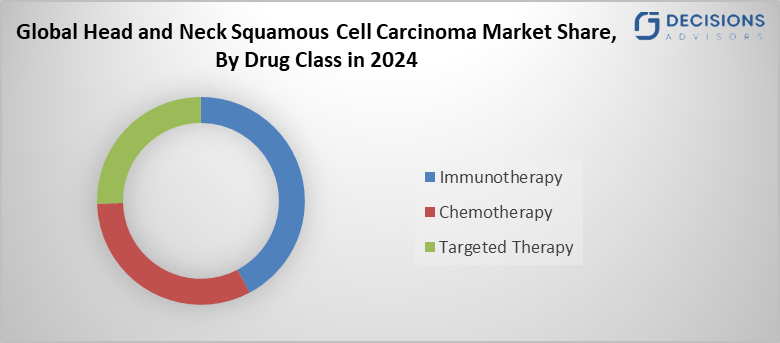
- The immunotherapy segment accounted for the largest market share in 2024 and is anticipated to grow at a substantial CAGR over the forecast period.
Based on the drug class, the head and neck squamous cell carcinoma market is segmented into immunotherapy, chemotherapy, and targeted therapy. Among these, the immunotherapy segment accounted for the largest market share in 2024 and is anticipated to grow at a substantial CAGR over the forecast period. This is due to a sharp increase in public awareness of the benefits and efficacy of cancer immunotherapy compared to chemotherapy. Additionally, it is anticipated that the increase in drug trials and the rising percentage of new drug approvals from regulatory bodies like the FDA and EMA will propel the segment expansion. For example, two PD-L1 inhibitors approved for the treatment of individuals with head and neck cancer are nivolumab (Opdivo) and pembrolizumab Keytruda. Dostarlimab (Jemperli) is now undergoing phase II clinical trials for advanced or recurrent head and neck squamous cell carcinoma.
- The hospital pharmacies segment accounted for the highest market revenue in 2024 and is anticipated to grow at a significant CAGR during the forecast period.
Based on the distribution channel, the head and neck squamous cell carcinoma market is differentiated into hospital pharmacies, retail store, and online pharmacies. Among these, the hospital pharmacies segment accounted for the highest market revenue in 2024 and is anticipated to grow at a significant CAGR during the forecast period. The segment's increase can be explained by the fact that more cancer patients are coming to the hospital for treatment, necessitating the use of HNSCC medications on hospital grounds. However, several medications used to treat cancer are prohibited from being sold online or even in physical pharmacies.
Regional Segment Analysis of the Head and Neck Squamous Cell Carcinoma Market
- North America (U.S., Canada, Mexico)
- Europe (Germany, France, U.K., Italy, Spain, Rest of Europe)
- Asia-Pacific (China, Japan, India, Rest of APAC)
- South America (Brazil and the Rest of South America)
- The Middle East and Africa (UAE, South Africa, Rest of MEA)
Asia Pacific is anticipated to hold the largest share of the head and neck squamous cell carcinoma market over the predicted timeframe.
Asia Pacific is anticipated to hold the largest share of the head and neck squamous cell carcinoma market over the predicted timeframe. In the Asia-Pacific area, head and neck squamous cell carcinoma (HNSCC) is a major health burden due to high incidence rates caused by viral infections like HPV and EBV, alcohol use, tobacco usage, and chewing betel quid. An estimated 300,000 new diagnoses are made in the region each year, with Southeast Asia and some regions of East Asia accounting for a significant portion of all cases worldwide. Nasopharyngeal carcinoma is common in places like southern China, Hong Kong, and Malaysia because of the EBV link, and HNSCC is one of the most common cancers in several Asia-Pacific nations.
AstraZeneca committed USD 2.5 billion to expand oncology research in Beijing, supporting early-stage HNSCC drug development.
North America is expected to grow at a rapid CAGR in the head and neck squamous cell carcinoma market during the forecast period. In North America, head and neck squamous cell carcinoma (HNSCC), which is mostly monitored in the US and Canada, has a steady to dropping overall incidence despite an increase in HPV-related oropharyngeal cases; as of recent years, the US has an estimated 67,000 new cases and 15,000 fatalities each year. According to US data from SEER, there were approximately 54,000 cases in 2022, or 3% of all cancer cases, with 27% localised at diagnosis and 51% locally progressed; total incidence decreased somewhat throughout the COVID-19 period, from 11.6 to 10.8 per 100,000 between 2019 and 2020, due to fewer localised detections.
INOVIO and Coherus BioSciences have entered into a clinical collaboration to evaluate INO-3112 (a DNA immunotherapy) in combination with LOQTORZI (toripalimab-tpzi), Coherus’ PD-1 inhibitor, for the treatment of head and neck squamous cell carcinoma (HNSCC).
Competitive Analysis:
The report offers the appropriate analysis of the key organisations/companies involved within the head and neck squamous cell carcinoma market, along with a comparative evaluation primarily based on their product offering, business overviews, geographic presence, enterprise strategies, segment market share, and SWOT analysis. The report also provides an elaborative analysis focusing on the current news and developments of the companies, which includes product development, innovations, joint ventures, partnerships, mergers & acquisitions, strategic alliances, and others. This allows for the evaluation of the overall competition within the market.
List of Key Companies
- Advaxis, Inc.
- Amgen, Inc.
- AstraZeneca plc
- Boehringer Ingelheim GmbH
- Bristol-Myers Squibb Company (Ono Pharmaceutical Co., Ltd.)
- Cel-Sci Corporation
- Coherus Biosciences
- Five Prime Therapeutics, Inc.
- GlaxoSmithKline plc
- Incyte Corporation
- IRX Therapeutics, Inc.
- Junshi Biosciences
- MacroGenics, Inc.
- Merck KGaA
- Others
Key Target Audience
- Market Players
- Investors
- End-users
- Government Authorities
- Consulting and Research Firm
- Venture capitalists
- Value-Added Resellers (VARs)
Recent Development
- In October 2025, Merck announced that KEYTRUDA (pembrolizumab) met its primary endpoint of event-free survival (EFS) in the Phase 3 KEYNOTE-689 trial, marking the first time an anti–PD-1 therapy has shown statistically significant and clinically meaningful benefit in the perioperative (neoadjuvant + adjuvant) setting for resected, locally advanced head and neck squamous cell carcinoma (HNSCC).
- In January 2025, GORTEC announced that its Phase 3 NIVOPOSTOP (GORTEC 2018-01) trial met its primary endpoint of disease-free survival (DFS) in patients with resected, locally advanced head and neck squamous cell carcinoma (LA-SCCHN) at high risk of relapse. Nivolumab's safety profile was in line with earlier research, and both study arms' compliance with SOC treatments was comparable.
Market Segment
This study forecasts revenue at global, regional, and country levels from 2020 to 2035. Decisions Advisors has segmented the head and neck squamous cell carcinoma market based on the below-mentioned segments:
Global Head and Neck Squamous Cell Carcinoma Market, By Drug Class
- Immunotherapy
- Chemotherapy
- Targeted Therapy
Global Head and Neck Squamous Cell Carcinoma Market, By Distribution Channel
- Hospital Pharmacies
- Retail Store
- Online Pharmacies.
Global Head and Neck Squamous Cell Carcinoma Market, By Regional Analysis
- North America
- US
- Canada
- Mexico
- Europe
- Germany
- UK
- France
- Italy
- Spain
- Russia
- Rest of Europe
- Asia Pacific
- China
- Japan
- India
- South Korea
- Australia
- Rest of Asia Pacific
- South America
- Brazil
- Argentina
- Rest of South America
- Middle East & Africa
- UAE
- Saudi Arabia
- Qatar
- South Africa
- Rest of the Middle East & Africa
Frequently Asked Questions (FAQ)
- What is the projected market size and growth rate for the Global Head and Neck Squamous Cell Carcinoma (HNSCC) Market?
The market was valued at USD 2.35 billion in 2024 and is expected to reach USD 5.65 billion by 2035, growing at a CAGR of 8.30% from 2025 to 2035.
- What are the main drivers of growth in the HNSCC market?
Rising incidence due to tobacco, alcohol, and HPV; increased adoption of immunotherapies and targeted therapies like pembrolizumab; advancements in precision medicine; strong R&D funding; and expanding healthcare infrastructure fuel growth. Chronic oral irritation from poor hygiene also contributes.
- What restrains market expansion?
High treatment costs limit access for low- and middle-income populations, while inadequate healthcare standards in some regions reduce demand for HNSCC medications and therapies.
- Which drug class holds the largest market share?
Immunotherapy dominated in 2024 and is projected to grow at the highest CAGR. Key drugs include nivolumab (Opdivo) and pembrolizumab (Keytruda), driven by rising awareness, clinical trials, and FDA/EMA approvals.
- Which distribution channel leads the market?
Hospital pharmacies generated the highest revenue in 2024 and will grow significantly, as more patients receive HNSCC treatments on-site. Many cancer drugs are restricted from retail or online sales.
- Which region has the largest market share, and why?
Asia-Pacific holds the largest share due to high incidence from HPV, EBV, tobacco, alcohol, and betel quid chewing—around 300,000 new cases annually, especially in Southeast and East Asia.
- Which region is expected to grow the fastest?
North America will see the fastest CAGR, with about 67,000 new U.S. cases yearly despite a slight overall decline. HPV-related oropharyngeal cases are rising, supported by advanced infrastructure.
- Who are the key players in the HNSCC market?
Major companies include Advaxis, Amgen, AstraZeneca, Boehringer Ingelheim, Bristol-Myers Squibb, Cel-Sci, Coherus Biosciences, Merck KGaA, Novartis, Pfizer, Roche (Genentech), and others.
- What are some recent developments in the market?
October 2025: Merck's KEYTRUDA showed event-free survival benefits in Phase 3 KEYNOTE-689 trial for resected HNSCC.
- Introduction
- Objectives of the Study
- Market Definition
- Research Scope
- Research Methodology and Assumptions
- Executive Summary
- Premium Insights
- Porter’s Five Forces Analysis
- Value Chain Analysis
- Top Investment Pockets
- Market Attractiveness Analysis By Drug Class
- Market Attractiveness Analysis By Distribution Channel
- Market Attractiveness Analysis By Region
- Industry Trends
- Market Dynamics
- Market Evaluation
- Drivers
- Supported by strong R&D and expanding healthcare infrastructure
- Restraints
- Strict adherence to regulations required and lack of appropriate healthcare situation
- Opportunities
- Targeted therapies, and advancements in precision medicine
- Challenges
- High cost of treatment and medications for particularly for those with poor and moderate incomes
- Global Head and Neck Squamous Cell Carcinoma Market Analysis and Projection, By Drug Class
- Segment Overview
- Immunotherapy
- Chemotherapy
- Targeted Therapy
- Global Head and Neck Squamous Cell Carcinoma Market Analysis and Projection, By Distribution Channel
- Segment Overview
- Hospital Pharmacies
- Retail Store
- Online Pharmacies
- Global Head and Neck Squamous Cell Carcinoma Market Analysis and Projection, By Regional Analysis
- Segment Overview
- North America
- U.S.
- Canada
- Mexico
- Europe
- Germany
- France
- U.K.
- Italy
- Spain
- Asia-Pacific
- Japan
- China
- India
- South America
- Brazil
- Middle East and Africa
- UAE
- South Africa
- Global Head and Neck Squamous Cell Carcinoma Market-Competitive Landscape
- Overview
- Market Share of Key Players in the Head and Neck Squamous Cell Carcinoma Market
- Global Company Market Share
- North America Company Market Share
- Europe Company Market Share
- APAC Company Market Share
- Competitive Situations and Trends
- Coverage Launches and Developments
- Partnerships, Collaborations, and Agreements
- Mergers & Acquisitions
- Expansions
- Company Profiles
- Advaxis, Inc
- Business Overview
- Company Snapshot
- Company Market Share Analysis
- Company Coverage Portfolio
- Recent Developments
- SWOT Analysis
- Amgen, Inc.
- Business Overview
- Company Snapshot
- Company Market Share Analysis
- Company Coverage Portfolio
- Recent Developments
- SWOT Analysis
- AstraZeneca plc
- Business Overview
- Company Snapshot
- Company Market Share Analysis
- Company Coverage Portfolio
- Recent Developments
- SWOT Analysis
- Boehringer Ingelheim GmbH
- Business Overview
- Company Snapshot
- Company Market Share Analysis
- Company Coverage Portfolio
- Recent Developments
- SWOT Analysis
- Bristol-Myers Squibb Company (Ono Pharmaceutical Co., Ltd.)
- Business Overview
- Company Snapshot
- Company Market Share Analysis
- Company Coverage Portfolio
- Recent Developments
- SWOT Analysis
- Cel-Sci Corporation
- Business Overview
- Company Snapshot
- Company Market Share Analysis
- Company Coverage Portfolio
- Recent Developments
- SWOT Analysis
- Coherus Biosciences
- Business Overview
- Company Snapshot
- Company Market Share Analysis
- Company Coverage Portfolio
- Recent Developments
- SWOT Analysis
- Five Prime Therapeutics, Inc.
- Business Overview
- Company Snapshot
- Company Market Share Analysis
- Company Coverage Portfolio
- Recent Developments
- SWOT Analysis
- GlaxoSmithKline plc
- Business Overview
- Company Snapshot
- Company Market Share Analysis
- Company Coverage Portfolio
- Recent Developments
- SWOT Analysis
- Incyte Corporation
- Business Overview
- Company Snapshot
- Company Market Share Analysis
- Company Coverage Portfolio
- Recent Developments
- SWOT Analysis
- IRX Therapeutics, Inc.
- Business Overview
- Company Snapshot
- Company Market Share Analysis
- Company Coverage Portfolio
- Recent Developments
- SWOT Analysis
- Junshi Biosciences
- Business Overview
- Company Snapshot
- Company Market Share Analysis
- Company Coverage Portfolio
- Recent Developments
- SWOT Analysis
- MacroGenics, Inc.
- Business Overview
- Company Snapshot
- Company Market Share Analysis
- Company Coverage Portfolio
- Recent Developments
- SWOT Analysis
- Merck KGaA
- Business Overview
- Company Snapshot
- Company Market Share Analysis
- Company Coverage Portfolio
- Recent Developments
- SWOT Analysis
- Others
- Business Overview
- Company Snapshot
- Company Market Share Analysis
- Company Coverage Portfolio
- Recent Developments
- SWOT Analysis
- Advaxis, Inc
List of Table
- Global Head and Neck Squamous Cell Carcinoma Market, By Drug Class, 2024-2035(USD Billion)
- Global Immunotherapy, Head and Neck Squamous Cell Carcinoma Market, By Region, 2024-2035(USD Billion)
- Global Chemotherapy, Head and Neck Squamous Cell Carcinoma Market, By Region, 2024-2035(USD Billion)
- Global Targeted Therapy, Head and Neck Squamous Cell Carcinoma Market, By Region, 2024-2035(USD Billion)
- Global Head and Neck Squamous Cell Carcinoma Market, By Distribution Channel, 2024-2035(USD Billion)
- Global Hospital Pharmacies, Head and Neck Squamous Cell Carcinoma Market, By Region, 2024-2035(USD Billion)
- Global Retail Store, Head and Neck Squamous Cell Carcinoma Market, By Region, 2024-2035(USD Billion)
- Global Online Pharmacies, Head and Neck Squamous Cell Carcinoma Market, By Region, 2024-2035(USD Billion)
- North America Head and Neck Squamous Cell Carcinoma Market, By Drug Class, 2024-2035(USD Billion)
- North America Head and Neck Squamous Cell Carcinoma Market, By Distribution Channel, 2024-2035(USD Billion)
- U.S. Head and Neck Squamous Cell Carcinoma Market, By Drug Class , 2024-2035(USD Billion)
- U.S. Head and Neck Squamous Cell Carcinoma Market, By Distribution Channel, 2024-2035(USD Billion)
- Canada Head and Neck Squamous Cell Carcinoma Market, By Drug Class, 2024-2035(USD Billion)
- Canada Head and Neck Squamous Cell Carcinoma Market, By Distribution Channel, 2024-2035(USD Billion)
- Mexico Head and Neck Squamous Cell Carcinoma Market, By Drug Class, 2024-2035(USD Billion)
- Mexico Head and Neck Squamous Cell Carcinoma Market, By Distribution Channel, 2024-2035(USD Billion)
- Europe Head and Neck Squamous Cell Carcinoma Market, By Drug Class, 2024-2035(USD Billion)
- Europe Head and Neck Squamous Cell Carcinoma Market, By Distribution Channel, 2024-2035(USD Billion)
- Germany Head and Neck Squamous Cell Carcinoma Market, By Drug Class, 2024-2035(USD Billion)
- Germany Head and Neck Squamous Cell Carcinoma Market, By Distribution Channel, 2024-2035(USD Billion)
- France Head and Neck Squamous Cell Carcinoma Market, By Drug Class, 2024-2035(USD Billion)
- France Head and Neck Squamous Cell Carcinoma Market, By Distribution Channel, 2024-2035(USD Billion)
- U.K. Head and Neck Squamous Cell Carcinoma Market, By Drug Class, 2024-2035(USD Billion)
- U.K. Head and Neck Squamous Cell Carcinoma Market, By Distribution Channel, 2024-2035(USD Billion)
- Italy Head and Neck Squamous Cell Carcinoma Market, By Drug Class, 2024-2035(USD Billion)
- Italy Head and Neck Squamous Cell Carcinoma Market, By Distribution Channel, 2024-2035(USD Billion)
- Spain Head and Neck Squamous Cell Carcinoma Market, By Drug Class, 2024-2035(USD Billion)
- Spain Head and Neck Squamous Cell Carcinoma Market, By Distribution Channel, 2024-2035(USD Billion)
- Asia Pacific Head and Neck Squamous Cell Carcinoma Market, By Drug Class, 2024-2035(USD Billion)
- Asia Pacific Head and Neck Squamous Cell Carcinoma Market, By Distribution Channel, 2024-2035(USD Billion)
- Japan Head and Neck Squamous Cell Carcinoma Market, By Drug Class, 2024-2035(USD Billion)
- Japan Head and Neck Squamous Cell Carcinoma Market, By Distribution Channel, 2024-2035(USD Billion)
- China Head and Neck Squamous Cell Carcinoma Market, By Drug Class, 2024-2035(USD Billion)
- China Head and Neck Squamous Cell Carcinoma Market, By Distribution Channel, 2024-2035(USD Billion)
- India Head and Neck Squamous Cell Carcinoma Market, By Drug Class, 2024-2035(USD Billion)
- India Head and Neck Squamous Cell Carcinoma Market, By Distribution Channel, 2024-2035(USD Billion)
- South America Head and Neck Squamous Cell Carcinoma Market, By Drug Class, 2024-2035(USD Billion)
- South America Head and Neck Squamous Cell Carcinoma Market, By Distribution Channel, 2024-2035(USD Billion)
- Brazil Head and Neck Squamous Cell Carcinoma Market, By Drug Class, 2024-2035(USD Billion)
- Brazil Head and Neck Squamous Cell Carcinoma Market, By Distribution Channel, 2024-2035(USD Billion)
- The Middle East and Africa Head and Neck Squamous Cell Carcinoma Market, By Drug Class, 2024-2035(USD Billion)
- The Middle East and Africa Head and Neck Squamous Cell Carcinoma Market, By Distribution Channel, 2024-2035(USD Billion)
- UAE Head and Neck Squamous Cell Carcinoma Market, By Drug Class, 2024-2035(USD Billion)
- UAE Head and Neck Squamous Cell Carcinoma Market, By Distribution Channel, 2024-2035(USD Billion)
- South Africa Head and Neck Squamous Cell Carcinoma Market, By Drug Class, 2024-2035(USD Billion)
- South Africa Head and Neck Squamous Cell Carcinoma Market, By Distribution Channel, 2024-2035(USD Billion)
List of Figures
- Global Head and Neck Squamous Cell Carcinoma Market Segmentation
- Head and Neck Squamous Cell Carcinoma Market: Research Methodology
- Market Size Estimation Methodology: Bottom-Up Approach
- Market Size Estimation Methodology: Top-down Approach
- Data Triangulation
- Porter’s Five Forces Analysis
- Value Chain Analysis
- Top investment pocket in the Head and Neck Squamous Cell Carcinoma Market
- Top Winning Strategies, 2024-2035
- Top Winning Strategies, By Development, 2024-2035(%)
- Top Winning Strategies, By Company, 2024-2035
- Moderate Bargaining power of Buyers
- Moderate Bargaining power of Suppliers
- Moderate Bargaining power of New Entrants
- Low threat of Substitution
- High Competitive Rivalry
- Top Player Positioning, 2024
- Market Share Analysis, 2024
- Restraint and Drivers: Head and Neck Squamous Cell Carcinoma Market
- Head and Neck Squamous Cell Carcinoma Market Segmentation, By Drug Class
- Head and Neck Squamous Cell Carcinoma Market For Immunotherapy, By Region, 2024-2035 ($ Billion)
- Head and Neck Squamous Cell Carcinoma Market For Chemotherapy, By Region, 2024-2035 ($ Billion)
- Head and Neck Squamous Cell Carcinoma Market For Targeted Therapy, By Region, 2024-2035 ($ Billion)
- Head and Neck Squamous Cell Carcinoma Market Segmentation, By Distribution Channel
- Head and Neck Squamous Cell Carcinoma Market For Hospital Pharmacies, By Region, 2024-2035 ($ Billion)
- Head and Neck Squamous Cell Carcinoma Market For Retail Store, By Region, 2024-2035 ($ Billion)
- Head and Neck Squamous Cell Carcinoma Market For Online Pharmacies, By Region, 2024-2035 ($ Billion)
- Advaxis, Inc: Net Sales, 2024-2035 ($ Billion)
- Advaxis, Inc: Revenue Share, By Segment, 2024 (%)
- Advaxis, Inc: Revenue Share, By Region, 2024 (%)
- Amgen, Inc.: Net Sales, 2024-2035 ($ Billion)
- Amgen, Inc.: Revenue Share, By Segment, 2024 (%)
- Amgen, Inc.: Revenue Share, By Region, 2024 (%)
- AstraZeneca plc: Net Sales, 2024-2035 ($ Billion)
- AstraZeneca plc: Revenue Share, By Segment, 2024 (%)
- AstraZeneca plc: Revenue Share, By Region, 2024 (%)
- Boehringer Ingelheim GmbH: Net Sales, 2024-2035 ($ Billion)
- Boehringer Ingelheim GmbH: Revenue Share, By Segment, 2024 (%)
- Boehringer Ingelheim GmbH: Revenue Share, By Region, 2024 (%)
- Bristol-Myers Squibb Company (Ono Pharmaceutical Co., Ltd.): Net Sales, 2024-2035 ($ Billion)
- Bristol-Myers Squibb Company (Ono Pharmaceutical Co., Ltd.): Revenue Share, By Segment, 2024 (%)
- Bristol-Myers Squibb Company (Ono Pharmaceutical Co., Ltd.): Revenue Share, By Region, 2024 (%)
- Cel-Sci Corporation: Net Sales, 2024-2035 ($ Billion)
- Cel-Sci Corporation: Revenue Share, By Segment, 2024 (%)
- Cel-Sci Corporation: Revenue Share, By Region, 2024 (%)
- Coherus Biosciences: Net Sales, 2024-2035 ($ Billion)
- Coherus Biosciences: Revenue Share, By Segment, 2024 (%)
- Coherus Biosciences: Revenue Share, By Region, 2024 (%)
- Five Prime Therapeutics, Inc.: Net Sales, 2024-2035 ($ Billion)
- Five Prime Therapeutics, Inc.: Revenue Share, By Segment, 2024 (%)
- Five Prime Therapeutics, Inc.: Revenue Share, By Region, 2024 (%)
- GlaxoSmithKline plc.: Net Sales, 2024-2035 ($ Billion)
- GlaxoSmithKline plc.: Revenue Share, By Segment, 2024 (%)
- GlaxoSmithKline plc.: Revenue Share, By Region, 2024 (%)
- Incyte Corporation: Net Sales, 2024-2035 ($ Billion)
- Incyte Corporation: Revenue Share, By Segment, 2024 (%)
- Incyte Corporation: Revenue Share, By Region, 2024 (%)
- IRX Therapeutics, Inc.: Net Sales, 2024-2035 ($ Billion)
- IRX Therapeutics, Inc.: Revenue Share, By Segment, 2024 (%)
- IRX Therapeutics, Inc.: Revenue Share, By Region, 2024 (%)
- Junshi Biosciences: Net Sales, 2024-2035 ($ Billion)
- Junshi Biosciences: Revenue Share, By Segment, 2024 (%)
- Junshi Biosciences: Revenue Share, By Region, 2024 (%)
- MacroGenics, Inc.: Net Sales, 2024-2035 ($ Billion)
- MacroGenics, Inc.: Revenue Share, By Segment, 2024 (%)
- MacroGenics, Inc.: Revenue Share, By Region, 2024 (%)
- Merck KGaA: Net Sales, 2024-2035 ($ Billion)
- Merck KGaA: Revenue Share, By Segment, 2024 (%)
- Merck KGaA: Revenue Share, By Region, 2024 (%)
- Others: Net Sales, 2024-2035 ($ Billion)
- Others: Revenue Share, By Segment, 2024 (%)
- Others: Revenue Share, By Region, 2024 (%)
Check Licence
Choose the plan that fits you best: Single User, Multi-User, or Enterprise solutions tailored for your needs.
We Have You Covered
- 24/7 Analyst Support
- Clients Across the Globe
- Tailored Insights
- Technology Tracking
- Competitive Intelligence
- Custom Research
- Syndicated Market Studies
- Market Overview
- Market Segmentation
- Growth Drivers
- Market Opportunities
- Regulatory Insights
- Innovation & Sustainability
Report Details
| Scope | Global |
| Pages | 241 |
| Delivery | PDF & Excel via Email |
| Language | English |
| Release | Dec 2025 |
| Access | Download from this page |