
Global Heat Interface Units Market
 |
Author:
Mayuri S
|
Pages:
245
|
Author:
Mayuri S
|
Pages:
245
Global Heat Interface Units Market Size, and Share, By Component (Heat Exchangers, Controllers, Pumps, Sensors, and Valves), By Product (Indirect and Direct), By Application (Residential, Commercial, and Industrial), and By Region (North America, Europe, Asia-Pacific, Latin America, Middle East, and Africa), Analysis and Forecast 2026 â 2035.
CAGR
8.15%
REVENUE 2025
USD Million 710.1
FORECAST 2035
USD Million 1554.1
REPORT COVERAGE
Global
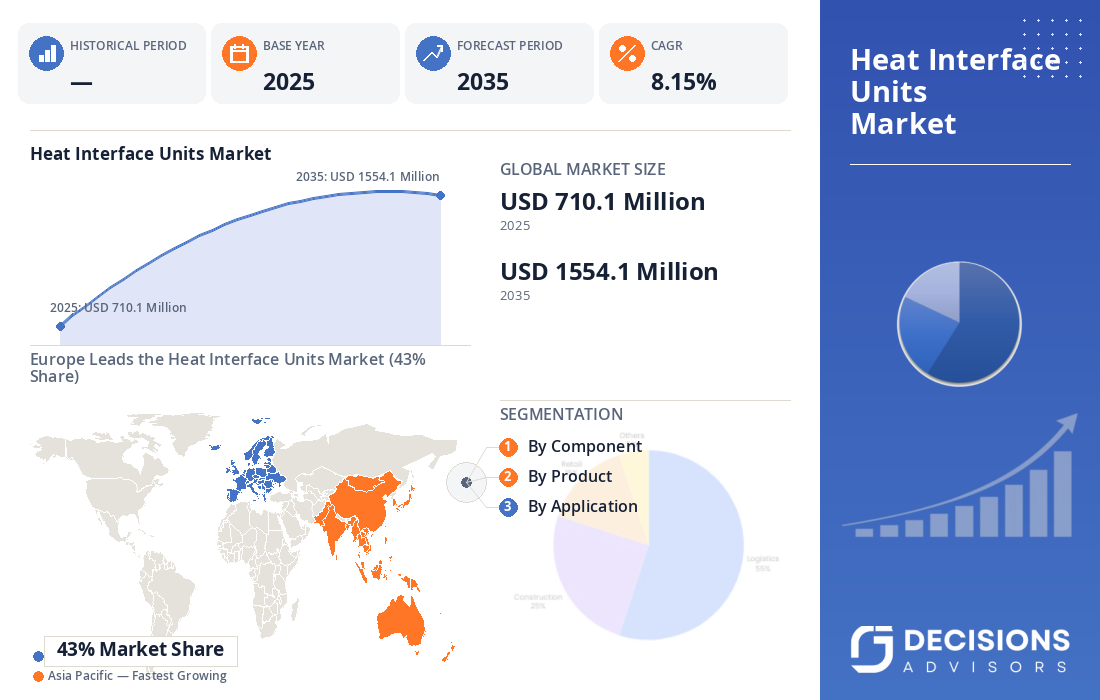
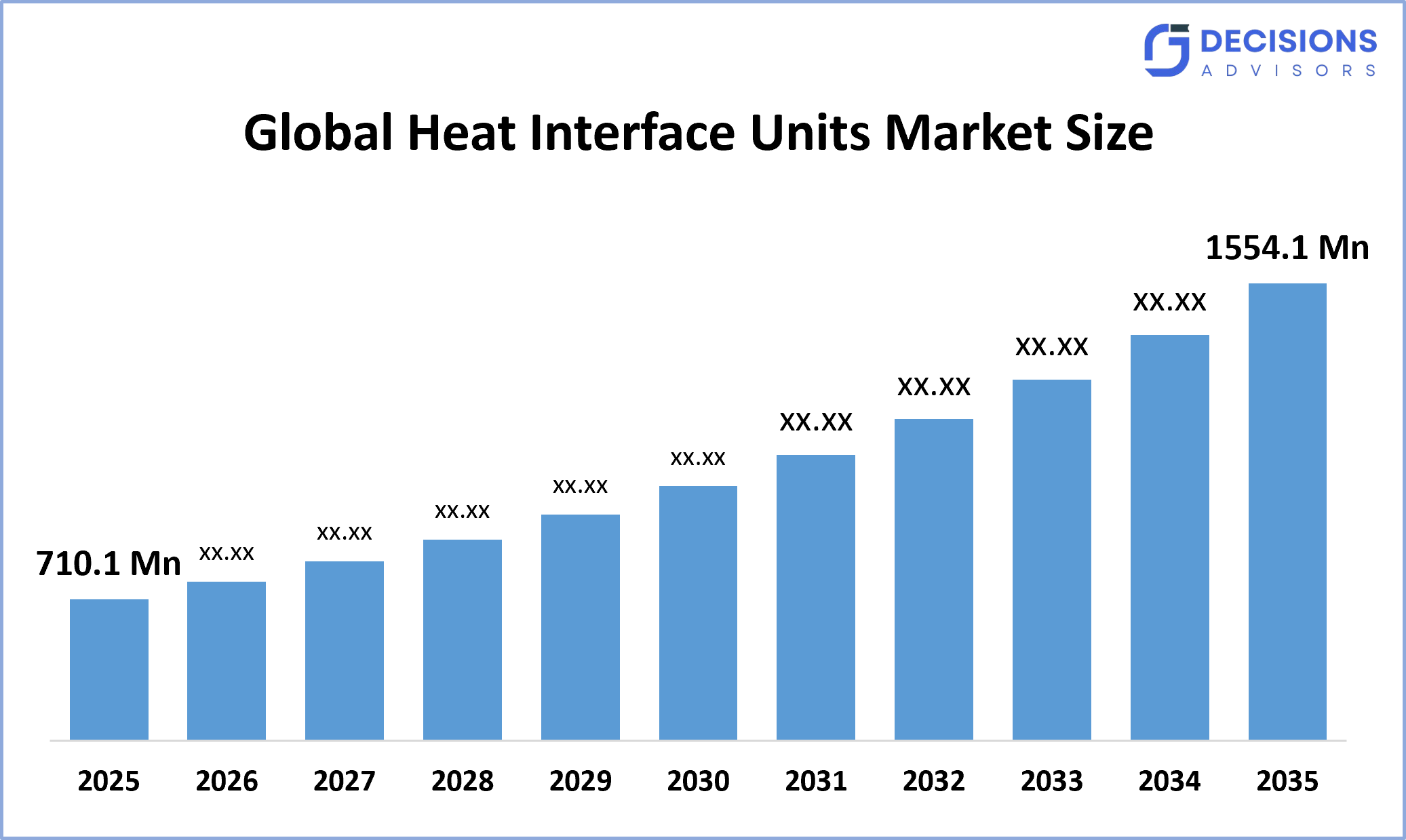
According to Decision Advisors, The Global Heat Interface Units Market Size was valued at USD 710.1 Million in 2025 and is anticipated to reach USD 1554.1 Million by 2035, growing with a CAGR of 8.15% during the forecast period 2026-2035. Expansion of low-carbon heat networks creates opportunities for advanced heat interface units, as growing networks require efficient heat transfer, smart controls, metering, and reliable building-level performance systems across urban areas.
Global Heat Interface Units Market Size Insights Forecasts to 2035
- The Global Heat Interface Units Market Size Was Valued at USD 710.1 million in 2025
- The Market Size is Expected to Grow at a CAGR of around 8.15% from 2025 to 2035
- The Worldwide Heat Interface Units Market Size is Expected to Reach USD 1554.1 million by 2035
- Asia Pacific is expected to grow the fastest during the forecast period.
What is a Heat Interface Units?
Heat Interface Units (HIUs) are compact devices that connect individual homes or buildings to centralized or district heating networks. They transfer heat to provide space heating and domestic hot water while controlling supply and measuring consumption. HIUs typically include heat exchangers, control valves, temperature controls, and heat meters. They eliminate the need for individual boilers in properties connected to heat networks and support efficient heat distribution, monitoring, and reliable heating performance.
Report Coverage
This research report categorizes the heat interface units market based on various segments and regions, forecasts revenue growth, and analyzes trends in each submarket. The report analyses the key growth drivers, opportunities, and challenges influencing the heat interface units market. Recent market developments and competitive strategies, such as expansion, product launches, development, partnership, merger, and acquisition, have been included to draw the competitive landscape in the market. The report strategically identifies and profiles the key market players and analyses their core competencies in each sub-segment of the heat interface units market.
Trending Factors
- Expansion of District Heating Networks: Growing deployment of district heating networks is increasing demand for heat interface units that efficiently connect individual buildings to centralized heat sources and distribute heating.
- Smart Controls and Metering: Integration of smart controls and metering is improving heat interface units by enabling better temperature regulation, consumption monitoring, remote management, and more efficient network operation.
- Adoption of Low-Carbon Heat Sources: Low-carbon heat sources such as large heat pumps, waste heat, and geothermal energy encourage compatible heat interface units for cleaner and more flexible heating networks.
- Compact and Efficient HIU Designs: Modern heat interface units emphasize compact designs, improved heat transfer, and reliable components, helping buildings achieve efficient heating while reducing space requirements and maintenance needs.
- Replacement and Upgrading of Existing Systems: Growing heat network upgrades are creating demand for replacement heat interface units that improve heating control, reliability, efficiency, and consumer experience in existing connected properties.
What is the use of AI in the Heat Interface Units Market?
AI can analyze data from HIUs, sensors, meters, and heat networks to optimize heating performance, identify abnormal operating conditions, predict maintenance requirements, and improve energy efficiency. AI-enabled controls can learn heating-demand patterns and support automated adjustments to temperatures, flows, and system operation. This helps reduce energy waste, improve reliability, maintain consumer comfort, and support predictive maintenance across connected heat networks.
Driving Factor
Expansion of District Heating Networks
The expansion of district and communal heating networks is driving demand for Heat Interface Units (HIUs). As more residential and commercial buildings connect to centralized heat sources, HIUs are required to transfer heat efficiently while providing temperature control and domestic hot water. Increasing development of low-carbon heat networks, urban housing projects, and centralized heating infrastructure further supports adoption. HIUs also enable individual heat metering and system control, helping network operators improve energy management, service reliability, and consumer-level heating performance.
Restraining Factors
Heat Interface Units can require specialized installation, commissioning, and integration with district heating infrastructure. Compatibility issues with existing heating systems, network configurations, controls, and metering equipment can increase installation costs, maintenance requirements, and technical complexity, limiting adoption.
Opportunities
Integration with Thermal Energy Storage
Integration of Heat Interface Units with thermal energy storage systems creates opportunities to manage variations in heating demand more effectively. Stored thermal energy can support heating requirements during peak periods, improve utilization of centralized heat sources, and provide greater operational flexibility. This combination can also help heat-network operators balance supply and demand while improving overall system efficiency.
Expansion of HIU Retrofit Solutions
The modernization of existing district and communal heating systems creates opportunities for retrofit-focused Heat Interface Units. Replacing older or inefficient units with modern HIUs can improve heat transfer, temperature control, metering, and system reliability. Manufacturers can develop compact and easily installable solutions that reduce disruption during upgrades, particularly in occupied residential buildings and older heat-network developments.
Market Segmentation
1. By Component
The heat exchangers segment held the largest share of the market in 2025. The segment is driven by the essential role of heat exchangers in transferring thermal energy between district heating networks and building-level heating systems. Heat exchangers enable efficient separation of primary and secondary circuits while supporting domestic hot water and space-heating requirements.
The sensors segment is growing rapidly due to increasing demand for accurate temperature monitoring, heat consumption measurement, and improved system control. Sensors help HIUs monitor operating conditions and support efficient heating performance.
2. By Product
The indirect segment dominated the market in 2025, driven by its ability to separate the primary heat network from the building’s secondary heating circuit. Indirect HIUs use heat exchangers to transfer thermal energy without directly mixing network water with building-system water.
The direct segment is growing rapidly due to its simpler configuration and efficient delivery of heat from centralized systems. Direct HIUs can provide heating with fewer heat-transfer stages, potentially supporting straightforward system designs and installation.
3. By Application
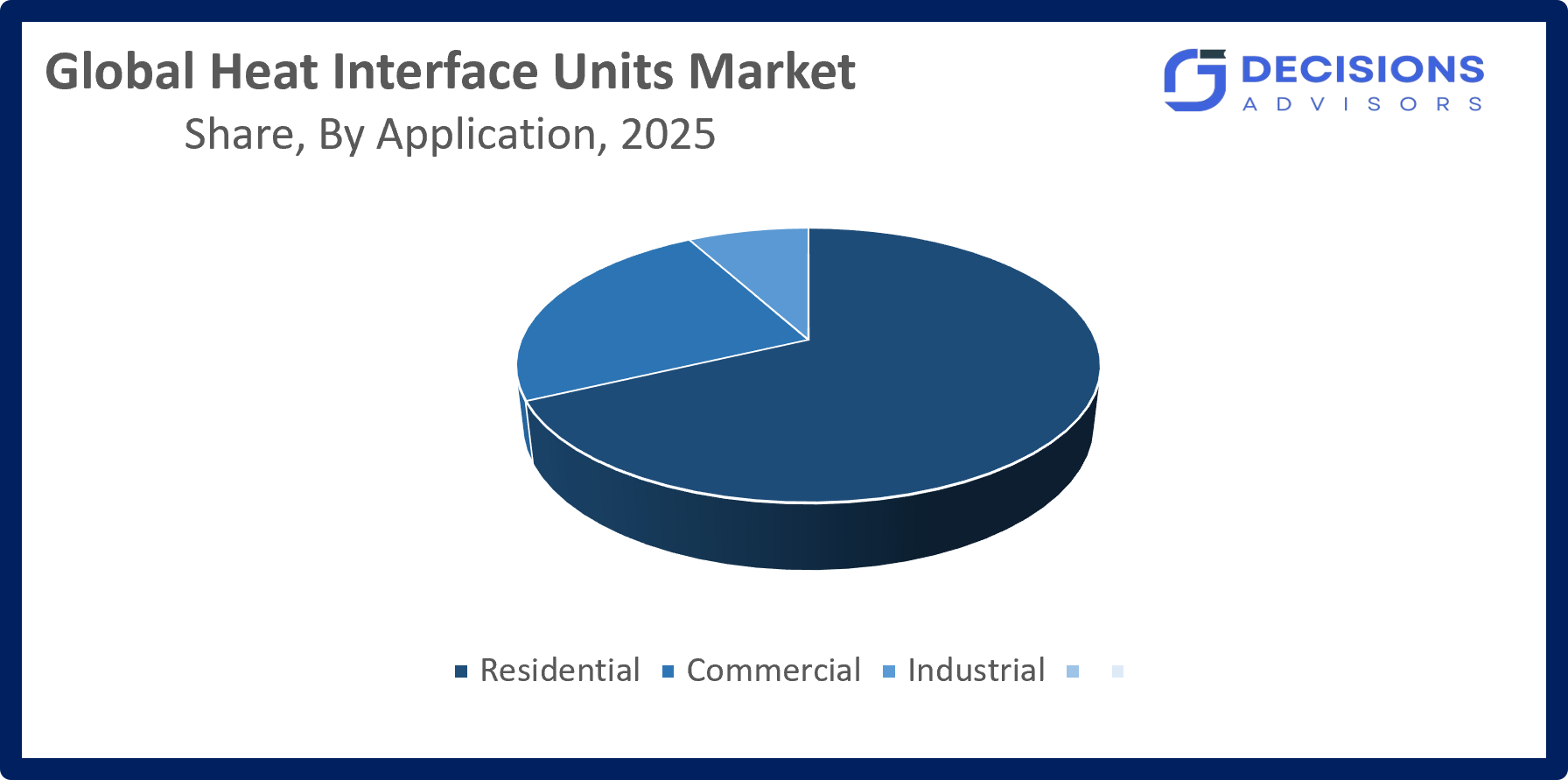
The residential segment dominated the market in 2025, supported by increasing connections of homes and apartment developments to district and communal heating networks. HIUs provide space heating and domestic hot water while enabling individual temperature control and heat consumption measurement.
The commercial segment is growing rapidly due to increasing adoption of centralized heating systems in offices, hotels, hospitals, educational institutions, and other commercial buildings. HIUs support efficient heat distribution, temperature regulation, and consumption monitoring in these facilities.
Regional Segment Analysis of the Heat Interface Units Market
- North America (U.S., Canada, Mexico)
- Europe (Germany, France, U.K., Italy, Spain, Rest of Europe)
- Asia-Pacific (China, Japan, India, Rest of APAC)
- South America (Brazil and the Rest of South America)
- The Middle East and Africa (UAE, South Africa, Rest of MEA)
Europe dominated the heat interface units market, accounting for 43% of the market share in 2025.
Growth in Europe is supported by established district heating networks, increasing deployment of low-carbon heating systems, and government efforts to modernize existing heat networks. The region includes the UK, Germany, France, Italy, Spain, and other European countries, with the UK playing an important role in heat-network development and modernization. Heat Interface Units are used to connect individual properties to centralized heating systems, providing space heating and hot water while enabling temperature control and metering. The UK government is supporting heat-network expansion through zoning, investment, and efficiency programs.
In September 2026, the UK government announced £90 million of investment in clean heat networks, with more than 750,000 homes expected to benefit. The funding also includes £13.3 million to upgrade 76 inefficient heat networks.
Asia Pacific is expected to be the fastest-growing regional market for heat interface units, supported by expanding urban development, increasing investment in centralized heating infrastructure, and growing demand for energy-efficient heating systems. China, Japan, South Korea, and other countries are important markets, particularly where district and communal heating systems are being developed or modernized. Increasing construction of residential and commercial buildings and the adoption of efficient heating technologies are creating opportunities for HIU manufacturers. The region's growing focus on energy efficiency and lower-carbon heating is also encouraging modernization of heating infrastructure and greater use of advanced heat-network equipment.
In March 2026, Beijing’s Development and Reform Commission announced its first 2026 round of fixed-asset investment support for new-energy heating projects, offering 30% support for projects with at least 60% new-energy capacity.
SWOT Analysis
|
Strength |
Growing demand for efficient district and communal heating systems |
|
Weakness |
Complex installation, integration, and maintenance requirements |
|
Opportunities |
Expansion of low-carbon heat networks and smart HIU technologies |
|
Threat |
Alternative individual heating systems and heat-pump solutions |
List of Key Companies
- Danfoss A/S
- Alfa Laval AB
- Armstrong Fluid Technology
- Caleffi S.p.A.
- Giacomini S.p.A.
- Cetetherm AB
- Dutypoint Ltd.
- SAV Systems Ltd.
- Intatec Ltd.
- Baxi Heating UK
- Ideal Heating
- Evinox Energy Ltd.
- Modutherm Ltd.
- Vital Energi Ltd.
- Others
Key Target Audience
- Market Players
- Investors
- End-users
- Government Authorities
- Consulting and Research Firm
- Venture capitalists
- Value-Added Resellers (VARs)
Recent Development
- In August 2025, NIBE Energy Systems expanded its UK HVAC portfolio by adding Cetetherm Pioneer heat interface units and substations, supporting district heating, heat pumps, and large-scale heat network projects.
- In March 2025, Danfoss showcased EvoFlat 4.0 PRO at ISH 2025, introducing a next-generation heat interface unit designed for heat-pump integration, remote monitoring, control, maintenance, and improved efficiency across buildings.
Market Segment
This study forecasts revenue at global, regional, and country levels from 2020 to 2035. Decision Advisors has segmented the heat interface units market based on the below-mentioned segments:
Global Heat Interface Units Market, By Component
- Heat Exchangers
- Controllers
- Pumps
- Sensors
- Valves
Global Heat Interface Units Market, By Product
- Indirect
- Direct
Global Heat Interface Units Market, By Application
- Residential
- Commercial
- Industrial
Global Heat Interface Units Market, By Regional Analysis
- North America
- US
- Canada
- Mexico
- Europe
- Germany
- UK
- France
- Italy
- Spain
- Russia
- Rest of Europe
- Asia Pacific
- China
- Japan
- India
- South Korea
- Australia
- Rest of Asia Pacific
- South America
- Brazil
- Argentina
- Rest of South America
- Middle East & Africa
- UAE
- Saudi Arabia
- Qatar
- South Africa
- Rest of the Middle East & Africa
Frequently Asked Questions (FAQ)
- What are Heat Interface Units?
Heat Interface Units connect individual homes or buildings to centralized or district heating networks, transferring heat for space heating and domestic hot water while providing temperature control, metering, and monitoring.
- What is the projected size of the Heat Interface Units market?
The global Heat Interface Units market was valued at USD 710.1 million in 2025 and is projected to reach USD 1554.1 million by 2035, growing at 8.15% CAGR during forecasts.
- What is driving the Heat Interface Units market?
Expansion of district and communal heating networks is a major driver, as more residential and commercial buildings require efficient heat transfer, temperature control, domestic hot water, and individual metering systems.
- How is AI used in the Heat Interface Units market?
AI can analyze data from HIUs, sensors, meters, and heat networks to optimize heating performance, detect abnormal conditions, predict maintenance needs, adjust operation, reduce energy waste, and improve system reliability.
- What restrains the Heat Interface Units market?
Complex installation, commissioning, and integration with district heating infrastructure can increase costs and maintenance requirements, while compatibility issues involving controls, network configurations, and metering equipment may limit overall market adoption.
Check Licence
Choose the plan that fits you best: Single User, Multi-User, or Enterprise solutions tailored for your needs.
We Have You Covered
- 24/7 Analyst Support
- Clients Across the Globe
- Tailored Insights
- Technology Tracking
- Competitive Intelligence
- Custom Research
- Syndicated Market Studies
- Market Overview
- Market Segmentation
- Growth Drivers
- Market Opportunities
- Regulatory Insights
- Innovation & Sustainability
Report Details
| Scope | Global |
| Pages | 245 |
| Delivery | PDF & Excel via Email |
| Language | English |
| Release | Oct 2026 |
| Access | Download from this page |