
Global Heat Pump Water Heater Market
 |
Author:
Pranali P
|
Pages:
210
|
Author:
Pranali P
|
Pages:
210
Global Heat pump water heater Market Size, Share, By Type (Air-to-Air, Air-to-Water, Water source, Ground Source, and Hybrid), By Rated Capacity (Up to 10 KW, Up to 500 liters, 500-1,000 liters, and Above 1,000 liters) By End User (Residential, Commercial, and Industrial), and By Region (North America, Europe, Asia-Pacific, Latin America, Middle East, and Africa), Analysis and Forecast 2026-2035
CAGR
14.47%
REVENUE 2025
USD Billion 6.8
FORECAST 2035
USD Billion 26.28
REPORT COVERAGE
Global
Market Snapshot
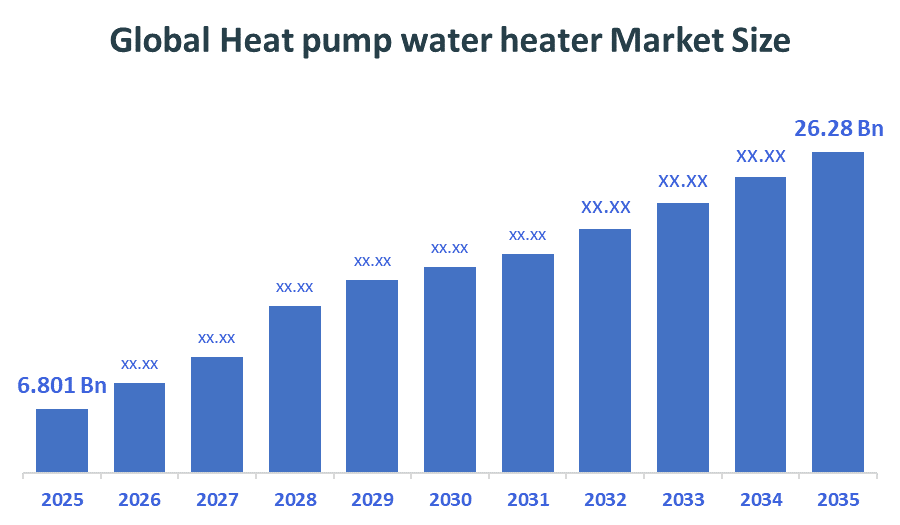
- Global Heat pump water heater Market Size (2025): USD 6.801 Billion
- Projected Global Heat pump water heater Market Size (2035): USD 26.28 Billion
- Global Heat pump water heater Compound Annual Growth Rate (CAGR): 14.47%
- Largest Regional Market: Asia pacific
- Fastest Growing Region: North America
- 3rd Largest Region: Europe
- Base Year: 2025
- Historical Period: 2021–2024
- Forecast Period: 2026–2035
Market Overview/ Introduction
The global market of the Heat Pump Water Heater (HPWH) is rapidly growing due to the growing demand for energy-efficient and sustainable methods of heating. The HPWH is a sophisticated system that heats water by transferring heat from the surrounding air, soil, or water to water. The system consumes less electricity than traditional gas or electric heaters. The system is capable of saving energy consumption of up to 3-4 times more compared to other traditional systems, thus being popular among households, hotels, hospitals, and industrial enterprises which need to maintain the steady flow of heated water. Growing cost of electricity, as well as environmental concerns and efforts to lower carbon emissions on a global scale, become key drivers for the global market development. Advancements in control systems, inverters, remote management technologies, and use of better refrigerants (R290), are making systems more efficient. The government plays an important part in this regard, providing subsidies and tax rebates and implementing energy efficiency rules. Promotion of renewable energy technologies, along with increased electrification through such programs, particularly in the Asia-Pacific and European regions, is driving the growth of the market.
- In March 2024: France offers up to €1,000+ subsidies and Ireland up to €4,500 for air-to-water heat pumps, while EU nations accelerate fossil boiler phase-out policies supporting clean heating adoption.
- In August 2022: The U.S. Inflation Reduction Act offers a 30% tax credit up to $2,000 for heat pump water heater installations, boosting residential adoption and energy-efficient heating transition.
Notable Insights: -
- Asia-Pacific holds the largest regional market share approximately 48% in the global Heat pump water heater market.
- North America is the fastest growing region market share approximately 39% in the global Heat pump water heater market.
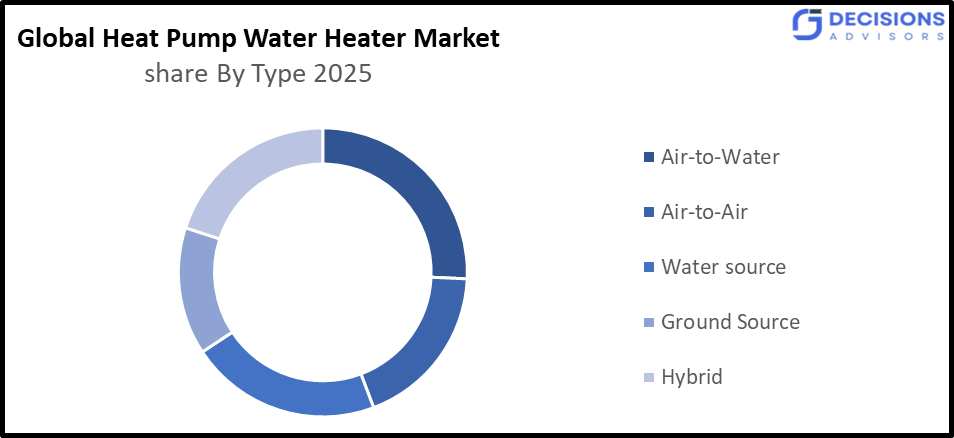
- By type, the Air-to-Water segment held a dominant position with 51% in terms of market share in 2025.
- By rated capacity, Up to 500 Liters segment is the dominating accounting for market is approximately 55%.
- By end user, residential segment held a dominant position market is approximately 58%.
- The market is likely to achieve a valuation of USD 26.28 Billion by 2035.
What is role of technology in grooming the market?
Technology plays a crucial role in shaping the Heat Pump Water Heater (HPWH) market by enhancing efficiency, intelligence, and sustainability. Advanced compressors and heat exchangers enable systems to achieve a Coefficient of Performance (COP) of 3–5, making them up to 3–6 times more energy-efficient than conventional heaters. Smart IoT-enabled controls and inverter technology reduce electricity consumption by 15–30% through optimized operation. The use of eco-friendly refrigerants such as R290 and CO? (R744) lowers environmental impact.
How is Recent Developments Helping the Market?
Recent developments are significantly boosting the Heat Pump Water Heater (HPWH) market by improving efficiency, affordability, and adoption. New product launches by companies like Carrier Global and Midea Group in 2025 focus on integrated air-to-water systems with higher efficiency and easier installation, accelerating consumer adoption. Smart technologies such as IoT-enabled controls and predictive systems are reducing energy consumption by 20–30%, while advanced models deliver 3–6× higher efficiency than traditional heaters.
Market Drivers
The HPWH market is fuelled by the increasing need for energy-efficient and environmentally friendly heating devices. Such technologies can provide up to three to four times more efficiency compared to ordinary electric water heaters, thus reducing electrical energy consumption. The awareness about climate change and regulations on emission reduction in many countries are contributing to the increase in sales. Many governments have developed standards for energy efficiency and provide rebates that cover from 20 to 50% of the cost of installing HPWH systems. The rise in electricity rates around the world encourages users to invest in energy-efficient systems. HPWH technology helps save 60 to 70% of the energy needed to heat water. Urbanization and building development are increasing the demand for innovative and reliable water heating equipment. Innovations related to inverters, controllers, and the possibility of using solar panels in conjunction with water heaters are developing rapidly.
Restrain
The heat pump water heater market faces restraints due to high upfront installation costs, often 2–3 times higher than conventional systems, limiting adoption in price-sensitive markets. Performance depends on ambient temperature, reducing efficiency in colder climates. Installation complexity and space requirements also hinder uptake. Additionally, low consumer awareness and limited availability of skilled technicians further restrict widespread market penetration.
Competitive Analysis:
The report offers the appropriate analysis of the key organizations/companies involved within the heat pump water heater market, along with a comparative evaluation primarily based on their Product of offering, business overviews, geographic presence, enterprise strategies, segment market share, and SWOT analysis. The report also provides an elaborative analysis focusing on the current news and developments of the companies, which includes Product development, innovations, joint ventures, partnerships, mergers & acquisitions, strategic alliances, and Others. This allows for the evaluation of the overall competition within the market.
Top Companies in Global Heat pump water heater Market
- Panasonic Holdings Corporation
- LG Electronics
- Mitsubishi Electric
- Johnson Controls-Hitachi Air Conditioning
- Trane Technologies
- Rheem Manufacturing Company
- A. O. Smith Corporation
- Bosch Thermotechnology
- Daikin Industries
- Stiebel Eltron
Government Initiatives
|
Country |
Key Government Initiatives |
|
U.S.
|
In August 2024: The U.S. offers a 30% tax credit up to $2,000 for heat pump water heaters, with additional rebates up to $1,750 and state incentives reaching $10,000. |
|
Japan |
In April 2024: Japan advanced heat pump water heater adoption, with CO?-based systems achieving up to 300% efficiency and reducing household energy use by nearly 60%, strengthening cold-climate performance leadership. |
Study on the Supply, Demand, Distribution, and Market Environment of Heat Pump Water Heater Market
The HPWH market represents an equilibrium of supply and demand with proper distribution and market environment conditions. Regarding supply, manufacturers are scaling up their production capabilities and employing modern technologies like inverter compressors and environmentally friendly refrigerants. As for demand, the market is growing owing to increased awareness about energy efficiency, as HPWH reduces energy usage by 60-70 percent compared to traditional systems. It is also experiencing robust growth in the residential and commercial markets, particularly in Asia-Pacific and Europe. Concerning distribution, online sales, HVAC distribution, and direct selling channels play important roles. Market factors include financial incentives provided by the government, carbon emission reduction initiatives, and green buildings regulations, all of which contribute to the adoption of HPWHs.
Price Analysis and Consumer Behaviour Analysis
Heat pump water heater pricing reveals that they have a much higher up-front cost of between $2,500 and $4,500, making them 2 to 3 times more expensive than other types of water heaters. But their energy-efficient nature allows for savings of 60 to 70%, thus resulting in a payback period of 2 to 3 years in most areas. Based on consumer behaviour, it is apparent that 68% of consumers choose them based on the savings achieved in the long term, 54% due to their environmental friendliness, while 49% do so due to government rebates. Most early adopters tend to be environmentally friendly and high-income earners, although their adoption has been spreading through increased awareness. High initial costs and installation complexity limit adoption
Market Segmentation
The Heat pump water heater market share is classified into mounting type, Rated Capacity, and end user
- The type segment dominated the market in 2025, and is projected to grow at a substantial CAGR of approximately 8.5% during the forecast period.
Based on the type, the heat pump water heater market is divided into air-to-air, air-to-water, water source, ground source, and hybrid. Among these, Air-to-water heat pump water heaters dominate the global market due to their low installation complexity, cost efficiency, and wide suitability for residential and commercial use. They are easier to deploy compared to ground source and water source systems, as they do not require drilling or access to natural water bodies. This segment holds approximately 51% of global market share and is expected to grow at a CAGR of around 8%–9% during the forecast period. Strong energy efficiency benefits and supportive government incentives further drive their widespread adoption globally.
Top of Form
- The rated capacity segment accounted for the largest share in 2025, and is anticipated to grow at a significant CAGR of approximately 8.7% during the forecast period.
Based on the rated capacity, the heat pump water heater market is divided into Up to 10 KW, Up to 500 Liters, 500-1,000 Liters, and Above 1,000 Liters. Among these, the “Up to 500 Liters” segment dominates the heat pump water heater market due to its high suitability for residential and small commercial applications. It offers an optimal balance of capacity, cost, and energy efficiency, making it widely preferred globally. This segment accounts for approximately 55% of global market revenue share and is expected to grow at a CAGR of around 8%–9%. Strong residential demand, urban housing growth, and energy-saving benefits further drive its market leadership.
Bottom of Form
- The end user segment dominated the market in 2025, and is projected to grow at a substantial CAGR of approximately 8.7% during the forecast period.
Based on the end user, the heat pump water heater market is divided into residential, commercial, industrial, malls & auditoriums, airports & transit stations, industrial, commercial, and others. Among these, the residential segment dominates the heat pump water heater market due to high adoption in households seeking energy-efficient and cost-saving water heating solutions. Growing urbanization, rising electricity prices, and government incentives for low-carbon technologies further support demand. This segment accounts for approximately 58% of global market revenue share and is projected to grow at a CAGR of around 8.2%–9.1% during the forecast period. Easy installation and replacement of conventional electric heaters also drive strong residential market leadership globally.
Top of Form
Bottom of Form
Strategies to Implement for Growth of the Market in Non-Leading Regions
In order to promote the growth of the heat pump water heater market in non-leadership areas, it is important to consider affordability, consumer education, and infrastructure development. Affordable pricing, financing solutions, and leasing options can help tackle the problem of high initial costs in price-sensitive markets. Cooperation with the government will ensure the provision of subsidies, tax incentives, and energy efficiency initiatives. It is crucial to educate customers on the benefits of using this technology by conducting promotional campaigns. The development of distribution channels, including the use of local dealers, online sales channels, and HVAC installation services, will help increase the product availability in remote markets. Local manufacturing will also be beneficial in terms of costs and product adjustment to the climatic conditions. Training programs for professionals will be useful in tackling the problems related to installation and operation. Furthermore, connecting the system with alternative power sources will make it attractive for customers in the markets with unreliable energy supply.
Regional Segment Analysis of the Heat pump water heater Market
- North America (U.S., Canada, Mexico)
- Europe (Germany, France, U.K., Italy, Spain, Rest of Europe)
- Asia-Pacific (China, Japan, India, Rest of APAC)
- South America (Brazil and the Rest of South America)
- The Middle East and Africa (UAE, South Africa, Rest of MEA)
Asia pacific is anticipated to hold the largest share of the heat pump water heater market over the predicted timeframe.
Asia Pacific is anticipated to hold the largest share of the heat pump water heater market over the forecast period, driven by rapid urbanization, supportive government policies, and rising energy efficiency awareness. The regional market is projected to grow from approximately 48% of the global market revenue share over the forecast period, registering a CAGR of around 8.5–9.2%. Strong demand from countries like China, Japan, and Australia, along with incentives for low-carbon technologies, is accelerating adoption. Increasing construction activities and rising electricity costs further contribute to sustained market expansion across residential and commercial sectors.
North America is expected to grow at a rapid CAGR in the heat pump water heater market during the forecast period. North America is expected to grow at a rapid CAGR in the heat pump water heater market during the forecast period, driven by rising energy efficiency regulations and increasing replacement of conventional water heating systems. The regional market is projected to reach approximately approximately 25%–30% of the global heat pump water heater market revenue share, registering a CAGR of about 7.5%–8.5%. Strong adoption in the United States and Canada is supported by government rebates, tax credits, and decarbonization targets. Increasing electricity costs and growing demand for sustainable residential and commercial heating solutions further accelerate market expansion across the region.
Europe is the 3rd largest region to grow in the heat pump water heater market during the region. Europe is the third-largest region in the heat pump water heater market, driven by strong decarbonization goals, energy efficiency regulations, and increasing adoption of renewable heating systems. The regional market is projected to grow from approximately 18%–22% of global market revenue share, registering a CAGR of about 7%–8% during the forecast period. Demand is supported by strict EU building energy codes, carbon neutrality targets for 2050, and government incentives for low-emission heating technologies. Countries such as Germany, France, the UK, and Nordic nations are leading adoption, especially in residential retrofits and commercial infrastructure upgrades.
Future Market Trends in Global Heat pump water heater Market: -
- Integration with Renewable Energy Systems
A major future trend is the integration of heat pump water heaters with renewable energy sources like solar PV. This combination allows users to run systems on clean, self-generated electricity, reducing grid dependence and energy costs. Smart controllers optimize heating during peak solar hours, improving efficiency. Government incentives for green energy adoption further support this trend. As net-zero housing expands globally, hybrid renewable-powered water heating systems are expected to become a standard solution in both residential and commercial buildings.
2. Smart and IoT-Enabled Systems
Heat pump water heaters are increasingly becoming smart and connected devices. IoT-enabled systems allow users to control temperature, monitor energy consumption, and set schedules via mobile apps. AI-based features optimize performance based on usage patterns and weather conditions, improving efficiency and reducing costs. Predictive maintenance alerts help prevent breakdowns and extend product life. With growing smart home adoption, demand for digitally advanced and remotely controlled water heating systems is rising rapidly in urban markets.
- Regulatory Push and Green Building Growth
Strict energy efficiency regulations and green building standards are driving adoption of heat pump water heaters. Governments worldwide are promoting low-carbon technologies through subsidies, tax credits, and building codes. Certifications like LEED and BREEAM encourage developers to install energy-efficient systems in new projects. This regulatory support is especially strong in Europe, North America, and Asia-Pacific. As countries move toward net-zero targets, heat pump water heaters are becoming essential in sustainable residential and commercial construction.
Recent Development
- In February 2025, Carrier launched a 4–14 kW air-to-water heat pump range using propane refrigerant, delivering up to 75°C water output, strengthening energy-efficient residential heat pump water heater solutions globally.
- In January 2025, Midea launched an air-source heat pump water heater for North America, delivering up to 70% energy savings and reducing electricity use by nearly 3× compared to conventional heaters.
- In July 2024, A. O. Smith launched the Voltex MAX hybrid heat pump water heater, offering up to 4× efficiency and reducing energy consumption by around 65% for residential applications.
Market Segment
This study forecasts revenue at global, regional, and country levels from 2021 to 2035. Decision Advisors has segmented the heat pump water heater market based on the below-mentioned segments:
Global Heat pump water heater Market, By Type
- Air-to-Air
- Air-to-Water
- Water source
- Ground Source
- Hybrid
Global Heat pump water heater Market, By Rated Capacity
- Up to 10 KW
- Up to 500 Liters
- 500-1,000 Liters
- Above 1,000 Liters
Global Heat pump water heater Market, By End User
- Residential
- Commercial
- Industrial
Global Heat pump water heater Market, By Regional Analysis
- North America
- US
- Canada
- Mexico
- Europe
- Germany
- UK
- France
- Italy
- Spain
- Russia
- Rest of Europe
- Asia Pacific
- China
- Japan
- India
- South Korea
- Australia
- Rest of Asia Pacific
- South America
- Brazil
- Argentina
- Rest of South America
- Middle East & Africa
- UAE
- Saudi Arabia
- Qatar
- South Africa
- Rest of the Middle East & Africa
Frequently Asked Questions (FAQ)
Q1. What are the key sustainability benefits of heat pump water heaters beyond energy savings?
Heat pump water heaters also contribute to reducing carbon emissions by lowering dependence on fossil-fuel-based heating systems. They support electrification of heating infrastructure and integrate well with renewable energy sources, helping organizations and households achieve long-term sustainability goals and net-zero targets.
Q2. How does climate variation impact the performance of heat pump water heaters?
Performance can vary depending on ambient temperature and humidity levels. In colder regions, efficiency may decline slightly, requiring hybrid or backup heating systems. However, modern technologies and advanced refrigerants are improving performance consistency across diverse climatic conditions.
Q3. What role does digital transformation play in future HPWH adoption?
Digital transformation is enabling predictive maintenance, remote monitoring, and AI-based optimization of energy usage. These advancements improve system reliability, reduce operational costs, and enhance user convenience, thereby increasing adoption in smart homes and commercial buildings.
Q4. How is urban infrastructure development influencing market growth?
Rapid urban expansion is increasing demand for modern residential and commercial buildings equipped with efficient heating systems. Integration of heat pump water heaters into new construction projects is becoming more common due to energy codes and sustainability requirements.
Q5. What are the emerging financing models supporting market expansion?
Innovative financing models such as pay-as-you-save schemes, leasing options, and performance-based contracts are making heat pump water heaters more affordable. These models reduce upfront financial burden and encourage wider adoption in developing and price-sensitive markets.
Check Licence
Choose the plan that fits you best: Single User, Multi-User, or Enterprise solutions tailored for your needs.
We Have You Covered
- 24/7 Analyst Support
- Clients Across the Globe
- Tailored Insights
- Technology Tracking
- Competitive Intelligence
- Custom Research
- Syndicated Market Studies
- Market Overview
- Market Segmentation
- Growth Drivers
- Market Opportunities
- Regulatory Insights
- Innovation & Sustainability
Report Details
| Scope | Global |
| Pages | 210 |
| Delivery | PDF & Excel via Email |
| Language | English |
| Release | Apr 2026 |
| Access | Download from this page |