
Global Helicobacter Pylori Infections Treatment Market
 |
Pages:
230
|
Pages:
230
Global Helicobacter Pylori Infections Treatment Market Size, Share, and COVID-19 Impact Analysis, By Treatment (Bismuth-quadruple Therapy, Concomitant Therapy, Levofloxacin Triple Therapy, Bismuth Therapy, and High-dose Dual Therapy), By Application (Hospitals, Diagnostic Laboratories, and Clinics), and By Region (North America, Europe, Asia-Pacific, Latin America, Middle East, and Africa), Analysis and Forecast 2025-2035
REPORT COVERAGE
Global
Global Helicobacter Pylori Infections Treatment Market Size Insights Forecasts to 2035
- The Global Helicobacter Pylori Infections Treatment Market Size Was valued at USD 681.3 Million in 2024
- The Global Helicobacter Pylori Infections Treatment Market Size is Expected to Grow at a CAGR of around 7.44% from 2025 to 2035
- The Worldwide Helicobacter Pylori Infections Treatment Market Size is Expected to Reach USD 1501.0 Million by 2035
- Asia-Pacific is expected to grow the fastest during the forecast period.
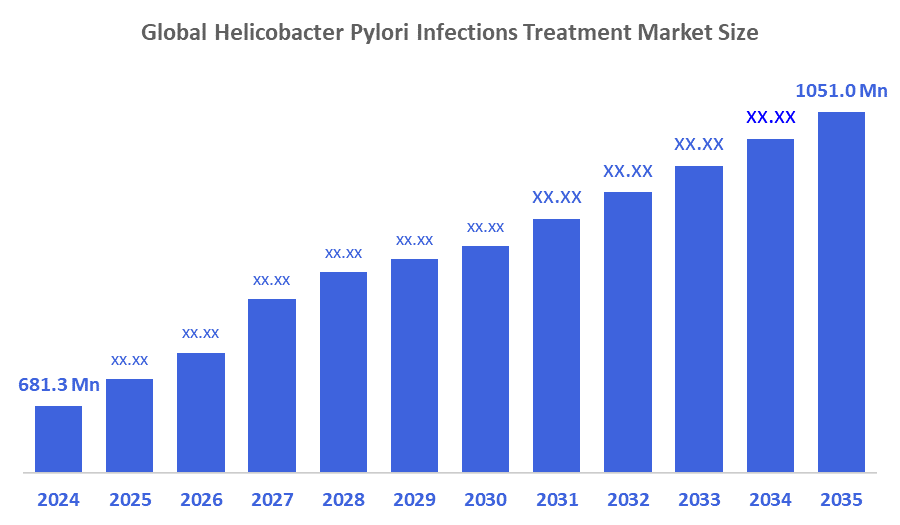
According to a research report published by Decisions Advisors and Consulting, The Global Helicobacter Pylori Infections Treatment Market Size Was Worth Around USD 681.3 Million In 2024 And Is Predicted To Grow To Around USD 1501.0 Million By 2035 With A Compound Annual Growth Rate (CAGR) Of 7.44% From 2025 To 2035. The Global Helicobacter Pylori Infections Treatment Market creates future growth opportunities through advanced therapy and diagnostic development personal treatment method creation public awareness campaigns and screening programs and new combination drug development and emerging healthcare market expansion.
Market Overview
The Global Helicobacter Pylori Infections Treatment Market Size refers to the worldwide industry which develops and produces and sells medical treatments and diagnostic products for Helicobacter pylori infections. The market includes antibiotics and proton pump inhibitors and combination therapies and supportive medications. Additionally, the commercial market currently faces strong impact from rising antibiotic resistance rates which affect Helicobacter pylori (H. pylori) treatment methods. The global medical community observes increasing antibiotic resistance patterns for drugs which include clarithromycin and metronidazole thus researchers need to create new treatment options. RedHill Biopharma developed Talicia which combines omeprazole magnesium amoxicillin and rifabutin to achieve an 84 percent clinical trial eradication rate while standard therapy reaches only 58 percent. Hospitals now prefer hybrid therapies which use multiple antibiotics together with proton pump inhibitors (PPIs) because these treatments better combat bacterial resistance. Phathom Pharmaceuticals and other companies currently conduct clinical trials to test new antibiotics and adjunct therapies which will keep the market active and focused on creating new products.
Report Coverage
This research report categorizes the helicobacter pylori infections treatment market based on various segments and regions, forecasts revenue growth, and analyzes trends in each submarket. The report analyses the key growth drivers, opportunities, and challenges influencing the helicobacter pylori infections treatment market. Recent market developments and competitive strategies such as expansion, type launch, development, partnership, merger, and acquisition, have been included to draw the competitive landscape in the market. The report strategically identifies and profiles the key market players and analyses their core competencies in each sub-segment of the helicobacter pylori infections treatment market.
Driving Factors
The implementation of better diagnostic equipment is changing how doctors identify and observe H. pylori infections. The public is increasingly choosing non-invasive diagnostic methods which include stool antigen tests and urea breath tests because of their precise results and straightforward application and high patient adherence. Molecular diagnostics which include PCR-based tests have become the new standard for H. pylori detection and its resistance pattern identification. The medical field now uses real-time PCR and line probe assays to identify H. pylori infection and antimicrobial resistance from actual patient samples. The latest advancements in technology provide doctors with tools to identify diseases at earlier stages while they create customized treatment plans. Healthcare providers can access complete patient information through digital health platforms which work with diagnostic tools to enhance their treatment methods.
Restraining Factors
People in underserved areas experience diagnostic and treatment delays because they have limited knowledge about H. pylori infections together with their possible complications. Many patients remain asymptomatic until the infection progresses to severe conditions such as gastric ulcers or cancer. The developing regions face a major healthcare challenge because public education campaigns do not exist while people in those areas lack proper access to medical facilities.
Market Segmentation
The helicobacter pylori infections treatment market share is classified into Treatment and application.
- The bismuth therapy segment dominated the market in 2024, approximately 40% and is projected to grow at a substantial CAGR during the forecast period.
Based on the treatment, the helicobacter pylori infections treatment market is divided into bismuth-quadruple therapy, concomitant therapy, levofloxacin triple therapy, bismuth therapy, and high-dose dual therapy. Among these, the bismuth therapy segment dominated the market in 2024, approximately 40% and is projected to grow at a substantial CAGR during the forecast period. The treatment shows better elimination results in areas where antibiotic resistance is increasing because of its higher success rate. The treatment has become a standard first-line option because clinical guidelines prove its effectiveness and dependability. The treatment demonstrates strong market demand and growth potential because physicians increasingly prefer combination regimens while clarithromycin-based therapies show rising resistance.
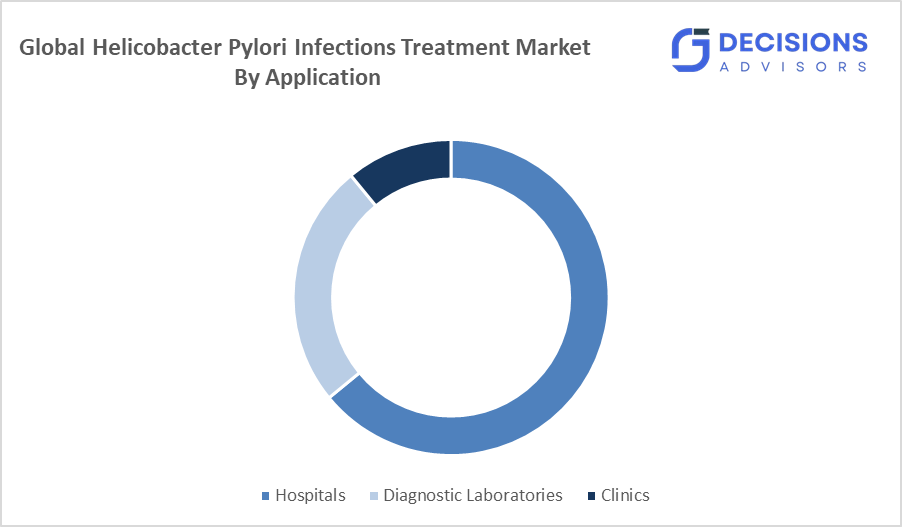
- The hospitals segment accounted for the largest share in 2024, approximately 55% and is anticipated to grow at a significant CAGR during the forecast period.
Based on the application, the helicobacter pylori infections treatment market is divided into hospitals, diagnostic laboratories, and clinics. Among these, the hospitals segment accounted for the largest share in 2024, approximately 55% and is anticipated to grow at a significant CAGR during the forecast period. The up-to-date advanced diagnostic technologies and specialized gastroenterological departments and combination drug treatment options enable hospitals to treat patients with severe infections who need complete medical attention. The sector maintains its dominant revenue share because of improved payment systems and skilled medical staff and increased treatment success rates.
Regional Segment Analysis of the Helicobacter Pylori Infections Treatment Market
- North America (U.S., Canada, Mexico)
- Europe (Germany, France, U.K., Italy, Spain, Rest of Europe)
- Asia-Pacific (China, Japan, India, Rest of APAC)
- South America (Brazil and the Rest of South America)
- The Middle East and Africa (UAE, South Africa, Rest of MEA)
North America is anticipated to hold the largest share of the helicobacter pylori infections treatment market over the predicted timeframe.
North America is anticipated to hold the largest share of the helicobacter pylori infections treatment market over the predicted timeframe. The United States holds 35% of the global market share because its advanced healthcare system supports high disease understanding and provides multiple successful treatment options. The United States serves as the main contributor because it receives large research and development funds which support the development of new treatments such as resistance-targeted antibiotics and their accompanying therapies. Canada plays an essential role in the process because it works to enhance diagnostic capabilities while implementing modern treatment methods. The strict regulatory requirements together with the active public health initiatives create stronger market protection for the region.
Asia-Pacific is expected to grow at a rapid CAGR in the helicobacter pylori infections treatment market during the forecast period. The rising market demand originates from two main factors which include the high H. pylori infection rates that affect densely populated countries especially China and India and Japan and the rising healthcare access and spending. Market growth results from government initiatives that improve public knowledge about gastrointestinal health and their support of new diagnostic and treatment methods. The pharmaceutical industry develops affordable treatment solutions which address specific regional requirements thereby driving market expansion.
Competitive Analysis:
The report offers the appropriate analysis of the key organizations/companies involved within the helicobacter pylori infections treatment market, along with a comparative evaluation primarily based on their type of offering, business overviews, geographic presence, enterprise strategies, segment market share, and SWOT analysis. The report also provides an elaborative analysis focusing on the current news and developments of the companies, which includes type development, innovations, joint ventures, partnerships, mergers & acquisitions, strategic alliances, and others. This allows for the evaluation of the overall competition within the market.
List of Key Companies
- AbbVie
- Alpha Laboratories
- Biohit
- Bio-Rad Laboratories
- Cumberland Pharmaceuticals
- Eisai Co.
- Hoffmann-La Roche
- Phathom Pharmaceuticals
- Redhill Biopharma
- Takeda Pharmaceuticals
Key Target Audience
- Market Players
- Investors
- End-users
- Government Authorities
- Consulting and Research Firm
- Venture capitalists
- Value-Added Resellers (VARs)
Recent Development
- In August 2025, a new review in Phytotherapy Research titled “Compounds of Plant Origin: The Blue Ocean of Anti-Helicobacter pylori Medicines” highlighted plant-derived bioactive compounds as promising alternatives to antibiotics against Helicobacter pylori infections, addressing resistance and treatment limitations with multiple mechanisms of action.
Market Segment
This study forecasts revenue at global, regional, and country levels from 2020 to 2035. Decisions Advisors has segmented the helicobacter pylori infections treatment market based on the below-mentioned segments:
Global Helicobacter Pylori Infections Treatment Market, By Treatment
- Bismuth-quadruple Therapy
- Concomitant Therapy
- Levofloxacin Triple Therapy
- Bismuth Therapy
- High-dose Dual Therapy
Global Helicobacter Pylori Infections Treatment Market, By Application
- Hospitals
- Diagnostic Laboratories
- Clinics
Global Helicobacter Pylori Infections Treatment Market, By Regional Analysis
- North America
- US
- Canada
- Mexico
- Europe
- Germany
- UK
- France
- Italy
- Spain
- Russia
- Rest of Europe
- Asia Pacific
- China
- Japan
- India
- South Korea
- Australia
- Rest of Asia Pacific
- South America
- Brazil
- Argentina
- Rest of South America
- Middle East & Africa
- UAE
- Saudi Arabia
- Qatar
- South Africa
- Rest of the Middle East & Africa
Frequently Asked Questions (FAQ)
- What is the projected growth of the Global Helicobacter Pylori Infections Treatment Market by 2035?
A: The market is expected to grow from USD 681.3 million in 2024 to USD 1501.0 million by 2035, registering a CAGR of 7.44% during 2025–2035.
2. Which treatment segment dominated the market in 2024?
A: The bismuth therapy segment dominated in 2024, accounting for approximately 40% share, driven by higher eradication rates and effectiveness against rising antibiotic resistance.
3. Which application segment held the largest market share in 2024?
A: Hospitals held the largest share at approximately 55% in 2024 due to advanced diagnostics, specialized care, higher patient inflow, and availability of combination therapies.
4. What key factors are driving market growth?
A: Growth is driven by advanced diagnostics, increasing antibiotic resistance, rising awareness, development of novel therapies, digital health integration, and expanding healthcare access in emerging regions.
Check Licence
Choose the plan that fits you best: Single User, Multi-User, or Enterprise solutions tailored for your needs.
We Have You Covered
- 24/7 Analyst Support
- Clients Across the Globe
- Tailored Insights
- Technology Tracking
- Competitive Intelligence
- Custom Research
- Syndicated Market Studies
- Market Overview
- Market Segmentation
- Growth Drivers
- Market Opportunities
- Regulatory Insights
- Innovation & Sustainability
Report Details
| Scope | Global |
| Pages | 230 |
| Delivery | PDF & Excel via Email |
| Language | English |
| Release | Feb 2026 |
| Access | Download from this page |