
Global High Altitude Pseudo-Satellite Market
 |
Author:
Atul K
|
Pages:
210
|
Author:
Atul K
|
Pages:
210
Global High Altitude Pseudo-Satellite Market Size, Share, By Platform Type (Solar-Powered Fixed Wing HAPS, Airship HAPS, and Hybrid HAPS) By Application (Telecommunications, Environmental Monitoring, Defense and Security, Disaster Management, and Commercial Imaging) By End User (Government and Defense, Commercial Enterprises, and Research Institutions) and By Region (North America, Europe, Asia-Pacific, Latin America, Middle East, and Africa), Analysis and Forecast 2026 ? 2035
CAGR
16.8%
REVENUE 2025
USD Million 113.49
FORECAST 2035
USD Million 546.4
REPORT COVERAGE
Global
Market Snapshot
- Global High Altitude Pseudo-Satellite Market Size (2025): USD 113.49
- Global High Altitude Pseudo-Satellite Projected Market Size (2035): USD 546.4 Million
- Global High Altitude Pseudo-Satellite Compound Annual Growth Rate (CAGR): 16.8%
- Largest Regional Market: North America
- Fastest Growing Region: Asia-Pacific
- 3rd Largest Region: Europe
- Base Year: 2025
- Historical Period: 2020–2024
- Forecast Period: 2026–2035
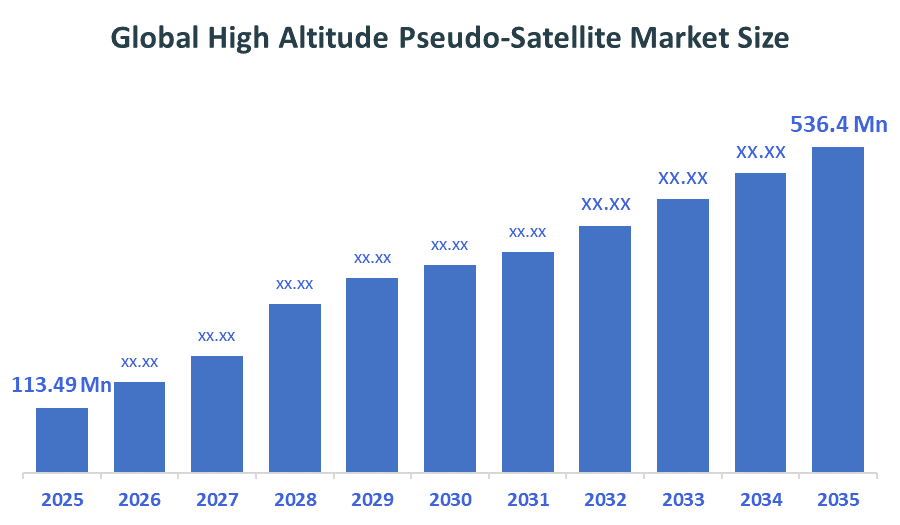
According to Decision Advisors, the global high altitude pseudo-satellite market size is expected to grow from USD 113.49 million in 2025 to USD 536.4 million by 2035, with a CAGR of 16.8% during the forecast period from 2026 to 2035. This sector is destined for a constant upward trajectory since such high-altitude stations will be required for telecommunications and defense systems around the world, mainly because of the requirement for low-latency connectivity and surveillance capabilities. The advancements in the field of lightweight composites and solar-electric propulsion have made these stations dependable enough to provide constant Earth monitoring capability, bridging the distance between ground-based masts and satellite-based stations. Given their cost-effectiveness compared to space-based assets, high-altitude pseudo-satellites are now being widely employed for managing natural disasters and expanding 5G networks.
Market Overview / Introduction
The high-altitude pseudo-satellites constitute an innovative range of aircraft flying in the stratosphere at around 20 kilometres in the air and acting as an intermediate between ground systems and satellites orbiting in space. These aircraft make use of revolutionary technologies such as solar-electric propulsion systems and ultralight carbon fibre structures in order to stay in the air continuously for several weeks and even months. Having been developed first for the purpose of atmospheric study and military experimentation, this kind of aircraft has grown more advanced and evolved into autonomous systems that feature high endurance levels, speedy redeployments, and data transmissions at much shorter latencies compared to satellite technology. One of the key factors driving growth in the Global High Altitude Pseudo-Satellite Market is the rising demand for reliable, ubiquitous, 5G networks and real-time environmental monitoring in distant areas and disaster-prone locations. High altitude pseudo-satellites play a very important role when it comes to ensuring efficiency in data relay and reconnaissance, particularly when defense and communication companies need to maintain constant over-the-horizon coverage without employing costly and complicated satellite solutions.
- The government and military segments contribute to approximately 60% of the application-based use in the market, driven by the increasing demand for border security monitoring, maritime security, and communication relay services.
- Telecommunications in the commercial segment is experiencing substantial growth with a CAGR forecasted to surpass 18% on account of increasing adoption of stratospheric platforms as part of the advanced generation cellular networks for providing broadband services to underserved rural areas.
Notable Insights: -
- Fixed Wing HAPS using solar power hold the dominant market share of about 48%, based on the advantages that these systems offer, such as their ability to operate for months at a time without any interruptions. These types of HAPS platforms are more cost-effective than satellites.
- Approximately 65% of existing HAPS deployments are concentrated in telecom-related applications because such aircraft offer a cost-effective means of establishing communications links in remote areas where access to ground-based facilities or satellite coverage is not feasible.
- The government and defense industries account for more than 60% of the overall market, as HAPS aircraft can conduct surveillance activities above normal commercial airspace without facing any interference.
What is the role of technology in shaping the market?
Advancements in technology are bringing about revolutionary changes in the field of the high-altitude pseudo-satellite industry through the improvements made in flight endurance, payload carrying capabilities, and automation in terms of performance. Today's contemporary stratospheric platforms are no longer a prototype but rather a complete system that has the ability to operate autonomously for a long time due to their ability to incorporate efficient, flexible solar panels, advanced lithium-sulfur batteries, and compatibility with multiple-band communications systems.
How are Recent Developments Helping the Market?
New developments, such as the use of AI-powered flight controllers, the use of ultralight carbon composite frames, and energy management applications, have provided considerable assistance to drive growth in the market. Companies have developed modular platforms that can carry different types of sensors, ranging from hyperspectral cameras to 5G transmitters and operate continuously in the air for several months. With the help of artificial intelligence algorithms, the modules will be able to autonomously fly using the stratospheric wind in order to stay stationary above a certain location. This feature is expected to make maritime observation and disaster management operations easier. Also, HAPS-to-satellite laser data backhaul technology will provide more speed in data transmission and contribute to effective internet connectivity and military operations.
Market Drivers
The global high altitude pseudo-satellite market is growing with the increasing investments of government defense agencies in persistent intelligence, surveillance, and reconnaissance (ISR) capabilities to monitor borders and maritime territories with high-resolution clarity. Modern stratospheric platforms are gaining strong preference in the market with the advantage of integrating multiple functions, such as environmental monitoring, tactical secure communications, and wide-area search and rescue support, into a single reusable system. On the other hand, the growing phenomenon of digital inclusion is fuelling the market demand for affordable broadband technologies that could address the connectivity problem in rural areas or locations where the implementation of fibre optics is impractical. Climate change has also spurred environmental organisations to use these systems for the regular monitoring of atmospheric conditions and tracking of deforestation or illegal mining operations.
Restraints
The development of the international high-altitude pseudo-satellite market is hindered by the challenges involved in ensuring the durability of the structures in the stratospheric environment due to the presence of extreme variations in temperatures and ultraviolet radiation. The costs involved in developing specific launching and retrieval facilities, as well as the costs related to highly efficient energy storage systems, pose further barriers to the quick implementation of the technology by smaller firms. Dependencies on international suppliers of solar cells that are highly efficient and the necessity for aerospace engineers to control the operation of the fleets pose additional challenges to the adoption of the technology in less developed countries.
Competitive Analysis:
The report offers the appropriate analysis of the key organisations/companies involved within the high-altitude pseudo-satellite market, along with a comparative evaluation primarily based on their product offerings, business overviews, geographic presence, enterprise strategies, segment market share, and SWOT analysis. The report also provides an elaborate analysis focusing on the current news and developments of the companies, which includes product development, innovations, joint ventures, partnerships, mergers & acquisitions, strategic alliances, and others. This allows for the evaluation of the overall competition within the market.
Top 10 Companies in the Global High Altitude Pseudo-Satellite Market
- Airbus SE (Airbus Defence and Space)
- AeroVironment, Inc.
- BAE Systems plc (Prismatic Ltd)
- Thales Group (Thales Alenia Space)
- Sceye S.A.
- SoftBank Group Corp. (HAPSMobile Inc.)
- AALTO HAPS (An Airbus Subsidiary)
- Northrop Grumman Corporation
- Lockheed Martin Corporation
- Alphabet Inc. (Loon / Google Research)
Government Initiatives
|
Country |
Key Government Initiatives |
|
US |
After the implementation of the CHIPS and Science Act of 2022, where about $52 billion was set aside for investment in semiconductor manufacturing and $280 billion for general technology and R&D, there has been a lot of interest on behalf of the Department of Defense towards the development of high-altitude platforms that use GaN semiconductors and energy density systems. |
|
India |
A program for the Indian Air Force with an investment of ?15,000 crore has been approved by HAPS under the Make in India scheme, which is sponsored by National Aerospace Laboratories and Hindustan Aeronautics Limited. |
|
UK |
The United Kingdom is developing the HAP technology by way of the Aerospace Technology Institute and its initiative of the Zephyr Innovation Programme, which aims to develop an indigenous ecosystem for the construction of solar-powered drones that can fly for 25+ days. |
Study on the Supply, Demand, Distribution, and Market Environment
The success of the high-altitude pseudo-satellite industry depends on finding the sweet spot between the ability to fly indefinitely at stratospheric altitudes and the growing need for constant, low-latency connectivity. The supply of HAPs comes from a focus on producing very lightweight carbon composite frames and highly efficient flexible solar panels capable of delivering continuous energy without the need for fuel or maintenance. The demand side derives from the transition towards non-terrestrial 5G and 6G wireless communication systems, the inclusion of high-resolution sensors in surveillance equipment used to monitor coastlines and borders, and the need for environmental observation in remote locations. Delivery of products occurs via lucrative defense deals and collaborations with international telecom providers.
Price Analysis and Consumer Behaviour Analysis
The pricing for high altitude pseudo-satellites varies depending on the size of the payload and endurance capabilities. Higher-end products using fixed-wing technology and equipped with state-of-the-art solar-electric propulsion systems coupled with multifunctional sensors are more expensive. However, stratospheric balloons and smaller airships are less costly and provide an ideal opportunity for local weather monitoring and temporary telecommunication services. Consumers have clearly demonstrated a preference towards cost-effectiveness and durability; hence, companies are expected to favour products that ensure autonomy, easy redeployment, and geostationary positioning for long periods of time. There is a growing tendency towards modular payloads to ensure hardware updates in response to evolving needs in telecommunication standards and intelligence gathering.
Market Segmentation
The Global High Altitude Pseudo-Satellite Market share is classified into platform type, application, and end user.
Solar-Powered Fixed Wing HAPS segment holds the largest share, contributing approximately 58% of the market in 2025.
Based on the Platform Type, the high-altitude pseudo-satellite market is divided into solar-powered fixed-wing haps, airship haps, and hybrid haps. Among these, Solar-Powered Fixed Wing HAPS segment holds the largest share, contributing approximately 58% of the market in 2025. Their dominance is owed to better aerodynamic performance and the capability to utilise the power of the sun using wingspans to generate lift. Airship High Altitude Persistent Station (HAPS) and Hybrid HAPS constitute the other parts of the market that have been gaining importance due to their huge carrying capacities.
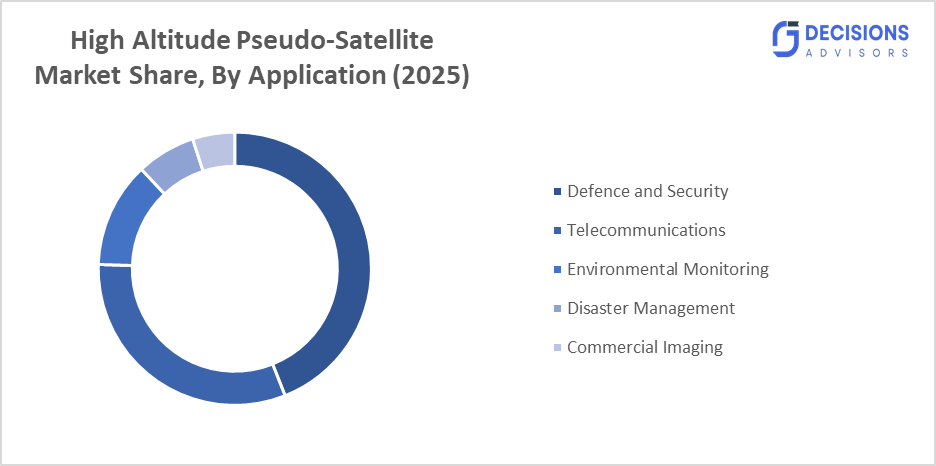
Defense and Security segment accounts for the largest share, representing over 44% of the global market in 2025.
Based on the Application, the high-altitude pseudo-satellite market is divided into telecommunications, environmental monitoring, defense and security, disaster management, and commercial imaging. Among these, Defense and Security segment accounts for the largest share, representing over 44% of the global market in 2025. These deployments are critical for instant detection of any threat, border surveillance, and marine safety, which require continuous visibility without incurring high expenses like those associated with satellite orbits. On the other hand, Telecommunications has emerged as the most promising application, thanks to the rapid rollout of non-terrestrial 5G infrastructure and the provision of broadband internet services to rural areas.
Government and Defense sector dominates the global market, accounting for approximately 62% of the total revenue in 2025.
Based on the End User, the high-altitude pseudo-satellite market is divided into government and defense, commercial enterprises, and research institutions. Among these, Government and Defense segment dominates the global market, accounting for approximately 62% of the total revenue in 2025. The commercial business category is seeing an increase in use, especially by mobile telephone companies and agricultural businesses that need higher resolution pictures and connectivity. The research category is relatively small but significant, concerned with atmosphere sampling and climate change research through the use of affordable stratospheric technology.
Strategies to Implement for Growth of the Market in Non-Leading Regions
The potential for growth within the HAPS industry in emerging regions could be increased through the deployment of efficient modular platforms in stratospheric altitudes for local telecommunications companies, as well as local agencies tasked with environmental management. Programs aimed at achieving digital inclusion by governments, coupled with the expansion of rural fibre-optic broadband networks, contribute substantially towards demand within regions with terrain that poses significant challenges to the installation of fibre-optics on the ground. Further support through increasing investments in training local aerospace engineers, as well as setting up regional maintenance facilities, will facilitate the adoption of persistent surveillance and emergency response solutions.
Regional Segment Analysis of the Global High Altitude Pseudo-Satellite Market
- North America (U.S., Canada, Mexico)
- Europe (Germany, France, U.K., Italy, Spain, Rest of Europe)
- Asia-Pacific (China, Japan, India, South Korea, Rest of APAC)
- Latin America (Brazil and the Rest of Latin America)
- The Middle East and Africa (UAE, South Africa, Rest of MEA)
North America is expected to hold the largest share of the high-altitude pseudo-satellite market during the forecast period. This region has about 38% share of global revenue, thanks to its highly sophisticated infrastructure related to aerospace, along with the extensive adoption of surveillance technology in both national security and maritime security applications. The largest part of this region’s revenues comes from the United States, as there is a lot of spending at the government level in advanced reconnaissance missions, along with local research related to solar-powered UAVs. Over-the-horizon communication upgrades and the early adoption of stratospheric systems in disaster relief operations have played key roles here.
Asia-Pacific is projected to be the fastest-growing region over the forecast period. This region is anticipated to witness a growth rate of around 18.3% CAGR, with a significant market share within the global industry. This is owing to the fast-developing telecommunication network infrastructure, coupled with the growing demand for rural broadband networks in countries such as China, India, and Southeast Asian countries. Other reasons for the same include greater investments made towards securing national borders in the region, state-supported HAPS indigenous research and development projects, and widespread adoption of stratospheric platform-based 5G and 6G network strategies.
Europe is anticipated to hold the third-largest share, contributing approximately 27% of the global market share. There is a competitive advantage in the region owing to clusters of aerospace technology innovation and financing for sustainable observation of the environment, as well as atmospheric science research. There is also a comparative advantage with countries like Germany, France, and the United Kingdom, which are highly skilled at lightweight composite manufacturing. Moreover, the rigorous regulatory standards that they have regarding HAPS operate around 20 km above the earth, which further gives them a comparative advantage. The presence of big aerospace firms, along with improved maritime awareness systems, has also helped introduce HAPS slowly but steadily.
Recent Developments
- In March 2026, the Airbus Zephyr HAPS initiative made strides in improving flight endurance by flying for more than 25 days above the 60,000-feet mark, and its current tests suggest an ability to provide continuous coverage and connectivity in areas as large as 1,000 km²
- In January 2026, the UK Ministry of Defense boosted its spending in HAPS technology, leading to a projected increase of 20% in persistent surveillance systems due to prolonged missions that surpass 30 days for gathering intelligence.
- In October 2025, BAE Systems sped up research on solar-powered UAVs that can operate for more than two weeks without refuelling, aiming to achieve greater than 15% efficiency gains in terms of mission time.
- In August 2025, the European Commission funded stratosphere and unmanned aerial system projects that sought to improve efficiency by up to 25%, as well as enhance capabilities for environmental monitoring and connectivity at high altitudes.
Market Segmentation
This study forecasts revenue at global, regional, and country levels from 2020 to 2035. The global high altitude pseudo-satellite (HAPS) market is segmented based on the following categories:
Global High Altitude Pseudo-Satellite Market, By Platform Type
- Solar-Powered Fixed Wing HAPS
- Airship HAPS
- Hybrid HAPS
Global High Altitude Pseudo-Satellite Market, By Application
- Telecommunications
- Environmental Monitoring
- Defense and Security
- Disaster Management
- Commercial Imaging
Global High Altitude Pseudo-Satellite Market, By End User
- Government and Defense
- Commercial Enterprises
- Research Institutions
Global High Altitude Pseudo-Satellite Market, By Regional Analysis
- North America
- United States
- Canada
- Mexico
- Europe
- Germany
- United Kingdom
- France
- Italy
- Spain
- Russia
- Rest of Europe
- Asia Pacific
- China
- Japan
- India
- South Korea
- Australia
- Rest of Asia Pacific
- Latin America
- Brazil
- Argentina
- Rest of Latin America
- Middle East & Africa
- United Arab Emirates
- Saudi Arabia
- Qatar
- South Africa
- Rest of Middle East & Africa
Frequently Asked Questions (FAQ)
What is a high-altitude pseudo-satellite (HAPS), and why is it important?
A high-altitude pseudo-satellite is an innovative aerospace vehicle that functions in the stratosphere and delivers satellite-like capabilities from a much closer range. It is essential for offering uninterrupted, latency-free connectivity, high-definition Earth imaging, and constant maritime surveillance to help countries keep their borders secure, close the digital divide between rural areas, and quickly deal with natural disasters.
What factors are driving the growth of the high-altitude pseudo-satellite market?
The market growth can be attributed to the investments made in the area of persistent ISR services by government agencies, the rising requirements for non-terrestrial 5G and 6G expansion, as well as the use of solar-powered UAVs in long endurance flights. The development in this area also owes to the increased interest in cheaper launch solutions and real-time environmental monitoring.
Which platform type dominates the high-altitude pseudo-satellite market?
Fixed-wing HAPS vehicles powered by solar energy represent the largest segment of the market due to their high aerodynamic efficiency, the capability to fly for extended periods using renewable energy sources, and their stability while flying. They also have a lot of potential when used in long-term telecommunications projects or in border control activities.
Which applications are widely used in this market?
Some applications such as Defense and Security and Telecommunications are widely used due to the acute necessity to monitor over-the-horizon areas and provide broadband connection in remote territories.
Check Licence
Choose the plan that fits you best: Single User, Multi-User, or Enterprise solutions tailored for your needs.
We Have You Covered
- 24/7 Analyst Support
- Clients Across the Globe
- Tailored Insights
- Technology Tracking
- Competitive Intelligence
- Custom Research
- Syndicated Market Studies
- Market Overview
- Market Segmentation
- Growth Drivers
- Market Opportunities
- Regulatory Insights
- Innovation & Sustainability
Report Details
| Scope | Global |
| Pages | 210 |
| Delivery | PDF & Excel via Email |
| Language | English |
| Release | Apr 2026 |
| Access | Download from this page |