
Global High-End Lighting Market
 |
Author:
Achal E
|
Pages:
210
|
Author:
Achal E
|
Pages:
210
Global High-End Lighting Market Size, Share, By Type (LED, HID, Fluorescent, Others) By Style (Modern, Traditional, Transitional) By Application (Interior Lighting, Exterior Lighting) By End User (Residential, Commercial, Industrial, Hospitality) and By Region (North America, Europe, Asia-Pacific, Latin America, Middle East and Africa), Analysis and Forecast 2026-2035
CAGR
7.25%
REVENUE 2025
USD Billion 21.05
FORECAST 2035
USD Billion 42.37
REPORT COVERAGE
Global
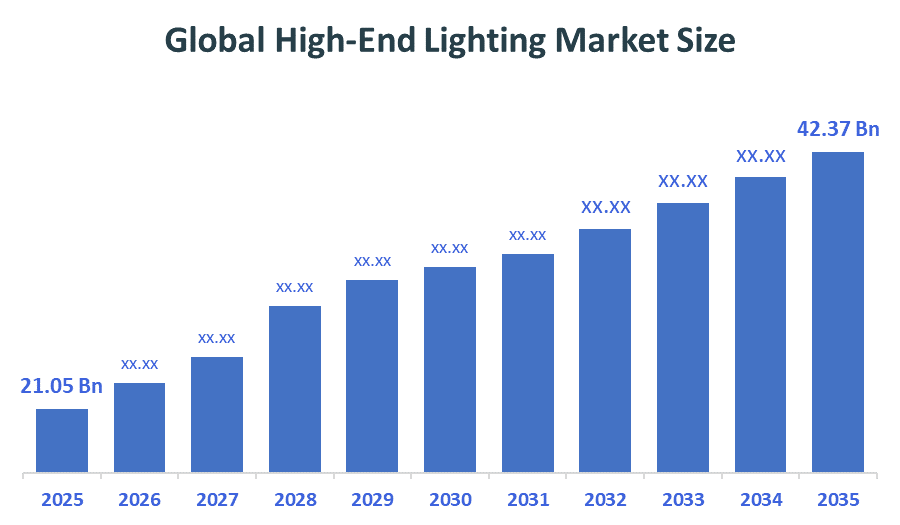
The Global High-End Lighting Market Size was predicted to grow from USD 21.05 Billion in 2025 and is projected to reach around USD 42.37 Billion by 2035. Industry research suggests that the LED segment dominates the global high-end lighting market, holding approximately 60-70% of the total share worldwide. Signify NV leads the market with reported full-year 2025 sales of EUR 5.8 billion, serving as a primary market driver for innovation in connected lighting and sustainable luxury illumination.
Market Snapshot
- Global High-End Lighting Market Size (2025): USD 21.05 Billion
- Global High-End Lighting Projected Market Size (2035): USD 42.37 Billion
- Global High-End Lighting Compound Annual Growth Rate (CAGR): 7.25%
- Largest Regional Market: Europe
- Fastest Growing Region: Asia-Pacific
- 3rd Largest Region: North America
- Base Year: 2025
- Historical Period: 2021 - 2024
- Forecast Period: 2026 - 2035
Market Overview / Introduction
The high-end lighting market represents a specialized segment of the illumination industry that merges cutting-edge technology with premium aesthetic design. High-end lighting fixtures act as functional art, utilizing superior materials such as precision-cut crystal, architectural-grade metals, and hand-blown glass to create sophisticated environments. These systems function through advanced light engines that prioritize color rendering, dimming precision, and glare control, ensuring optimal visual comfort in luxury settings. The modern high-end lighting ecosystem has transitioned from simple decorative fixtures to intelligent devices equipped with IoT connectivity, allowing for seamless integration into smart home and building management systems. This evolution is driven by a global shift toward energy efficiency and human-centric design, where lighting is utilized to enhance biological wellness and productivity. The increase in the use of premium luminaires is attributed to the expansion of luxury real estate, high-end hospitality projects, and the modernization of urban infrastructure in smart cities.
- The residential and hospitality segments contribute to approximately 55% of the application-based use in the market, driven by the demand for personalized luxury environments and brand-defining ambiance in five-star hotels and boutique retail spaces.
- There is a rapid rise in the integration of AI-driven lighting controllers, with the CAGR for connected smart fixtures predicted to exceed 10% because of the growing requirement for adaptive lighting that responds to occupancy, natural light levels, and user preferences.
Notable Insights: -
- LED/Smart LED modules make up about 60.8% of the total market share of this sector.
- Applications of high-end lighting in the sphere of sustainable architecture account for almost 43% of all demand.
- Chandeliers and pendants show an annual increase above 7.2%.
What is the Role of Technology in Shaping the Market?
The advancements in technology have made major changes in the lighting industry regarding spectral precision, wireless mesh networking, and miniaturization. High-end lighting technology of the current generation has evolved beyond being mere lamps to spatial interconnection devices that can operate within complex IoT ecosystems. These systems use nano-optics, GaN-on-Si (Gallium Nitride on Silicon) semiconductors, and advanced polymers for lens construction to provide flicker-free, high-fidelity light that supports the health and wellness of occupants.
How are Recent Developments Helping the Market?
They involve the use of Li-Fi for secure data communication through light, high-temperature resistant OLED panels, and precision 3D-printing for customizable fixture geometries. These innovations have played an important role in facilitating growth and development within the market. There have been innovations involving the development of circadian-active lighting that can protect the natural sleep-wake cycles of individuals in healthcare and residential settings. Such innovations facilitate the production of highly efficient lighting layouts that use the mechanical properties of modern-day conductors to maintain structural integrity while providing high-lumen output.
Market Drivers
The market demand for global high-end lighting is on the rise due to higher investments from real estate developers and government bodies into smart city infrastructure and energy-efficient building standards. Modern high-end lighting has enjoyed significant market popularity because of its advantages of combining multiple properties in one durable system, such as high color rendering indices (CRI), modular design, and effective heat dissipation. On the other hand, the establishment of luxury experiential retail centers has brought about greater demands for bespoke lighting solutions to address the trend of creating immersive shopping experiences that require high-precision accent lighting.
Restraints
However, the development of the global market for the high-end lighting industry is limited by the complexities involved in maintaining the stability of the price of premium raw materials like copper, brass, and rare-earth phosphors, considering that the market may be characterized by fluctuations that lead to cost overrun problems. Additionally, a shortage of skilled technicians capable of installing complex automated lighting systems remains a barrier to widespread adoption in emerging markets.
Competitive Analysis:
The report offers the appropriate analysis of the key organisations/companies involved within the high-end lighting market, along with a comparative evaluation primarily based on their product offerings, business overviews, geographic presence, enterprise strategies, segment market share, and SWOT analysis. The report also provides an elaborate analysis focusing on the current news and developments of the companies, which includes product development, innovations, joint ventures, partnerships, mergers & acquisitions, strategic alliances, and others. This allows for the evaluation of the overall competition within the market.
Top 10 Companies in the Global High-End Lighting Market
- Signify NV (formerly Philips Lighting)
- Acuity Brands Lighting Inc.
- Zumtobel Group
- Cree Lighting (IDEAL Industries)
- Hubbell Incorporated
- Legrand Group
- Lutron Electronics Co. Inc.
- Artemide S.p.A.
- Flos S.p.A.
- Louis Poulsen A/S
Government Initiatives
|
Country |
Key Government Initiatives |
|
China |
Under the Green Lighting Project, the government has prioritised the replacement of traditional mercury lamps with high-efficiency LEDs in all new public architectural projects and smart city developments. |
|
India |
The Street Lighting National Programme (SLNP) and the PM E-DRIVE Scheme are promoting high-efficiency lighting in urban hubs, with incentives for local manufacturing of premium lighting components. |
|
US |
The Department of Energy (DOE) Solid-State Lighting Program has expanded funding for next-generation OLED research and the development of energy-efficient decorative lighting standards. |
Study on the Supply, Demand, Distribution, and Market Environment
It is necessary for the high-end lighting market to strike a balance between operating at optimal optical efficiency and the increased demand for aesthetics that are both unique and durable. The production of high-end lighting involves the manufacture of precision-engineered heat sinks and specialised optical lenses that can offer sustained thermal stability without the risk of yellowing or degradation inherent to older plastic components. Distribution is increasingly multi-channel, with high-end brands utilising flagship showrooms to provide tactile experiences while expanding digital storefronts for global reach.
Price Analysis and Consumer Behaviour Analysis
The cost of high-end lighting is influenced by the quality of the finish, the complexity of the integrated electronics, and the brand's designer pedigree. Sophisticated materials, such as the use of hand-carved alabaster or smart-integrated OLED panels, are expensive due to their inclusion of advanced control systems made from polyimide or sapphire substrates. On the other hand, high-quality architectural downlights used in commercial offices and retail can be considered cost-effective over their lifecycle due to significant energy savings and minimal maintenance requirements. Consumers have shown interest in wellness and wellness-certified devices; thus, manufacturers should aim at providing health-conscious and easily integrable products.
Market Segmentation
The Global High-End Lighting Market share is classified into type, style, application, and end user.
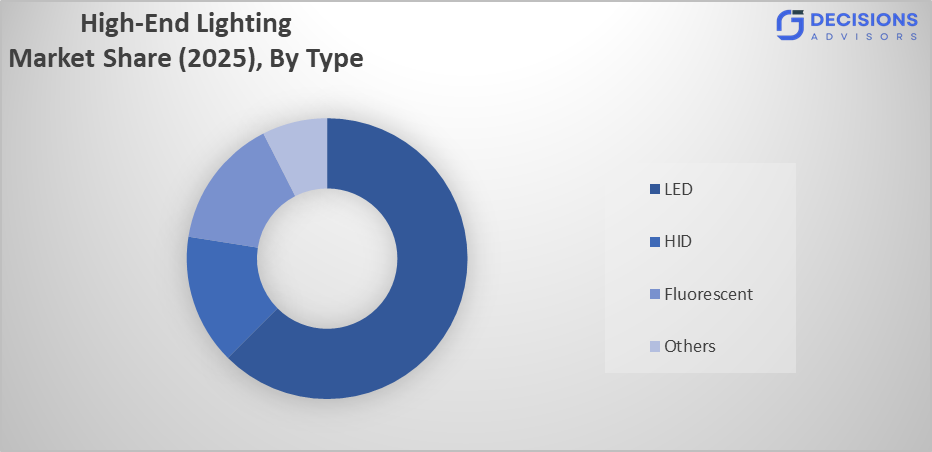
The LED lighting segment holds the largest share, contributing approximately 60-65% of the market in 2025.
Based on the Type, the global high-end lighting market is divided into LED, HID, Fluorescent, and Others. Among these, the LED lighting segment holds the largest share, contributing approximately 60-65% of the market in 2025. The reason for this dominance lies in their superior energy efficiency and versatility in luxury design, allowing for miniaturised fixtures and precise spectral control that mimics natural daylight without the high heat emission or short lifespan associated with traditional halogen or HID alternatives.
The Modern style segment accounts for the largest share, representing over 50% of the global market in 2025.
Based on the Style, the global high-end lighting market is divided into Modern, Traditional, and Transitional. Among these, the modern style segment accounts for the largest share, representing over 50% of the global market in 2025. These designs are critical for contemporary luxury residential and commercial architecture, providing sleek aesthetics and seamless integration with smart home technologies. On the other hand, the Transitional segment has emerged as a rapidly growing sector, thanks to the increasing adoption of high-end fixtures that blend classical silhouettes with state-of-the-art digital dimming capabilities.
Interior Lighting dominates the global market, accounting for approximately 60% of the total revenue in 2025.
Based on the Application, the global high-end lighting market is divided into Interior Lighting and Exterior Lighting. Among these, Interior Lighting dominates the global market, accounting for approximately 60% of the total revenue in 2025. This segment is preferred by designers who require high-fidelity illumination and aesthetic statement pieces for art galleries, luxury homes, and executive suites. The Exterior Lighting category is seeing a steady increase in use, especially in the expansion of high-end landscape architecture and smart urban plazas, where durable, weather-resistant luminaires are required to maintain safety and visual grandeur.
The Commercial & Hospitality segment dominates the global market, accounting for approximately 45% of the total revenue in 2025.
Based on the End User, the global high-end lighting market is divided into Residential, Commercial, Industrial, and Hospitality. Among these, the Commercial & Hospitality segment dominates the global market, accounting for approximately 45% of the total revenue in 2025. This segment is preferred by developers who require reliable performance and high-impact visual branding for luxury retail stores and five-star hotels. The Residential segment is seeing a sharp increase in use, especially by manufacturers in the smart home industry who value the high-temperature resistance and efficiency of advanced LED drivers for premium living environments.
Strategies to Implement for Growth of the Market in Non-Leading Regions
The possibilities of growth for the high-end lighting industry in emerging regions can be enhanced through the creation of efficient localized assembly facilities that cater to the unique aesthetic preferences of regional architects. The initiatives from local governments focused on smart city development and luxury tourism play a major role in creating a demand in those regions that are transitioning from basic illumination to high-performance lighting. The additional assistance of investment in the training of local lighting designers and system integrators will help achieve this.
Regional Segment Analysis of the Global High-End Lighting Market
- North America (U.S., Canada, Mexico)
- Europe (Germany, France, U.K., Italy, Spain, Rest of Europe)
- Asia-Pacific (China, Japan, India, South Korea, Rest of APAC)
- Latin America (Brazil and the Rest of Latin America)
- The Middle East and Africa (UAE, South Africa, Rest of MEA)
Europe is projected to be a major region over the forecast period. In 2025, the European region will account for approximately 30% of global revenue. This is owing to the presence of legendary lighting design houses, coupled with the rigorous energy efficiency standards in the European Union that mandate high-performance LED adoption. Other reasons include greater investments made toward the preservation and modernisation of historic architectural sites and the widespread adoption of sustainable luxury standards.
Asia-Pacific is expected to be the fastest-growing region during the forecast period. This region is anticipated to witness a growth rate of around 10.5% CAGR, driven by rapid urbanisation and the massive scale of luxury residential projects in China, India, and Southeast Asia. The rise of a high-net-worth individual (HNWI) population has created a booming market for designer home lighting and high-end commercial interiors.
North America holds a significant share, contributing approximately 28% of the global market share in 2025. This region benefits from a highly sophisticated smart home market and the extensive adoption of connected lighting technology in corporate headquarters and high-value industrial applications. The United States leads this region’s revenues, as there is significant corporate-level spending in workplace modernization programs that prioritize human-centric lighting for employee productivity.
Recent Developments
- In February 2026, Signify NV announced a definitive agreement to integrate its connected lighting platform with a major AI-based building automation firm to enhance real-time energy optimisation in high-end commercial towers.
- In October 2025, Flos S.p.A. completed the acquisition of a boutique smart-controls startup, marking a strategic move toward becoming a full-service provider of both artistic fixtures and integrated digital lighting ecosystems.
- In May 2024, Lutron Electronics successfully launched its next-generation wireless dimming protocol, which allows for ultra-precise control of high-lumen high-end fixtures without the need for additional wiring in historic building retrofits.
- In November 2021, Artemide S.p.A. launched a line of Integralis luminaires, a technological breakthrough that combines luxury lighting with sanitising ultraviolet light to enhance safety in high-traffic commercial and hospitality environments.
Market Segmentation
This study forecasts revenue at global, regional, and country levels from 2021 to 2035. The Global High-End Lighting Market is segmented based on the following categories:
Global High-End Lighting Market, By Type
- LED/Smart LED
- HID (High-Intensity Discharge)
- Fluorescent/CFL
- Incandescent/Halogen
Global High-End Lighting Market, By Style
- Modern
- Traditional
- Transitional
- Industrial/Minimalist
Global High-End Lighting Market, By Application
- Interior Lighting
- Exterior Lighting
- Landscape Lighting
- Architectural/Public Spaces
Global High-End Lighting Market, By End User
- Residential (Luxury Villas/Apartments)
- Commercial (Offices/Retail)
- Hospitality (Hotels/Restaurants)
- Industrial (High-Tech Labs)
- Institutional (Art Galleries/Museums)
Global High-End Lighting Market, By Regional Analysis
- North America
- United States
- Canada
- Mexico
- Europe
- Germany
- United Kingdom
- France
- Italy
- Spain
- Russia
- Rest of Europe
- Asia Pacific
- China
- Japan
- India
- South Korea
- Australia
- Rest of Asia Pacific
- Latin America
- Brazil
- Argentina
- Rest of Latin America
- Middle East & Africa
- United Arab Emirates
- Saudi Arabia
- Qatar
- South Africa
- Rest of Middle East & Africa
Frequently Asked Questions (FAQ)
What is the impact of Human-Centric Lighting on the high-end market?
Human-Centric Lighting (HCL) is designed to mimic the natural solar cycle, adjusting color temperature and intensity to support the human circadian rhythm. In the high-end market, this technology is a major selling point for luxury residential and high-performance workspaces, as it enhances sleep quality, mood, and focus.
How is the Low-Altitude Economy creating new opportunities for lighting?
The rise of unmanned delivery stations and drone transportation hubs requires specialized high-intensity, smart-integrated landing and navigation lighting. This has opened a brand-new growth track for premium manufacturers who can provide interactive projection and sensor-based signaling systems.
What role does Circular Design play in high-end lighting?
Circular design focuses on creating products that can be easily disassembled, repaired, and recycled. Luxury brands are increasingly adopting this to meet environmental regulations and appeal to eco-conscious consumers, ensuring that premium fixtures remain functional for decades rather than becoming electronic waste.
How does 8K television and high-definition broadcasting affect high-end lighting in sports and events?
As broadcasting moves to ultra-high definition, stadiums and event venues require high-end lighting with superior color consistency and zero-flicker performance. This ensures that the light quality meets stringent broadcast standards for slow-motion replays and vibrant color reproduction.
Why is smart lighting integration essential for high-end hospitality?
In five-star hotels, high-end lighting systems allow for spatial interconnection, where lighting scenes automatically adjust based on guest presence or time of day. This level of automation provides an immersive luxury experience while significantly reducing energy overhead for the operator.
Check Licence
Choose the plan that fits you best: Single User, Multi-User, or Enterprise solutions tailored for your needs.
We Have You Covered
- 24/7 Analyst Support
- Clients Across the Globe
- Tailored Insights
- Technology Tracking
- Competitive Intelligence
- Custom Research
- Syndicated Market Studies
- Market Overview
- Market Segmentation
- Growth Drivers
- Market Opportunities
- Regulatory Insights
- Innovation & Sustainability
Report Details
| Scope | Global |
| Pages | 210 |
| Delivery | PDF & Excel via Email |
| Language | English |
| Release | Apr 2026 |
| Access | Download from this page |