
Global High Temperature Cables Market
 |
Author:
Pranali P
|
Pages:
245
|
Author:
Pranali P
|
Pages:
245
Global High Temperature Cables Market Size, Share, By Type (Fluoropolymers, Silicon Rubber, Polyethylene, Others) By Conductor (Copper, Nickel Plated Copper, Silver Plated Copper, Others) By Application (Power Cables, Control & Instrumentation Cables, Data Cables) By End User (Aeronautics & Defense, Energy & Power, Automotive, Oil & Gas, Industrial, Manufacturing) and By Region (North America, Europe, Asia-Pacific, Latin America, Middle East and Africa), Analysis and Forecast 2026-2035
CAGR
5.27%
REVENUE 2025
USD Billion 4.95
FORECAST 2035
USD Billion 8.27
REPORT COVERAGE
Global
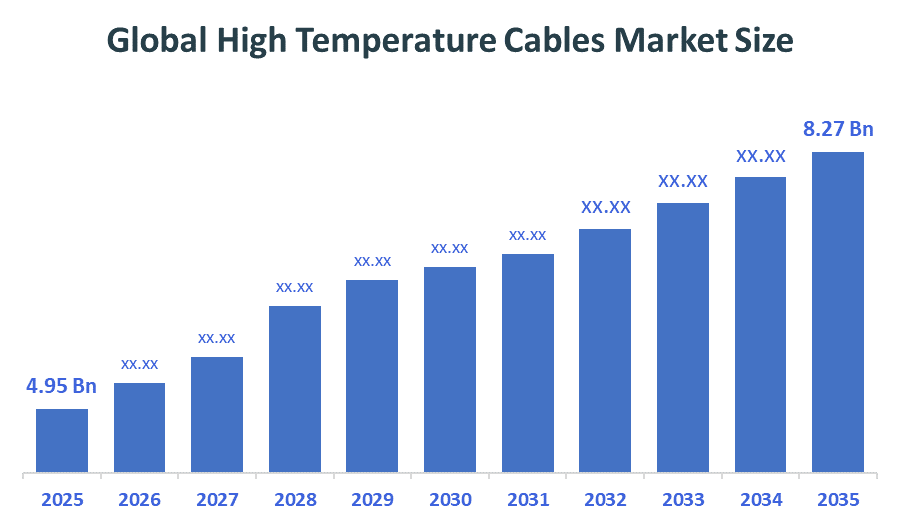
The Global High Temperature Cables Market Size was predicted to grow from USD 4.95 Billion in 2025 and is projected to reach around USD 8.27 Billion by 2035. According to Decision Advisors, a detailed research report on the high temperature cables market shows that the Fluoropolymers segment dominates the global high temperature cables market, holding approximately 45-55% of the total share worldwide. Prysmian Group leads the market with total revenues of €19,650 million in 2025, making it one of the major market drivers for shaping the industry.
Market Snapshot
- Global High Temperature Cables Market Size (2025): USD 4.95 Billion
- Global High Temperature Cables Projected Market Size (2035): USD 8.27 Billion
- Global High Temperature Cables Compound Annual Growth Rate (CAGR): 5.27%
- Largest Regional Market: Asia-Pacific
- Fastest Growing Region: North America
- 3rd Largest Region: Europe
- Base Year: 2025
- Historical Period: 2021 - 2024
- Forecast Period: 2026 - 2035
Market Overview / Introduction
High temperature cables are specialized wiring solutions designed to maintain electrical and mechanical integrity in environments where temperatures exceed standard operating limits. These cables act as crucial intermediaries between high-stress industrial heat sources and critical control systems, using cutting-edge insulation materials such as PTFE, PFA, and silicone rubber to attain maximum safety in extreme thermal conditions. The modern high temperature cables have various characteristics, including flame retardancy and chemical resistance, so as to perform optimally and minimize chances of system failures in hazardous environments. The high temperature cables have evolved from being simple glass-braided conductors to advanced high-tech specialized wires that are equipped with multi-layered protection, high heat tolerance, and used in aerospace and heavy industrial furnaces. The increase in the use of high temperature cables can be attributed to the increasing need for advanced fire safety standards and high-performance industrial automation within modernizing cities and industries. This is because high temperature cables provide protection to electrical equipment from loss of efficiency and wear-and-tear caused by thermal degradation, since there is no need for secondary cooling systems in many installations.
- The energy and power utilities segments contribute to approximately 42% of the application-based use in the market, driven by the increasing demand for nuclear power plant maintenance, geothermal energy exploration, and the modernisation of thermal power grids.
- There is an exponential rise in the development of specialised automotive cables, and the CAGR is predicted to exceed 7.5% because of the growing application of wiring harnesses in engine compartments and battery management systems of next-generation vehicles due to their ability to offer heat resistance and long-term durability.
Notable Insights: -
- Fluoropolymer-based modules make up about 45-55% of the total market share of this sector.
- Applications of high-temperature cables in the sphere of aerospace and defence account for almost 32% of all demand.
- Silicon rubber insulation systems show an annual increase above 5.9%.
What is the Role of Technology in Shaping the Market?
The advancements in technology have made some major changes in the cable industry regarding thermal stability, signal integrity, and diameter reduction. High-temperature cable technology of the current generation has evolved beyond being mere conductive wires to complex engineering systems that can operate in temperatures up to 1000°C because they are able to use ceramic fiber braiding, cross-linked polymers, and nickel-plated conductors.
How are Recent Developments Helping the Market?
They involve the use of halogen-free flame retardant (HFFR) materials, thin-wall insulation techniques, and high-frequency shielding in thermal environments. These innovations have played an important role in facilitating growth and development within the market. There have been innovations involving the development of cables that are able to resist extreme vibration while maintaining thermal shields, which are able to protect all types of sensors and actuators in aircraft engines. Such innovations would facilitate the production of streamlined wiring paths using the mechanical flexibility of modern-day materials, without breaking down due to melting or insulation cracking.
Market Drivers
The market demand for global high temperature cables is on the rise due to higher investments in industrial safety and government mandates for fire-resistant infrastructure in public buildings and transportation hubs. Modern high temperature cable has enjoyed significant market popularity because of its advantages of combining multiple properties in one durable system, such as excellent flexibility at high heat, resistance to corrosive chemicals, and high dielectric strength. On the other hand, the establishment of more deep-sea oil rigs and mining operations has brought about greater demands for cabling solutions to address the trend of drilling in high-pressure, high-temperature (HPHT) reservoirs.
Restraints
However, the development of the global market for the high temperature cable industry is limited by the complexities involved in the high cost of raw materials like silver, nickel, and specialized fluoropolymers, considering that the market may be characterised by fluctuations that may lead to higher project costs for end users.
Competitive Analysis:
The report offers the appropriate analysis of the key organisations/companies involved within the high temperature cables market, along with a comparative evaluation primarily based on their product offerings, business overviews, geographic presence, enterprise strategies, segment market share, and SWOT analysis. The report also provides an elaborate analysis focusing on the current news and developments of the companies, which includes product development, innovations, joint ventures, partnerships, mergers & acquisitions, strategic alliances, and others. This allows for the evaluation of the overall competition within the market.
Top 10 Companies in the Global High Temperature Cables Market
- Prysmian Group
- Nexans S.A.
- Leoni AG
- Belden Inc.
- Southwire Company, LLC
- Lapp Group
- Furukawa Electric Co., Ltd.
- TE Connectivity
- Sumitomo Electric Industries, Ltd.
- HELUKABEL GmbH
Government Initiatives
|
Country |
Key Government Initiatives |
|
China |
Under the 15th Five-Year Plan (2026-2030), the government has prioritised high-end manufacturing equipment. This includes subsidies for fire-resistant materials and thermal-stable cabling used in the domestic aerospace sector. |
|
India |
The National Fire Safety Mission 2026 mandates the use of high-temperature, flame-retardant, low-smoke (FRLS) cables in all new commercial high-rise constructions and metro rail projects to enhance public safety. |
|
US |
The Department of Energy expanded the Grid Modernization Initiative in 2026 with funding aimed at securing high-performance conductors that can withstand extreme weather and high thermal loads in ageing utility sectors. |
Study on the Supply, Demand, Distribution, and Market Environment
It is necessary for the high temperature cables market to strike a balance between operating at peak thermal resistance and the increased demand for cables that are lightweight and easy to install. The production of high temperature cables involves the manufacture of advanced alloys and polymers that can offer sustained signal clarity without the risk of insulation melting inherent to standard PVC cables.
Price Analysis and Consumer Behaviour Analysis
The cost of cabling is influenced by the type of conductor plating, the thickness of the fluoropolymer layer, and the specific temperature rating (e.g., 200°C vs 450°C). The more sophisticated materials, such as the use of silver-plated copper for better conductivity at high frequencies, are expensive due to their inclusion of high-grade minerals and complex extrusion processes. On the other hand, standard silicone rubber wires used in commercial ovens and heating elements can be considered cost-effective and provide an excellent chance for routine industrial maintenance and appliance manufacturing. Consumers have shown interest in longevity and safety certifications; thus, manufacturers should aim at providing certified and rigorously tested products.
Market Segmentation
The Global High Temperature Cables Market share is classified into type, conductor, application, and end user.
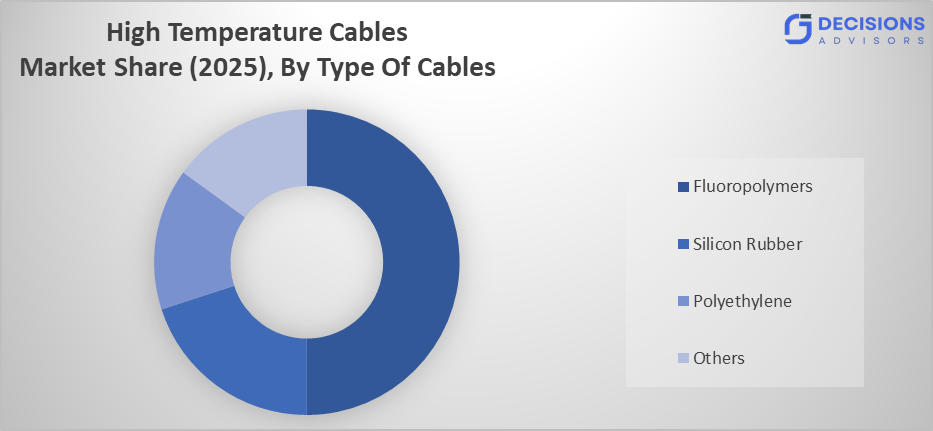
The Fluoropolymers segment holds the largest share, contributing approximately 45-55% of the market in 2025.
Based on the Type, the global high temperature cables market is divided into Fluoropolymers, Silicon Rubber, Polyethylene, and Others. Among these, the Fluoropolymers segment holds the largest share, contributing approximately 45-55% of the market in 2025. The reason for this dominance lies in their exceptional resistance to heat, chemicals, and UV radiation, making them essential for harsh chemical processing and aerospace applications.
The Power Cables segment accounts for the largest share, representing over 50% of the global market in 2025.
Based on the Application, the global high temperature cables market is divided into Power Cables, Control & Instrumentation Cables, and Data Cables. Among these, the Power Cables segment accounts for the largest share, representing over 50% of the global market in 2025. These cables are critical for heavy industrial machinery and power distribution in heat-intensive environments. On the other hand, the Data Cables segment has emerged as a rapidly growing sector, thanks to the increasing demand for high-speed communication in automated industrial plants operating at elevated temperatures.
Energy & Power dominate the global market, accounting for approximately 35% of the total revenue in 2025.
Based on the End User, the global high temperature cables market is divided into Aeronautics & Defense, Energy & Power, Automotive, Oil & Gas, Industrial, and Manufacturing. Among these, Energy & Power dominate the global market, accounting for approximately 35% of the total revenue in 2025. This segment is preferred by utility providers who require reliable performance in power generation plants. The Automotive category is seeing a steady increase in use, especially in the development of hybrid and electric powertrains where thermal management is a priority.
Strategies to Implement for Growth of the Market in Non-Leading Regions
The possibilities of growth for the high temperature cable industry in emerging regions can be enhanced through the creation of specialized extrusion plants for high-heat polymers, as well as collaboration with local infrastructure developers. The initiatives from governments focused on updating building safety codes and expanding industrial zones play a major role in creating a demand in those regions that currently rely on standard-grade wiring. The additional assistance of investment in local testing facilities for fire-safety certification will help achieve this.
Regional Segment Analysis of the Global High Temperature Cables Market
- North America (U.S., Canada, Mexico)
- Europe (Germany, France, U.K., Italy, Spain, Rest of Europe)
- Asia-Pacific (China, Japan, India, South Korea, Rest of APAC)
- Latin America (Brazil and the Rest of Latin America)
- The Middle East and Africa (UAE, South Africa, Rest of MEA)
Asia-Pacific is projected to be the largest region over the forecast period. This region is anticipated to witness a growth rate of around 6.5% CAGR. In 2025, the Asia-Pacific region will account for approximately 48% of global revenue. This is owing to the massive expansion of the manufacturing sector and increased power generation projects in countries such as China and India.
North America is expected to hold a significant share of the high temperature cables market during the forecast period. This region holds approximately 21% share of global revenue in 2025, thanks to its established aerospace and defense industries. The largest part of this region’s revenues comes from the United States, driven by rigorous safety regulations and high demand for advanced industrial automation.
Europe is anticipated to hold a substantial share, contributing approximately 24% of the global market share. There is a competitive advantage in the region owing to the strong presence of major automotive manufacturers and a focus on high-efficiency, green energy systems in Germany and France.
Recent Developments
- In March 2026, Nexans announced the opening of a new specialized facility dedicated to high-temperature aerospace cabling to meet the rising demand for narrow-body aircraft production.
- In September 2025, Leoni AG introduced a new range of halogen-free, high-temperature cables for electric vehicle battery systems, improving safety during fast-charging cycles.
- In June 2024, Prysmian Group successfully completed a major contract to supply fire-resistant and high-heat cables for a large-scale renewable energy project in the North Sea.
- In December 2021, Lapp Group launched its OLFLEX HEAT series expansion, providing improved mechanical strength for cables operating in environments up to 260°C.
Market Segmentation
This study forecasts revenue at global, regional, and country levels from 2021 to 2035. The global high temperature cables market is segmented based on the following categories:
Global High Temperature Cables Market, By Type
- Fluoropolymers (PTFE, PFA, FEP)
- Silicon Rubber
- Polyethylene
- Others
Global High Temperature Cables Market, By Conductor
- Copper
- Nickel Plated Copper
- Silver Plated Copper
- Others
Global High Temperature Cables Market, By Application
- Power Cables
- Control & Instrumentation Cables
- Data Cables
Global High Temperature Cables Market, By End User
- Aeronautics & Defense
- Energy & Power
- Automotive
- Oil & Gas
- Industrial & Manufacturing
Global High Temperature Cables Market, By Regional Analysis
- North America
- United States
- Canada
- Mexico
- Europe
- Germany
- United Kingdom
- France
- Italy
- Spain
- Russia
- Rest of Europe
- Asia Pacific
- China
- Japan
- India
- South Korea
- Australia
- Rest of Asia Pacific
- Latin America
- Brazil
- Argentina
- Rest of Latin America
- Middle East & Africa
- United Arab Emirates
- Saudi Arabia
- Qatar
- South Africa
- Rest of Middle East & Africa
Frequently Asked Questions (FAQ)
What is the benefit of using nickel-plated conductors in high temperature cables?
At temperatures exceeding 250°C, standard copper begins to oxidise rapidly, which increases resistance and leads to failure. Nickel plating provides a protective barrier that prevents oxidation, ensuring consistent electrical conductivity and extending the cable's lifespan in extreme heat environments like industrial kilns.
How do fluoropolymer-insulated cables contribute to chemical safety?
Fluoropolymers like PTFE are nearly inert to most industrial chemicals and solvents. In environments such as chemical processing plants, these cables not only withstand heat but also prevent degradation when exposed to corrosive vapors, reducing the risk of short circuits and chemical fires.
What role does high temperature cable play in the 2026 EV market?
Modern EVs use high-voltage systems that generate significant internal heat. High temperature cables are essential for the wiring within the motor and battery packs to prevent insulation breakdown during peak performance and rapid charging, ensuring the vehicle's long-term safety.
Can high temperature cables be used in cryogenic (extremely cold) environments?
Yes, many materials used for high temperature resistance, specifically certain fluoropolymers, also exhibit excellent performance at extremely low temperatures. This makes them ideal for applications that undergo extreme thermal cycling, such as those found in aerospace and liquid gas processing.
Check Licence
Choose the plan that fits you best: Single User, Multi-User, or Enterprise solutions tailored for your needs.
We Have You Covered
- 24/7 Analyst Support
- Clients Across the Globe
- Tailored Insights
- Technology Tracking
- Competitive Intelligence
- Custom Research
- Syndicated Market Studies
- Market Overview
- Market Segmentation
- Growth Drivers
- Market Opportunities
- Regulatory Insights
- Innovation & Sustainability
Report Details
| Scope | Global |
| Pages | 245 |
| Delivery | PDF & Excel via Email |
| Language | English |
| Release | Apr 2026 |
| Access | Download from this page |