
Global Hospital Outsourcing Market
 |
Pages:
195
|
Pages:
195
Global Hospital Outsourcing Market Size, Share, By Service (Clinical Services, Healthcare, IT, Business Services, Transportation Services) By Type (Private, Public) and By Region (North America, Europe, Asia-Pacific, Latin America, Middle East, and Africa), Analysis and Forecast 2025-2035.
REPORT COVERAGE
Global
Market Snapshot
- Market Size (2025): USD 426.80 Billion
- Projected Market Size (2035): USD 1193.50 Billion
- Compound Annual Growth Rate (CAGR): 10.83%
- Largest Regional Market: North America
- Fastest Growing Region: Asia-Pacific
- 3rd Largest Region: Europe
- Base Year: 2025
- Historical Period: 2021–2024
- Forecast Period: 2025–2035
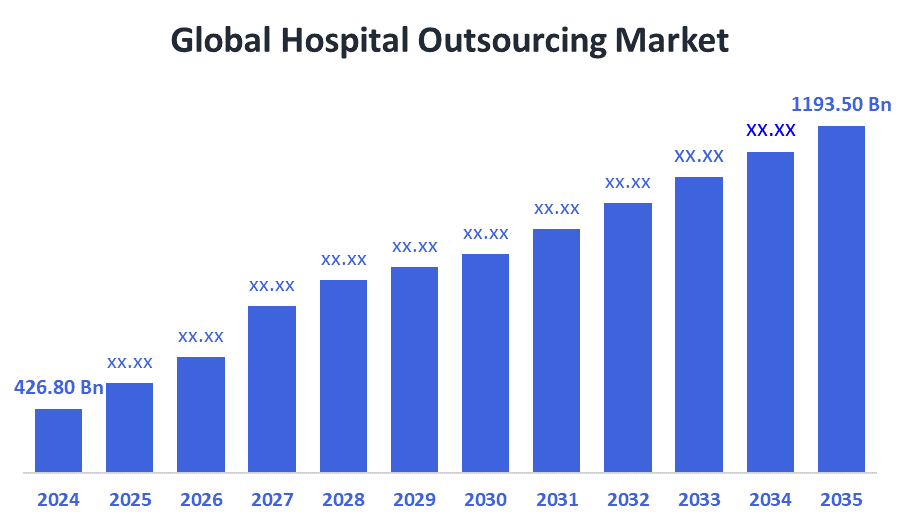
According to Decision Advisors, the Hospital Outsourcing Market Size is expected to grow from USD 426.80 billion in 2025 to USD 1193.50 billion by 2035, at a CAGR of 10.83% during the forecast period 2025-2035. The global hospital outsourcing market grew due to rising patient volumes, expanding populations, and increasing demand for additional resources. Healthcare facilities outsourced services to manage operational challenges, improve efficiency, and focus on core medical care, while also reducing costs and maintaining quality treatment standards.
Market Overview/ Introduction
The global hospitals outsourcing market delegates both medical and non-medical work, which external service providers perform while hospitals maintain their primary operations for patient treatment. The system serves three main purposes, which include decreasing expenses, enhancing operational efficiency, and providing access to specialized knowledge. The hospital outsourcing innovation process focuses on three main areas, including digital transformation and AI-powered services, and unified clinical solutions. The companies develop contemporary EHR systems together with telemedicine platforms and predictive analytics tools, and automated revenue cycle management systems. Healthcare providers now have access to new products that include remote patient monitoring systems, mobile health applications, and cloud-based collaboration platforms. The outsourcing companies use robotics together with process automation technology and intelligent scheduling systems to create better clinical and non-clinical service delivery systems. The systems create operational efficiency improvements together with hospital cost reductions, which lead to better patient treatment outcomes. The healthcare chains and multi-location hospitals gain advantages from standardized solutions, which can expand their operations while maintaining smooth integration and clinical and administrative system integration.
- Superhealth introduced a proprietary hospital operating system backed by MS Dhoni, Panther Peak Capital, and additional investors. The platform sought to optimize hospital functions and administrative workflows, aiding initiatives to set up 100 centers within 5–7 years while improving operational efficiency and managing patient care.
- The company partnered to launch a business transformation outsourcing (BTO) solution using the AI-powered xperience1 platform for healthcare payers. The initiative aimed to reduce call handle times, improve administrative efficiency, and streamline billing and claims processes, demonstrating the growing adoption of technology-driven outsourcing in healthcare operations.
Notable Insights: -
- North America holds the largest regional market share, approximately 69.8%, in the global hospital outsourcing market.
- Asia-Pacific is the fastest-growing region in the global hospital outsourcing market.
- By service, the clinical services segment held the largest share in terms of market share in 2025.
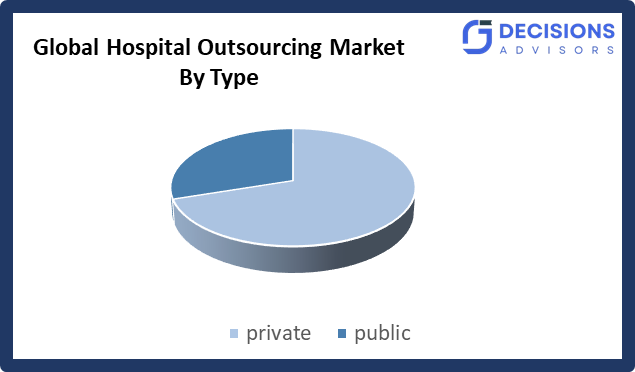
- By type, the private segment is the highest market share in 2025.
- The compound annual growth rate of the global spirit market is 10.83%.
- The market is likely to achieve a valuation of USD 1193.50 billion by 2035.
What is the role of technology in grooming the market?
Technology significantly influences the worldwide hospital outsourcing market by fostering efficiency, innovation, and scalability within healthcare operations. Technologies for digital transformation, including electronic health records (EHR) and cloud computing, have enhanced data management and fostered better coordination between hospitals and external providers. This enables quicker retrieval of patient data and improved decision-making. AI and predictive analytics have improved both clinical and administrative operations. These technologies assist in diagnostics, patient tracking, demand prediction, and revenue cycle management, enhancing the precision and efficiency of outsourced services. Telemedicine and remote patient monitoring systems have broadened the range of outsourced healthcare services. Hospitals are now able to outsource virtual care, easing the pressure on on-site staff while ensuring continuity of care. Automation technologies, encompassing robotics and process automation, have enhanced operational workflows by decreasing manual tasks, reducing errors, and cutting costs in domains like billing, scheduling, and supply chain management.
How are recent developments helping the market?
Recent advancements are greatly enhancing the expansion of the worldwide hospital outsourcing market by boosting service quality, efficiency, and accessibility. Developments in digital health tools like telemedicine, cloud computing, and electronic health records have allowed hospitals to outsource intricate functions more efficiently while ensuring smooth operations. The incorporation of artificial intelligence and data analytics has improved decision-making, patient care, and administrative tasks, rendering outsourced services more dependable and precise. The emergence of remote patient monitoring and mobile health apps has broadened the outsourcing landscape beyond hospitals, enabling ongoing patient care and alleviating pressure on healthcare facilities. Enhanced investments, collaborations, and acquisitions among healthcare firms have bolstered service abilities and broadened international presence
Market Drivers
The hospital outsourcing market is propelled due to the hospitals' use of outsourcing to handle non-essential tasks, are raised in healthcare costs create financial burdens. Hospitals need to concentrate on their primary medical functions as patient demand and healthcare quality requirements are increasing. Healthcare facilities experience an additional need for outsourcing, fueled by their lack of sufficient qualified healthcare personnel. The industry needs more resources because it requires specialized knowledge and faces rapid technological changes, and needs to meet regulatory compliance requirements. Hospitals use outsourcing as a strategic solution to enhance operational efficiency while delivering better services and faster service times.
Restrain
The main restraints on the hospital outsourcing market include patient data security concerns, service quality control loss, third-party vendor dependence, regulatory complexities, contract management difficulties, staff resistance, and service disruption risks, all of which combine to restrict the growth of the hospital outsourcing market.
Competitive Analysis:
The report offers the appropriate analysis of the key organizations/companies involved within the hospital outsourcing market, along with a comparative evaluation primarily based on their product of offering, business overviews, geographic presence, enterprise strategies, segment market share, and SWOT analysis. The report also provides an elaborative analysis focusing on the current news and developments of the companies, which includes product development, innovations, joint ventures, partnerships, mergers & acquisitions, strategic alliances, and others. This allows for the evaluation of the overall competition within the market.
Top Companies in the Hospital Outsourcing Market
- Allscripts
- Cerner Corporation
- Integrated Medical Transport
- The Allure Group
- Aramark Corporation
- Sodexo
- Abbott
- LogistiCare Solutions, LLC
- ABM Industries
- Flatworld Solutions
- Alere Inc.
- Compass Group PLC
Government Initiatives
|
Country |
Key Government Initiatives |
|
UK |
The UK government has promoted digital health adoption through funding and policy support for electronic health records (EHR) and telehealth services, encouraging hospitals to outsource IT and administrative functions to improve efficiency and patient care delivery. Recent NHS initiatives focus on operational efficiency and outsourcing back-office functions. |
|
US |
The U.S. government supports healthcare outsourcing by incentivizing the adoption of AI, telemedicine, and revenue cycle management technologies through programs like the HITECH Act and ongoing telehealth reimbursement reforms, enabling hospitals to outsource clinical and non-clinical services while maintaining compliance and improving cost-efficiency. |
|
India |
The Indian government has launched initiatives like Ayushman Bharat Digital Mission (ABDM) to promote digital health infrastructure and interoperability, supporting hospital outsourcing in telemedicine, electronic health records, and administrative services. Policies encourage private sector participation and outsourcing to improve healthcare access and operational efficiency. |
Market Segmentation
The hospital outsourcing market share is classified into service and type.
- The clinical services segment accounted for the largest share in 2025 and is projected to grow at a substantial CAGR during the forecast period.
Based on the service, the hospital outsourcing market by service is classified into clinical services, healthcare IT services, business services, and transportation services. Among these, the clinical services segment accounted for the largest share in 2025 and is anticipated to grow at a significant CAGR during the forecast period. Clinical services dominated the hospital outsourcing market as healthcare delivery and specialized medical expertise became increasingly essential. The healthcare industry now faces greater demands because hospitals have started to outsource clinical tasks and their patient care operations. Outsourcing also enables hospitals to streamline internal processes, optimize resource utilization, and focus more effectively on core medical services.
- The private segment accounted for the highest market share in 2025 and is anticipated to grow at a significant CAGR during the forecast period.
Based on the type, the hospital outsourcing market is segmented into private hospitals and public hospitals. Among these, the private segment accounted for the highest market share in 2025 and is anticipated to grow at a significant CAGR during the forecast period. Private hospitals dominate the market in view of higher patient volumes, greater focus on cost efficiency, and faster adoption of outsourcing for clinical, IT, and administrative services. Public hospitals increasingly adopt outsourcing to manage resource constraints, reduce operational burdens, improve service quality, and meet growing healthcare demand while maintaining compliance with government regulations and budget limitations.
What is the Reason of the Region Dominance?
The dominance of certain regions in the hospital outsourcing market is driven by a combination of structural, economic, and technological factors. Regions with advanced hospitals and healthcare infrastructure play a major role. Regions with advanced hospitals and healthcare systems are more likely to adopt outsourcing to manage complex operations efficiently. High healthcare expenditure and strong financial capacity enable hospitals to invest in outsourced services, technologies, and specialized providers. The key factor is the availability of a skilled workforce and specialized service providers, which supports high-quality outsourcing in both clinical and non-clinical areas.
Strategies to Implement for Growth of the Market in Non-Leading Regions
Growth in non-leading regions can be supported through a combination of technology adoption, infrastructure development, and workforce enhancement. Upgrading healthcare facilities and implementing advanced solutions such as electronic health records, AI-powered analytics, telemedicine, and cloud platforms improves operational efficiency and service quality. Training hospital staff to manage outsourced functions, promoting public–private partnerships, and offering cost-effective outsourcing models help increase adoption. Clear regulations, data security standards, and financial incentives build trust among healthcare providers. Additionally, leveraging remote patient monitoring, virtual care, and mobile health applications extends service reach, reduces operational costs, and supports better patient outcomes in emerging markets
Regional Segment Analysis of the Spirits Market
- North America (U.S., Canada, Mexico)
- Europe (Germany, France, U.K., Italy, Spain, Rest of Europe)
- Asia-Pacific (China, Japan, India, Rest of APAC)
- South America (Brazil and the Rest of South America)
- The Middle East and Africa (UAE, South Africa, Rest of MEA)
North America is anticipated to hold the largest share of the hospital outsourcing market during the forecast period. North America is anticipated to hold the largest share of the hospital outsourcing market during the forecast period, driven by its well-developed healthcare infrastructure and widespread adoption of outsourcing solutions. In 2025, North America dominated the global hospital outsourcing market, accounting for over 69.8% share, driven by advanced healthcare systems, high outsourcing adoption, and rising operational cost pressures. The region has a high concentration of hospitals and specialized service providers, particularly in the United States and Canada. Rising healthcare costs, increasing patient volumes, and shortages of skilled healthcare professionals drive hospitals to outsource clinical, IT, and administrative functions. Moreover, strict regulatory requirements, growing focus on operational efficiency, and the need to improve service quality further support market growth.
Asia Pacific is expected to grow at a rapid CAGR in the hospital outsourcing market during the forecast period. Asia Pacific is anticipated to hold the largest share of the hospital outsourcing market over the predicted timeframe, driven by the rising demand for cost-effective medical services. Countries such as China, India, and Japan are witnessing increasing patient populations, growth in private hospitals, and higher adoption of outsourced clinical and non-clinical services. Government initiatives to improve healthcare access, rising medical tourism, and investments in digital health technologies further support market growth. Additionally, shortages of skilled healthcare professionals and pressure to reduce operational costs encourage hospitals in the region to outsource IT, diagnostics, billing, and administrative services, accelerating market expansion.
Europe is the 3rd largest region to grow in the hospital outsourcing market during the forecast period. It is because Europe, with Germany, the U.K., and France being key contributors. Outsourcing adoption is fueled by hospitals’ focus on operational efficiency, cost optimization, and workforce management. Healthcare IT, clinical support, and business services are widely outsourced across public and private hospitals. Regulatory compliance, advanced IT infrastructure, and multi-location hospital networks drive demand for standardized external services. Sustainability initiatives and integrated service models are increasingly important. Strategic partnerships with technology providers enable hospitals to enhance patient outcomes while reducing administrative burden.
Future Market Trends in Global Hospital Outsourcing Market: -
- Increased Adoption of Digital Health Technologies
Hospitals are increasingly outsourcing electronic health records (EHR), telemedicine platforms, cloud systems, and mobile health applications. These solutions streamline operations, improve data management, and enhance patient care, allowing hospitals to focus on core medical services.
- Growth of AI and Predictive Analytics Services
Outsourcing of AI, machine learning, and predictive analytics helps hospitals optimize diagnostics, resource allocation, patient flow, and personalized care strategies. This enhances efficiency, reduces errors, and supports better clinical outcomes.
- Expansion of Remote Patient Monitoring and Telehealth
Hospitals outsource remote monitoring and virtual care services to manage patients outside the facility, particularly for chronic conditions, improving access, reducing hospital burden, and supporting continuous care delivery.
Recent Development
- In March 2026, Inventurus Knowledge Solutions approved a $40 million investment in its subsidiary, IKS Inc., to expand its technology-enabled care enablement platform. The investment aimed to strengthen outsourced healthcare services and support hospitals in improving operational efficiency
- In February 2026, True North Private Equity invested INR 150 crore in ACN Healthcare RCM to enhance AI-driven revenue cycle management solutions in India. The investment aimed to expand outsourced healthcare billing, coding, and claims services, improving operational efficiency and supporting hospitals in managing financial and administrative processes effectively.
- In January 2026, Canada’s strict ICD-10-CA standards and workforce pressures had pushed hospitals beyond in-house models, and outsourcing medical coding had emerged as an effective solution to improve data accuracy and ensure regulatory compliance.
- In October 2025, The article “Outsourcing Health: Shifting the Balance in Private Surgery Market” reported that health systems had outsourced elective surgeries to private hospitals to reduce wait times and expand capacity. This approach helped hospitals manage patient demand, improve service delivery, and maintain care quality while relying on external providers for surgical services
Market Segment
This study forecasts revenue at global, regional, and country levels from 2020 to 2035. Decision Advisor has segmented the hospital outsourcing market based on the below-mentioned segments:
Hospital Outsourcing Market, By Service
- Clinical Services
- Healthcare Services
- IT Services
- Business Services
- Transportation Services
Hospital Outsourcing Market, By Type
- Private
- Public
Hospital Outsourcing Market, By Regional Analysis
- North America
- US
- Canada
- Mexico
- Europe
- Germany
- UK
- France
- Italy
- Spain
- Russia
- Rest of Europe
- Asia Pacific
- China
- Japan
- India
- South Korea
- Australia
- Rest of Asia Pacific
- South America
- Brazil
- Argentina
- Rest of South America
- Middle East & Africa
- UAE
- Saudi Arabia
- Qatar
- South Africa
- Rest of the Middle East & Africa
Frequently Asked Questions (FAQ)
Q. How do regulatory challenges impact the growth and adoption of hospital outsourcing services globally?
A. Regulatory challenges significantly impact hospital outsourcing by requiring providers to comply with diverse privacy laws, data security standards, and healthcare regulations across regions. Strict compliance increases operational complexity and costs for outsourcing vendors, which can slow adoption. However, clear regulatory frameworks and certifications build trust and encourage hospitals to outsource specialized services confidently.
Q. What role do public–private partnerships (PPPs) play in expanding hospital outsourcing in developing countries?
A. Public–private partnerships enable developing countries to leverage private sector expertise, technology, and capital to improve healthcare infrastructure and service delivery. PPPs facilitate outsourcing of non-clinical and clinical services by aligning government goals with private efficiency, helping overcome resource constraints and improve access to quality care in underserved areas.
Q. How does workforce skill shortage drive innovation in hospital outsourcing service models?
A. The shortage of skilled healthcare professionals compels hospitals to outsource specialized tasks like coding, billing, and IT support to external providers who possess the required expertise. This drives innovation by encouraging outsourcing firms to invest in AI, automation, and remote services, creating scalable and cost-effective solutions that enhance service quality despite workforce gaps.
Q. How is medical tourism influencing the adoption of hospital outsourcing services in emerging markets?
A. Medical tourism drives hospitals in emerging markets to adopt outsourcing for specialized services such as diagnostics, billing, patient coordination, and telemedicine. By delegating non-core tasks to external providers, hospitals can focus on high-quality clinical care, handle increased international patient volumes efficiently, and enhance overall service standards.
Check Licence
Choose the plan that fits you best: Single User, Multi-User, or Enterprise solutions tailored for your needs.
We Have You Covered
- 24/7 Analyst Support
- Clients Across the Globe
- Tailored Insights
- Technology Tracking
- Competitive Intelligence
- Custom Research
- Syndicated Market Studies
- Market Overview
- Market Segmentation
- Growth Drivers
- Market Opportunities
- Regulatory Insights
- Innovation & Sustainability
Report Details
| Scope | Global |
| Pages | 195 |
| Delivery | PDF & Excel via Email |
| Language | English |
| Release | Mar 2026 |
| Access | Download from this page |