
Global Hot Tub Market
 |
Author:
Rahul B
|
Pages:
210
|
Author:
Rahul B
|
Pages:
210
Global Hot Tub Market Size, Share, By Type (Portable Hot Tubs, In-Ground Hot Tubs, Inflatable Hot Tubs, and Wooden Hot Tubs), By Material (Acrylic, Fiberglass, Rotomolded Plastic, Wood and Stainless Steel), By Technology (Hydrotherapy Jets, LED Lighting, Bluetooth Connectivity, Built-in Speakers, and Energy Efficiency), By End Use (Residential, Commercial, Health and Wellness Centres) and By Region (North America, Europe, Asia-Pacific, Latin America, Middle East, and Africa), Analysis and Forecast 2026-2035
CAGR
5.89%
REVENUE 2025
USD Billion 4.63
FORECAST 2035
USD Billion 8.19
REPORT COVERAGE
Global
Market Snapshot
- Global Hot Tub Market Size (2025): USD 4.624 Billion
- Projected Global Hot Tub Market Size (2035): USD 8.195 Billion
- Global Hot Tub Compound Annual Growth Rate (CAGR): 5.89%
- Largest Regional Market: North America Asia Pacific
- Fastest Growing Region: Asia Pacific
- 3rd Largest Region: Europe
- Base Year: 2025
- Historical Period: 2021–2024
- Forecast Period: 2026–2035
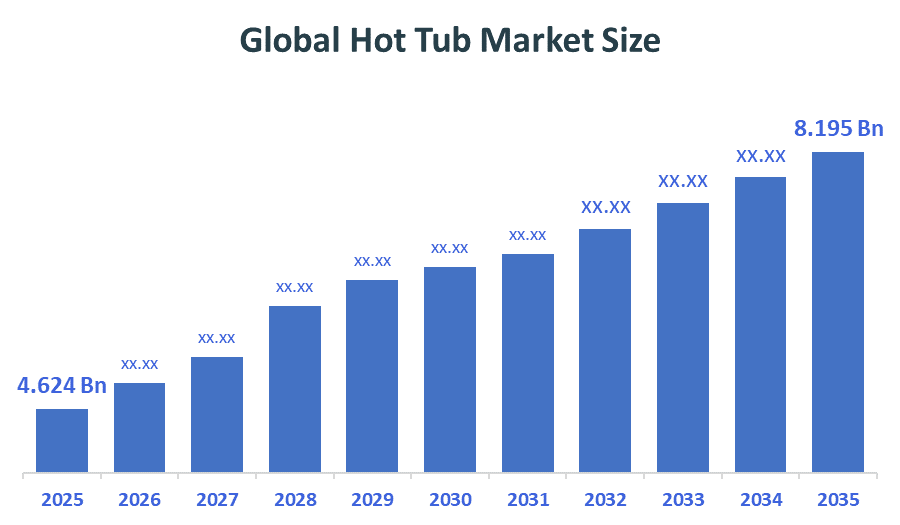
According to Decision Advisors, the Global Hot Tub Market Size is expected to grow from USD 4.624 Billion in 2025 to USD 8.195 Billion by 2035, at a CAGR of 5.89% during the forecast period 2026-2035. Global hot tub market is expected to experience substantial growth over the forecast period due to rising wellness and spa culture, increasing disposable income, growing demand for home leisure products, technological advancements like smart and energy-efficient hot tubs, and expanding residential and commercial applications.
Market Overview/ Introduction
The Hot Tub Market involves the manufacturing, sale, and distribution of hot tubs and spas, including portable, in-ground, and inflatable types, along with accessories. Growth is driven by residential, commercial, and wellness sectors, lifestyle trends, and smart, energy-efficient innovations. A hot tub is a large tub or small pool designed for hydrotherapy, relaxation, and recreational use, typically filled with heated water. Most hot tubs have jets that create massaging bubbles, and they can be portable or built-in, used at homes, resorts, or wellness centres. Hot tubs are used for relaxation, stress relief, and hydrotherapy, helping alleviate muscle and joint pain, improve circulation, enhance sleep quality, and support post-exercise recovery. They also serve recreational and social purposes in homes and wellness centers. Drivers of the hot tub market include rising wellness awareness, growing disposable incomes, increasing demand for home leisure and spa experiences, technological advancements like energy-efficient and smart hot tubs, expanding residential and commercial applications, and lifestyle trends favouring relaxation and recreation. Recent hot tub technologies include smart controls with mobile app integration, energy-efficient heating systems, advanced water purification, customizable hydrotherapy jets, LED lighting, automated maintenance features, and eco-friendly materials, enhancing user convenience, comfort, safety, and sustainable home and commercial spa experiences. Recent developments in the hot tub market include launch of smart, energy-efficient models, integration with IoT and mobile apps, enhanced water purification systems, customizable hydrotherapy features, eco-friendly materials, and expanding partnerships between manufacturers and wellness resorts to boost residential and commercial adoption.
- In California, Title?24 regulations (effective 2026) require new pools and hot tubs to use electric heat pumps or solar systems, phasing out gas-only heaters as primary sources, though gas may remain supplemental, impacting efficiency and emissions standards.
- In Japan, where the senior population is 29.3%, preventive healthcare programs are promoting hydrotherapy and spa use, encouraging investment in residential and high-end built-in hot tubs, boosting demand for wellness-focused and luxury hot tub products.
Notable Insights: -
- Asia-Pacific holds the largest regional market share approximately 20% in the global Hot tub market.
- North America is the fastest growing region market share approximately 40% in the global hot tub market.
- By type, the portable hot tubs segment held a dominant position with 36% in terms of market share in 2025.
- By material, acrylic segment is the dominating accounting for market is approximately 55%.
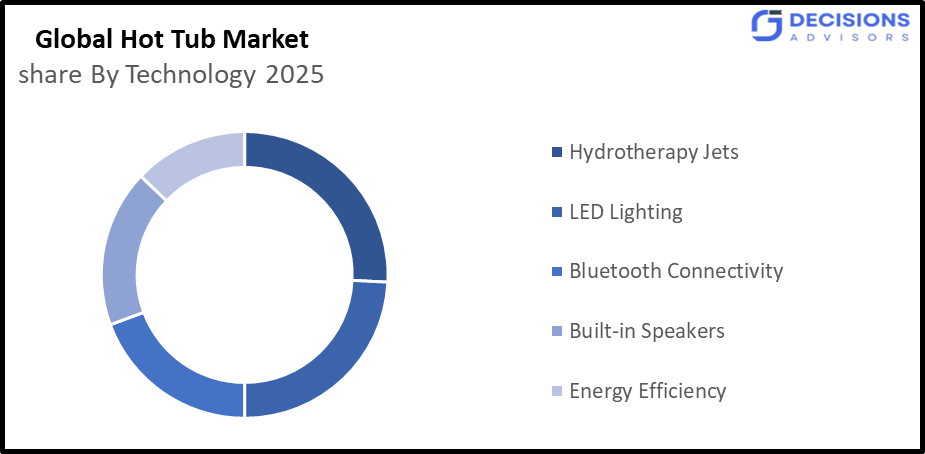
- By technology, hydrotherapy jets segment held a dominant position market is approximately 49%.
- By end user, residential segment is the dominating accounting for market is approximately 69%.
- The market is likely to achieve a valuation of USD 8.195 Billion by 2035.
What is role of technology in grooming the market?
Technology plays a crucial role in shaping the Hot Tub market by enabling energy-efficient heating, smart controls, automated maintenance, and advanced hydrotherapy features. Innovations in IoT integration, water purification systems, and eco-friendly materials enhance user experience, convenience, and safety. Integration with AI-driven smart systems, mobile apps, and remote monitoring further accelerates adoption across residential, commercial, and wellness sectors, driving market growth and continuous product innovation globally.
How is Recent Developments Helping the Market?
Recent developments in Hot Tubs are accelerating market growth by improving energy efficiency, automation, and user customization. Innovations such as smart app controls, advanced water treatment systems, customizable jets, and eco-friendly materials enable enhanced wellness experiences, reduced operational costs, and simplified maintenance. Increased R&D investments and integration with AI-driven monitoring systems further enhance performance, safety, and sustainability, encouraging wider adoption across homes, spas, hotels, and fitness centres globally.
Market Drivers
The Hot Tub market is primarily driven by growing wellness and spa culture, as consumers increasingly seek relaxation, stress relief, and hydrotherapy benefits at home or in commercial settings. Rising disposable incomes and urbanization are boosting demand for luxury home leisure products, making hot tubs more accessible to a broader consumer base. Technological advancements are another major driver, including smart controls, energy-efficient heating, advanced water purification, customizable hydrotherapy jets, LED lighting, and IoT integration, all of which enhance convenience, comfort, and safety. Increasing awareness of health and wellness benefits, such as improved circulation, muscle recovery, and better sleep, further supports adoption. Additionally, the expansion of commercial applications in resorts, hotels, gyms, and rehabilitation centres creates new market opportunities. Eco-friendly and sustainable product innovations also appeal to environmentally conscious consumers, while lifestyle trends favouring home entertainment and leisure continue to accelerate global market growth.
Restrain
The Hot Tub market faces restraints such as high purchase and maintenance costs, complex installation requirements, and significant energy consumption. Technical challenges, including water treatment maintenance, durability under extreme weather, and integration with smart systems, can also hinder performance. Additionally, space constraints for installation and seasonal demand fluctuations limit widespread adoption in certain regions.
Competitive Analysis:
The report offers the appropriate analysis of the key organizations/companies involved within the hot tub market, along with a comparative evaluation primarily based on their Product of offering, business overviews, geographic presence, enterprise strategies, segment market share, and SWOT analysis. The report also provides an elaborative analysis focusing on the current news and developments of the companies, which includes Product development, innovations, joint ventures, partnerships, mergers & acquisitions, strategic alliances, and others. This allows for the evaluation of the overall competition within the market.
Top Companies in Global Hot Tub Market
- Jacuzzi Brands LLC
- Bullfrog Spas
- HotSpring Spas (Watkins Wellness)
- Sundance Spas
- Cal Spas
- Master Spas
- Marquis Spas
- Dimension One Spas
- Artesian Spas
- Canadian Spa Company
- ThermoSpas
- Hydrorelax
Government Initiatives
|
Country |
Key Government Initiatives |
|
Australia |
Government sustainability initiatives are driving energy efficiency in households, impacting the spa market. Regulations now favor energy-efficient pumps, heaters, and insulated covers for hot tubs, reducing carbon footprint and operational costs. |
|
Singapore
|
The Singapore Standards Council enforces strict electrical and water safety standards for hot tubs, emphasizing waterproof components and proper ventilation, ensuring consumer safety and compliance for manufacturers and distributors. |
Study on the Supply, Demand, Distribution, and Market Environment of Energy Management Systems Market
The Hot Tub market is shaped by evolving supply, demand, distribution, and regulatory environments. On the supply side, increasing availability of advanced hot tub models, smart controls, energy-efficient systems, and customizable hydrotherapy features is strengthening market capabilities, with key players investing in innovative, eco-friendly, and IoT-enabled designs. Demand is rising due to growing wellness awareness, lifestyle trends, rising disposable incomes, and the popularity of home leisure and spa experiences, as well as expanding applications in commercial settings such as resorts, hotels, gyms, and rehabilitation centres. In terms of distribution, hot tubs are delivered through direct sales, specialty retailers, online platforms, and partnerships with wellness centres, with digital sales and IoT-enabled services expanding reach and accessibility. The market environment is influenced by supportive lifestyle trends, wellness initiatives, and growing focus on eco-friendly and energy-efficient solutions. Challenges such as high initial costs, installation complexity, and seasonal demand fluctuations may impact growth, while continuous technological advancements create new opportunities.
Price Analysis and Consumer Behaviour Analysis
Price analysis in the Hot Tub market shows relatively high costs due to premium materials, advanced water treatment systems, smart technology integration, and customization features, with prices varying by size, jet configuration, energy efficiency, and additional wellness features. Consumer behaviour is primarily driven by comfort, health benefits, convenience, and aesthetic appeal rather than price sensitivity. Residential buyers prioritize relaxation, stress relief, and home wellness, while commercial buyers focus on durability, performance, and energy efficiency. However, increasing competition, technological innovations, and the growing adoption of smart, energy-efficient, and eco-friendly hot tubs are gradually making products more accessible and encouraging broader adoption across residential and commercial sectors.
Market Segmentation
The Hot Tub market share is classified into type, material, technology, and end user.
- The type segment dominated the market in 2025, and is projected to grow at a substantial CAGR of approximately 36% during the forecast period.
Based on the technology, the Hot tub market is divided into portable hot tubs, in-ground hot tubs, inflatable hot tubs, and wooden hot tubs. Among these, portable hot tubs dominate the global hot tub market, holding approximately 36% of the total market share in 2025. Their popularity is driven by ease of installation, affordability, and flexibility, making them highly suitable for residential users. In comparison, in-ground and wooden hot tubs occupy smaller, premium-focused segments, while inflatable hot tubs are growing but still lag behind in market share. The portable segment continues to lead due to its broad consumer appeal and cost-effectiveness.
- The material segment accounted for the largest share in 2025, and is anticipated to grow at a significant CAGR of approximately 55% during the forecast period.
Based on the material, the hot tub market is divided into acrylic, fiberglass rotomolded plastic, wood, stainless steel. Among these, acrylic is the leading material in the global Hot Tub market, holding approximately 55% of the material segment in 2025. Its dominance is due to durability, heat retention, low maintenance, and design flexibility, making it the preferred choice for residential and commercial buyers. Wood, fiberglass, and rotomolded plastic account for around 40%, while stainless steel and other niche materials represent the remaining share. Acrylic’s combination of strength, aesthetics, and insulation keeps it at the forefront of consumer preference globally.
- The technology segment dominated the market in 2025, and is projected to grow at a substantial CAGR of approximately 49% during the forecast period.
Based on the service, the Hot tub market is divided into hydrotherapy jets, LED lighting, bluetooth connectivity, built-in speakers, and energy efficiency. Among these, hydrotherapy jets dominate the global Hot Tub market, accounting for approximately 45–50% of the feature segment. Their dominance is driven by strong consumer demand for wellness, relaxation, and therapeutic benefits, including muscle relief, stress reduction, and improved circulation. While features like LED lighting, Bluetooth connectivity, built-in speakers, and energy efficiency enhance user experience, hydrotherapy jets are considered essential for both residential and commercial buyers, making them the most valued and widely adopted feature in hot tubs globally
.
- The end user segment dominated the market in 2025, and is projected to grow at a substantial CAGR of approximately 69% during the forecast period.
Based on the End Use, the hot tub market is divided into residential, commercial, health and wellness centres. Among these, residential is the dominant end?use segment in the global Hot Tub market, typically accounting for about 60–70?% of total market share. This dominance is driven by rising disposable incomes, growing home improvement trends, and increased focus on private wellness and relaxation spaces. Homeowners increasingly invest in hot tubs for leisure, hydrotherapy, and lifestyle enhancement, making residential use the largest and most consistent revenue generator compared with commercial and health and wellness centres.
Strategies to Implement for Growth of the Market in Non-Leading Regions
To expand the Hot Tub market in non-leading regions, companies should focus on affordable and energy-efficient models tailored to local preferences. Partnerships with resorts, gyms, and wellness centres can increase visibility and adoption. Leveraging digital marketing, e-commerce platforms, and social media campaigns can educate consumers about health, relaxation, and lifestyle benefits. Offering flexible financing, installation support, and after-sales services reduces adoption barriers. Localized R&D and product customization for climate, space, and cultural preferences can enhance appeal. Government collaborations promoting wellness and eco-friendly products further support growth in emerging markets.
Regional Segment Analysis of the Hot tub Market
- North America (U.S., Canada, Mexico)
- Europe (Germany, France, U.K., Italy, Spain, Rest of Europe)
- Asia-Pacific (China, Japan, India, Rest of APAC)
- South America (Brazil and the Rest of South America)
- The Middle East and Africa (UAE, South Africa, Rest of MEA)
Asia Pacific is anticipated to hold the largest share of the Hot tub market over the predicted timeframe.
Asia Pacific is expected to hold the largest share of the global hot tub market over the forecast period, driven by rising demand for luxury wellness products and residential installations. The region’s market is projected to grow at a CAGR of approximately 4.8–6.4% from 2025 to 2035, outpacing other regions. Key contributors include China, Japan, India, and Southeast Asia, with Asia Pacific currently accounting for around 20% of global market revenue.
North America is expected to grow at a rapid CAGR in the Hot tub market during the forecast period. North America’s hot tub market is projected to grow steadily over the forecast period, driven by rising consumer interest in wellness, relaxation, and home leisure upgrades. The region is expected to expand at a CAGR of around 3.6–3.9%, reflecting consistent demand for hydrotherapy products and outdoor lifestyle investments. North America also continues to hold a significant market share around approximately 38–42% of the global, underpinned by strong disposable incomes and established adoption trends.
Europe is the 3rd largest region to grow in the Hot tub market during the region. Europe is projected to be the third?largest regional growth market for hot tubs during the forecast period. The European hot tub market is expected to expand at a CAGR of about 3.7%, supported by rising consumer interest in wellness, relaxation, and hydrotherapy benefits. Europe also holds roughly 22–30% of the global hot tub market share, with strong adoption in countries like Germany, the UK, and France.
Future Market Trends in Global Hot Tub Market: -
- Smart and IoT-Enabled Hot Tubs
Integration of smart controls and IoT technology is transforming the hot tub market. Users can now control temperature, jets, lighting, and water quality remotely via mobile apps. Predictive maintenance alerts, automated cleaning, and energy optimization features improve convenience and reduce operational costs. Smart hot tubs also allow data-driven customization of hydrotherapy sessions, enhancing wellness experiences. This trend is expected to drive adoption in residential, commercial, and luxury wellness sectors, appealing to tech-savvy consumers globally.
2. Energy Efficiency and Eco-Friendly Designs
Increasing awareness of sustainability and energy costs is driving the development of energy-efficient and eco-friendly hot tubs. Advanced insulation, low-energy pumps, solar-assisted heating, and eco-conscious materials reduce environmental impact and operating costs. Consumers and commercial buyers increasingly prefer products with certifications and green technology features. This trend supports adoption in regions with high energy costs or environmental regulations and aligns with global sustainability goals, making energy-efficient hot tubs a key market differentiator.
3. Health & Wellness Focus
Hot tubs are increasingly marketed for therapeutic and wellness benefits, including stress relief, improved circulation, muscle recovery, and better sleep. Integration of customizable hydrotherapy jets, aromatherapy, and temperature control enhances the wellness experience. Rising awareness of self-care, preventive healthcare, and mental well-being is boosting demand across residential, hotel, spa, and rehabilitation sectors. Wellness-focused innovations position hot tubs as lifestyle essentials rather than luxury items, driving long-term market growth and product diversification worldwide.
Recent Development
Jacuzzi 2026 Collection: The new J4 and J5 hot tubs feature infrared therapy, True Water nanobubbles, multi-layer insulation, and smart hydrotherapy jets. Jacuzzi earned America’s Most Trusted® Hot Tub Brand, offering trade-in rebates up to $3,000.
In 2026, Caldera & Fantasy Spa: New hot tubs feature smart connectivity with smartphones and voice assistants, enhanced insulation, energy-efficient pumps, and ergonomic seating, combining comfort, lower operating costs, and modern technology for all-age residential and wellness markets.
In 2026, Hot Tub 2026 Lineup: Brands unveil redesigned Luxury, Sport, Modern, Classic, and All-In-110V series, combining modern aesthetics with therapy-first performance, highlighting hydrotherapy, ergonomic design, and premium wellness features for residential and wellness markets.
In 2026, Be Well Canada / Maple Spas: The redesigned 2026 lineup features the Maple 950 flagship with 66 jets, neck jets, and jetted foot dome, alongside Maple 350/550/650+ models optimized for ergonomics, hydrotherapy, and showroom appeal.
Market Segment
This study forecasts revenue at global, regional, and country levels from 2021 to 2035. Decision Advisors has segmented the hot tub market based on the below-mentioned segments:
Global Hot Tub Market, By Type
- Portable Hot Tubs
- In-Ground Hot Tubs
- Inflatable Hot Tubs
- Wooden Hot Tubs
Global Hot Tub Market, By Material
- Acrylic
- Fiberglass
- Rotomolded Plastic
- Wood
- Stainless Steel
Global Hot Tub Market, By Technology
- Hydrotherapy Jets
- LED Lighting
- Bluetooth Connectivity
- Built-in Speakers
- Energy Efficiency
Global Hot Tub Market, By End User
- Residential
- Commercial
- Health and Wellness Centres
Global Hot Tub Market, By Regional Analysis
- North America
- US
- Canada
- Mexico
- Europe
- Germany
- UK
- France
- Italy
- Spain
- Russia
- Rest of Europe
- Asia Pacific
- China
- Japan
- India
- South Korea
- Australia
- Rest of Asia Pacific
- South America
- Brazil
- Argentina
- Rest of South America
- Middle East & Africa
- UAE
- Saudi Arabia
- Qatar
- South Africa
- Rest of the Middle East & Africa
Frequently Asked Questions (FAQ)
1. Q: What is the average lifespan of a residential hot tub?
A: Most residential hot tubs last 10–20 years, depending on maintenance, water treatment, material quality, and frequency of use. Acrylic and well-insulated models tend to have the longest lifespan.
2. Q: Are there financing options available for purchasing hot tubs?
A: Yes, many manufacturers and retailers offer instalment plans, low-interest financing, and seasonal promotions. Flexible financing helps make high-end and energy-efficient models more accessible to residential and commercial buyers.
3. Q: How much does energy consumption vary between hot tub models?
A: Energy use depends on size, insulation, pump type, heater efficiency, and usage patterns. Smart energy-efficient models with multi-layer insulation can reduce electricity costs by 20–40% compared with older, standard models.
4. Q: Can hot tubs be used year-round in colder climates?
A: Yes, hot tubs with advanced insulation, energy-efficient heating, and winter covers allow year-round use even in freezing conditions. Some regions also offer state or provincial rebates for energy-efficient systems to offset operating costs.
5. Q: Are there emerging materials or designs expected in future hot tubs?
A: Innovative materials like eco-friendly composites, recycled plastics, and antimicrobial coatings are being introduced. Designs are trending toward modular, compact, and portable units with integrated smart technology and wellness-focused hydrotherapy features.
- Introduction
- Objectives of the Study
- Market Definition
- Research Scope
- Research Methodology and Assumptions
- Executive Summary
- Premium Insights
- Porter’s Five Forces Analysis
- Value Chain Analysis
- Top Investment Pockets
- Market Attractiveness Analysis By Type
- Market Attractiveness Analysis By Material
- Market Attractiveness Analysis By Technology
- Market Attractiveness Analysis By End User
- Market Attractiveness Analysis By Region
- Industry Trends
- Market Dynamics
- Market Evaluation
- Drivers
- Increase in health consciousness
- Restraints
- Strict adherence to regulations required for sugar substitute products
- Opportunities
- Increased investment in R&D activities by manufacturers
- Challenges
5.5.1. Product labeling and claims issues
- Global Hot Tub Market Analysis and Projection, By Type
- Segment Overview
- Portable Hot Tubs
- In-Ground Hot Tubs
- Inflatable Hot Tubs
- Wooden Hot Tubs
- <<Sub1_se5>>
- Global Hot Tub Market Analysis and Projection, By Material
- Segment Overview
- Acrylic
- Fiberglass
- Rotomolded Plastic
- Wood
- Stainless Steel
- Global Hot Tub Market Analysis and Projection, By Technology
- Segment Overview
- Hydrotherapy Jets
- LED Lighting
- Bluetooth Connectivity
- Built-in Speakers
- Energy Efficiency
- Global Hot Tub Market Analysis and Projection, By End User
- Segment Overview
- Residential
- Commercial
- Health and Wellness Centres
- <<Sub4_se4>>
- <<Sub4_se5>>
- Global Hot Tub Market Analysis and Projection, By <<Seg5>>
- Segment Overview
- <<Sub5_se1>>
- <<Sub5_se2>>
- <<Sub5_se3>>
- <<Sub5_se4>>
- <<Sub5_se5>>
- Global Hot Tub Market Analysis and Projection, By Regional Analysis
- Segment Overview
- North America
- U.S.
- Canada
- Mexico
- Europe
- Germany
- France
- U.K.
- Italy
- Spain
- Asia-Pacific
- Japan
- China
- India
- South America
- Brazil
- Middle East and Africa
- UAE
- South Africa
- Global Hot Tub Market-Competitive Landscape
- Overview
- Market Share of Key Players in the Hot Tub Market
- Global Company Market Share
- North America Company Market Share
- Europe Company Market Share
- APAC Company Market Share
- Competitive Situations and Trends
- Coverage Launches and Developments
- Partnerships, Collaborations, and Agreements
- Mergers & Acquisitions
- Expansions
- Company Profiles
- Jacuzzi Brands LLC
- Business Overview
- Company Snapshot
- Company Market Share Analysis
- Company Coverage Portfolio
- Recent Developments
- SWOT Analysis
- Bullfrog Spas
- Business Overview
- Company Snapshot
- Company Market Share Analysis
- Company Coverage Portfolio
- Recent Developments
- SWOT Analysis
- HotSpring Spas (Watkins Wellness)
- Business Overview
- Company Snapshot
- Company Market Share Analysis
- Company Coverage Portfolio
- Recent Developments
- SWOT Analysis
- Sundance Spas
- Business Overview
- Company Snapshot
- Company Market Share Analysis
- Company Coverage Portfolio
- Recent Developments
- SWOT Analysis
- Cal Spas
- Business Overview
- Company Snapshot
- Company Market Share Analysis
- Company Coverage Portfolio
- Recent Developments
- SWOT Analysis
- Master Spas
- Business Overview
- Company Snapshot
- Company Market Share Analysis
- Company Coverage Portfolio
- Recent Developments
- SWOT Analysis
- Marquis Spas
- Business Overview
- Company Snapshot
- Company Market Share Analysis
- Company Coverage Portfolio
- Recent Developments
- SWOT Analysis
- Dimension One Spas
- Business Overview
- Company Snapshot
- Company Market Share Analysis
- Company Coverage Portfolio
- Recent Developments
- SWOT Analysis
- Artesian Spas
- Business Overview
- Company Snapshot
- Company Market Share Analysis
- Company Coverage Portfolio
- Recent Developments
- SWOT Analysis
- Canadian Spa Company
- Business Overview
- Company Snapshot
- Company Market Share Analysis
- Company Coverage Portfolio
- Recent Developments
- SWOT Analysis
- ThermoSpas
- Business Overview
- Company Snapshot
- Company Market Share Analysis
- Company Coverage Portfolio
- Recent Developments
- SWOT Analysis
- Hydrorelax
- Business Overview
- Company Snapshot
- Company Market Share Analysis
- Company Coverage Portfolio
- Recent Developments
- SWOT Analysis
- Jacuzzi Brands LLC
List of Table
- Global Hot Tub Market, By Type, 2024-2035(USD Billion)
- Global Portable Hot Tubs, Hot Tub Market, By Region, 2024-2035(USD Billion)
- Global In-Ground Hot Tubs, Hot Tub Market, By Region, 2024-2035(USD Billion)
- Global Inflatable Hot Tubs, Hot Tub Market, By Region, 2024-2035(USD Billion)
- Global Wooden Hot Tubs, Hot Tub Market, By Region, 2024-2035(USD Billion)
- Global Hot Tub Market, By Material, 2024-2035(USD Billion)
- Global Acrylic, Hot Tub Market, By Region, 2024-2035(USD Billion)
- Global Fiberglass, Hot Tub Market, By Region, 2024-2035(USD Billion)
- Global Rotomolded Plastic, Hot Tub Market, By Region, 2024-2035(USD Billion)
- Global Wood, Hot Tub Market, By Region, 2024-2035(USD Billion)
- Global Stainless Steel, Hot Tub Market, By Region, 2024-2035(USD Billion)
- Global Hot Tub Market, By Technology, 2024-2035(USD Billion)
- Global Hydrotherapy Jets, Hot Tub Market, By Region, 2024-2035(USD Billion)
- Global LED Lighting, Hot Tub Market, By Region, 2024-2035(USD Billion)
- Global Bluetooth Connectivity, Hot Tub Market, By Region, 2024-2035(USD Billion)
- Global Built-in Speakers, Hot Tub Market, By Region, 2024-2035(USD Billion)
- Global Energy Efficiency, Hot Tub Market, By Region, 2024-2035(USD Billion)
- Global Hot Tub Market, By End User, 2024-2035(USD Billion)
- Global Residential, Hot Tub Market, By Region, 2024-2035(USD Billion)
- Global Commercial, Hot Tub Market, By Region, 2024-2035(USD Billion)
- Global Health and Wellness Centres, Hot Tub Market, By Region, 2024-2035(USD Billion)
- North America Hot Tub Market, By Type, 2024-2035(USD Billion)
- North America Hot Tub Market, By Material, 2024-2035(USD Billion)
- North America Hot Tub Market, By Technology, 2024-2035(USD Billion)
- North America Hot Tub Market, By End User, 2024-2035(USD Billion)
- U.S. Hot Tub Market, By Type, 2024-2035(USD Billion)
- U.S. Hot Tub Market, By Material, 2024-2035(USD Billion)
- U.S. Hot Tub Market, By Technology, 2024-2035(USD Billion)
- U.S. Hot Tub Market, By End User, 2024-2035(USD Billion)
- Canada Hot Tub Market, By Type, 2024-2035(USD Billion)
- Canada Hot Tub Market, By Material, 2024-2035(USD Billion)
- Canada Hot Tub Market, By Technology, 2024-2035(USD Billion)
- Canada Hot Tub Market, By End User, 2024-2035(USD Billion)
- Mexico Hot Tub Market, By Type, 2024-2035(USD Billion)
- Mexico Hot Tub Market, By Material, 2024-2035(USD Billion)
- Mexico Hot Tub Market, By Technology, 2024-2035(USD Billion)
- Mexico Hot Tub Market, By End User, 2024-2035(USD Billion)
- Europe Hot Tub Market, By Type, 2024-2035(USD Billion)
- Europe Hot Tub Market, By Material, 2024-2035(USD Billion)
- Europe Hot Tub Market, By Technology, 2024-2035(USD Billion)
- Europe Hot Tub Market, By End User, 2024-2035(USD Billion)
- Germany Hot Tub Market, By Type, 2024-2035(USD Billion)
- Germany Hot Tub Market, By Material, 2024-2035(USD Billion)
- Germany Hot Tub Market, By Technology, 2024-2035(USD Billion)
- Germany Hot Tub Market, By End User, 2024-2035(USD Billion)
- France Hot Tub Market, By Type, 2024-2035(USD Billion)
- France Hot Tub Market, By Material, 2024-2035(USD Billion)
- France Hot Tub Market, By Technology, 2024-2035(USD Billion)
- France Hot Tub Market, By End User, 2024-2035(USD Billion)
- U.K. Hot Tub Market, By Type, 2024-2035(USD Billion)
- U.K. Hot Tub Market, By Material, 2024-2035(USD Billion)
- U.K. Hot Tub Market, By Technology, 2024-2035(USD Billion)
- U.K. Hot Tub Market, By End User, 2024-2035(USD Billion)
- Italy Hot Tub Market, By Type, 2024-2035(USD Billion)
- Italy Hot Tub Market, By Material, 2024-2035(USD Billion)
- Italy Hot Tub Market, By Technology, 2024-2035(USD Billion)
- Italy Hot Tub Market, By End User, 2024-2035(USD Billion)
- Spain Hot Tub Market, By Type, 2024-2035(USD Billion)
- Spain Hot Tub Market, By Material, 2024-2035(USD Billion)
- Spain Hot Tub Market, By Technology, 2024-2035(USD Billion)
- Spain Hot Tub Market, By End User, 2024-2035(USD Billion)
- Asia Pacific Hot Tub Market, By Type, 2024-2035(USD Billion)
- Asia Pacific Hot Tub Market, By Material, 2024-2035(USD Billion)
- Asia Pacific Hot Tub Market, By Technology, 2024-2035(USD Billion)
- Asia Pacific Hot Tub Market, By End User, 2024-2035(USD Billion)
- Japan Hot Tub Market, By Type, 2024-2035(USD Billion)
- Japan Hot Tub Market, By Material, 2024-2035(USD Billion)
- Japan Hot Tub Market, By Technology, 2024-2035(USD Billion)
- Japan Hot Tub Market, By End User, 2024-2035(USD Billion)
- China Hot Tub Market, By Type, 2024-2035(USD Billion)
- China Hot Tub Market, By Material, 2024-2035(USD Billion)
- China Hot Tub Market, By Technology, 2024-2035(USD Billion)
- China Hot Tub Market, By End User, 2024-2035(USD Billion)
- India Hot Tub Market, By Type, 2024-2035(USD Billion)
- India Hot Tub Market, By Material, 2024-2035(USD Billion)
- India Hot Tub Market, By Technology, 2024-2035(USD Billion)
- India Hot Tub Market, By End User, 2024-2035(USD Billion)
- South America Hot Tub Market, By Type, 2024-2035(USD Billion)
- South America Hot Tub Market, By Material, 2024-2035(USD Billion)
- South America Hot Tub Market, By Technology, 2024-2035(USD Billion)
- South America Hot Tub Market, By End User, 2024-2035(USD Billion)
- Brazil Hot Tub Market, By Type, 2024-2035(USD Billion)
- Brazil Hot Tub Market, By Material, 2024-2035(USD Billion)
- Brazil Hot Tub Market, By Technology, 2024-2035(USD Billion)
- Brazil Hot Tub Market, By End User, 2024-2035(USD Billion)
- The Middle East and Africa Hot Tub Market, By Type, 2024-2035(USD Billion)
- The Middle East and Africa Hot Tub Market, By Material, 2024-2035(USD Billion)
- The Middle East and Africa Hot Tub Market, By Technology, 2024-2035(USD Billion)
- The Middle East and Africa Hot Tub Market, By End User, 2024-2035(USD Billion)
- UAE Hot Tub Market, By Type, 2024-2035(USD Billion)
- UAE Hot Tub Market, By Material, 2024-2035(USD Billion)
- UAE Hot Tub Market, By Technology, 2024-2035(USD Billion)
- UAE Hot Tub Market, By End User, 2024-2035(USD Billion)
- South Africa Hot Tub Market, By Type, 2024-2035(USD Billion)
- South Africa Hot Tub Market, By Material, 2024-2035(USD Billion)
- South Africa Hot Tub Market, By Technology, 2024-2035(USD Billion)
- South Africa Hot Tub Market, By End User, 2024-2035(USD Billion)
List of Figures
- Global Hot Tub Market Segmentation
- Hot Tub Market: Research Methodology
- Market Size Estimation Methodology: Bottom-Up Approach
- Market Size Estimation Methodology: Top-down Approach
- Data Triangulation
- Porter’s Five Forces Analysis
- Value Chain Analysis
- Top investment pocket in the Hot Tub Market
- Top Winning Strategies, 2024-2035
- Top Winning Strategies, By Development, 2024-2035(%)
- Top Winning Strategies, By Company, 2024-2035
- Moderate Bargaining power of Buyers
- Moderate Bargaining power of Suppliers
- Moderate Bargaining power of New Entrants
- Low threat of Substitution
- High Competitive Rivalry
- Top Player Positioning, 2024
- Market Share Analysis, 2024
- Restraint and Drivers: Hot Tub Market
- Hot Tub Market Segmentation, By Type
- Hot Tub Market For Portable Hot Tubs, By Region, 2024-2035 ($ Billion)
- Hot Tub Market For In-Ground Hot Tubs, By Region, 2024-2035 ($ Billion)
- Hot Tub Market For Inflatable Hot Tubs, By Region, 2024-2035 ($ Billion)
- Hot Tub Market For Wooden Hot Tubs, By Region, 2024-2035 ($ Billion)
- Hot Tub Market Segmentation, By Material
- Hot Tub Market For Acrylic, By Region, 2024-2035 ($ Billion)
- Hot Tub Market For Fiberglass, By Region, 2024-2035 ($ Billion)
- Hot Tub Market For Rotomolded Plastic, By Region, 2024-2035 ($ Billion)
- Hot Tub Market For Wood, By Region, 2024-2035 ($ Billion)
- Hot Tub Market For Stainless Steel, By Region, 2024-2035 ($ Billion)
- Hot Tub Market Segmentation, By Technology
- Hot Tub Market For Hydrotherapy Jets, By Region, 2024-2035 ($ Billion)
- Hot Tub Market For LED Lighting, By Region, 2024-2035 ($ Billion)
- Hot Tub Market For Bluetooth Connectivity, By Region, 2024-2035 ($ Billion)
- Hot Tub Market For Built-in Speakers, By Region, 2024-2035 ($ Billion)
- Hot Tub Market For Energy Efficiency, By Region, 2024-2035 ($ Billion)
- Hot Tub Market Segmentation, By End User
- Hot Tub Market For Residential, By Region, 2024-2035 ($ Billion)
- Hot Tub Market For Commercial, By Region, 2024-2035 ($ Billion)
- Hot Tub Market For Health and Wellness Centres, By Region, 2024-2035 ($ Billion)
- Jacuzzi Brands LLC: Net Sales, 2024-2035 ($ Billion)
- Jacuzzi Brands LLC: Revenue Share, By Segment, 2024 (%)
- Jacuzzi Brands LLC: Revenue Share, By Region, 2024 (%)
- Bullfrog Spas: Net Sales, 2024-2035 ($ Billion)
- Bullfrog Spas: Revenue Share, By Segment, 2024 (%)
- Bullfrog Spas: Revenue Share, By Region, 2024 (%)
- HotSpring Spas (Watkins Wellness): Net Sales, 2024-2035 ($ Billion)
- HotSpring Spas (Watkins Wellness): Revenue Share, By Segment, 2024 (%)
- HotSpring Spas (Watkins Wellness): Revenue Share, By Region, 2024 (%)
- Sundance Spas: Net Sales, 2024-2035 ($ Billion)
- Sundance Spas: Revenue Share, By Segment, 2024 (%)
- Sundance Spas: Revenue Share, By Region, 2024 (%)
- Cal Spas: Net Sales, 2024-2035 ($ Billion)
- Cal Spas: Revenue Share, By Segment, 2024 (%)
- Cal Spas: Revenue Share, By Region, 2024 (%)
- Master Spas: Net Sales, 2024-2035 ($ Billion)
- Master Spas: Revenue Share, By Segment, 2024 (%)
- Master Spas: Revenue Share, By Region, 2024 (%)
- Marquis Spas: Net Sales, 2024-2035 ($ Billion)
- Marquis Spas: Revenue Share, By Segment, 2024 (%)
- Marquis Spas: Revenue Share, By Region, 2024 (%)
- Dimension One Spas: Net Sales, 2024-2035 ($ Billion)
- Dimension One Spas: Revenue Share, By Segment, 2024 (%)
- Dimension One Spas: Revenue Share, By Region, 2024 (%)
- Artesian Spas.: Net Sales, 2024-2035 ($ Billion)
- Artesian Spas.: Revenue Share, By Segment, 2024 (%)
- Artesian Spas.: Revenue Share, By Region, 2024 (%)
- Canadian Spa Company: Net Sales, 2024-2035 ($ Billion)
- Canadian Spa Company: Revenue Share, By Segment, 2024 (%)
- Canadian Spa Company: Revenue Share, By Region, 2024 (%)
- ThermoSpas: Net Sales, 2024-2035 ($ Billion)
- ThermoSpas: Revenue Share, By Segment, 2024 (%)
- ThermoSpas: Revenue Share, By Region, 2024 (%)
- Hydrorelax: Net Sales, 2024-2035 ($ Billion)
- Hydrorelax: Revenue Share, By Segment, 2024 (%)
- Hydrorelax: Revenue Share, By Region, 2024 (%)
Check Licence
Choose the plan that fits you best: Single User, Multi-User, or Enterprise solutions tailored for your needs.
We Have You Covered
- 24/7 Analyst Support
- Clients Across the Globe
- Tailored Insights
- Technology Tracking
- Competitive Intelligence
- Custom Research
- Syndicated Market Studies
- Market Overview
- Market Segmentation
- Growth Drivers
- Market Opportunities
- Regulatory Insights
- Innovation & Sustainability
Report Details
| Scope | Global |
| Pages | 210 |
| Delivery | PDF & Excel via Email |
| Language | English |
| Release | Apr 2026 |
| Access | Download from this page |