
Global Household Fans Market
 |
Author:
Nikita K
|
Pages:
240
|
Author:
Nikita K
|
Pages:
240
Global Household Fans Market Size, Share, By Product Type (Ceiling Fans, Table Fans, Pedestal Fans, Wall-mounted Fans, and Window Fans) By Connectivity (Smart Fans and Conventional Fans) By End User (Residential and Semi-Commercial) and By Region (North America, Europe, Asia-Pacific, Latin America, Middle East and Africa), Analysis and Forecast 2026-2035
CAGR
4.88%
REVENUE 2025
USD Billion 11.75
FORECAST 2035
USD Billion 18.93
REPORT COVERAGE
Global
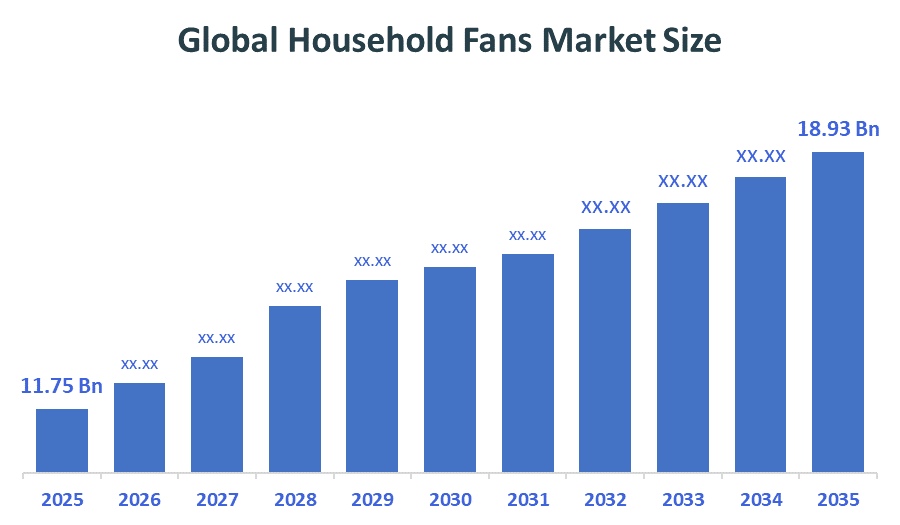
The Global Household Fans Market Size was predicted to grow from USD 11.75 Billion in 2025 and is projected to reach around USD 18.93 Billion by 2035. According to Decision Advisors, a detailed research report on the household fans market shows that the ceiling fan segment dominates the global market, holding approximately 60-65% of the total share worldwide. Panasonic Corporation leads the market with USD 56.8 billion annual revenue in 2025, making it one of the major market drivers for shaping the industry through advanced motor efficiency and aesthetic design.
Market Snapshot
- Global Household Fans Market Size (2025): USD 11.75 Billion
- Global Household Fans Projected Market Size (2035): USD 18.93 Billion
- Global Household Fans Compound Annual Growth Rate (CAGR): 4.88%
- Largest Regional Market: Asia-Pacific
- Fastest Growing Region: Middle East & Africa
- 3rd Largest Region: North America
- Base Year: 2025
- Historical Period: 2021 - 2024
- Forecast Period: 2026 - 2035
Market Overview / Introduction
Household fans are mechanical air-circulating devices that function in the creation of airflow for thermal comfort in domestic and semi-commercial environments. These fans act as crucial intermediaries between basic ventilation and advanced HVAC systems, using cutting-edge aerodynamic blade designs and Brushless DC (BLDC) motor techniques to attain maximum cooling capacity with a minimal amount of energy used. Modern household fans have various characteristics, including silent operation technology and IoT connectivity, so as to perform optimally and minimize electricity consumption. The fans have evolved from being simple rotating blades to advanced high-tech smart fans that are equipped with specialized sensors, voice control compatibility, and used in modern smart home ecosystems. The increase in the use of household fans can be attributed to the increasing need for energy-efficient cooling and the expansion of residential housing within modernizing cities and tropical regions. This is because household fans provide an affordable cooling solution that prevents the excessive power drainage caused by traditional air conditioning units.
- The residential ceiling fan and portable fan segments contribute to approximately 72% of the product-based use in the market, driven by the increasing demand for urban home upgrades, energy-efficient appliance adoption, and the maintenance of indoor air quality in densely populated areas.
- There is an exponential rise in the development of high-tech smart fans in the consumer electronics industry, and the CAGR is predicted to exceed 9% because of the growing application of automated thermal sensors in next-generation homes due to their ability to offer optimized air distribution and user convenience.
Notable Insights:
- Ceiling fan units make up about 60-65% of the total market share of this sector. They have gained a reputation for uniform cooling requirements, particularly in living rooms, bedrooms, and large communal residential spaces.
- Applications of household fans in the sphere of eco-friendly building ventilation account for almost 41.2% of all demand.
- Smart-enabled fan systems show an annual increase above 8.5%. The rise in home automation and frequent occurrences of lifestyle upgrades create conditions that encourage consumers to invest more money in voice-controlled and app-integrated cooling solutions.
What is the Role of Technology in Shaping the Market?
The advancements in technology have made some major changes in the fan industry regarding motor efficiency, noise reduction, and smart integration. Household fan technology of the current generation has evolved beyond being mere air-movers to smart home devices that can operate based on ambient room temperature because they are able to use BLDC motor technology, aerodynamic composite materials, and wireless communication protocols for remote operation.
How are Recent Developments Helping the Market?
They involve the use of inverter-based motor systems, high-efficiency aerodynamic blades, and specialized sleep-mode programming. These innovations have played an important role in facilitating growth and development within the market. There have been innovations involving the development of fans that are able to synchronize with air conditioners, and which are able to protect the energy bills of households from those used in small apartments to fully developed smart villa systems. Such innovations would facilitate the production of aesthetic and functional units using the mechanical properties of modern-day materials, without compromising on airflow volume or motor longevity.
Market Drivers
The market demand for global household fans is on the rise due to higher investments by consumer appliance brands and governments into energy-labeling initiatives and efficient motors capable of meeting carbon reduction goals in the current era. Modern fans have enjoyed significant market popularity because of their advantages of combining multiple properties in one durable system, such as low noise levels, integrated LED lighting, and effective air delivery. On the other hand, the establishment of smart city projects has brought about greater demands for connected cooling solutions to address the trend of shifting from manual appliances to automated home systems.
Restraints
However, the development of the global market for the household fan industry is limited by the complexities involved in maintaining the stability of the price of raw inputs such as copper, high-grade plastics, and aluminum, considering that the market may be characterized by fluctuations that may lead to production cost hurdles.
Competitive Analysis:
The report offers the appropriate analysis of the key organisations/companies involved within the household fans market, along with a comparative evaluation primarily based on their product offerings, business overviews, geographic presence, enterprise strategies, segment market share, and SWOT analysis. The report also provides an elaborate analysis focusing on the current news and developments of the companies, which includes product development, innovations, joint ventures, partnerships, mergers & acquisitions, strategic alliances, and others. This allows for the evaluation of the overall competition within the market.
Top 10 Companies in the Global Household Fans Market
- Panasonic Corporation
- Hunter Fan Company
- Crompton Greaves Consumer Electricals Limited
- Havells India Ltd.
- Midea Group
- Emerson Electric Co.
- Orient Electric
- Luminous Power Technologies
- SMC Corporation
- Big Ass Fans (Delta T, LLC)
Government Initiatives
|
Country |
Key Government Initiatives |
|
China |
Under the 15th Five-Year Plan (2026-2030), the government has prioritized high-efficiency household appliances. The MIIT has targeted subsidies for manufacturers integrating AI and energy-saving BLDC motors into domestic goods. |
|
India |
The PM E-DRIVE and associated energy efficiency schemes have expanded to domestic appliances, mandating strict star-labeling for ceiling fans through 2026 to ensure 100% adoption of efficient motor technologies. |
|
US |
The EPA’s ENERGY STAR program has expanded in 2026 with new performance standards specifically for smart-connected fans, securing a push toward products that reduce residential energy consumption. |
Study on the Supply, Demand, Distribution, and Market Environment
It is necessary for the household fans market to strike a balance between operating at optimal airflow efficiency and the increased demand for designs that are both aesthetically pleasing and inexpensive. The production of fans involves the manufacture of lightweight polymers and precision motor windings that can offer sustained operation without the risk of motor overheating inherent to older fan models.
Price Analysis and Consumer Behaviour Analysis
The cost of fans is influenced by the type of motor, the material of the blades, and the level of smart integration. The more sophisticated products, such as those featuring BLDC motors and air purification filters, are expensive due to their inclusion of advanced control boards and high-grade finishes. On the other hand, ordinary induction motor fans used in basic residential settings can be considered cheap and provide an excellent chance for rapid market penetration in developing regions. Consumers have shown interest in energy-saving features and remote controllability; thus, manufacturers should aim at providing long-lasting and easily installable products.
Market Segmentation
The Global Household Fans Market share is classified into product type, connectivity, and end user.
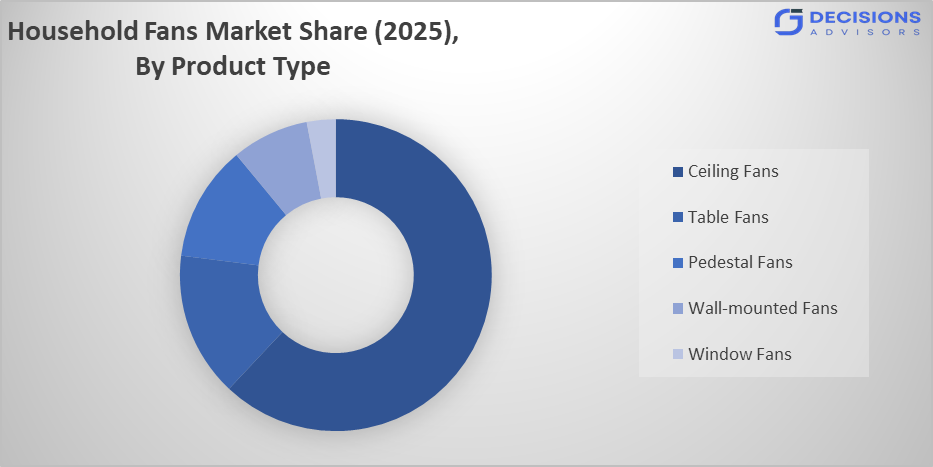
The Ceiling Fans segment holds the largest share, contributing approximately 62% of the market in 2025.
Based on the Product Type, the global household fans market is divided into Ceiling Fans, Table Fans, Pedestal Fans, Wall-mounted Fans, and Window Fans. Among these, the Ceiling Fans segment holds the largest share, contributing approximately 62% of the market in 2025. The reason for this dominance lies in their superior ability to provide uniform air circulation across large living areas and their permanent integration into residential architecture, which minimises the need for floor space in increasingly compact urban housing.
The Conventional Fans segment accounts for the largest share, representing over 75% of the global market in 2025.
Based on connectivity, the global household fans market is divided into Smart Fans and Conventional Fans. Among these, the Conventional Fans segment accounts for the largest share, representing over 75% of the global market in 2025. These fans are critical for general-purpose cooling in regions with developing power infrastructure, providing ease of maintenance and immediate affordability through established retail networks. On the other hand, the Smart Fans segment has emerged as a rapidly growing sector, thanks to the increasing adoption of Wi-Fi-enabled motors and voice-controlled ecosystems in modern smart homes.
The Residential segment dominates the global market, accounting for approximately 85% of the total revenue in 2025.
Based on the End User, the global household fans market is divided into Residential and Semi-Commercial. Among these, the Residential segment dominates the global market, accounting for approximately 85% of the total revenue in 2025. This segment is preferred by manufacturers who require high-volume production and focus on lifestyle aesthetics, decorative finishes, and energy-star ratings for home appliances. The Semi-Commercial category is seeing a steady increase in use, especially by planners in the small-scale retail and hospitality sectors who value the high-velocity air delivery and durability of heavy-duty pedestal and wall-mounted units.
Strategies to Implement for Growth of the Market in Non-Leading Regions
The possibilities of growth for the household fan industry in the emerging regions can be enhanced through the creation of efficient localized assembly facilities for the use of local housing developers, as well as local bodies responsible for the distribution of energy-labeled products. The initiatives from the government focused on affordable housing, together with an increase in rural electrification, play a major role in creating a demand in those regions.
Regional Segment Analysis of the Global Household Fans Market
- North America (U.S., Canada, Mexico)
- Europe (Germany, France, U.K., Italy, Spain, Rest of Europe)
- Asia-Pacific (China, Japan, India, South Korea, Rest of APAC)
- Latin America (Brazil and the Rest of Latin America)
- The Middle East and Africa (UAE, South Africa, Rest of MEA)
Asia-Pacific is projected to be the largest region over the forecast period. This region is anticipated to witness a growth rate of around 7.15% CAGR, maintaining a dominant market share within the global industry. In 2025, the Asia-Pacific region already accounts for approximately 42.6% of global revenue. This is owing to the fast-developing residential housing infrastructure, coupled with the growing demand for affordable cooling solutions in countries such as China, India, and Vietnam. Other reasons for the same include greater investments made toward smart city development in the region, state-supported indigenous manufacturing projects for energy-efficient appliances, and the widespread adoption of mandatory star-labeling standards for ceiling fans.
North America is expected to hold a significant share of the household fans market during the forecast period. This region holds approximately 21.8% share of global revenue in 2025, thanks to its highly sophisticated smart home sector, along with the extensive adoption of energy-efficient technology in both national sustainability goals and high-value residential applications. The largest part of this region’s revenues comes from the United States, as there is a lot of spending at the corporate level in the expansion of premium and decorative fan product lines, along with local research related to AI-integrated air circulation systems.
Europe is anticipated to hold a substantial share, contributing approximately 19.4% of the global market share. There is a competitive advantage in the region owing to clusters of precision engineering innovation and financing for sustainable home transitions, as well as indoor air quality research. There is also a comparative advantage with countries like Germany and Italy, which are highly skilled at manufacturing high-performance motors for silent-operation units. Moreover, the rigorous environmental standards regarding carbon footprints and the Ecodesign for Sustainable Products Regulation (ESPR) further give them a competitive advantage.
Recent Developments
- In March 2026, Panasonic announced a definitive agreement to integrate advanced climate sensors into its fan lineup, aimed at creating a unified smart home experience.
- In December 2025, Havells India approved the acquisition of a regional motor manufacturer to streamline its BLDC motor supply chain.
- In July 2024, Hunter Fan Company successfully launched its carbon-neutral fan series, utilizing 100% recycled materials for blade fabrication.
Market Segmentation
Global Household Fans Market, By Product Type
- Ceiling Fans
- Table Fans
- Pedestal Fans
- Wall-mounted Fans
- Window Fans
Global Household Fans Market, By Connectivity
- Smart Fans
- Conventional Fans
Global Household Fans Market, By End User
- Residential
- Semi-Commercial
Global Household Fans Market, By Regional Analysis
- North America
- United States
- Canada
- Mexico
- Europe
- Germany
- United Kingdom
- France
- Italy
- Spain
- Russia
- Rest of Europe
- Asia Pacific
- China
- Japan
- India
- South Korea
- Australia
- Rest of Asia Pacific
- Latin America
- Brazil
- Argentina
- Rest of Latin America
- Middle East & Africa
- United Arab Emirates
- Saudi Arabia
- Qatar
- South Africa
- Rest of Middle East & Africa
Frequently Asked Questions (FAQ)
What is the significance of BLDC technology in modern household fans?
BLDC (Brushless DC) motors reduce power consumption by nearly 50% compared to traditional induction motors. They run cooler and quieter, extending the service life of the fan and helping consumers meet energy efficiency targets.
How does the transition to smart homes affect fan specifications?
The integration of Wi-Fi and Bluetooth requires specialized control boards that can interface with assistants like Alexa or Google Home. This shift leads to more complex circuitry and the need for precision manufacturing in the electronics segment of the fan.
What are the primary differences in consumer preference between 2021 and 2026?
While basic cooling was the primary driver in 2021, the 2026 market shows a heavy preference for aesthetic design (designer fans), energy ratings, and silent operation technology.
Check Licence
Choose the plan that fits you best: Single User, Multi-User, or Enterprise solutions tailored for your needs.
We Have You Covered
- 24/7 Analyst Support
- Clients Across the Globe
- Tailored Insights
- Technology Tracking
- Competitive Intelligence
- Custom Research
- Syndicated Market Studies
- Market Overview
- Market Segmentation
- Growth Drivers
- Market Opportunities
- Regulatory Insights
- Innovation & Sustainability
Report Details
| Scope | Global |
| Pages | 240 |
| Delivery | PDF & Excel via Email |
| Language | English |
| Release | Apr 2026 |
| Access | Download from this page |