
Global Humidifier Market
 |
Author:
David J
|
Pages:
240
|
Author:
David J
|
Pages:
240
Global humidifier market Size, Share, By Product (Heated Humidifiers, Adiabatic, Bubble Humidifiers, Passover Humidifiers, Passover Humidifiers), By Distribution Channel (Offline Channels, Online Channels), By End Use (Hospitals, Outpatient Facilities, and Home Care), and By Region (North America, Europe, Asia-Pacific, Latin America, Middle East, and Africa), Analysis and Forecast 2025-2035
CAGR
6.43%
REVENUE 2025
USD Billion 3.83
FORECAST 2035
USD Billion 7.14
REPORT COVERAGE
Global
Market Snapshot
- Market Size (2025): USD 3.83 Billion
- Projected Market Size (2035): USD 7.14Billion
- Compound Annual Growth Rate (CAGR): 6.43%
- Largest Regional Market: North America
- Fastest Growing Region: Asia-Pacific
- 3rd Largest Region: Europe
- Base Year: 2025
- Historical Period: 2021–2024
- Forecast Period: 2025–2035
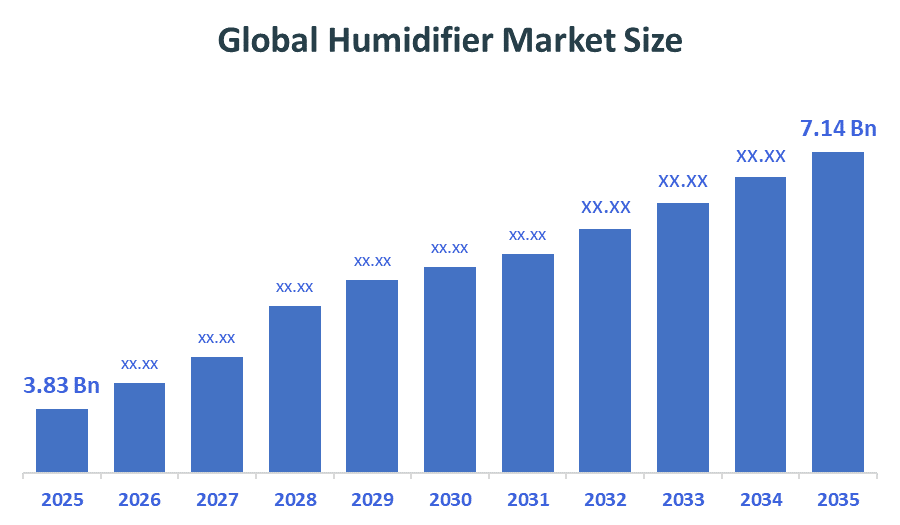
According to Decision Advisors, the Global humidifier market Size is expected to grow from USD 3.83 billion in 2025 to USD 7.14billion by 2035, at a CAGR of 6.43% during the forecast period 2025-2035. the global humidifier market is driven by rising respiratory disorders, increasing air pollution, growing awareness of indoor air quality, demand for smart home devices, and expanding HVAC adoption in residential, commercial, and healthcare sectors, improving comfort and health conditions globally.
Market Overview/ Introduction
The Global Humidifier Market refers to the industry of devices that add moisture to indoor air, which results in better air quality and increased comfort and health benefits for people who spend time in homes and offices and hospitals and industrial spaces. Current market trends show that 35?% of models now include smart sensors for their IoT-enabled smart humidifiers which users can control through their apps. The development of new technologies aims to create products that use less energy while providing HEPA/UV filtration and delivering quieter performance. The expanding residential market which accounts for 60?% of total demand provides business opportunities together with the rising demand for products in healthcare and commercial sectors that operate in regions with high air pollution and climate-related challenges.
- In India the Production Linked Incentive (PLI) Scheme for White Goods (Air Conditioners & LED Lights) supports domestic manufacturing through financial incentives, boosting component localization, reducing imports, and strengthening supply chains, indirectly benefiting energy-efficient technologies like LED-based lighting and cooling systems
- Growing hospital and home healthcare infrastructure, rising ICU/NICU investments, and increased ventilation use drive demand. ISO 80601-2-74 ensures global safety and performance standards for respiratory humidifiers in clinical applications and oxygen therapy.
Notable Insights: -
- North America holds the largest regional market share approximately 34% in global humidifier market.
- Asia Pacific is the fastest growing region in the global humidifier market with a CAGR of approximately 8.9%.
- By product, the Passover Humidifiers segment held a dominant position with approximately 38% in terms of market share in 2025.
- By distribution channel, predictive analytics engines segment is the dominating accounting for over 63% of the global market share in 2025.
- The compound annual growth rate of the global humidifier market is 6.43%.
- The market is likely to achieve a valuation of USD 7.14billion by 2035.
What is role of technology in grooming the market?
The global humidifier market experiences major changes through technological advancements which convert standard humidifiers into intelligent environmentally sustainable devices. The system combines Internet of Things technology with sensors and artificial intelligence controls to provide users with automatic real-time humidity detection which enhances indoor air quality and user comfort. Smart connectivity functions now account for approximately 42% of market expansion because technology has a strong impact on user adoption. The market for smart humidifiers which use Wi-Fi and app control systems at present shows a growth rate between 10% and 11% CAGR because the industry undergoes rapid digital transformation. Technological advancements have enhanced power efficiency, cleanliness through modern ultrasonic and evaporative systems which consume 25% to 30% less energy than conventional systems. About 35% of new humidifier products now integrate with smart home systems which support voice-activated features through assistants such as Alexa and Google Home to function within contemporary smart environments. Technology functions as the primary force which drives performance improvements for international market expansion through enhanced user experience.
Market Drivers
the global humidifier market experiences growth because people now understand how indoor air quality impacts their health and respiratory well-being, which leads to higher demand for humidifiers in multiple countries.?The market, valued at USD?4.73?billion, reflects growing consumer demand for healthier indoor environments.?Smart and energy?efficient humidifiers with advanced controls appeal to tech?savvy buyers.?Online sales growth supports broader reach. The market experiences increased demand from growing urban areas and new healthcare facilities, which results in portable units holding 64.5 % of market share in 2025 because they offer convenient operation and budget-friendly pricing. Technological advancements, such as ultrasonic, hybrid, and energy-efficient humidifiers, along with rising disposable incomes, further accelerate market growth globally.
Restrain
The market expansion of advanced humidifiers is hindered by their expensive upfront costs and their need for constant upkeep and their risk of bacteria and mold growth from improper maintenance. Price-sensitive regions show limited adoption of consumers identify product complexity and noise issues as their main reasons for not purchasing. The market growth is delayed by environmental regulations which restrict energy usage and the low energy knowledge of people living in rural communities.
Competitive Analysis:
The report offers the appropriate analysis of the key organizations/companies involved within the Global Humidifier market, along with a comparative evaluation primarily based on their product of offering, business overviews, geographic presence, enterprise strategies, segment market share, and SWOT analysis. The report also provides an elaborative analysis focusing on the current news and developments of the companies, which includes product development, innovations, joint ventures, partnerships, mergers & acquisitions, strategic alliances, and others. This allows for the evaluation of the overall competition within the market.
Top Companies in the Global Humidifier Market
- Honeywell International Inc.
- Dyson Ltd.
- Koninklijke Philips N.V.
- Vicks (Procter & Gamble)
- Crane USA
- Condair Group AG
- Carel Industries S.p.A.
- Boneco AG
- Levoit (Vesync Co.)
- Xiaomi Corporation
Government Initiatives
|
Country |
Key Government Initiatives |
|
Europe |
In European Union, The Net-Zero Industry Act (NZIA) and Green Deal Industrial Plan target 380 GWh EU battery manufacturing capacity by 2030, supporting rapid permitting for strategic net-zero projects like batteries and promoting “Made in EU” local-content requirements through upcoming subsidy and procurement rules |
|
US |
In United States, March 2025 Dyson allocated around $200 million for humidifier and hybrid air-care R&D to advance smart, sensor-based humidification and air purification technologies |
|
China |
In China, The New Energy Vehicle (NEV) Industry Development Plan provides subsidies, a dual-credit system, and phased purchase tax exemptions (partial 5% tax from 2026), strongly supporting LiFePO? adoption due to cost efficiency and domestic supply chain strength. |
Study on the Supply, Demand, Distribution, and Market Environment Global Humidifier Market
The global humidifier market of 2025-2026 has an estimated value range between USD 4.8 billion and USD 5.1 billion and it will increase to almost USD 7.1 billion which represents a compound annual growth rate between 6.5% and 7.8%. The market experiences growth because of increasing cases of respiratory diseases combined with people's need for better indoor air quality and their adoption of smart home technology. The global manufacturers based in North America and Asia-Pacific supply the market while residential spaces and the healthcare sector represent the highest demand with residential areas accounting for 65 to 70% of total demand. Online channels now receive the majority of distribution resources because they experience a growth rate between 9 and 10% compound annual growth. The market now develops into a health-centered industry that utilizes advanced technology and has significant potential for international expansion.
Price Analysis and Healthcare Facilities Behaviour Analysis
The global medical humidifier market averages USD 2,000–2,200 per unit for advanced systems used in oxygen therapy and ICU ventilation, while basic hospital-grade humidifiers are lower in cost but still capital-intensive for small facilities. High upfront costs and recurring maintenance expenses often delay adoption, especially in budget-constrained hospitals, which leads many facilities to extend equipment lifespan instead of purchasing new systems. Healthcare facilities increasingly prefer heated humidifiers in ICUs, which dominate adoption due to severe respiratory cases and ventilator dependency, while HMEs (heat moisture exchangers) are used as cost-saving alternatives in short-term ventilation. Hospital behaviour patterns after COVID show a trend towards permanent humidification systems because hospitals want to use them for better infection control and improved patient results.
Market Segmentation
The global humidifier market share is classified into solution product, distribution channel, and End Use
- The heated humidifiers segment dominated the market in 2025, and is projected to grow at a substantial CAGR of approximately 38% during the forecast period.
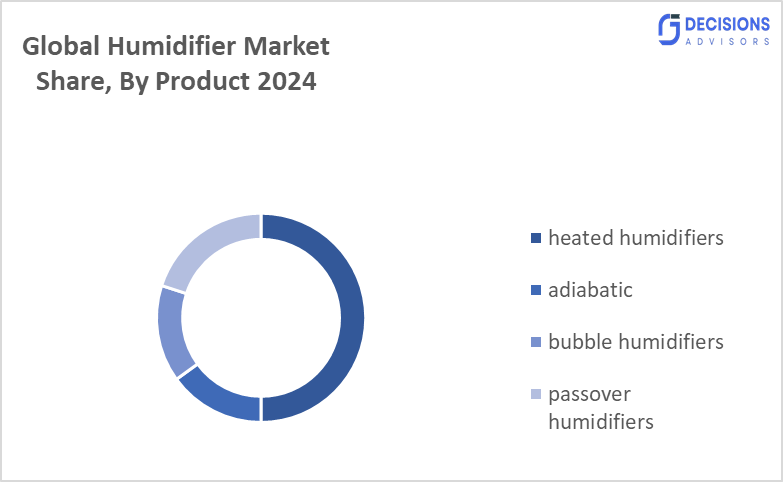
Based on the product, the global humidifier marketis divided into heated humidifiers, adiabatic, bubble humidifiers, passover humidifiers. Among these, the heated humidifiers segment dominated the market in 2025, and is projected to grow at a substantial CAGR of approximately 38% during the forecast period. The heated humidifiers segment dominates because it provides exact humidity control and hospitals and ICU respiratory care facilities use it extensively and its system efficiently prevents airway dryness and users can use it with ventilators and critical care facilities are expanding while respiratory diseases are becoming more common throughout the world.
- The offline channels segment accounted for the largest share in 2025, and is anticipated to grow at a significant CAGR of approximately 63% during the forecast period.
Based on the distribution channel, the global humidifier marketis divided into offline channels, online channels. Among these, the offline channels segment accounted for the largest share in 2025, and is anticipated to grow at a significant CAGR of approximately 63% during the forecast period. The offline channels segment controls the humidifier market because customers want to see and touch products to evaluate their dimensions and sound production and water tank size and material construction before making their purchase decision. The company maintains its dominant market position through its wide product distribution across retail stores and supermarkets and specialty appliance stores, which provide customers with immediate access to products and after-sales support and guidance from recognized brands.
- The hospitals segment dominated the market at a CAGR of approximately 39% in 2025, and is projected to grow at a substantial CAGR during the forecast period.
Based on the End Use, the global humidifier marketis divided into hospitals, outpatient facilities, home care. Among these, the hospitals segment dominated the market at a CAGR of approximately 39% in 2025, and is projected to grow at a substantial CAGR during the forecast period. The humidifier market shows its highest sales through hospital operations which require humidifiers in intensive care units and neonatal intensive care units and respiratory treatment areas that depend on mechanical ventilation and oxygen therapy. The medical industry shows increasing demand for humidifiers because of rising respiratory diseases and expanding hospital infrastructure and hospitals' need to comply with strict clinical requirements for airway moisture control and patient safety.
Strategies to Implement for Growth of the Market in Non-Leading Regions
The humidifier market will grow in non-leader markets when businesses use rising government healthcare expenditures, which are currently growing at 10 to 15% each year for developing markets. Establishing local manufacturing units can reduce product costs by 20 to 25%, which will make products more affordable. Partnerships with hospitals and distributors help expand access, especially in regions where over 40% of healthcare facilities still lack advanced respiratory humidification systems. Increased public knowledge about indoor air quality will lead to a 30% increase in demand from urban residential markets. Middle-income consumers will adopt smart humidifiers more when we provide them with affordable products and flexible payment plans. The demonstration programs at hospitals and smart homes create trust, which leads to greater market penetration.
Regional Segment Analysis of the Cardiac AI monitoring and diagnostics Market
- North America (U.S., Canada, Mexico)
- Europe (Germany, France, U.K., Italy, Spain, Rest of Europe)
- Asia-Pacific (China, Japan, India, Rest of APAC)
- South America (Brazil and the Rest of South America)
- The Middle East and Africa (UAE, South Africa, Rest of MEA)
North America is anticipated to hold the largest share approximately 34% of the global humidifier market over the predicted timeframe. North America is expected to lead the worldwide humidifier industry because people there understand indoor air quality better and disinfect their spaces from respiratory diseases which include asthma and COPD and they widely use smart home devices. The region has established medical facilities and spends more money on healthcare services which creates a need for medical-grade humidifiers. The product experiences higher demand because of extreme temperature changes during the year which includes the dry winter season. The market leadership of the company becomes more powerful because of its strong position in the industry and its fast development of new products. North America currently holds 34% of the worldwide market share.
Asia Pacific is expected to grow at a rapid CAGR approximately 8.9% in the global humidifier market during the forecast period. The Asia Pacific region will experience the fastest compound annual growth rate throughout the forecast period for the global humidifier market because urbanization increases and air pollution rises and people become more aware of indoor air quality. The growing middle-class in China and India increases the need for budget-friendly home medical equipment. The combination of high respiratory disease rates and extreme weather conditions and rising smart home technology use leads to increased market expansion. The area enjoys advantages from its extensive manufacturing operations combined with its economical production expenses. The Asia Pacific region will achieve a compound annual growth rate approximately 8.9% which exceeds the global average growth rate.
Europe is the 3rd largest region to grow in the global humidifier market during the region.
The high prevalence of asthma and allergies which affects approximately 30% of the European population together with cold weather conditions that require indoor heating and create dry air problems. The market growth receives additional support from robust healthcare systems and the rising need for energy-efficient smart humidifiers. Western Europe demonstrates the highest consumption levels because of its advanced HVAC systems and higher disposable income especially in Germany France and the UK.
Future Market Trends Global Humidifier Market: -
1. Smart & IoT-Enabled Humidifiers Growth
Smart humidifiers are becoming a dominant trend due to rising smart home adoption. Smart humidifier adoption is driving about 38% of total market growth. The IoT-enabled models are expected to grow at 8%–9% CAGR. Nearly 35% of new products now include app or sensor-based humidity control.
2. Rising Demand for Portable & Ultrasonic Humidifiers
Consumers prefer compact, efficient, and low-noise devices. the Portable humidifiers hold around 52%–64% market share globally. Ultrasonic humidifiers account for about 38%–47% share. Portable segment expected to grow at around 7%–8% CAGR
3. Strong Growth in Online & E-commerce Sales Channels
Digital buying is transforming distribution patterns worldwide. The Online sales contribute nearly 35%–40% of total market share. E-commerce channels are growing at nearly 9%–10% CAGR. Around 70% of consumers prefer online comparison before purchase
Recent Development
- In July 2025, Xiaomi launched the Mijia Mist-Free Humidifier 3, featuring natural evaporation technology, dual output modes (400/600 mL/h), 4–5L tank, Mi Home app control, 30 dB low noise, and residue-free operation for healthier indoor air environments.
- In June–November 2024–2025, Blueair introduced the 2-in-1 Purify + Humidify DH3i, integrating HEPASilent air purification with humidification, app control, and InvisibleMist technology, expanding its smart air wellness portfolio for improved indoor air quality and comfort.
- In March 2025, Levoit (Arovast) launched the OasisMist 450S Smart Humidifier, featuring warm and cool mist modes, top-fill design, dual 360° nozzles, and app-based smart control for improved indoor air comfort and energy-efficient humidity management.
- In March 2025, Dyson continued innovation in hybrid air-care systems with its Pure Humidify+Cool series, featuring AI and sensor-based auto-adjustment for humidity and air quality, supported by ongoing R&D investments to enhance smart humidification technologies and performance efficiency.
How is Recent Developments Helping the Market?
The Global Humidifier Market experiences growth through recent product advancements which improve performance and connectivity and user convenience. Smart features such as app control, automatic humidity sensing, and IoT integration are now included in 35?% of new models, which appeal to health-conscious consumers and smart-home adopters. The market experiences increased demand through two innovations which combine humidification systems with air purification technology and through ultrasonic technology that offers energy efficiency in 42% of new products and through sound reduction enhancements. The market expands through product portfolio growth and product launches in different regions and the introduction of hybrid mist modes which provide better indoor air quality management solutions for customers worldwide.
Market Segment
This study forecasts revenue at global, regional, and country levels from 2020 to 2035. Decision Advisor has segmented the global humidifier market based on the below-mentioned segments:
Global Humidifier Market, By product
- Heated Humidifiers
- Adiabatic
- Bubble Humidifiers
- Passover Humidifiers
Global Humidifier Market, By distribution channel
- Offline Channels
- Online Channels
Global Humidifier Market, By End Use
- Hospitals
- Outpatient Facilities
- Home Care
Global Humidifier Market, By Regional Analysis
- North America
- US
- Canada
- Mexico
- Europe
- Germany
- UK
- France
- Italy
- Spain
- Russia
- Rest of Europe
- Asia Pacific
- China
- Japan
- India
- South Korea
- Australia
- Rest of Asia Pacific
- South America
- Brazil
- Argentina
- Rest of South America
- Middle East & Africa
- UAE
- Saudi Arabia
- Qatar
- South Africa
- Rest of the Middle East & Africa
Frequently Asked Questions (FAQ)
1. What factors are driving the growth of the global humidifier market?
The market is driven by increasing respiratory disorders, rising air pollution levels, growing awareness of indoor air quality, and expanding adoption of smart home devices. Additionally, increasing healthcare infrastructure and HVAC integration are accelerating demand globally.
2. Which product segment dominates the humidifier market?
Heated humidifiers dominate the market due to their precise humidity control and widespread use in hospitals, ICUs, and respiratory care applications, especially in ventilator-supported treatments.
3. Why does North America lead the global humidifier market?
North America leads due to high healthcare spending, strong awareness of indoor air quality, advanced medical infrastructure, and high adoption of smart and connected humidifier devices.
4. Why is Asia-Pacific the fastest-growing region in this market?
Asia-Pacific is growing rapidly due to rising pollution, urbanization, expanding middle-class population, increasing disposable income, and strong manufacturing capabilities in countries like China and India.
5. What role do online sales channels play in the humidifier market?
Online channel are becoming crucial as they offer convenience, competitive pricing, product comparison, and wider availability, contributing significantly to market expansion.
6. How is technology influencing the humidifier market?
Technological advancements such as IoT integration, AI-based humidity control, energy-efficient ultrasonic systems, and hybrid air purification features are enhancing product performance and driving market growt
Check Licence
Choose the plan that fits you best: Single User, Multi-User, or Enterprise solutions tailored for your needs.
We Have You Covered
- 24/7 Analyst Support
- Clients Across the Globe
- Tailored Insights
- Technology Tracking
- Competitive Intelligence
- Custom Research
- Syndicated Market Studies
- Market Overview
- Market Segmentation
- Growth Drivers
- Market Opportunities
- Regulatory Insights
- Innovation & Sustainability
Report Details
| Scope | Global |
| Pages | 240 |
| Delivery | PDF & Excel via Email |
| Language | English |
| Release | Apr 2026 |
| Access | Download from this page |