
Global HVAC Fan & Evaporator Coil Market
 |
Author:
Pranali P
|
Pages:
210
|
Author:
Pranali P
|
Pages:
210
Global HVAC Fan & Evaporator Coil Market Size, Share, By Product Type (HVAC Fans, Evaporator Coils) By Material (Copper, Aluminium, Composite Alloys) By Application (Residential, Commercial, Industrial, Cold Storage) By End User (Construction, Logistics, Manufacturing, Healthcare, Data Centers) and By Region (North America, Europe, Asia-Pacific, Latin America, Middle East and Africa), Analysis and Forecast 2026 - 2035
CAGR
5.58%
REVENUE 2025
USD Billion 9.06
FORECAST 2035
USD Billion 15.6
REPORT COVERAGE
Global
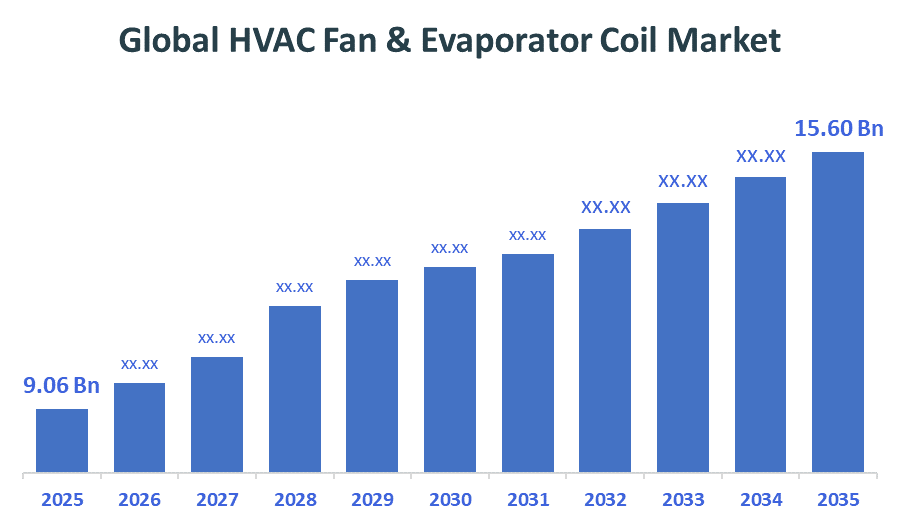
The Global HVAC Fan & Evaporator Coil Market Size was predicted to grow from USD 9.06 Billion in 2025 and is projected to reach around USD 15.60 Billion by 2035. According to Decision Advisors, a detailed research report on the thermal exchange market shows that the evaporator coil segment dominates the global HVAC fan & evaporator coil market, holding approximately 55-62% of the total share worldwide. Daikin Industries leads the market with approximately USD 24.5 billion in annual HVAC-related revenue in 2025, making it one of the major market drivers for shaping the industry.
Market Snapshot
- Global HVAC Fan & Evaporator Coil Market Size (2025): USD 9.06 Billion
- Global HVAC Fan & Evaporator Coil Projected Market Size (2035): USD 15.60 Billion
- Global HVAC Fan & Evaporator Coil Compound Annual Growth Rate (CAGR): 5.58%
- Largest Regional Market: Asia-Pacific
- Fastest Growing Region: North America
- 3rd Largest Region: Europe
- Base Year: 2025
- Historical Period: 2021 - 2024
- Forecast Period: 2026 - 2035
Market Overview / Introduction
The HVAC fans and evaporator coils are an assembly of thermal exchange components that function in the regulation of indoor climates and industrial cooling processes. The evaporator coils act as crucial intermediaries between liquid refrigerants and ambient air, using cutting-edge fin geometries and tube configurations to attain maximum heat absorption in a small amount of space used. The modern evaporator coils and fans have various characteristics, including high corrosion resistance and variable-speed aerodynamics, so as to perform optimally and minimize chances of system failure. The HVAC components have evolved from being simple mechanical blowers and lead-soldered tubes to advanced high-tech units equipped with hydrophilic coatings, antimicrobial surfaces, and used in high-precision cleanroom environments. The increase in the use of high-efficiency fans and coils can be attributed to the increasing need for green building certifications and cold-chain logistics within modernizing cities and industries. This is because advanced evaporator coils provide protection to the overall system from loss of efficiency and wear-and-tear caused by lack of thermal conductivity, since there is no need for oversized compressor units.
- The residential and commercial construction segments contribute to approximately 62% of the application-based use in the market, driven by the increasing demand for high-efficiency heat pumps, smart home integration, and the maintenance of essential hospital ventilation networks.
- There is an exponential rise in the development of high-tech copper-aluminum composite coils in the industrial sector, and the CAGR is predicted to exceed 7.2% because of the growing application of specialized air handlers
- in pharmaceutical manufacturing due to their ability to offer optimized hygiene and thermal stability.
Notable Insights: -
- Evaporator coil modules make up about 55-62% of the total market share of this sector. They have gained a reputation for high-thermal-conductivity requirements, particularly in central air conditioning systems, supermarket refrigeration, and heavy-duty industrial chillers.
- Applications of HVAC fans in the sphere of energy-efficient ventilation account for almost 41.5% of all demand. The rapid development of smart building sensors has mandated the use of Electronically Commutated Motors (ECM) in fans to allow for precision airflow.
- Micro-channel evaporator systems show an annual increase above 6.8%. The rise in equipment miniaturization and frequent occurrences of space constraints in urban high-rises create the conditions that encourage enterprises to invest more money in space-efficient thermal solutions.
What is the Role of Technology in Shaping the Market?
The advancements in technology have made some major changes in the thermal management industry regarding exchange efficiency, airflow silence, and structural durability. HVAC fan and coil technology of the current generation has evolved beyond being mere metal parts to intelligent heat exchange devices that can operate in corrosive environments because they are able to use nano-composite coatings, oxygen-free copper tubing, and specialized polymer fan blades.
How are Recent Developments Helping the Market?
They involve the use of triple-coated fin systems, high-temperature antimicrobial resins, and laser-welded tube joints. These innovations have played an important role in facilitating growth and development within the market. There have been innovations involving the development of coils that are able to resist formicary corrosion, and which are able to protect all types of air handlers that are fed by variable refrigerant flow (VRF) systems, from those used in residential apartments to fully developed industrial HVAC systems. Such innovations would facilitate the production of tightly packed fin-and-tube assemblies using the mechanical properties of modern-day alloys, without breaking down due to leakage or thermal fatigue.
Market Drivers
The market demand for global HVAC fans and evaporator coils is on the rise due to higher investments in construction firms and governments into sustainable cooling infrastructure and efficient motors capable of meeting climate goals in the current era. Modern fan units have enjoyed significant market popularity because of their advantages of combining multiple properties in one durable system, such as low acoustic footprint, high pressure capability, and effective airflow distribution. On the other hand, the establishment of massive data centers and cold storage warehouses has brought about greater demands for cooling solutions to address the trend of shifting from conventional ventilation to precision thermal control, which requires highly efficient evaporator surface areas.
Restraints
However, the development of the global market for the HVAC fan and evaporator coil industry is limited by the complexities involved in maintaining the stability of the price of inputs such as copper and aluminium, considering that the market may be characterised by fluctuations that may lead to cost overrun problems for large-scale infrastructure projects.
Competitive Analysis
The report offers the appropriate analysis of the key organisations/companies involved within the HVAC fan & evaporator coil market, along with a comparative evaluation primarily based on their product offerings, business overviews, geographic presence, enterprise strategies, segment market share, and SWOT analysis. The report also provides an elaborate analysis focusing on the current news and developments of the companies, which includes product development, innovations, joint ventures, partnerships, mergers & acquisitions, strategic alliances, and others. This allows for the evaluation of the overall competition within the market.
Top 10 Companies in the Global HVAC Fan & Evaporator Coil Market
- Daikin Industries, Ltd.
- Carrier Global Corporation
- Trane Technologies plc
- Johnson Controls International plc
- Lennox International Inc.
- Rheem Manufacturing Company
- LG Electronics Inc.
- Modine Manufacturing Company
- Nortek Global HVAC
- Emerson Electric Co.
Government Initiatives
|
Country |
Key Government Initiatives |
|
China |
Under the 15th Five-Year Plan (2026-2030), the government has prioritised the development of "Green Manufacturing Hubs." This mandates a 15% reduction in industrial HVAC energy consumption, pushing for the adoption of high-efficiency fan systems and heat exchangers. |
|
India |
The "PM E-DRIVE" and smart city initiatives in 2026 have expanded to include energy-efficient cooling for public infrastructure, offering tax rebates for the installation of BEE Star-rated evaporator coils in commercial buildings. |
|
US |
The Department of Energy (DOE) expanded its efficiency mandates in 2026, targeting the commercial sector to adopt advanced coil designs that utilise lower-GWP (Global Warming Potential) refrigerants to secure domestic climate targets. |
Study on the Supply, Demand, Distribution, and Market Environment
It is necessary for the HVAC fan and evaporator coil market to strike a balance between operating at optimal thermal efficiency and the increased demand for components that are both durable and easy to maintain. The production involves the manufacture of advanced alloys and hydrophilic coatings that can offer sustained heat exchange without the risk of biological fouling or corrosion inherent to older coil designs.
Price Analysis and Consumer Behaviour Analysis
The cost of thermal components is influenced by the quality of the alloy, the density of the fins, and the level of coating protection. More sophisticated materials, such as the use of gold-fin technology specifically designed for coastal environments, are expensive due to their inclusion of advanced epoxy resins. On the other hand, ordinary aluminum fin-and-tube coils used in standard residential units can be considered cost-effective for mass-market usage. Consumers have shown interest in durability and energy-saving devices; thus, manufacturers should aim at providing long-lasting and corrosion
Market Segmentation
The Global HVAC Fan & Evaporator Coil Market share is classified into product type, material, application, and end user.
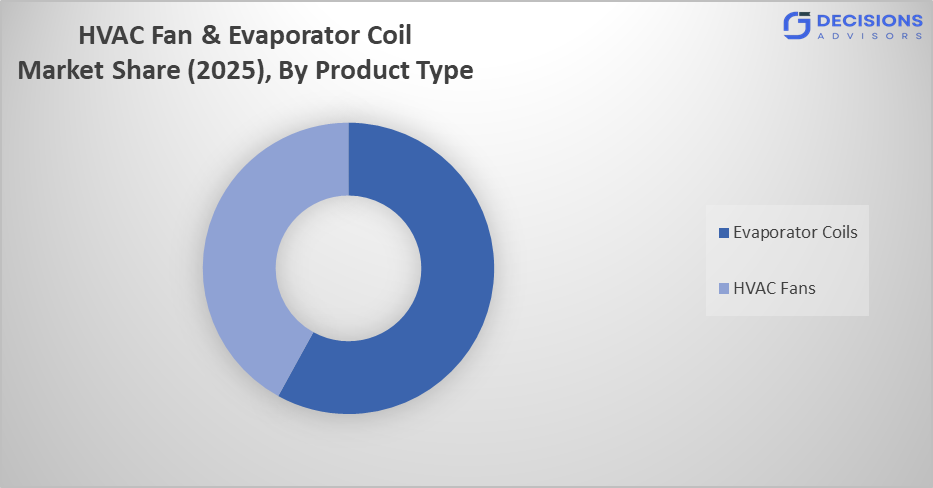
The Evaporator Coil segment holds the largest share, contributing approximately 58% of the market in 2025.
Based on the Product Type, the global HVAC fan & evaporator coil market is divided into HVAC Fans and Evaporator Coils. Among these, the Evaporator Coil segment holds the largest share, contributing approximately 58% of the market in 2025. The reason for this dominance lies in the critical nature of the coil in the thermodynamic heat exchange process and its high replacement rate during maintenance cycles compared to the mechanical longevity of fan housings. These components are essential for refrigerant-to-air heat transfer in every split, package, and central ai
The Copper segment accounts for the largest share, representing over 62% of the global market in 2025.
Based on the Material, the global HVAC fan & evaporator coil market is divided into Copper, Aluminum, and Composite Alloys. Among these, the Copper segment accounts for the largest share, representing over 62% of the global market in 2025. These materials are critical for high-efficiency thermal conductivity and offer superior ease of repair and brazing in the field. On the other hand, the Aluminum segment has emerged as a rapidly growing sector, thanks to the increasing adoption of all-aluminium micro-channel coils, which offer significant weight reduction and resistance to formicary corrosion in residential applications.
Commercial applications dominate the global market, accounting for approximately 46% of the total revenue in 2025.
Based on the Application, the global HVAC fan & evaporator coil market is divided into Residential, Commercial, Industrial, and Cold Storage. Among these, the Commercial segment dominates the global market, accounting for approximately 46% of the total revenue in 2025. This segment is preferred by developers and facility managers who require reliable climate control for office towers, shopping malls, and large-scale hospitality venues. The Cold Storage category is seeing a steady increase in use, especially in the expansion of global food logistics chains where high-capacity evaporator coils are required to maintain strict temperature safety standards.
The Construction segment dominates the global market, accounting for approximately 42% of the total revenue in 2025.
Based on the End User, the global HVAC fan & evaporator coil market is divided into Construction, Logistics, Manufacturing, Healthcare, and Others. Among these, the Construction segment dominates the global market, accounting for approximately 42% of the total revenue in 2025. This segment is preferred by urban planners and MEP (Mechanical, Electrical, and Plumbing) designers who require integrated, high-performance HVAC systems for new residential and commercial developments. The Healthcare segment is seeing a sharp increase in use, especially by hospital administrators who value the specialised antimicrobial coatings and easy-clean fin designs of advanced evaporator coils for maintaining sterile air environments in surgical suites.
Strategies to Implement for Growth of the Market in Non-Leading Regions
The possibilities of growth for the HVAC fan and evaporator coil industry in emerging regions can be enhanced through the creation of efficient localised assembly facilities for the use of regional HVAC contractors, as well as local bodies responsible for managing the climate control requirements of rapidly urbanising zones. The initiatives from the government focused on energy self-sufficiency and the adoption of green building codes play a major role in creating a demand in those regions that face difficulties regarding the importation of high-efficiency thermal components. The additional assistance of investment in the training of local HVAC technicians, together with regional testing labs for airflow and thermal performance, will help achieve this.
Regional Segment Analysis of the Global HVAC Fan & Evaporator Coil Market
- North America (U.S., Canada, Mexico)
- Europe (Germany, France, U.K., Italy, Spain, Rest of Europe)
- Asia-Pacific (China, Japan, India, South Korea, Rest of APAC)
- Latin America (Brazil and the Rest of Latin America)
- The Middle East and Africa (UAE, South Africa, Rest of MEA)
Asia-Pacific is projected to be the largest region over the forecast period. This region is anticipated to witness a growth rate of around 7.12% CAGR, maintaining a dominant market share within the global industry. In 2025, the Asia-Pacific region already accounts for approximately 45.8% of global revenue. This is owing to the fast-developing real estate sectors, coupled with the growing demand for industrial cooling infrastructure in countries such as China, India, and Vietnam. Other reasons for the same include greater investments made toward smart city development in the region, state-supported indigenous manufacturing projects for cooling equipment, and widespread adoption of high-efficiency ventilation standards.
North America is expected to hold a significant share of the HVAC fan & evaporator coil market during the forecast period. This region holds approximately 22.5% share of global revenue in 2025, thanks to its highly sophisticated retrofit market, along with the extensive adoption of high-efficiency SEER2 and HSPF2 standards in the United States. The largest part of this region’s revenues comes from the United States, as there is a lot of spending at the corporate and residential levels in modernization programs for aging air conditioning systems, along with local research related to low-GWP refrigerant-compatible coil materials.
Europe is anticipated to hold a substantial share, contributing approximately 20.4% of the global market share. There is a competitive advantage in the region owing to clusters of precision engineering innovation and financing for sustainable building transitions under the European Green Deal. There is also a comparative advantage with countries like Germany and Italy, which are highly skilled at precision manufacturing for high-performance fans and specialized heat exchangers. Moreover, the rigorous environmental standards regarding F-gas regulations and industrial energy waste further give them a competitive advantage.
Recent Developments
- In February 2026, Daikin Industries announced the expansion of its coil manufacturing facility in India to cater to the rising demand for variable refrigerant volume (VRV) systems in Southeast Asia.
- In October 2025, Carrier Global completed a strategic investment in specialised coating technology to enhance the lifespan of evaporator coils used in high-salinity coastal environments
- In May 2024, Johnson Controls launched a new line of ultra-quiet HVAC fans specifically designed for hospital environments, utilising biomimetic blade designs to reduce noise levels by 25%.
- In November 2021, Modine Manufacturing introduced a high-performance micro-channel coil that reduces refrigerant charge by 40%, significantly lowering the environmental impact of commercial cooling units.
Market Segmentation (Forecast Data)
This study forecasts revenue at global, regional, and country levels from 2021 to 2035. The Global HVAC Fan & Evaporator Coil Market is segmented based on the following categories:
Global HVAC Fan & Evaporator Coil Market, By Product Type
- HVAC Fans (Axial, Centrifugal)
- Evaporator Coils (Fin-and-Tube, Micro-channel)
Global HVAC Fan & Evaporator Coil Market, By Material
- Copper
- Aluminum
- Composite Alloys
Global HVAC Fan & Evaporator Coil Market, By Application
- Residential (Apartments, Villas)
- Commercial (Offices, Retail, Hotels)
- Industrial (Manufacturing, Warehousing)
- Cold Storage
Global HVAC Fan & Evaporator Coil Market, By End User
- Construction
- Logistics
- Manufacturing
- Healthcare
- Data Centers
Global HVAC Fan & Evaporator Coil Market, By Regional Analysis
- North America
- United States
- Canada
- Mexico
- Europe
- Germany
- United Kingdom
- France
- Italy
- Spain
- Russia
- Rest of Europe
- Asia Pacific
- China
- Japan
- India
- South Korea
- Australia
- Rest of Asia Pacific
- Latin America
- Brazil
- Argentina
- Rest of Latin America
- Middle East & Africa
- United Arab Emirates
- Saudi Arabia
- Qatar
- South Africa
- Rest of Middle East & Africa
Frequently Asked Questions (FAQ)
What is the significance of hydrophilic coatings on evaporator coils?
Moisture from the air often condenses on coils, which can lead to water bridging between fins and reducing airflow. Hydrophilic coatings allow water to spread thinly and drain away quickly, preventing biological growth and maintaining optimal heat transfer efficiency.
How does the transition to low-GWP refrigerants affect coil design?
Newer refrigerants often operate at different pressures and have different thermal properties. This requires evaporator coils to have reinforced tube walls and optimized internal grooving to ensure safety and efficiency without increasing the physical size of the HVAC unit.
What role do ECM fans play in smart HVAC systems?
Electronically Commutated Motors (ECM) allow the fan to adjust its speed precisely based on the cooling demand. This prevents the "on-off" cycling of traditional motors, leading to significant energy savings and more stable indoor temperatures.
What are the primary differences in the application of copper versus aluminum coils in 2026?
While copper remains preferred for high-pressure industrial applications due to its durability and ease of repair, aluminum is dominating the residential market. Aluminum coils are lighter and more resistant to certain types of chemical corrosion found in modern household environments
Check Licence
Choose the plan that fits you best: Single User, Multi-User, or Enterprise solutions tailored for your needs.
We Have You Covered
- 24/7 Analyst Support
- Clients Across the Globe
- Tailored Insights
- Technology Tracking
- Competitive Intelligence
- Custom Research
- Syndicated Market Studies
- Market Overview
- Market Segmentation
- Growth Drivers
- Market Opportunities
- Regulatory Insights
- Innovation & Sustainability
Report Details
| Scope | Global |
| Pages | 210 |
| Delivery | PDF & Excel via Email |
| Language | English |
| Release | Apr 2026 |
| Access | Download from this page |