
Global Hyperkalemia Market
 |
Author:
David J
|
Pages:
240
|
Author:
David J
|
Pages:
240
Global Hyperkalemia Market Size, Share, and COVID-19 Impact Analysis, By Treatment Type (Potassium Binders, Loop Diuretics, Calcium Salts, Sodium Bicarbonate, and Insulin and Glucose), By Route of Administration (Oral, Intravenous, and Rectal), By Patient Class (Renal Impairment, Cardiac Disease, Hypertension, and Diabetes), and By Region (North America, Europe, Asia-Pacific, Latin America, Middle East, and Africa), Analysis and Forecast 2025-2035
CAGR
5.25%
REVENUE 2024
USD Billion 1.35
FORECAST 2035
USD Billion 2.37
REPORT COVERAGE
Global
Global Hyperkalemia Market Size Insights Forecasts to 2035
- The Global Hyperkalemia Market Size Was Estimated at USD 1.35 Billion in 2024
- The Market Size is Expected to Grow at a CAGR of around 5.25 % from 2025 to 2035
- The Worldwide Hyperkalemia Market Size is Expected to Reach USD 2.37 Billion by 2035
- Europe is expected to grow the fastest during the forecast period.
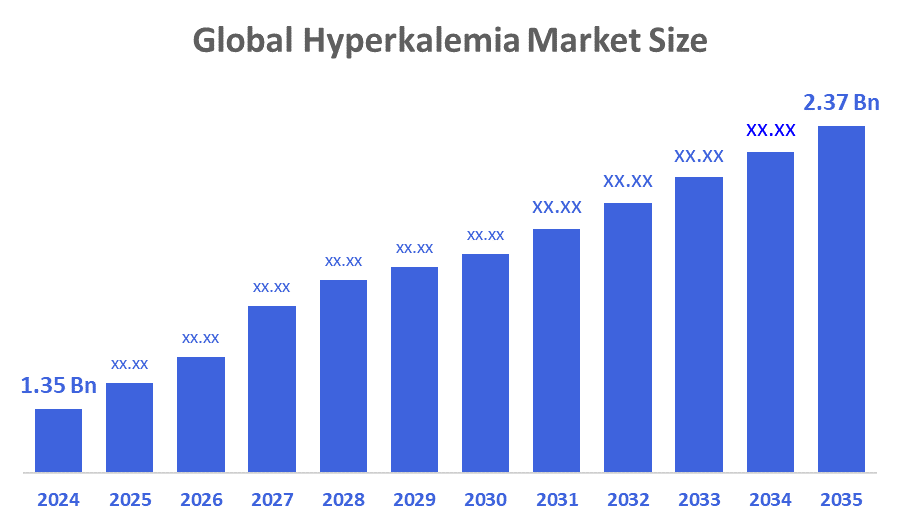
According to a research report published by Decisions Advisors and Consulting, The Global Hyperkalemia Market Size Was Worth Around USD 1.35 Billion In 2024 And Is Predicted To Grow To Around USD 2.37 Billion By 2035 With A Compound Annual Growth Rate (CAGR) Of 5.25 % From 2025 To 2035. It is estimated that this trend will be largely supported by the rising levels of diseases like hyperparathyroidism, malignancy, associated hypercalcemia, and chronic kidney disease. Moreover, there is a high need for their proper management, which increases the demand for hypercalcemia treatments. Besides this, innovations in therapies and increased awareness among doctors and patients also play a role in the growing market.
Market Overview
The hyperkalemia market refers to the global healthcare industry segment focused on the diagnosis, management, and treatment of hyperkalemia, a condition characterised by elevated potassium levels in the blood. Hyperkalemia is a disorder of the body that results from elevated potassium levels in the blood. Potassium plays an important role in the proper working of nerve and muscle cells, including the heart. The normal range for potassium is 3.5 to 5.0 mmol/L. If the level goes up to 5.5 mmol/L, it is said to be hyperkalemia. The symptoms of this condition are mostly very few and nonspecific. The signs include fatigue, muscle weakness, pain, numbness, and the like. In extreme situations, patients experiencing the disorder may have palpitations, diarrhoea, abdominal pain, shortness of breath and irregular heart rhythm, which may lead to cardiac arrest and death. Usually, a blood test to measure the potassium level in the blood is sufficient to detect hyperkalemia. A healthcare provider may also order other tests, such as serum blood urea nitrogen and creatinine to check kidney function, and urinalysis to look for kidney disease. Apart from that, an electrocardiography (ECG) may be done to determine whether there is a risk of arrhythmia.
Report Coverage
This research report categorises the hyperkalemia market based on various segments and regions, forecasts revenue growth, and analyzes trends in each submarket. The report analyses the key growth drivers, opportunities, and challenges influencing the hyperkalemia market. Recent market developments and competitive strategies, such as expansion, product launch, development, partnership, merger, and acquisition, have been included to draw the competitive landscape in the market. The report strategically identifies and profiles the key market players and analyzes their core competencies in each sub-segment of the hyperkalemia market.
Driving Factors
The hyperkalemia treatment market is going through significant changes at present as the number of people suffering from hyperkalemia, a condition that elevates potassium levels in the blood, keeps on increasing. Further, the rise in knowledge about hyperkalemia, doctors and medical staff are concentrating more on treatment techniques that work, leading to more innovative solutions being launched into the market. Drug manufacturing firms are constantly pushing the boundaries of science to come up with medications that can treat the condition better, hence improving the quality of life for such patients. In addition, technological progress is greatly influencing the hyperkalemia treatment market. The application of digital health technologies, like teleconsultations and health tracking apps, allows healthcare professionals to keep a closer watch on their patients as well as help them stick to their medication schedules. The approach is extremely applicable since it provides for fast reactions and individualised care plans that are critical in controlling hyperkalemia. Besides, the industry is moving towards a more supportive setting for patients with their condition, which involves educating and assisting them for a high revenue share.
Restraining Factors
There are many challenges facing the adoption and advancement of the hypercalcemia sector, such as innovative therapies for hypercalcemia are associated with several limitations that hinder their broader availability and effectiveness. The most striking one is probably the high price of biologic medicines, which renders the treatment inaccessible and unaffordable for a vast majority of patients, especially those in the less affluent areas. Besides, if patients visit medical facilities in the developed countries, the lack of knowledge about and experience with the disease in some of the poor and less developed countries results in the disease being underdiagnosed and its treatment being delayed.
Market Segmentation
The hyperkalemia market share is classified into treatment type, route of administration and patient class.
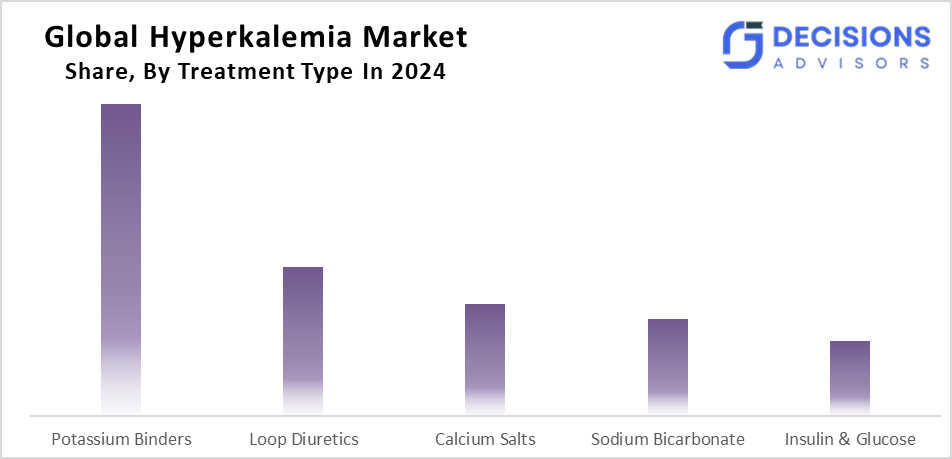
- The potassium binders segment accounted for the largest market share in 2024 and is anticipated to grow at a substantial CAGR over the forecast period.
Based on the treatment type, the hyperkalemia market is divided into potassium binders, loop diuretics, calcium salts, sodium bicarbonate, and insulin and glucose. Among these, the potassium binders segment accounted for the largest market share in 2024 and is anticipated to grow at a substantial CAGR over the forecast period. Potassium Binders are proven to be the most prominent treatment available in the management of hyperkalemia, preferred for their unique mechanism of action that specifically targets the absorption of potassium in the gastrointestinal tract. The long-standing presence of potassium binders in the market indicates their safety and efficacy, which has led to their widespread adoption by healthcare providers.
- The oral segment accounted for the highest market share in 2024 and is anticipated to grow at a significant CAGR during the forecast period.
Based on the route of administration, the hyperkalemia market is segmented into oral, intravenous, and rectal. Among these, the oral segment accounted for the highest market share in 2024 and is anticipated to grow at a significant CAGR during the forecast period. The preferred route of administration for the treatment of hyperkalemia is still oral because of its ease of administration and good patient acceptance. This route of administration makes it easy to treat hyperkalemia.
- The renal impairment segment accounted for the highest market revenue in 2024 and is anticipated to grow at a notable CAGR over the forecast period.
Based on the patient class, the hyperkalemia market is classified into renal impairment, cardiac disease, hypertension, and diabetes. Among these, the renal impairment segment accounted for the highest market revenue in 2024 and is anticipated to grow at a notable CAGR over the forecast period. Renal impairment, encompassing chronic kidney disease and acute renal failure, represents the dominant segment in the hyperkalemia market. Patients in this category are particularly vulnerable to potassium imbalances and require specialised intervention strategies, which drives a steady demand for tailored therapies.
Regional Segment Analysis of the Hyperkalemia Market
- North America (U.S., Canada, Mexico)
- Europe (Germany, France, U.K., Italy, Spain, Rest of Europe)
- Asia-Pacific (China, Japan, India, Rest of APAC)
- South America (Brazil and the Rest of South America)
- The Middle East and Africa (UAE, South Africa, Rest of MEA)
Asia Pacific is anticipated to hold the largest share of the hyperkalemia market over the predicted timeframe.
Asia Pacific is anticipated to hold the largest share of the Hyperkalemia market over the predicted timeframe. The Asia-Pacific market is experiencing a substantial rise in the hyperkalemia market due to factors such as an increase in healthcare spending, the prevalence of chronic diseases, and growing awareness about hyperkalemia. The governments of countries such as Japan and Australia are also improving their frameworks to facilitate the entry of new treatments, which will further fuel the growth of the market. The emphasis on innovative therapies and patient-centric strategies is expected to define the future of this market.
China and India are the key countries in this market, with a rapidly developing healthcare infrastructure and growing investments from key players such as Roche and Eli Lilly. The competitive environment is changing, with both MNCs and domestic players attempting to gain a foothold in the market.
Europe is expected to grow at a rapid CAGR in the hyperkalemia market during the forecast period. The European market is driven by favourable regulatory systems and efforts to enhance patient outcomes. Rising awareness regarding hyperkalemia and its complications, coupled with the growing geriatric population, are major factors fueling the growth of the market. Furthermore, research and development activities are expected to bring new therapies to the market, thus increasing the market potential.
The European Medicines Agency (EMA) is a vital factor in making new therapies easily accessible to the market. Germany and France are the most prominent countries in this market, with a strong presence of major players such as Fresenius Medical Care and Sanofi.
Competitive Analysis:
The report offers the appropriate analysis of the key organizations/companies involved within the hyperkalemia market, along with a comparative evaluation primarily based on their product offering, business overviews, geographic presence, enterprise strategies, segment market share, and SWOT analysis. The report also provides an elaborative analysis focusing on the current news and developments of the companies, which includes product development, innovations, joint ventures, partnerships, mergers & acquisitions, strategic alliances, and others. This allows for the evaluation of the overall competition within the market.
List of Key Companies
- Amgen Inc.
- Ardelyx Inc.
- AstraZeneca plc
- Bayer AG
- Cipla Ltd.
- Merck & Co., Inc.
- Novartis AG Otsuka Pharmaceutical Co., Ltd.
- Perrigo Company plc
- Pfizer Inc.
- Sanofi SA
- Takeda Pharmaceutical Company Limited
- Vifor Pharma AG / CSL Vifor
- ZS Pharma Inc.
- Others
Key Target Audience
- Market Players
- Investors
- End-users
- Government Authorities
- Consulting and Research Firm
- Venture capitalists
- Value-Added Resellers (VARs)
Recent Development
- In November 2025, AstraZeneca received regulatory approval to update the prescribing information for Lokelma (sodium zirconium cyclosilicate), its treatment for hyperkalemia. The update was recommended by India’s Subject Expert Committee (SEC) under the Central Drugs Standard Control Organisation (CDSCO), focusing on clarifications in dosing, administration, warnings, and adverse reactions.
- In September 2025, AccurKardia announced a multicenter clinical pilot study of its AK+ Guard software, an FDA Breakthrough Device–designated, AI-powered tool that detects hyperkalemia using ECG signals. The study will enrol over 150 patients across inpatient, outpatient, and home settings in the U.S., aiming to validate the software’s ability to identify dangerous potassium imbalances quickly and non-invasively.
Market Segment
This study forecasts revenue at global, regional, and country levels from 2020 to 2035. Decisions Advisors has segmented the hyperkalemia market based on the below-mentioned segments:
Global Hyperkalemia Market, By Treatment Type
- Potassium Binders
- Loop Diuretics
- Calcium Salts
- Sodium Bicarbonate
- Insulin and Glucose
Global Hyperkalemia Market, By Route of Administration
- Oral
- Intravenous
- Rectal
Global Hyperkalemia Market, By Patient Class
- Renal Impairment
- Cardiac Disease
- Hypertension
- Diabetes
Global Hyperkalemia Market, By Regional Analysis
- North America
- US
- Canada
- Mexico
- Europe
- Germany
- UK
- France
- Italy
- Spain
- Russia
- Rest of Europe
- Asia Pacific
- China
- Japan
- India
- South Korea
- Australia
- Rest of Asia Pacific
- South America
- Brazil
- Argentina
- Rest of South America
- Middle East & Africa
- UAE
- Saudi Arabia
- Qatar
- South Africa
- Rest of the Middle East & Africa
Frequently Asked Questions (FAQ)
- What is the projected size of the Global Hyperkalemia Market?
The market was valued at USD 1.35 billion in 2024 and is expected to reach USD 2.37 billion by 2035, growing at a CAGR of 5.25% from 2025 to 2035.
- What are the main treatment types in the hyperkalemia market?
Treatments are segmented into potassium binders, loop diuretics, calcium salts, sodium bicarbonate, and insulin and glucose, with potassium binders holding the largest share in 2024 due to their efficacy in blocking potassium absorption in the gut.
- Which route of administration dominates the market?
The oral route led with the highest market share in 2024 and is projected to grow significantly, thanks to its ease of use and strong patient acceptance compared to intravenous or rectal options.
- What patient class drives the most revenue?
Renal impairment (including chronic kidney disease and acute renal failure) accounted for the highest revenue in 2024 and is expected to grow at a notable CAGR, as these patients are highly vulnerable to potassium imbalances.
- Which region is expected to grow the fastest?
Europe is poised for the fastest growth during the forecast period, driven by advanced healthcare infrastructure, while Asia-Pacific holds the largest overall share due to rising chronic diseases and healthcare investments in countries like China and India.
- What are the key drivers of market growth?
Growth is fueled by the rising prevalence of conditions like chronic kidney disease, increased awareness, innovations in therapies (e.g., potassium binders), and digital health tools for better patient monitoring and adherence.
- What challenges restrain the hyperkalemia market?
High costs of advanced therapies limit access, especially in low-income regions, alongside underdiagnosis due to limited awareness and expertise in developing countries.
- Who are the major companies in the market?
Key players include Amgen Inc., AstraZeneca plc, Pfizer Inc., Sanofi SA, Novartis AG, and Vifor Pharma AG/CSL Vifor, with recent developments like AstraZeneca's 2025 approval update for Lokelma in India highlighting ongoing innovation.
Check Licence
Choose the plan that fits you best: Single User, Multi-User, or Enterprise solutions tailored for your needs.
We Have You Covered
- 24/7 Analyst Support
- Clients Across the Globe
- Tailored Insights
- Technology Tracking
- Competitive Intelligence
- Custom Research
- Syndicated Market Studies
- Market Overview
- Market Segmentation
- Growth Drivers
- Market Opportunities
- Regulatory Insights
- Innovation & Sustainability
Report Details
| Scope | Global |
| Pages | 240 |
| Delivery | PDF & Excel via Email |
| Language | English |
| Release | Feb 2026 |
| Access | Download from this page |